Historic Cities · Netherlands
Amsterdam through the ages
Amsterdam is the capital and largest city of the Netherlands. As of 2024, it had a population of 933,680 within the city proper, 1,457,018 in the urban area and 2,480,394 in the metropolitan area. Located in the Dutch province of North Holland, Amsterdam is colloquially referred to as the "Venice of the North", for its large number of canals, now a UNESCO World Heritage Site.

Amsterdam in 1550
Walled Amsterdam
This is Amsterdam before the seventeenth‑century canal ring: a compact, walled river-port clustered at the mouth of the Amstel. The walk moves from the IJ and Damrak's inner harbour through the Dam and church squares into the dense lanes of timber houses, markets, convent courts and the Waag.
A low skyline of church towers and stepped gables, red‑tiled roofs and wooden façades leaning over narrow canals. The city sits within earthen walls and bulwarks; cobbled streets meet busy quays where herring busses and coasters lie cheek by jowl. Colours are the dark browns and greys of tarred hulls and peat‑smoke, with flashes of painted shutters, cloth stalls and clerical habits.
The route: 22 streets, squares and views
The IJ Harbour → Sint Antoniespoort Gate → Zeedijk Quay → Damrak Inner Harbour → The Dam → Nieuwe Kerk, Damfront → Oudezijds Voorburgwal → Oude Kerk Churchyard → Warmoesstraat → Grimburgwal Canal → …
Step inside, 12 interiors
Shipwright's Loft · Herring Packer's Quay House · High Choir with Civic Benches · Waterside Tavern Longroom · Ship-Keel Vaulted Nave · Dyers' Vat Room · Printers' Workshop · Begijnhof Chapel · Merchant's Counting House · Kloveniers Company Hall · Surgeons' Guild Chamber · Weighing Hall
Planned from the Wikipedia record: History of Amsterdam.
Amsterdam in 1660
Golden Age Amsterdam
Amsterdam at mid‑century is at the height of its Golden Age: new canals ring the city, the vast new Town Hall crowns Dam Square, and fleets of East Indiamen ride at the quays. The walk moves from the harbour into the grachtengordel and the dense working streets where merchants, mapmakers, tulip sellers and artists animate every quay and square.
Low, closely spaced gabled façades in brick and dark timber cluster along narrow canals cut in the last decades; rows of mansions line the Herengracht’s bend like a merchant parade. The skyline is punctured by church towers and the new pale stone Town Hall on the Dam, while the IJ and Oosterdok hold masts and broad‑hulled ships. Quays bustle with cargo, carts and men in short cloaks and broad hats; tulip bunches, rolled maps and barrels add bright, everyday colour.
The route: 22 streets, squares and views
Across the IJ → Schreierstoren Tower → Damrak Quays → Dam Square, Nieuwe Stadhuis → Beurs (Stock Exchange) → Rokin Canal → Spui and Begijnhof → Kalverstraat Market → Nieuwmarkt and Waag → Sint Antoniesbreestraat → …
Step inside, 12 interiors
Timber Counting-House · Harbour Watchroom · Marble Burgerzaal · Beurs Trading Hall · Mapmaker's Workshop · Weighing Hall · Rembrandt's Studio · Nave of Oude Kerk · Shipwrights' Loft · Bulb Dealer's Parlour · Canal-House Voorhuis · Art and Map Cabinet
Planned from the Wikipedia record: Dutch Golden Age.
Amsterdam in 1890
Van Gogh's Amsterdam
This is Amsterdam at the height of nineteenth‑century modernization: the new Rijksmuseum stands on Stadhouderskade and Amsterdam Centraal rises on artificial islands in the IJ, horse trams cross the canal bridges and diamond workshops hum in the Jewish quarter. The walk moves from the city’s water approach through busy quays, market streets and canal rings to leafy parks and wide bridges.
The skyline is a low, serried horizon of brick gables and church spires, recently punctured by Pierre Cuypers’s gothic‑renaissance Rijksmuseum and the new profile of Centraal Station on its islands. Canals dominate the scale: narrow streets, iron and wooden bridges, rows of dark-brown cafés, gas lamps and tramlines. Red brick, dark timber, slate roofs and the pale stone of public buildings set a sober, warm town palette under often pale Dutch light.
The route: 23 streets, squares and views
Approach from the IJ → Schreierstoren → Amsterdam Centraal → Oosterdok Docks → Damrak Quays → Dam Square → Kalverstraat Market → Oude Kerk Exterior → Warmoesstraat → Nieuwmarkt and De Waag → …
Step inside, 12 interiors
Central Station Concourse · Damrak Shipping Office · Town Hall Burgerzaal · Kalverstraat Drapery Shop · Nave of the Oude Kerk · Brown Café Taproom · Waag Great Hall · Diamond-cutters' Workshop · Herengracht Salon · Flower Merchant's Workroom · Concertgebouw Grand Hall · Gallery of Honour
Planned from the Wikipedia record: History of Amsterdam.
Its story
The story of Amsterdam.
A Dam in the Amstel, 1170–1306
Amsterdam was founded later than the other towns of the Low Countries because the ground had to be made first. Land reclamation in the watery Amestelle began in the late tenth century; as the drained peat subsided, dikes had to be raised. The All Saints' Flood of 1170 then changed the geography: the shallow IJ became a wide estuary, giving the Amstel an open connection to the Zuiderzee and the waterways beyond, and leaving the drier river mouth fit for permanent settlement. The village built there immediately afterwards lived from traffic, production and trade rather than farming.
The dam that gave the place its name was built between about 1264 and 1275. The settlement first appears in a document of 27 October 1275, in which Count Floris V of Holland exempted the people apud Amestelledamme from tolls at bridges, locks and dams throughout his county, a move in a long contest for the district between the count and the Van Amstel family, who governed it for the bishop of Utrecht. Freedom from tolls let Amsterdam traders undersell their rivals on goods shipped in from Scandinavia and Germany. City rights followed, granted either in 1300 or in 1306.
Beer, Herring and the Baltic Staple, 1323–1452
The town's first trades were brewing and fishing. In 1323 Count Willem III established a toll on Hamburg beer, and the contacts made in that trade became the basis of dealings with the Hanseatic towns of the Baltic, from which Amsterdammers drew grain and timber in growing quantity. From the fifteenth century Amsterdam ran its own Baltic route in grain and timber, cutting the Hanseatic middlemen out, became the granary of the northern Low Countries and the staple market of Europe for bulk cargo. Herring paid for much of it: on-board gibbing and the haringbuis, from 1415, let Dutch boats follow the shoals far from the coast, and the saying ran that the city was built on herringbones.
The miracle of Amsterdam, dated by legend to 12 March 1345, made the town a place of pilgrimage, and the Stille Omgang procession carried the tradition on after the Reformation. Fire twice swept the wooden town, in 1421 and again in 1452, when three quarters of it burned; afterwards new houses were required to be built of stone.
The Alteratie: Persecution, Blockade and Revolt, 1534–1610
After the Anabaptists of Münster rebelled in 1534, Charles V decreed the persecution of the whole church; within two years the Amsterdam authorities had executed 71 Mennonites and exiled many others, and executions continued into the 1550s. When the Low Countries rose against Philip II from 1566, Amsterdam began the war on the crown's side: in 1572 almost every Dutch city went over to William of Orange and Amsterdam alone stayed loyal to the Spanish king. The rebels blockaded its port and the city was quickly impoverished. After six years it changed sides in the bloodless revolution of 1578 known as the Alteratie.
Amsterdam then became a Protestant city. Catholic priests were driven out, the churches converted to Reformed worship, and only members of the official church could hold public office; open Catholic practice was forbidden, but Catholic, Lutheran and Mennonite congregations were tacitly allowed to meet in clandestine churches inside ordinary houses. When Antwerp, the leading city of the Seventeen Provinces, fell to Spanish forces in 1585 and the Scheldt was blockaded, its merchants moved north in numbers. Whether that migration was decisive for Amsterdam's rise is disputed; the city's population more than doubled between 1585 and 1610.
Company, Exchange and Immigrants: the Golden Age
In the seventeenth century Amsterdam became the wealthiest city in the Western world and Europe's most important hub for the shipment of goods. Its merchants held the largest share in both the Dutch East India Company, founded in 1602, and the Dutch West India Company. The company's Amsterdam office became the world's first stock exchange by trading in its own shares; the Bank of Amsterdam opened in 1609; and from 1613 the city expanded around its new canals while the port grew into the largest in the world, trading with 625 foreign ports. Amsterdam was also a major destination port for Dutch slave ships in the triangular trade, an involvement the United Netherlands abolished in 1814 at the request of the British government.
Almost a third of the population in the first half of the century were immigrants, most of them Germans and usually Lutheran, with smaller numbers of French Huguenots and Ashkenazi and Sephardic Jews; guild membership and the city patrol pulled newcomers in quickly, and the council itself held men of Dutch, German, Flemish, French and Scottish background. Tolerance, though, was practised for the city's convenience rather than as a principle. Wealthy Sephardic Jews from Portugal were welcomed and given every privilege except citizenship, while poor Ashkenazi Jews from Eastern Europe were vetted far more carefully and those who became dependent on the city were encouraged to move on. Housing for Huguenot refugees was provided in 1681, as Louis XIV's religious policy began driving Protestants out of France, though no such provision was made for dispossessed Dutch from the countryside. The Portuguese Synagogue opened in 1675, and Yiddish left its mark on the Amsterdam dialect.
The city was run by a closed oligarchy of regents, and by the mid-1660s it held about 200,000 people. Its trading connections also carried plague, which struck from 1663 to 1666: 24,148 people were buried in Amsterdam in 1664, and more than a tenth of the population died.
Decline, the North Sea Canal and the Eel Riots, 1780–1900
Competition from England, France, Prussia and Russia wore the city down, the Fourth Anglo-Dutch War of 1780–84 worst of all. France conquered the Netherlands in 1795, and in 1810 the country was annexed outright and Amsterdam declared the third imperial capital after Paris and Rome. The Continental System's blockade brought its fortunes to their lowest point. French troops left in mid-November 1813, and on 16 November the citizens rose against those who remained. The population dipped below 200,000 in 1820.
Recovery came with industry: diamonds, shipbuilding, clothing and engine works, and in 1863 parliamentary approval for the privately funded North Sea Canal, which opened the port to larger steamships by way of IJmuiden. Industry drew workers from the countryside in large numbers, and with them the socialist movement: through the 1880s and 1890s police and socialists fought in the streets weekly. In the Palingoproer, the eel riots of 1886, the army killed 26 demonstrators after the police lost control of a crowd watching an outlawed game of eel-pulling; in the Orange riots of 1887 a socialist pub was destroyed and the socialists who defended it arrested, while their attackers went unpunished. The same decades built the Concertgebouw in 1886 and Centraal Station in 1889.
Occupation, the Jewish Quarter and the Hunger Winter, 1940–1945
Germany invaded the Netherlands on 10 May 1940. About 60,000 Jewish people were living in Amsterdam at the time, including pre-war refugees from Germany and Austria; before the war a tenth of the city's population was Jewish. After a Dutch resistance fighter attacked a member of the fascist NSB and the man died, Himmler ordered reprisals: 427 Amsterdam Jews were arrested on 22 February 1941 and sent to Mauthausen, where only two survived. The arrests brought the February strike, in which 300,000 people stopped work in protest at the persecution of Jews, a mass protest without precedent in occupied Europe. The occupiers broke it, and the union and party organisation behind it, and the SS and German police, supported by collaborators in the Dutch police, whose chief Sybren Tulp was particularly culpable, then arrested Jews in the Jewish Quarter, into which Jewish families from elsewhere in the city had been forced to move. The main deportation waves came on 26 May and 20 June 1943.
More than 100,000 Dutch Jews were deported and murdered, 56,521 of them at Auschwitz and 34,082 at Sobibor; three quarters of the country's Jewish population died, the highest proportion in Western Europe under German occupation, and only a fifth of Amsterdam's Jews survived. Among the deported was Anne Frank, whose family's hiding place was betrayed in August 1944; she and her sister Margot died at Bergen-Belsen early in 1945. Amsterdam had been the world's centre of the diamond trade, largely in Jewish hands, and that trade essentially disappeared. Few Jews returned after the war, and the buildings of the Jewish Quarter were left derelict and vacant.
In the Hunger Winter of 1944 the Germans cut off food and fuel to the unliberated west; an estimated 20,000 people died in Amsterdam and the other cities still held, and buildings were stripped of wood and furniture to burn. Allied bombing of the Fokker works killed more than 200 civilians in Amsterdam-Noord. German forces in the Netherlands surrendered on 5 May 1945, but two days later German troops opened fire on a crowd gathered on the Dam to welcome the advancing Allies, killing some thirty people, before British and then Canadian units took over the city.
Suburbs, Squatters and Overtourism, 1945–2026
New suburbs went up after the war, and the population reached an all-time high of 872,000 in 1959. Then government-sponsored suburbanisation to the growth centres of Purmerend and Almere emptied it out: the net loss peaked at 25,000 people in 1973, and by 1985 only 675,570 remained. Immigration reshaped the city in the same decades, with arrivals from Indonesia after independence in the 1940s and 1950s, guest workers from Turkey, Morocco, Italy and Spain in the 1960s, and a large Surinamese settlement, much of it in the Bijlmer, after Suriname's independence in 1975.
The rebuilding of the centre was fought over. Demolition for a metro line and an urban motorway began in the former Jewish neighbourhood, where almost every building was pulled down, until the Nieuwmarkt riots stopped it: the metro opened in 1977, the motorway was never built, and the quarter itself was rebuilt from 1980. From 1966 the city passed through what Geert Mak called a twenty years' urban war, from the Provo movement through the Kabouters to the squatters, who took direct action against property speculation amid a housing shortage; street fighting during Queen Beatrix's coronation in 1980 cost them public sympathy, and by the mid-1980s the movement was marginalised.
An El Al cargo aircraft crashed into flats in the Bijlmermeer in 1992, killing at least 43 people. The film-maker Theo van Gogh was murdered in the street on 2 November 2004 by an Islamic fundamentalist; the mayor, Job Cohen, and his alderman Ahmed Aboutaleb answered with a policy of social dialogue and firm action against lawbreaking. The Grachtengordel canals were added to the UNESCO World Heritage List in July 2010. Visitor numbers rose from 10 million to 17 million between 2012 and 2015, pushing property prices up and replacing local shops with tourist ones; the North/South metro line, three times over budget by 2008, opened on 21 July 2018. Amsterdam remains the constitutional capital of the Netherlands, though the government, parliament and supreme court sit at The Hague, and on 1 January 2026 the city proper held 941,873 people.
From the archive
Amsterdam on paper: the old town as it was mapped.
A period plan or bird's-eye view of the old town, drawn between 1500 and 1850, the streets this page's reconstructions walk. Public domain, with its source named.
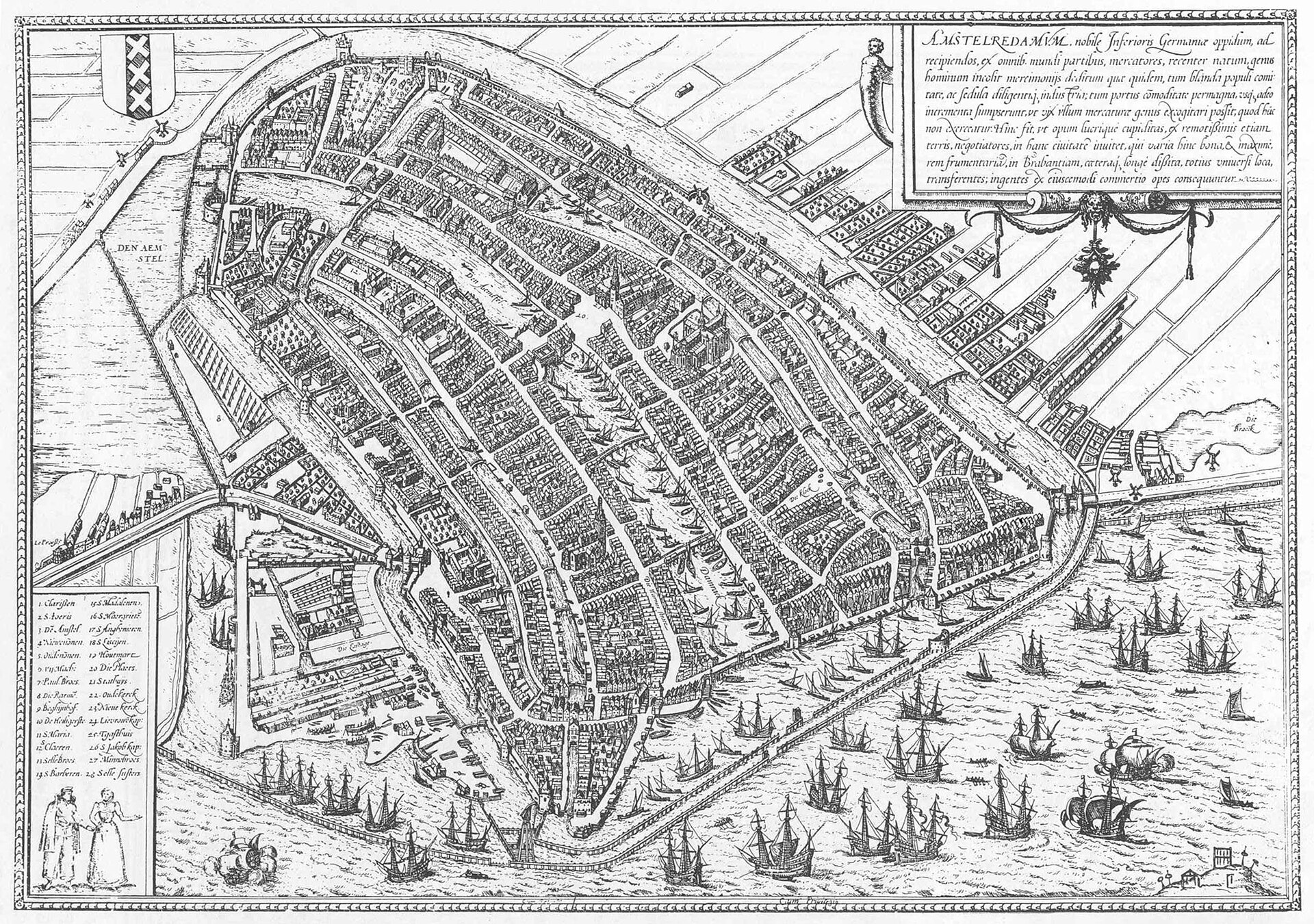
Bird's-eye view of Amsterdam, from Braun & Hogenberg's Civitates Orbis Terrarum (1574)
Oblique bird's-eye view of Amsterdam showing the concentric canal rings, quays and harbour breakwaters, numerous ships and prominent churches.
1574 · Braun and Hogenberg · Wikimedia Commons
Public domain (plate dated 1574)
In this city
Landmarks of Amsterdam, see each in its prime


Ships tied to Amsterdam
- Vasa: Her builders worked to Amsterdam feet on one side, leaving her heavier to port
Castles of Amsterdam

More cities to explore
 NetherlandsUtrechtExplore it in 1400 · 1700
 NetherlandsDelftExplore it in 1660
 NetherlandsSaeftingheExplore it in 1570
 NetherlandsRotterdamExplore it in 1690 · 1935
Castles of Europe · Landmarks of Europe · create your own reconstruction.