Andrews
Son of Andrew, apostle, patron saint, common name.
- Origin
- London, England
- Famous bearer
- Thomas Andrews (1873–1912), Belfast naval architect; chief designer of RMS Titanic; went down with the ship on the night of 14–15 April 1912
- Register
- English family
The Andrews arms and country

Coat of armsEscutcheon of the Andrews baronets of Lathbury (1661)Borne by the Lathbury line, one branch of the name rather than all of it.Charles Matthews · CC BY-SA 4.0 
Coat of armsEscutcheon of the Andrews baronets of Shaw Place (1766)Borne by the Shaw Place line, one branch of the name rather than all of it.Charles Matthews · CC BY-SA 4.0
.svg)
.svg)
- Coat of arms: Granted to an individual and inherited down that one documented line. These are the arms of particular families of the name, not of everyone who shares the surname.
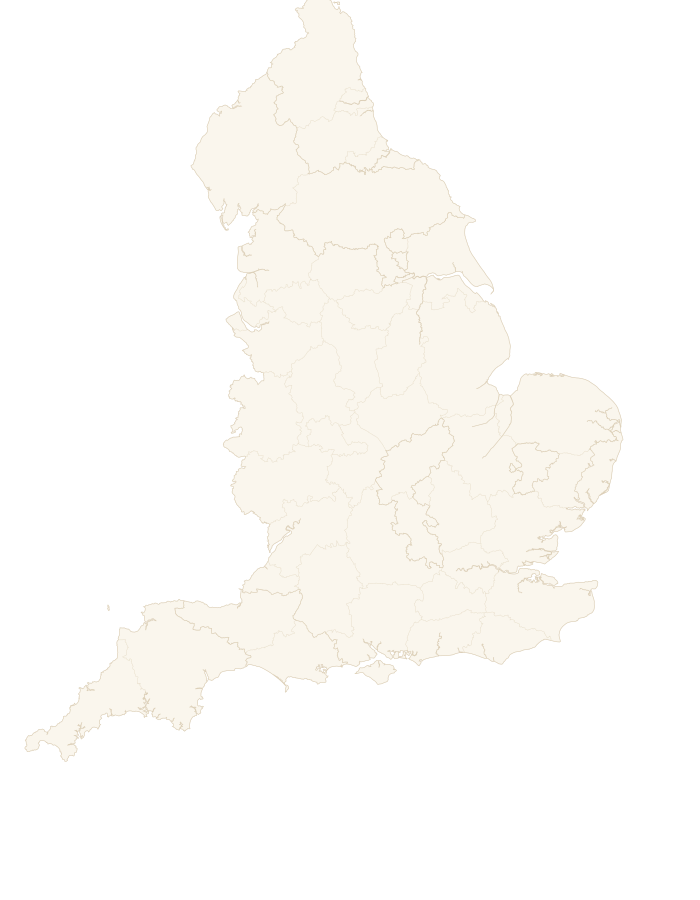
CoreHistoric reach
The seat of Andrews
Seat vacantChief
No one leads the Andrews community yet. When the movement opens, you can stand for its leadership, or help elect whoever does.
Current mission
No shared goal set yet. Once Andrews has leadership, it sets the public focus: a restoration, a gathering, a real-world project that helps its own.
The Andrews clan is being rebuilt. Join the waiting list for the movement today, and you help decide who leads it and what it does.
Help rebuild the Andrews clan →What does the Andrews name mean?
Patronymic, son of Andrew (Greek Andreas, 'manly'). Andrew was a common mediaeval Christian first name on account of the apostle, and through him on account of Saint Andrew the patron saint of Scotland. The patronymic Andrews is densely English in modern distribution, though the surname is also strong in Scotland and Northern Ireland through the Saint-Andrew association.
The history of Andrews
The apostle's name, thickest on the Dorset chalk
Andrews is a patronymic and means exactly what it says: the son of Andrew, from the Greek Andreas, 'manly'. Andrew was one of the standard baptismal names of mediaeval England on account of the apostle, and behind the apostle stood Saint Andrew, patron saint of Scotland. The name hardened into a surname while hereditary naming was still settling: by 1400 most English families, and those of Lowland Scotland, had adopted inherited family names, so a word that had described one man's father in one generation became the fixed property of his descendants whether or not any Andrew still headed the house.
The 1881 British census shows where that fixing left the name. Andrews stood at its densest in Dorset, running at 3.6 times the British average, and after Dorset in Wiltshire, Huntingdonshire, Worcestershire, Hampshire, Suffolk, Cambridgeshire, Devon and Somerset. It is a southern and West Country surname first, and one of the hundred commonest names in England. Scotland and Northern Ireland carry it strongly as well, pulled along by the Saint Andrew association rather than descended from any single household.
Caithness, Clan Ross and the Highland MacAndrews
The traditional Scottish account places the first of the name in Caithness in the far north, and ties the Andrewses closely to Clan Ross; both Andrew and Andrews are counted septs of Ross. In the Highlands the MacAndrews are reckoned a sept of Clan Mackintosh and of the wider Clan Chattan confederation, with a further association to Clan MacDonell of Glengarry.
The Scottish Andrewses did not consolidate around one seat but dispersed across the 17th, 18th and 19th centuries, and are now found in America, Canada and Australia; many moved into Northern Ireland and England.
Lathbury recusants, Norwich counting-houses, Pembrokeshire quays
In England the name surfaces as gentry and trading families rather than as one lordship. The Andrews of Lathbury in Buckinghamshire were a Catholic gentry family of the 17th century. The Andrews of Norwich and the Andrews of Pembrokeshire were mercantile lines of the 18th century, one in East Anglia and one in south-west Wales, and between them they show the pattern the surname took: no castle, several counting-houses.
The Georgian generations put the name into print and into learning. James Pettit Andrews (c. 1737–1797) was an English historian. Henry Andrews (1744–1820) worked as a British mathematician and astronomer. Henry Cranke Andrews, active from 1794 to 1830, was an English botanist, botanical artist and engraver. Across the Irish Sea Francis Andrews (1718–1774) sat as an Irish politician of the same century.
Victorians who carried the name to work
The 19th century spread Andrews through the trades, the arts and the movements. Solomon Andrews (1835–1908) was an English entrepreneur who built his business in Wales. Emily Augusta Patmore, born Andrews (1824–1862), was a British author and a Pre-Raphaelite muse, and the inspiration for the poem The Angel in the House. Henry John Andrews (1871–1919) served as a British Army officer. A. W. Andrews (1868–1959) was a pioneer of British rock-climbing.
Edith Alice Andrews (1873–1958) and Edith Lovell Andrews (1886–1980) both worked as British artists, as did Sybil Andrews (1898–1992). Elizabeth Andrews (1882–1960) organised for the Labour Party in Wales. Mahala Andrews (1939–1997) was a British vertebrate palaeontologist.
The Belfast drawing office and the Stormont benches
The hardest single story the surname owns is Ulster's. Thomas Andrews (1873–1912) was a Belfast naval architect and the chief designer of RMS Titanic. On the night of 14–15 April 1912 he went down with the ship he had drawn.
The same Ulster generation put the name into government. J. M. Andrews (1871–1956) became the second Prime Minister of Northern Ireland, and his son Jack Andrews (1903–1986) followed him into Northern Irish politics. Sir James Andrews, 1st Baronet (1877–1951), sat on the Privy Council of Northern Ireland. The name ran the other way as well: Todd Andrews (1901–1985) was an Irish republican activist and a founder of Fianna Fáil. Harold Marcus Ervine-Andrews (1911–1995) served as an Irish soldier, and Eamonn Andrews (1922–1987) was an Irish television presenter.
A stepfather's name and a four-octave voice
Julia Elizabeth Wells was born at Walton-on-Thames in Surrey on 1 October 1935, daughter of a woodwork teacher and a vaudeville pianist. Her mother remarried the music-hall singer Ted Andrews, the family went out on the British music-hall circuit, and the girl took her stepfather's stage surname with her. Trained from the age of seven, she was found to have an unusual four-octave coloratura range, and at twelve she made her West End debut at the London Hippodrome in 1947, singing the Polonaise from Mignon.
She was the phenomenon of late-1940s London music-hall. At thirteen she sang for the Royal Family at the Royal Command Performance at the Palladium; she made her radio debut in 1950 and stayed on the halls until 1953. The American producer Cy Feuer saw her at twenty in Sandy Wilson's The Boy Friend in London and brought her to New York for the Broadway transfer, which opened in September 1954.
Eliza, Poppins and Maria von Trapp
Two productions made Julie Andrews the female musical-theatre lead of her generation. Lerner and Loewe cast her as Eliza Doolittle in the original Broadway My Fair Lady opposite Rex Harrison; it opened in March 1956 and ran 2,717 performances, the longest Broadway musical run of its century to that point. She played Eliza on Broadway and in the West End and took a Tony nomination for it, and in December 1960 the same writers cast her as Guenevere in Camelot opposite Richard Burton.
Walt Disney signed her in 1963 for the title role in Mary Poppins. The film came out in 1964, was the Disney studio's great commercial success of the post-war decade, and won her the Best Actress Academy Award at the 1965 ceremony. Robert Wise's The Sound of Music followed in 1965 with Andrews as Maria von Trapp: the highest-grossing film in the history of cinema at its release, and on inflation-adjusted figures the third-most-successful film ever made. She was twenty-nine.
Her second marriage, to the director Blake Edwards in 1969, became the working partnership of the rest of her career, through Victor/Victoria (1982), which brought a third Best Actress nomination, and That's Life! (1986). A throat operation in 1997 ended her singing voice; she carried on as an actor through The Princess Diaries in 2001 and 2004, Despicable Me 2 in 2013 and the Bridgerton series. She was created Dame Commander of the Order of the British Empire in 2000.
Mongolia, the attic and the Andrews Sisters
The American Andrewses were in the Civil War generation. James J. Andrews (1829–1862) served as a Unionist spy. Christopher Columbus Andrews (1829–1922) rose to American brigadier general. John Nevins Andrews (1829–1883) went out as a Seventh-day Adventist missionary. Stephen Pearl Andrews (1812–1886) argued the American anarchist case, Solomon Andrews (1806–1872) combined politics with the invention of a dirigible aircraft, and Elisha Benjamin Andrews (1844–1917) worked as an economist while Judith Walker Andrews (1826–1914) worked as a philanthropist and social reformer.
Roy Chapman Andrews (1884–1960) was born in Wisconsin and took the name to the far side of the world. As a palaeontologist he led the American Museum of Natural History expeditions to Mongolia through the 1920s, the expeditions that found the first dinosaur eggs. Yvette Borup Andrews (1891–1959) worked as an American photographer.
The 20th-century American name belongs to performers and to one publishing phenomenon. LaVerne (1911–1967), Maxene (1916–1995) and Patty Andrews (1918–2013) sang as the Andrews Sisters. Dana Andrews (1909–1992) acted and served as President of the Screen Actors Guild. Cleo Virginia Andrews (1923–1986), born at Portsmouth in Virginia and published as V. C. Andrews, wrote Flowers in the Attic in 1979 and with it one of the bestselling Gothic-horror series in American publishing.
Champions of the Andrews name
The bearers whose lives are inseparable from this surname. Each has their own page, biography, achievements, geography, connection to the family.
- Dame Julie Andrews
The Walton-on-Thames child star with a four-octave range who created Eliza in the original My Fair Lady on Broadway, won the 1965 Best Actress Academy Award for Mary Poppins, and starred in The Sound of Music, one of the most successful films in the history of cinema.
- Daniel Andrews
The Williamstown Labor staffer who entered the Victorian parliament for Mulgrave in 2002, led Victorian Labor from 2010, and served as Premier of Victoria for three consecutive terms from 2014 to 2023, leading the state through its COVID-19 response.
Historic Places, Rebuilt
Explore the streets and seats the Andrews name knew, rebuilt with AI as they stood in history.
Castles that share the Andrews name
The same name on the map, look one up, see what it looked like in its prime, and recreate it to explore.
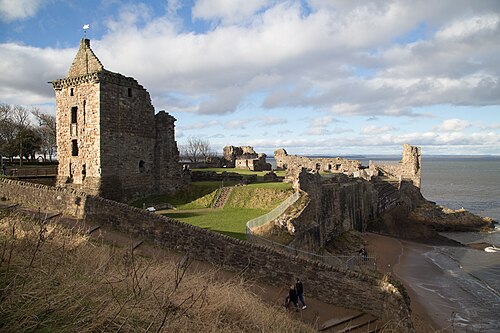
All castles in England → · Strongest castles in England → · Castles of Europe
Play As Your Clan
Hold a real castle against whatever you choose to send at it, take a ship out in her own service years, or stand at the shoulder of someone the record remembers. The chronicler sets the scene; the deeds are yours.
Notable bearers of the Andrews name
- Thomas Andrews (1873–1912), Belfast naval architect; chief designer of RMS Titanic; went down with the ship on the night of 14–15 April 1912
- Julie Andrews (b. 1935), actress, singer (Mary Poppins, The Sound of Music)
- V.C. Andrews (1923–1986), novelist (Flowers in the Attic)
- Roy Chapman Andrews (1884–1960), paleontologist