Bailey
The steward of the bailey, castle administration in one syllable.
- Origin
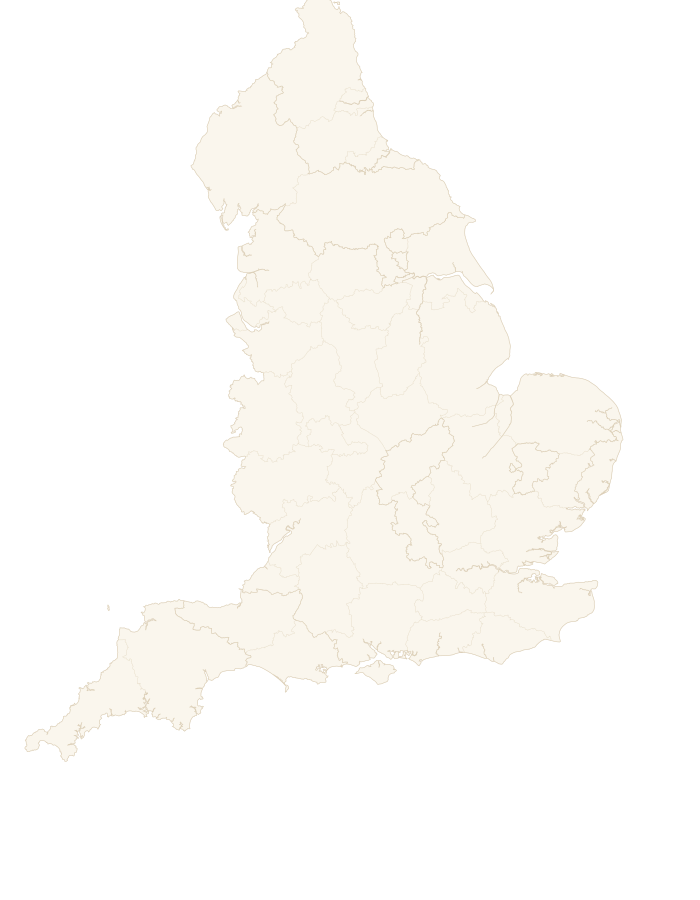
- South East, England
- Famous bearer
- Sir Donald Bailey (1901–1985), engineer, inventor of the Bailey bridge
- Register
- English family
The Bailey arms and country

Coat of armsCoat of arms of Bailey baronets of GlanuskBorne by the Glanusk line, one branch of the name rather than all of it.CC BY-SA 4.0

- Coat of arms: Granted to an individual and inherited down that one documented line. These are the arms of particular families of the name, not of everyone who shares the surname.
CoreHistoric reach
The seat of Bailey
Seat vacantChief
No one leads the Bailey community yet. When the movement opens, you can stand for its leadership, or help elect whoever does.
Current mission
No shared goal set yet. Once Bailey has leadership, it sets the public focus: a restoration, a gathering, a real-world project that helps its own.
The Bailey clan is being rebuilt. Join the waiting list for the movement today, and you help decide who leads it and what it does.
Help rebuild the Bailey clan →What does the Bailey name mean?
Middle English bail(l)i, steward, officer of the bailey (outer court); or locative from Middle English baili, the wall itself.
The history of Bailey
The officer who came to collect
Bailey is, before anything else, the name of a job, and it was one of the most exposed jobs in medieval England. Bailiff was the term the Normans used for the officer the Saxons had called a reeve: the man responsible for executing the decisions of a court. He served the summonses and executed the warrants it issued, and the district he worked was called his bailiwick, a word English still uses. If you carry this surname, an ancestor of yours was the person the court sent.
As the Saxon and Norman populations mixed, reeve narrowed to the shire courts, which is why sheriff is a contraction of shire-reeve, while bailiff attached itself to the courts below: the manorial and hundred courts, where a rent, a boundary dispute or an unpaid debt was actually settled. The bailiff was therefore the face of authority for people who would never lay eyes on a sheriff, let alone a king.
One rule of appointment explains the whole tenor of the office. Bailiffs were outsiders and free men, deliberately not drawn from the bailiwick they were answerable for. A man who might have to seize his neighbour's goods could not be his neighbour. That made the bailiff a permanent stranger in the place he governed, trusted by the lord because the village had no hold over him, and disliked by the village for the same reason. The name carries both halves of that bargain.
Bailli, bailie, Bailey: three roads to one spelling
The likeliest origin of the surname is the Anglo-Norman bailli, the direct equivalent of bailiff, which entered Middle English as bail(l)i. Scotland kept its own form of the word: bailie remains the regional Scottish variant of bailiff, and a baron bailie was the chief officer of a barony. The surname is recorded as English or Scottish from the beginning, and the two traditions behind it have never wholly separated.
Northumberland holds the earliest record, and with it a story worth telling honestly. It was said there that Bailey was Balliol altered out of recognition, because the name of the Scottish king John Balliol, who died in 1314, had become unbearable to carry. There appears to be no historical evidence for it, and Bain concluded that the earliest form was simply Baillie or Bailli, recorded in the early 14th century. A separate suggestion makes the Norman name locational, from Bailleul-En-Vimeu in Normandy.
Then there is the second Bailey, the one made of stone. A castle's bailey is its walled outer court, and the motte-and-bailey castles the Normans threw up in unprecedented numbers to hold down England after 1066 planted that word in every county; a family living at the bailey took its name from the wall itself. The two derivations sit closer than they look: the Latin root behind bailli was bajulivus, an official in charge of a castle, that is, a royal castellan. Office and courtyard were the same idea from the start.
The lord's most important intermediary
Manorialism gave this surname its working world. A manor held up to three classes of land: demesne, controlled directly by the lord for his own household; dependent villein holdings, owing him specified labour services or a share of their output; and free peasant land, owing money rent fixed at the time of the lease. The lord held a court governed by public law and local custom, and in the plainest description the system gives of itself, the power of the lord was exercised through various intermediaries, the most important of which was the bailiff.
In practice that meant accountancy with teeth. A bailiff of a manor oversaw its lands and buildings, collected its rents, managed its accounts and ran its farms, the work Walter of Henley wrote his estate treatise to teach. Rent was only part of it: the lord also drew income from charges for his mill, bakery and wine-press, from the right to hunt and to let pigs feed in his woodland, from court revenues, and from a payment on every change of tenant. Someone had to assess each of those, chase them, and answer when they failed.
Villeins were not slaves: they held legal rights subject to local custom and had recourse to the law, although the court charges they paid were themselves another stream of manorial income. That is the vice the bailiff lived in. When inflation after 1170 pushed lords to take back leased estates and re-impose labour dues, and again when those services were commuted into cash from the 13th century onward, it was the bailiff who had to make each reversal work on the ground, against tenants who remembered the old terms exactly.
Steward of the hall, bailiff of the fields
Alongside the bailiff stood the steward, and this family's own etymology names both offices. Steward is the older word and an entirely English one: Old English stiweard, from stig, meaning hall or household, and weard, meaning warden or keeper, attested from the 11th century and borrowed outward rather than inward, the Old French and Old Norse forms both taken from the English. Where bailli arrived with the Normans, steward was already here.
In the earliest arrangement a steward was a servant who supervised both the lord's estate and his household. As other household posts arose the job divided, and by the 13th century a great house commonly kept two stewards, one for the estate and the other, the majordomo, for domestic routine. Stewards commonly earned up to three or four pounds a year. They took care of their lord's castles while he was away and checked the taxes of the serfs on his manors, working the ledger the bailiff worked from the other end.
How far a name taken from estate administration could rise is not in question. The Lord High Steward of England held real power from the 12th to the 14th centuries, the Lord High Steward of Ireland has been hereditary since the 15th, and the Stewart family traces its very appellation to the office of High Steward of Scotland. An office surname was never a humble surname by definition: it recorded who had been trusted with the keys, the accounts and the castle.
The century the name stopped changing
An occupational byname is not yet a surname. It becomes one at the moment it stops describing a man and starts descending to his children. In England the introduction of family names is generally attributed to the preparation of the Domesday Book in 1086, and surnames were adopted first among the feudal nobility and gentry before spreading slowly through the rest of society, some Norman incomers marking themselves with a territorial de before their village or estate back in France.
The window that matters for Bailey is the 14th century. By then most English and most Scottish people used surnames, and by 1400 most English families and those of Lowland Scotland had adopted hereditary ones. That is precisely when the earliest recorded forms of this name, Baillie and Bailli, appear. Wales followed much later, after unification under Henry VIII in 1536. So a man called the bailli in 1290 might still have been a bailli by trade; his grandson in 1380 was a Bailey whatever he did for a living, and the name spread from Norman office-holders into every English shire.
There is a sting in that timing. In the late Middle Ages mandatory surnames were resisted in England precisely because they were associated with taxes: a fixed name made a man findable, which is an exact irony for a family whose name means the officer who collected. One caution belongs here: a standard dictionary of English surnames observes that surnames of office such as Abbot, Bishop and King are often nicknames, so some early Baileys were named for a bailiff's manner rather than his warrant. Bailey nonetheless belongs to the native occupational majority mapped by the 2016 Oxford English Dictionary of Family Names in Britain and Ireland, which found over 90 per cent of 45,602 surnames home-grown.
Bailli of the king: the office that ran half of Europe
The same office, under the same word, was doing far heavier work across the Channel. In pre-revolutionary France the bailli was the king's administrative representative in the north, responsible for the application of justice and for control of the administration and local finances in his bailliage. The network was built in the late 12th and early 13th centuries by Philip II, and laid over existing fiscal divisions called baillies that earlier sovereign princes, including the Duke of Normandy, had already used.
The French model differed from the English one in a way that shaped the reputation of the office everywhere. Where Norman England was administered through sheriffs drawn from the great local families, the French bailli was a paid official with no power network in the area he was assigned, owing his income and social standing wholly to the central administration he represented. He was, in Norman Cantor's phrase, fanatically loyal to the king and concerned only with the full exercise of royal power. The cathedral schools and the University of Paris supplied the clerks and lawyers who filled the posts.
From there the word travelled and stuck fast. In Flanders the count appointed his own baljuw; the Low Countries and German-speaking lands used schout, meier, drossate, amman and Amtmann for the same function, and the Holy Roman Empire had its Vogt. Sweden's national enforcement agency, Kronofogdemyndigheten, is literally the Crown Bailiff Authority. In two places the title never came down at all: in the Channel Islands the bailiff is still the first civil officer of each bailiwick, Crown-appointed and presiding both in the Royal Court and over the island assembly, and the Isle of Man keeps its High Bailiff as head stipendiary magistrate.
Bum-bailiffs, water bailiffs and the Bailiff of Bedford
The office paid for its power in reputation. A bailiff could delegate a court instruction to other men, and as the population expanded that work arose mainly from financial disputes, so his assistants became fixed in the public mind as debt collectors. By Shakespeare's time they had acquired the nickname bum-bailiffs, perhaps because they followed debtors so closely behind them; France used a word of its own, pousse-cul, for the same men doing the same work.
Parliament eventually put a frame around it. The County Courts Act 1888 renamed bailiffs as high bailiffs to separate them from their underlings, held them responsible for the under-bailiffs they appointed, restricted the hours in which an under-bailiff could execute a possession warrant to between 6 a.m. and 10 p.m., and required six days' notice before a complaint could be brought against a bailiff. The Law of Distress Amendment Act of the same year barred anyone from levying distress for rent without a county court judge's authority.
The word bit deep into English speech. In the Fens of eastern England, Bailiff of Bedford was slang for the destructive floods of the River Great Ouse: the river cast as the one collector nobody could turn away at the door. And the office never entirely went away. The High Bailiff of Westminster and the Bailiff of Dover Castle keep the title; farm bailiffs still run the home farm, the rents and the labour on landed estates; water bailiffs police rivers against illegal fishing under the Salmon and Freshwater Fisheries Act 1975. In Scotland bailies sat as burgh magistrates until 1975 and survive as an honorary title in Glasgow for councillors who deputise for the Lord Provost.
The Baileys of record, and the bridge that took the name to war
The name enters the public record early and never leaves it. A John Bailey sat as a member of parliament and died in 1436, within a generation of the point at which the name had become fully hereditary. Nathan Bailey, who died in 1742, was the English lexicographer who spent his life fixing the meanings of words rather than collecting rents. John Bailey (1750-1819) was an English agriculturist and engraver, the old estate competence turned into published expertise, and Samuel Bailey (1791-1870) a British philosopher and writer.
The Victorian and modern lists run long. Philip James Bailey (1816-1902) was a British poet, John Eglington Bailey (1840-1888) an English antiquary, and Nancy Bailey (1863-1913) the indexer of Hansard and The Times. Edward Battersby Bailey (1881-1965) was an English geologist and Harold Walter Bailey (1899-1996) an English linguistic scholar. Sidney Bailey (1882-1942) rose to admiral in the Royal Navy, Vivian Bailey (1869-1938) was an Irish-born British Army brigadier general in the First World War, and Wilfred Bailey (1891-1948) sat in the Lords as 3rd Baron Glanusk. Alan Bailey (1931-2023) was a British civil servant and Stanley Bailey (1926-2008) a senior British police officer: the medieval job description still walking about in modern dress.
The most consequential bearer was Sir Donald Bailey (1901-1985). Born in Rotherham and working at the War Office's Experimental Bridging Establishment, he produced in 1940 a modular, prefabricated, hand-erectable military bridge. From 1941 to 1945 it carried allied armies across the rivers of the European and Pacific theatres, and Field Marshal Montgomery's verdict was that without the Bailey bridge the war would not have been won. There is a symmetry in that: a surname that began with the man who kept an estate's courts, accounts and crossings in working order ended up on the crossings themselves.
The name went out with the emigrations and made its own history abroad. Bert Bailey (1868-1953) was a New Zealand-born Australian writer and actor; Cindy-Lu Bailey, born 1965, became the most decorated woman in Deaflympics history swimming for Australia; Abe Bailey (1864-1940) made a fortune as a South African diamond tycoon, politician and cricketer. Nat Bailey (1902-1978) was a Canadian restaurateur, Liberty Hyde Bailey (1858-1954) an American botanist, Lydia Bailey (1779-1869) an American printer; Maurice and Maralyn Bailey survived 117 days adrift at sea and hold the world record for it. One honest caution for a reader tracing a line back: the spelling was also reached by routes that had nothing to do with European ancestral migration. This page tells the European story, because that is the one it can follow.
Champions of the Bailey name
The bearers whose lives are inseparable from this surname. Each has their own page, biography, achievements, geography, connection to the family.
Historic Places, Rebuilt
Explore the streets and seats the Bailey name knew, rebuilt with AI as they stood in history.
Castles that share the Bailey name
The same name on the map, look one up, see what it looked like in its prime, and recreate it to explore.

All castles in England → · Strongest castles in England → · Castles of Europe
Play As Your Clan
Hold a real castle against whatever you choose to send at it, take a ship out in her own service years, or stand at the shoulder of someone the record remembers. The chronicler sets the scene; the deeds are yours.
Notable bearers of the Bailey name
- Sir Donald Bailey (1901–1985), engineer, inventor of the Bailey bridge