Bradley
The broad clearing in the wood.
- Origin
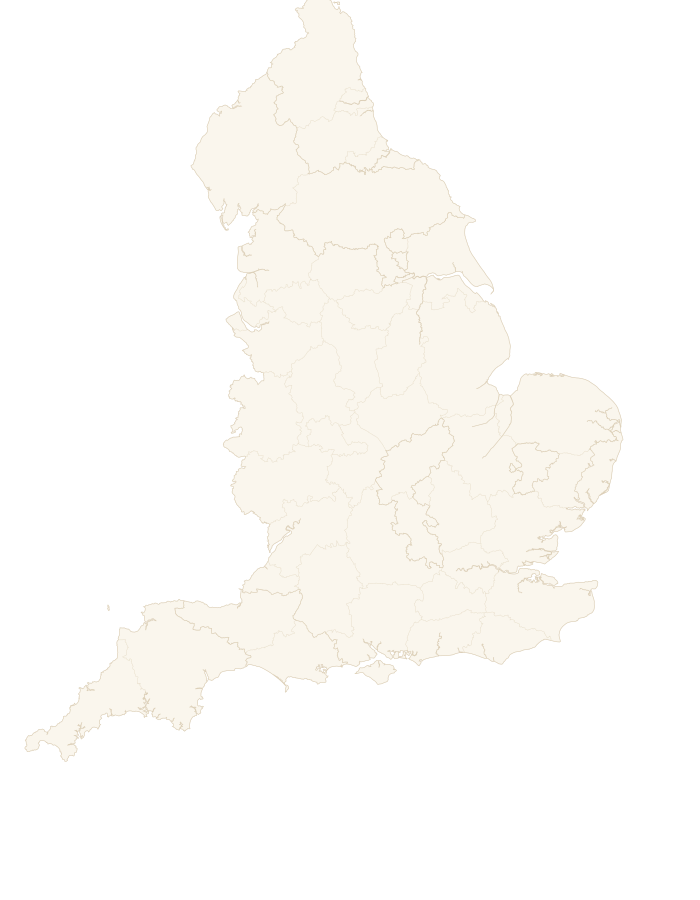
- West Midlands, England
- Famous bearer
- F. H. Bradley (1846–1924), philosopher
- Register
- English family
Where the Bradley name comes from
CoreHistoric reach
The seat of Bradley
Seat vacantChief
No one leads the Bradley community yet. When the movement opens, you can stand for its leadership, or help elect whoever does.
Current mission
No shared goal set yet. Once Bradley has leadership, it sets the public focus: a restoration, a gathering, a real-world project that helps its own.
The Bradley clan is being rebuilt. Join the waiting list for the movement today, and you help decide who leads it and what it does.
Help rebuild the Bradley clan →What does the Bradley name mean?
Locational, from Old English brad, 'broad', and leah, a wood or clearing, so 'the broad clearing'. Bradley place-names recur across the midlands and the north, in Staffordshire, Derbyshire, the West Riding and County Durham, each able to give its name to a local family.
The history of Bradley
The broad clearing in the wood
Bradley is a place before it is a person. It joins two Old English words: brad, broad, and leah, which meant a wood and then the clearing cut inside one. The broad clearing was a description long before it was an address, and it belonged to a country still largely under trees, where the useful unit of land was the gap a community had cleared out of the wood and worked to keep open.
Habitation names are built from a first element that describes and a second that names the kind of settlement, and the second shifts its meaning with period and district. The Old English tun behind so many English villages may have begun as an enclosure and ended up meaning a farmstead, a village, a manor or a whole estate. Leah does the same uncertain work in Bradley: the word fixes that a clearing was meant, not how much ground or how large a settlement any particular Bradley had become.
Domesday, and the men who took their village for a name
The habit of carrying a fixed second name arrived with the Normans. William landed at Pevensey on 28 September 1066, killed Harold Godwinson at Hastings on 14 October and was crowned at Westminster Abbey on Christmas Day, and the survey his clerks completed in 1086, the Domesday Book, is where English family names are conventionally said to begin. Domesday was arranged by shire and set out every tenant-in-chief's holdings beside the name of whoever had held that land before the conquest, which made a man's estate the obvious way to identify him.
The incomers had already worked out the form. A Norman lord distinguished himself by putting de in front of the village or estate he held, a territorial surname that followed directly from feudal landholding, and the practice spread downward from the nobility rather than upward from the fields. Christopher Daniell dates the first recorded English surname inherited across several generations to 1140. By 1400 most English families, and most in lowland Scotland, used hereditary surnames; a man out of the broad clearing was written down as being of Bradley until the preposition wore away.
Stafford, Pontefract and Durham: the country the name comes from
The districts that carry the name thickest are Staffordshire, Derbyshire, the West Riding, Cheshire, Lincolnshire, Worcestershire and Durham, and several of them were ground William had to fight for. Early in 1069 the newly installed Norman earl of Northumbria, Robert de Comines, was massacred at Durham with several hundred of the soldiers who had come north with him. William followed, beat the Mercian rebels in battle at Stafford, forced a crossing of the swollen River Aire at Pontefract, wore his crown ceremonially at York on Christmas Day 1069, and spent that winter devastating Northumbria in the Harrying of the North.
In early 1070 he based himself at Chester and crushed what was left of the resistance there before turning south again. The result went into the ground: castles in unprecedented numbers, mostly motte-and-bailey at first, and a landholding class replaced almost wholesale. Robert Liddiard's remark that a glance at the urban landscape of Norwich, Durham or Lincoln is a forcible reminder of the invasion holds for the clearings too. When Domesday counted, barely five per cent of the land south of the Tees was still in English hands.
One name, a dozen different places
There is no single Bradley to point at, and that is the character of the name. Staffordshire has a Bradley and a Bradley in the Moors. Derbyshire has one, and so do Lincolnshire, Hampshire, North Yorkshire and Gloucestershire, which also carries Bradley Green and Bradley Stoke. Bradley in Huddersfield stands for the West Riding, Bradley Green sits in Worcestershire, Cheshire holds both a Bradley that was once a civil parish and a Bradley Green of its own, and the West Midlands and the Pendle district of Lancashire each have theirs. Wrexham has one across the Welsh border.
Any of those could name the family that came out of it, independently, with no connection to the rest, which is why the surname is thick in the midlands and the north and why two people who share it need share nothing else. A National Trust house in England is called simply Bradley. What looks from a distance like one large family is a scatter of unrelated small ones who farmed the same kind of ground.
When a quarter of London's boys were called John
A byname only becomes necessary when first names run out, and in medieval and early modern England they had. Of the boys born in London in the year 1510, 24.4 per cent were christened John, 13.3 per cent Thomas and 11.7 per cent William. Three names covered nearly half the male population, and that held across the early modern period. A parish with four Johns in it needed something else to tell them apart, and the something else was usually where a man had come from, what he did, or what he looked like.
The pressure eased slowly. Mary for girls and John or William for boys still topped the lists through most of the nineteenth century. Only by 1900 had the top three names fallen to 22.9 per cent of newborn boys and 16.2 per cent of girls, and by 1994 to 11 and 8.6 per cent. Long before that the bynames had hardened into surnames and stopped describing anyone: a Bradley in 1900 was not a man from a clearing, he was a man from a family that had once been.
Nobody is called Bradley while they still live there
Habitational surnames come overwhelmingly from small places rather than large ones, and the reason is movement. In the clearing itself, saying a man is from the broad clearing distinguishes nothing; the label only works once he has walked into a market town where nobody else has come from there. Medieval migration ran from small communities toward the cities, and a new arrival needed a defining name on the day he arrived. Bradley was handed over by strangers rather than by neighbours.
A four-year study led by the University of the West of England, concluded in 2016 and published as the Oxford English Dictionary of Family Names in Britain and Ireland, worked through sources from the eleventh century to the nineteenth and found more than ninety per cent of its 45,602 surnames native to Britain and Ireland. Its leader, Richard Coates, sorted the place-derived names alongside Hill and Green, set against occupational names such as Smith and Baker and patronymics such as Jackson. Bradley belongs in the first group.
The brothers Bradley, and a general with five stars
By the nineteenth century the name had travelled well clear of any clearing. F. H. Bradley (1846–1924), the Idealist philosopher who wrote Appearance and Reality, and his brother A. C. Bradley (1851–1935), who worked on Shakespeare, between them made a field name out of the English midlands a fixture of English intellectual life.
In the United States it belongs first to General Omar Bradley (1893–1981), who held five-star rank in the US Army and was the last man alive to hold it. The name is carried by the armoured M2 and M3 Bradley fighting vehicles and by the Oliver Hazard Perry-class frigate USS Robert G. Bradley. Bill Bradley, born in 1943, won at basketball before serving as a United States senator.
Bradley on the American map
The clearing crossed the Atlantic as a place name as well as a family one. There is a Bradley County in Arkansas and another in Tennessee, settlements called Bradley in Arkansas, California, Georgia, Illinois, Maine, Michigan, Nebraska, Ohio, Oklahoma, South Carolina, South Dakota and Wisconsin, two more in West Virginia, in Boone County and Raleigh County, a Bradley Township in Jackson County, Illinois, a Bradley inside Louisville, and Bradley Junction in Florida.
It is fixed to American institutions too: Bradley University in Peoria, Illinois, the Bradley Foundation and the Bradley Center in Milwaukee, Bradley International Airport at Windsor Locks in Connecticut, the Harold C. Bradley House in Madison, Wisconsin. It even reached the Arctic, where Bradley Land was the island Frederick Cook reported and which turned out never to have been there at all.
The castles of the homeland
The great strongholds of the homeland, look one up, see what it looked like in its prime, and recreate it to explore.
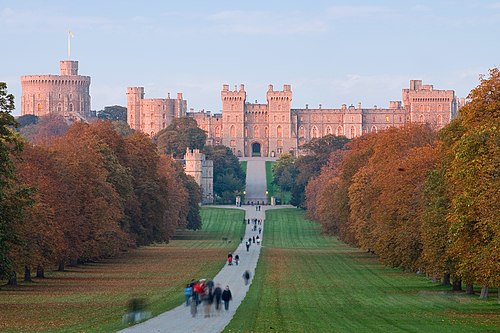 Windsor CastleRestored · prime 1820
 Tower of LondonRestored · prime 1285
 Bamburgh CastleRestored · prime 1904
All castles in England → · Strongest castles in England → · Castles of Europe
Play As Your Clan
Hold a real castle against whatever you choose to send at it, take a ship out in her own service years, or stand at the shoulder of someone the record remembers. The chronicler sets the scene; the deeds are yours.
Notable bearers of the Bradley name
- F. H. Bradley (1846–1924), philosopher
- General Omar Bradley (1893–1981), US Army general
- Bill Bradley (b. 1943), US senator and basketball player