Hardy
also Hardie
The bold one, a Norman nickname.
- Origin
- South West, England
- Famous bearer
- Thomas Hardy (1840–1928), novelist and poet
- Register
- English family
Where the Hardy name comes from
CoreHistoric reach
The seat of Hardy
Seat vacantChief
No one leads the Hardy community yet. When the movement opens, you can stand for its leadership, or help elect whoever does.
Current mission
No shared goal set yet. Once Hardy has leadership, it sets the public focus: a restoration, a gathering, a real-world project that helps its own.
The Hardy clan is being rebuilt. Join the waiting list for the movement today, and you help decide who leads it and what it does.
Help rebuild the Hardy clan →What does the Hardy name mean?
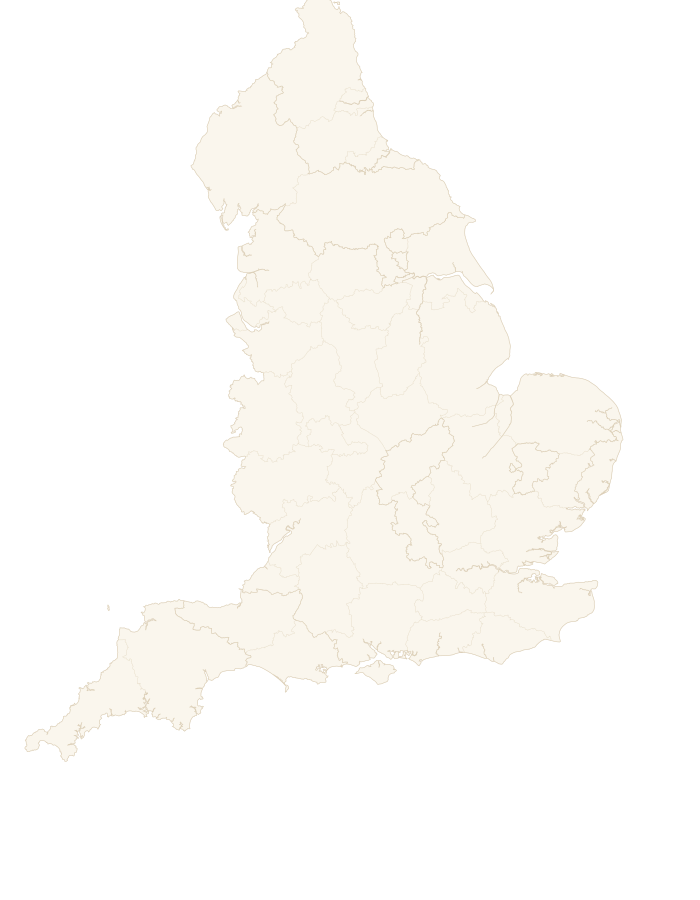
A nickname surname from Old French hardi, 'bold, brave, hardy', brought in with the Normans and applied to a courageous or foolhardy man. It is densest in the West Country, above all in Dorset, where the line that produced Thomas Hardy and Nelson's flag-captain was long rooted; the Scottish variant is Hardie.
The history of Hardy
Hardi: a word for courage, and for going too far
Behind the surname sits Old French hardi, 'bold, courageous', itself from Old Frankish hardjan, 'to make hard', a Germanic root that reached England by way of France rather than straight across the North Sea. The final -y is the ordinary settling of a French ending, the same one running through French given names, surnames and place names alike. Hardy belongs to the class of surname whose origin describes the original bearer (the bracket that holds Brown, Short and Thin) rather than his trade, his farm or his father.
Nicknames of this kind describe the first man to carry them, and they do not always flatter. Richard Coates, who led the four-year University of the West of England study of 45,602 surnames published as the Oxford English Dictionary of Family Names in Britain and Ireland, cautioned that Short may itself have been an ironic label fixed on a tall man. Hardi carries the same double edge: it praised a brave man and it mocked a rash one, and the parchment seldom says which was meant.
A knight called de Hardy, and the eight thousand who came with William
The word crossed with the Normans, and the Normans had themselves been made in France. In 911 Charles the Simple settled Rollo's Vikings on the lower Seine by the Treaty of Saint-Clair-sur-Epte; within a few generations they had given up Norse paganism for Christianity and Old Norse for the Old French of their new home, keeping enough of the old speech to turn it into the Norman language. Hardi belonged to that hybrid tongue when William's fleet landed at Pevensey on 28 September 1066 and broke Harold's shield wall on Senlac Hill on 14 October.
Some of the oldest English Hardy families are traced back to a Norman knight recorded as de Hardy in the middle of the eleventh century. He stands a little apart from his fellows. Some of the early Norman nobility marked themselves out by fixing 'de' to the name of a village or estate back in France (a territorial surname, the direct product of feudal landholding), whereas Hardy names the man and nothing else. Historians put the number of Norman and other continental landholders in the conquered kingdom at around eight thousand. The name entered England in that company.
The Wessex ground the name settled on
English Hardy families gather in two districts, and the heavier of them is the West Country: Dorset and Wiltshire, Somerset and the Bristol country, Devon, with older reach into Hampshire and the Isle of Wight, Gloucestershire and Cornwall. That ground did not take the Conquest quietly. William besieged Exeter in 1068, where Harold Godwinson's mother Gytha was among those inside, and suffered heavy losses before he could negotiate the town's surrender.
The following year was worse. Harold's sons came back out of their refuge in Ireland and were beaten at the Battle of Northam in Devon by Norman forces under Count Brian, a son of Eudes, Count of Penthièvre. Rebels from Devon and Cornwall attacked the Norman garrison at Exeter and were repulsed by the defenders; rebels out of Dorset, Somerset and the neighbouring country besieged Montacute Castle and were broken by an army gathered from London, Winchester and Salisbury under Geoffrey of Coutances. The Wessex in which Hardy became a common name was a conquered one.
Yorkshire, the second Hardy country
The other English concentration lies in Yorkshire, and its founding decade was harsher still. Early in 1069 the newly installed Norman Earl of Northumbria, Robert de Comines, was massacred with several hundred men at Durham; the castellan of York, Robert fitz Richard, was defeated and killed, and the rebels laid siege to the Norman castle there. William came north, beat them outside the walls, pursued them into York and massacred the inhabitants, then raised a second castle over the city. When a large fleet sent by Sweyn II of Denmark joined a fresh Northumbrian rising that autumn, William bought the Danes off and spent the winter of 1069–70 systematically devastating Northumbria in the Harrying of the North. By the Domesday survey of 1086 only about five per cent of the land in England south of the Tees was still in English hands.
When a nickname turned into an inheritance
Hardi was still a label on a living man, not something a son received. The introduction of English family names is generally attributed to the preparation of the Domesday Book in 1086, and the earliest recorded use of a modern surname inherited across several generations is dated to 1140, untidily formed at first, as when the sons of a certain Robert took FitzGerald in honour of an earlier relative named Gerald. Surnames were adopted first among the feudal nobility and gentry and worked their way slowly down the ranks. Across England and Lowland Scotland the process was largely finished by 1400, most families by then carrying an inherited name.
The habit was not always welcome. In late medieval England compulsory surnames were resisted precisely because people associated them with taxes: a fixed name is what makes a man findable by the exchequer. Everything else was moving the same way. Anglo-Norman displaced Old English among the ruling class, official documents shifted from Old English to Latin, and French given names such as William, Robert and Richard became ordinary. A French adjective for courage had become an English family's property.
Mac C(h)ardaih, the craftsman's son who came out as Hardy
Scotland reached the same spelling by a different road, in truth by more than one. Scottish Hardi is held to be Norman or Viking in some lines, and in others to be Celtic and quite unconnected: a shortened Mac Hardie, anglicising Mac C(h)ardaih, 'son of the craftsman', from the root ceardaiche. Two languages and two meanings, courage on one side and a workshop on the other, collapsed into a single surname that no reader can now tell apart by sight.
The Scottish name is mainly a Lowland one, yet its clan affiliations point north into the hills: Scottish Hardys stand as a sept of Clan Mackintosh and of Clan Farquharson, and so inside the wider confederation of Clan Chattan.
Hardie, the Scottish spelling, and the roll it carries
Alongside Hardy sits Hardie, the Scottish spelling, and it carries a public roll of its own. Keir Hardie (1856–1915) and Andrew Hardie, Baron Hardie (born 1946) were both British politicians; another Andrew Hardie is remembered simply as a radical. Philip Hardie holds a professorship of Latin literature. The compound forms travelled furthest from home: Jerzy Hardie-Douglas (born 1951) and Jakub Hardie-Douglas (born 1982) are both Polish politicians, the Scottish name surviving inside a hyphenated Polish one, and Michael Hardie Boys (1931–2023) was a New Zealand judge and governor-general.
Elsewhere the Hardies turn up in the ordinary registers of public life. James Allen Hardie (1823–76) was an American soldier and Robert Gordon Hardie (1854–1904) an American painter; R. A. Hardie was a Canadian physician and a missionary to Korea; Norman Hardie (1924–2017) was a New Zealand mountaineer. Sport carries much of the rest. John Hardie (born 1938) and Martin Hardie both played football in Scotland, Ryan Hardie (born 1997) plays there still, and Grant Hardie (born 1992) is a Scottish curler, as Neil Hardie is an English one. John Hardie (born 1988) is a New Zealand rugby union player, and Brad Hardie (born 1962) played Australian rules football.
The Dorset Hardys: a novelist, a flag-captain and two on screen
The name's two most famous bearers both came off the Dorset ground where it is densest. Thomas Hardy (1840–1928), born near Dorchester, wrote Tess of the d'Urbervilles, Far from the Madding Crowd and Jude the Obscure, mapping his native Dorset as the heart of his 'Wessex', the same conquered West Country the surname settled on, put back into English fiction under its older name. Vice-Admiral Sir Thomas Masterman Hardy (1769–1839), also of Dorset, was Nelson's flag-captain at Trafalgar and the 'Hardy' of the dying admiral's last words.
On screen the name belongs to Oliver Hardy (1892–1957), the heavier half of Laurel and Hardy, and to the British actor Tom Hardy (born 1977). A nickname for a bold or a rash man, fastened on a Norman in the eleventh century, ended as the name over a Wessex parish in fiction, a Trafalgar quarterdeck and a comedy double act.
The castles of the homeland
The great strongholds of the homeland, look one up, see what it looked like in its prime, and recreate it to explore.
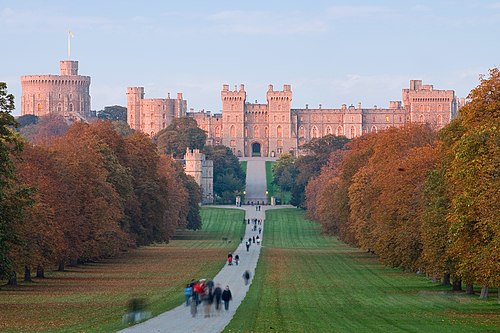 Windsor CastleRestored · prime 1820
 Tower of LondonRestored · prime 1285
 Bamburgh CastleRestored · prime 1904
All castles in England → · Strongest castles in England → · Castles of Europe
Play As Your Clan
Hold a real castle against whatever you choose to send at it, take a ship out in her own service years, or stand at the shoulder of someone the record remembers. The chronicler sets the scene; the deeds are yours.
Notable bearers of the Hardy name
- Thomas Hardy (1840–1928), novelist and poet
- Vice-Admiral Sir Thomas Hardy (1769–1839), Nelson's flag-captain
- Tom Hardy (b. 1977), actor