Adams
Son of Adam.
- Origin
- South West, England
- Famous bearer
- William Adams (1564–1620), navigator, the first Englishman in Japan
- Register
- English family
Where the Adams name comes from
CoreHistoric reach
The seat of Adams
Seat vacantChief
No one leads the Adams community yet. When the movement opens, you can stand for its leadership, or help elect whoever does.
Current mission
No shared goal set yet. Once Adams has leadership, it sets the public focus: a restoration, a gathering, a real-world project that helps its own.
The Adams clan is being rebuilt. Join the waiting list for the movement today, and you help decide who leads it and what it does.
Help rebuild the Adams clan →What does the Adams name mean?
Patronymic, son of Adam.
The history of Adams
Adam's son, written the English way
Adams is a common surname of English and Scottish origin, and it means what it looks like: it descends from the given name Adam. Where the north of England and Lowland Scotland built Adamson, southern speech simply added the possessive s and left the rest understood: Adam's, with son or servant taken as read. The same shorthand made Roberts from Robert and Vickers from the vicar; A Dictionary of English Surnames notes that a servant could take his master's name as readily as a son took his father's.
The related forms fan out from the same root: Addams is the older written variant, while McAdam and MacAdam are the Gaelic build, with mac, "son", set in front instead of s behind. The University of the West of England surname study, concluded in 2016, places Adams in the patronymic class, the names that originally enshrined the father's name.
The name the Church carried in, not the Conquest
Very few given names used in England have English derivations at all; the mass of them are Hebrew or Greek imports (Daniel, David, Elizabeth, Susan) that arrived on the back of Scripture rather than on the back of a horse. Adam is the oldest of that Hebrew stratum: adam means "man" or "humanity", and it belongs to the first human of the Hebrew Bible. No conquering lord brought it to Britain. Priests did, one baptism at a time.
The contrast with 1066 matters, because most English surnames of this shape sit on the other side of it. One of the plainest effects of the Norman Conquest was that names common in France replaced Anglo-Saxon ones: William, Robert and Richard, the seed of Williams, Roberts and Richardson. Adam owes them nothing. The Conquest also handed the English Church to continental churchmen, so that after Wulfstan died in 1095 no bishopric in England was held by an Englishman; the names such clergy gave at the font went with them into every parish.
An Old Testament name before England had a fashion for them
Medieval England drew on a startlingly small pool of names. Of the boys born in London in 1510, 24.4 per cent were christened John, and across the early modern period the top three male names covered close to half the male population. Adam was never in that first rank, but it was one of the handful of Old Testament names in steady use long before anyone thought of them as a Protestant taste, quite unlike the saints' names filling the rest of the register.
That timing is the point. English surnames were not at first inherited, but by 1400 most English families, and those of Lowland Scotland, had adopted hereditary ones. Adams was fixed and passing down before the Reformation made biblical patriarchs fashionable at the font. A family called Adams was not being pious in 1600; it was carrying a medieval man's name that had stopped meaning anything but itself.
Adam in Scotland, in Ireland, and across the water
The name is Scottish as well as English, and there the older build survives: Adamson, plainly "son of Adam", with a tradition in some families of naming the first-born son Adam each generation. Gaelic renders the name Adhamh on both sides of the North Channel, and from that form Mac Adaim comes into English as McAdam and MacAdam. An Irish family and a Somerset family can share this surname without sharing a drop of blood, because each named a man after the same man in Genesis.
The pattern repeats in every language that read the same book: Adamo in Italy, Adamski and Adamowicz in Poland, Adamov across the Slavic east, Adan in Spain and Adao in Portugal. Not borrowings from one another, but the same act performed independently across a continent, which is why the surname is common in a dozen countries and the property of none.
The Gillingham boy who ended as a samurai
The most extraordinary life the name carried belongs to William Adams (1564–1620), born at Gillingham in Kent, two miles from Rochester. His father died when he was twelve; apprenticed at Limehouse to the shipyard master Nicholas Diggins, he spent twelve years learning shipbuilding, astronomy and navigation. He served against the Spanish Armada in 1588 as master of the Richarde Dyffylde, and in 1598 was hired as chief pilot of five ships fitted out by Rotterdam merchants.
Only one of the five reached Japan. The Liefde made landfall at Bungo in 1600, and Adams became the first Englishman to set foot in the country. He and his second mate Jan Joosten became advisors to the shogun Tokugawa Ieyasu, each appointed hatamoto; Adams was granted samurai status and is known in Japan still as Miura Anjin, the pilot of Miura. Given eventual leave to sail home, he chose to stay, and died there at fifty-five. James Clavell built John Blackthorne, the hero of Shogun, from him.
From a Somerset village to a Massachusetts farm
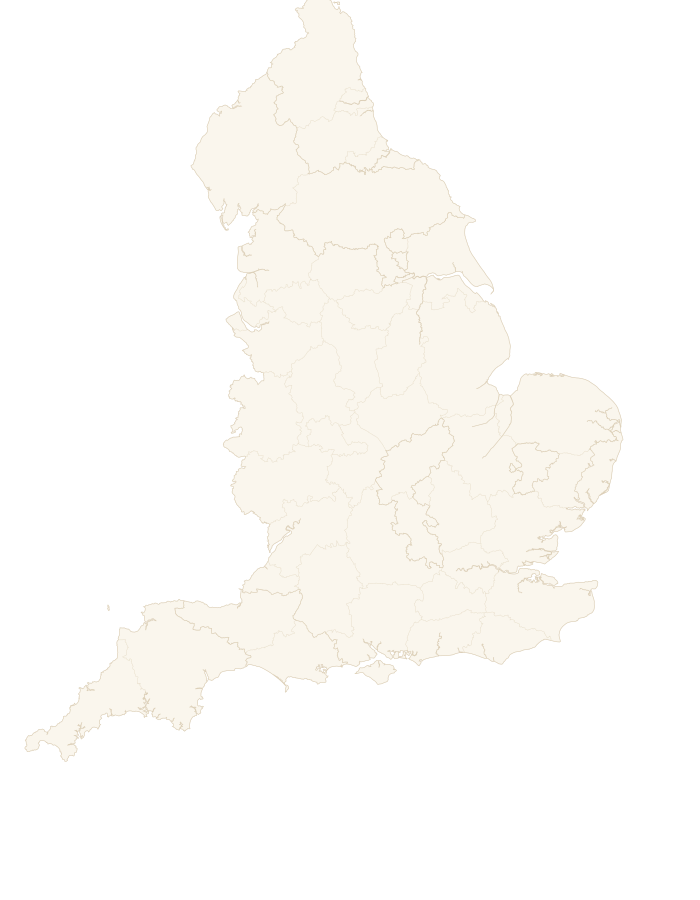
The Adamses of the West Country and West Midlands were farming and trading families, not barons, and the surname is thickest still in that band of England: Somerset and Bristol, Devon and Cornwall, Dorset and Wiltshire, and through Warwickshire, Staffordshire and the Black Country. From this stock the name crossed the Atlantic. Henry Adams (1583–1646) is recorded as born at Barton St David in Somerset and as the first of his family to emigrate to New England; a second account has the same man reaching Massachusetts from Braintree in Essex around 1638. The two have never been reconciled.
The family settled in eastern Massachusetts, in a town they named Braintree after the English one, and farmed there for four generations. John Adams (1735–1826) was born on that farm, son of a deacon who was also a cordwainer, a militia lieutenant and the selectman who oversaw the town's schools and roads. He became the second President of the United States and author of the oldest written constitution still in force; his son John Quincy Adams became the sixth, and his cousin Samuel Adams (1722–1803) sat in the Continental Congress and governed Massachusetts.
What a diaspora Adams inherits
The name kept producing people who worked in words rather than land. Douglas Adams (1952–2001), born in Cambridge and raised in Essex, wrote The Hitchhiker's Guide to the Galaxy, a 1978 BBC radio comedy that grew into five books and sold more than fourteen million copies in his lifetime. He came, on his father's side, from a Glasgow line: the Scottish half of this surname surfacing in an English writer.
That is the inheritance. Not a castle or a chief, but a name given by a parish priest to an ordinary English child, frozen into a family name before 1400, carried into Somerset farms and Midlands workshops, and then further: to a Kentish pilot's grave in Japan and a Massachusetts farmhouse that produced two presidents. If you are an Adams in Ohio or Otago, your line does not begin with the famous ones. It begins with a man called Adam whose children were known by his name.
Champions of the Adams name
The bearers whose lives are inseparable from this surname. Each has their own page, biography, achievements, geography, connection to the family.
Historic Places, Rebuilt
Explore the streets and seats the Adams name knew, rebuilt with AI as they stood in history.
The castles of the homeland
The great strongholds of the homeland, look one up, see what it looked like in its prime, and recreate it to explore.
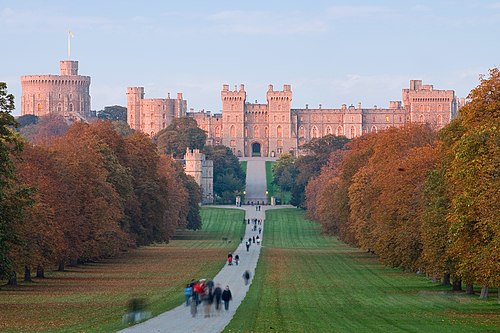 Windsor CastleRestored · prime 1820
 Tower of LondonRestored · prime 1285
 Bamburgh CastleRestored · prime 1904
All castles in England → · Strongest castles in England → · Castles of Europe
Play As Your Clan
Hold a real castle against whatever you choose to send at it, take a ship out in her own service years, or stand at the shoulder of someone the record remembers. The chronicler sets the scene; the deeds are yours.
Notable bearers of the Adams name
- William Adams (1564–1620), navigator, the first Englishman in Japan
- Douglas Adams (1952–2001), novelist