Healy
also Healey, Ó hÉalaighthe
The ingenious one, Donoughmore in mid-Cork.
- Origin
- Munster, Ireland
- Motto
- Vincere vel mori
- Famous bearer
- Tim Healy (1855–1931), first Governor-General of the Irish Free State
- Register
- Irish family
Where the Healy name comes from
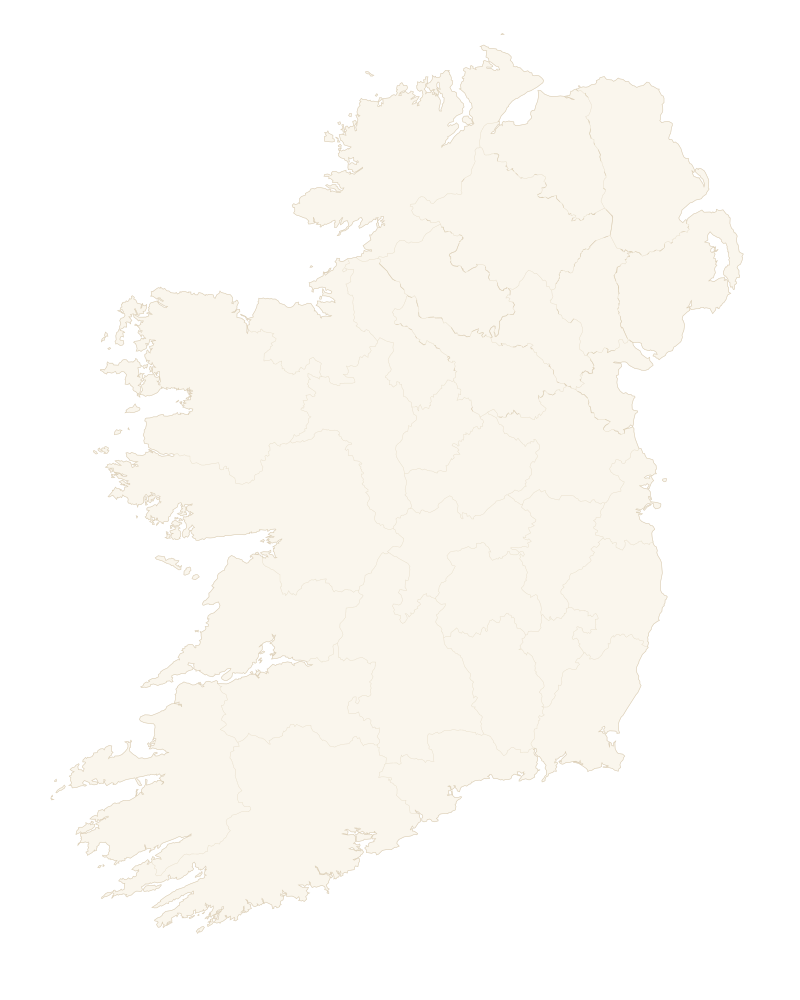
CoreHistoric reach
The seat of Healy
Seat vacantChief
No one leads the Healy community yet. When the movement opens, you can stand for its leadership, or help elect whoever does.
Current mission
No shared goal set yet. Once Healy has leadership, it sets the public focus: a restoration, a gathering, a real-world project that helps its own.
The Healy clan is being rebuilt. Join the waiting list for the movement today, and you help decide who leads it and what it does.
Help rebuild the Healy clan →Motto
Vincere vel mori
“Conquer or die”
What does the Healy name mean?
From Ó hÉalaighthe, descendant of Éalaighthe ('clever' or 'ingenious'). The principal Ó hÉalaighthe sept was settled in the Donoughmore-Macroom area of mid-Cork from the 11th century, with their seat at Donoughmore (Domhnach Mór) on the river Lee. A separate Healy line in Sligo descends from Mac Céile Eilidhthe of the Cinéal Bonáin, a sub-sept of the O'Connors of Sligo. Both lines Anglicised as Healy or Healey.
The history of Healy
Éalaighthe the ingenious, and the h that gives the name away
Healy is the anglicised shell of Ó hÉalaighthe, 'descendant of Éalaighthe', a personal name carrying the sense of clever or ingenious. The stray h is grammar: a man's Gaelic surname is built from Ó ('descendant', historically Ua) or Mac ('son') plus a name in the genitive, and when Ó falls before a vowel a lowercase h attaches to it, as in Ó hUiginn for Higgins. A woman of the family was not Ó hÉalaighthe at all. She was Ní, from Iníon Uí, 'the descendant's daughter'; on marriage she became Bean Uí, or simply Uí.
The anglicisers stripped that apparatus out. The prefix went first, so Ó hÉalaighthe surfaced in English records as Healy and Healey, with no trace of the Ó and no way to tell a man's form from a woman's. Two unrelated Irish families were flattened into the one spelling by it: the mid-Cork sept, and a Sligo line descending from Mac Céile Eilidhthe of the Cinéal Bonáin, a sub-sept of the O'Connors of Sligo whose country lay around Ballymote.
Donoughmore on the Lee, held of the MacCarthy Mór
The principal Ó hÉalaighthe sept sat at Donoughmore, Domhnach Mór, on the river Lee in mid-Cork from the eleventh century, an Eóganacht line holding its land of the MacCarthy Mór kings of Desmond. Gaelic Ireland was organised into finte, kinship groups tracing descent from a common ancestor, and the great Munster grouping was the Eóganachta, out of which MacCarthy of Desmond and O'Brien of Thomond rose to royal standing. A sept like the Ó hÉalaighthe held under such a king rather than beside him: a chieftain's family, not a royal one.
Under Brehon law the head of the fine was no proprietor. He was appointed by his kinsmen as custodian of the clan, answerable for maintaining and protecting its people and property, and his power was territorial rather than personal. An Irish clan also absorbed unrelated clients of the chief, who took the leading lineage's name as a show of allegiance while remaining ineligible ever to be elected chief. It is one reason the name grew broader than any single bloodline, and why the Book of Ballymote and the Book of Lecan record the descent of chiefs and not of every man who bore it.
The lordship broken, the name left planted
The clan system was the basis of Irish society until the seventeenth century, and it was in that century that it stopped being so. Tudor surrender-and-regrant reduced the Donoughmore lordship, replacing the Irish tanistry that let a group of a chief's male cousins succeed by election with the English system of primogeniture, and the Cromwellian settlement finished it. What the settlement could not do was move the people: the surname stayed densely planted across mid-Cork through every census that followed, with a second concentration around Ballymote. The motto that came down with it, Vincere vel mori, conquer or die, kept the older register long after the lordship was gone.
The Bantry town clerk's son who reached the Commons at twenty-five
Timothy Michael Healy was born at Bantry, on the south-west coast of County Cork, on 17 May 1855, second of the eight children of Maurice Healy, Bantry's Town Clerk and for forty years a town commissioner, and Eliza Sullivan of Bantry. He was schooled by the Christian Brothers at Fermoy, and at sixteen went to clerk's work on the Newcastle-upon-Tyne railway. From 1878 he was in London as parliamentary correspondent for the Nation, the leading Irish-nationalist weekly, which put a provincial clerk in the press gallery as the Irish Parliamentary Party was being built.
Charles Stewart Parnell took him up in 1879 and 1880 and sent him home as a parliamentary agent for the Wexford by-election of November 1880. Healy came out of it not as an agent but as the member, returned for Wexford in his twenty-fifth year. He sat in the Commons for the next thirty-eight years, moving seat by seat as the party's needs shifted: Wexford, then Monaghan from 1883, South Londonderry from 1885, North Longford from 1887, North Louth from 1892 to 1910, and North-East Cork from 1910 to 1918.
The Healy Clause, and the tenant's own improvements
He read for the law alongside the politics, was called to the Irish Bar in 1884 and to the English Bar at Gray's Inn in 1903, took silk as Queen's Counsel in 1899, and built one of the largest commercial and equity practices in the Four Courts. The two careers met in 1887. Drafting for the Land Law (Ireland) Act of that year, Healy wrote the provision that has carried his name since: the Healy Clause, securing to the Irish tenant the value of his own improvements as part of the fair-rent calculation under the Land Act of 1881.
Before it, a tenant who improved his holding could see the rent raised on the strength of work he had paid for himself. After it, that value was his. The clause was called the Magna Carta of Irish tenant farming.
The split of December 1890 and the long semi-detachment
In December 1890 Healy broke with Parnell in the split that tore the Irish Parliamentary Party in two, and through the 1890s he was one of the leading anti-Parnellite members. When the party was reunified in 1900 under John Redmond he did not come fully back in. For fifteen years he sat as a semi-detached independent, drifting towards William O'Brien's All-for-Ireland League and growing more critical of Redmond's pro-war policy after 1914. The general election of December 1918 that swept Sinn Féin to power took his North-East Cork seat and ended a parliamentary career of thirty-eight years.
Vice-Regal Lodge, 6 December 1922
The Treaty of December 1921 established the Irish Free State, and the new state was constitutionally founded in December 1922. For the office of Governor-General, the Crown's representative under the dominion constitution, Healy was nominated jointly by W. T. Cosgrave, President of the Executive Council, and the Treaty signatories. George V appointed him on 6 December 1922, in his sixty-eighth year, and he held the office five and a half years until January 1928.
He established it at the Vice-Regal Lodge in the Phoenix Park, the house now called Áras an Uachtaráin, and how he conducted it mattered more than anything he could formally decide. His ceremonial conduct of the office set the template that the Constitution of 1937 converted into the Presidency of Ireland. He died at Glenaulin, Chapelizod, on 26 March 1931, in his seventy-sixth year.
Healy and Healey, one name in two spellings
The anglicisers left the name two settled forms and no rule for choosing between them, and both travelled. Denis Healey (1917 to 2015), born at Mottingham, was Anglo-Irish Healey on his father's side and carried the second spelling to the top of British politics, serving as Defence Secretary from 1964 to 1970 and as Chancellor of the Exchequer from 1974 to 1979. The two forms ended in two different capitals: Healy in the Phoenix Park in 1922, Healey in the Treasury in 1974. Neither is the older or truer one; both are what English clerks made of the same Irish word for clever.
Champions of the Healy name
The bearers whose lives are inseparable from this surname. Each has their own page, biography, achievements, geography, connection to the family.
Historic Places, Rebuilt
Explore the streets and seats the Healy name knew, rebuilt with AI as they stood in history.
The castles of the homeland
The great strongholds of the homeland, look one up, see what it looked like in its prime, and recreate it to explore.
 Ashford Castle, County MayoRestored · prime 1880
 Manderley CastleRestored · prime 1840
 Dublin CastleRestored · prime 1790
All castles in Ireland → · Strongest castles in Ireland → · Castles of Europe
Play As Your Clan
Hold a real castle against whatever you choose to send at it, take a ship out in her own service years, or stand at the shoulder of someone the record remembers. The chronicler sets the scene; the deeds are yours.
Notable bearers of the Healy name
- Tim Healy (1855–1931), first Governor-General of the Irish Free State
- Denis Healey (1917–2015), British Labour politician, Chancellor 1974–79
- Patrick Healy (1834–1910), first African-American president of a Catholic US university (Georgetown)