McLaughlin
also McLoughlin, Mac Lochlainn
Sons of the Norseman, kings of Inishowen.
- Origin
- Ulster, Ireland
- Famous bearer
- Muircheartach Mac Lochlainn (d. 1166), high king of Ireland
- Register
- Irish family
Where the McLaughlin name comes from
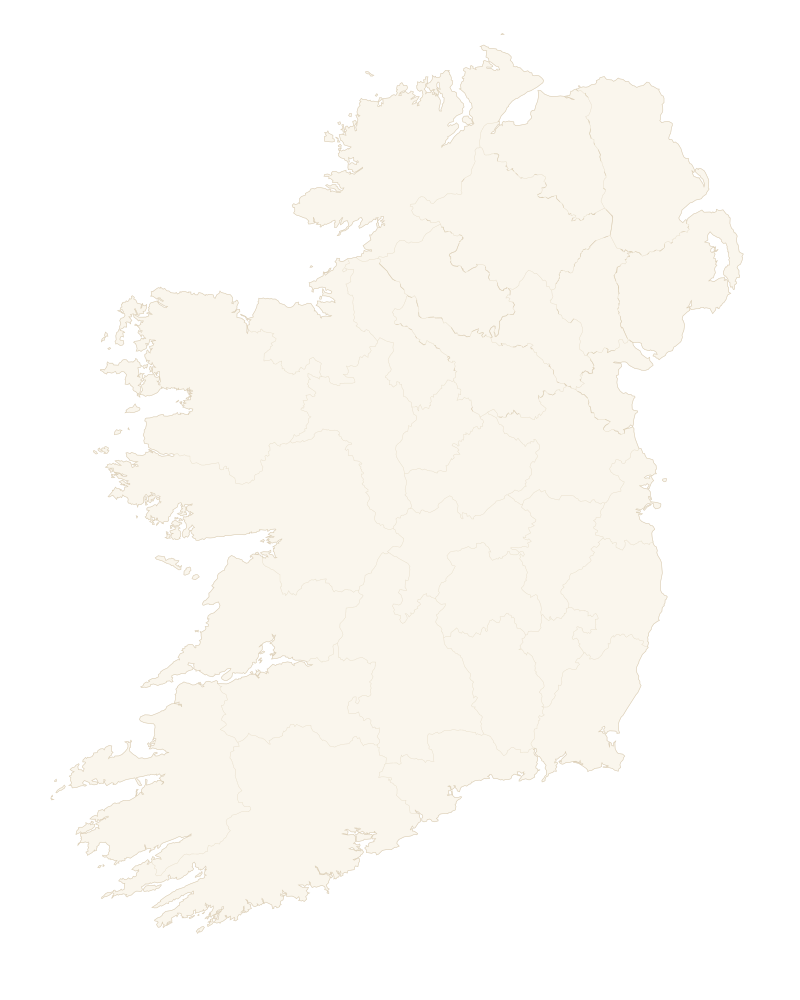
CoreHistoric reach
The seat of McLaughlin
Seat vacantChief
No one leads the McLaughlin community yet. When the movement opens, you can stand for its leadership, or help elect whoever does.
Current mission
No shared goal set yet. Once McLaughlin has leadership, it sets the public focus: a restoration, a gathering, a real-world project that helps its own.
The McLaughlin clan is being rebuilt. Join the waiting list for the movement today, and you help decide who leads it and what it does.
Help rebuild the McLaughlin clan →What does the McLaughlin name mean?
From Mac Lochlainn, son of Lochlann ('Norseman', 'Scandinavian'). The Mac Lochlainn were a sept of the Cinéal nÉogain of the Uí Néill federation, distinct from the O'Neills proper, with their seat at Inishowen in north-west Donegal, the peninsula between Lough Foyle and Lough Swilly. Through the 11th and 12th centuries the Mac Lochlainn briefly displaced the O'Neills as the dominant Cinéal nÉogain dynasty, producing two high kings of Ireland.
The history of McLaughlin
Son of the Norseman
The name is Mac Lochlainn, 'son of Lochlann', and Lochlann means Norseman or Scandinavian - the Viking lands. In Irish it still bends to its bearer: a son is Mac Lochlainn, a daughter Nic Lochlainn. Mc is only a contraction of Mac, sometimes cut again to M', so MacLaughlin, McLaughlin and M'Laughlin are one name, not three.
Not every Gaelic surname recorded a father; some recorded a people, and MacLachlainn meant son of a Scandinavian. A family at the head of the Uí Néill carrying a Norse name is no contradiction: the Vikings who settled Ireland from the 9th to the 11th centuries became wholly Gaelicised, and built its first towns.
Cenél nEógain, and the peninsula between two loughs
The Mac Lochlainn belonged to the Cenél nEógain, senior branch of the Northern Uí Néill, who claimed descent from Niall Noígíallach, Niall of the Nine Hostages. The O'Neills were the chiefly family of that grouping; the MacLoughlins stood inside it. Their own seat was Inishowen in north-west Donegal, the peninsula between Loughs Foyle and Swilly.
Gaelic Ireland did not hand power to eldest sons. Under Brehon law a chief was elected by his kinsmen as custodian of the clan, the succession running by tanistry - the next chief chosen from the cousins of a shared grandfather. So being Cenél nEógain did not mean waiting your turn behind the O'Neills. It meant you could take it. For two generations, the Mac Lochlainn did.
Two high kings, and the battle at Leitir Lúin
The Uí Néill had lost the high kingship in 1002 to Brian Boru of the Dál gCais. Domhnall Mac Lochlainn, who died in 1121, made himself the dominant lord of the north by 1100 and was acknowledged High King of Ireland with opposition until his death - the annalists' careful formula for a supremacy real and recognised but never unchallenged. He had put the northern Uí Néill back at the summit of Ireland through his own line, not the O'Neills'.
His great-grandson Muircheartach Mac Lochlainn, who died in 1166, was the most powerful Irish king of the mid-12th century, ruling from Tír Eógain and binding most of Ulster, Connacht and Leinster into nominal submission. It ended at Leitir Lúin in 1166, where he was defeated and killed by Donnchadh Ó Cearbhaill of Airgialla. The vacuum he left was the opening Diarmait Mac Murchada exploited a year later, seeking help abroad and bringing back the Norman intervention of 1169. The knights who reshaped Ireland came through a door a Mac Lochlainn defeat had opened.
From high kings to an Inishowen lordship
After 1166 the leadership of the Cenél nEógain reverted to the O'Neills and never came back. The Mac Lochlainn declined into a regional lordship in Inishowen - still chiefs of their own country, no longer makers of kings.
The order they belonged to was dismantled by law before it was broken by war. In the 16th century English common law was extended across Ireland, and the county and the sheriff replaced the chief and his country. From the founding of the Kingdom of Ireland in 1541 the chiefs were drawn in with new titles, while surrender and regrant swapped tanistry for primogeniture. In 1607 the senior chiefs of Ulster sailed for Spain to seek support, failed, and died in Rome. That Flight of the Earls cleared the way for the Plantation of Ulster, and the Mac Lochlainn lost their lands with the rest.
Three families behind one spelling
Most Irish surnames have one Gaelic source. McLaughlin has three. Besides Mac Lochlainn of Inishowen, the spelling also renders Ó Maoilsheachlainn, anglicised O'Melaghlin - the Clann Cholmáin of the Southern Uí Néill, descendants of Máel Sechnaill II, King of Meath from 976 to 1022 and himself High King of Ireland. More rarely it renders Ó Lachtna, or Loughney. From the English spelling alone a bearer cannot tell which of the three he descends from.
Nor was an Irish clan ever purely a bloodline: it took in unrelated clients of the chief, who assumed the leading lineage's name as a show of allegiance. The great genealogies, from Rawlinson B 502 to the Leabhar Mór na nGenealach, record the descent of chiefs, not of every member, and one genetic study judges them accurate only back to the Middle Ages. The tradition that the family also crossed the North Channel to become Clan MacLachlan sits in the same category: reported, plausible, unproven.
The name that crossed the water
The surname stayed densest across Inishowen and the north-west, and left with the 19th-century Donegal, Derry and Antrim emigrations - to Pennsylvania, the Carolinas and the towns that became the Rust Belt, and to Glasgow and Liverpool. McLaughlin became the usual American form, McLoughlin the modern Irish one, and where the Mc was dropped the name survives as Loughlin. No name was ever legally changed at Ellis Island, whatever the family story says; the emigrants chose their own.
Ann McLaughlin Korologos was US Secretary of Labor from 1987 to 1989; Audrey McLaughlin led Canada's New Democratic Party; Donal McLaughlin designed the United Nations flag; John McLaughlin, a Doncaster violinist's son, taught himself the guitar, played on Miles Davis's In a Silent Way and Bitches Brew at the birth of jazz-rock fusion, and founded the Mahavishnu Orchestra. And in Donegal North East, the constituency that holds Inishowen, the family's own country has sent Pádraig Mac Lochlainn to parliament under the name in its original Irish.
Champions of the McLaughlin name
The bearers whose lives are inseparable from this surname. Each has their own page, biography, achievements, geography, connection to the family.
Historic Places, Rebuilt
Explore the streets and seats the McLaughlin name knew, rebuilt with AI as they stood in history.
The castles of the homeland
The great strongholds of the homeland, look one up, see what it looked like in its prime, and recreate it to explore.
 Ashford Castle, County MayoRestored · prime 1880
 Manderley CastleRestored · prime 1840
 Dublin CastleRestored · prime 1790
All castles in Ireland → · Strongest castles in Ireland → · Castles of Europe
Play As Your Clan
Hold a real castle against whatever you choose to send at it, take a ship out in her own service years, or stand at the shoulder of someone the record remembers. The chronicler sets the scene; the deeds are yours.
Notable bearers of the McLaughlin name
- Muircheartach Mac Lochlainn (d. 1166), high king of Ireland
- Domhnall Mac Lochlainn (d. 1121), high king of Ireland
- John McLaughlin (1927–2016), American TV host, The McLaughlin Group
- John McLaughlin (b. 1942), English jazz guitarist (Mahavishnu Orchestra)