Meredith
also Maredudd, ap Maredudd
Son of the great lord, princely surname of Deheubarth.
- Origin
- Powys, Wales
- Famous bearer
- George Meredith (1828–1909), novelist (The Egoist, Diana of the Crossways)
- Register
- Welsh family
Where the Meredith name comes from
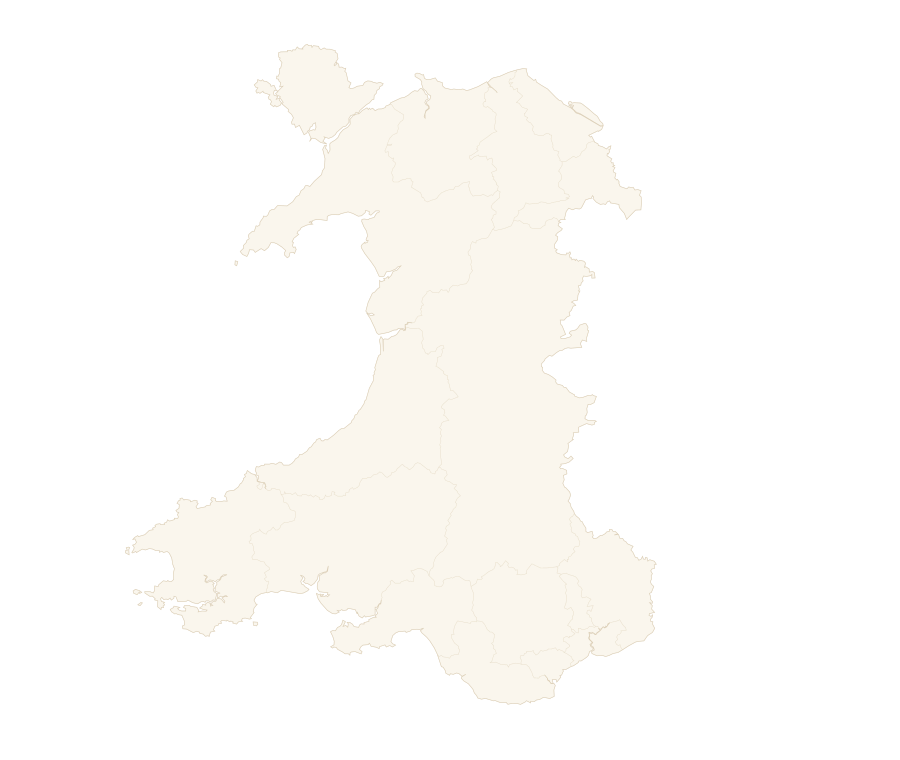
CoreHistoric reach
The seat of Meredith
Seat vacantChief
No one leads the Meredith community yet. When the movement opens, you can stand for its leadership, or help elect whoever does.
Current mission
No shared goal set yet. Once Meredith has leadership, it sets the public focus: a restoration, a gathering, a real-world project that helps its own.
The Meredith clan is being rebuilt. Join the waiting list for the movement today, and you help decide who leads it and what it does.
Help rebuild the Meredith clan →What does the Meredith name mean?
From ap Maredudd, son of Maredudd, a personal name probably derived from Old Welsh elements meaning 'great-lord' or 'splendid lord'. Maredudd was the personal name of two princes of Deheubarth, Maredudd ab Owain (d. 999), king of all Wales briefly in the 990s, and Rhys ap Maredudd (d. 1292), the last sovereign prince of Deheubarth. The patronymic ap Maredudd compressed into Meredith under Tudor naming policy, with the southern Welsh counties remaining the surname's heartland.
The history of Meredith
Son of the great lord
Maredudd was a personal name, not a job and not a place. Old Welsh built it from elements read as 'great-lord' or 'splendid lord', and princes of Deheubarth carried it. A man was ap Maredudd, son of Maredudd, for as long as his neighbours needed telling which of the local Ieuans or Rhyses he was. It was renewed every generation and belonged to nobody permanently.
That is what the modern surname rests on. Meredith is not the fossil of a trade every village needed, the way Smith and Miller are; it is a first name that stopped moving. Tudor naming policy compressed ap Maredudd into the fixed word Meredith, and the heartland stayed Powys and Ceredigion, with the older Deheubarth ground of Carmarthenshire and Pembrokeshire behind it.
Maredudd ab Owain and the last rising of Deheubarth
Maredudd ab Owain, who died in 999, was briefly the closest thing to a king of all Wales between Hywel Dda and Llywelyn the Great. For a few years in the 990s he held Deheubarth in the south west, Gwynedd in the north west and Powys in the centre under one rule. Rhys ap Maredudd, his descendant, raised the last serious revolt of native Deheubarth against Edward I in 1287; he was captured, and executed at York in 1292.
With him the princely line ended, and so did the political history of the name in Wales. What survived was not a dynasty with a seat and charters but the patronymic itself, carried in commoner branches across Powys and Ceredigion through to the Tudor period. A reader with this surname is not looking at a family that held a castle and lost it, but at a princely first name that dropped out of the ruling class and kept circulating among ordinary households.
The ap system, and the law that froze it
Before fixed surnames the Welsh ran a working patronymic system. A baptismal name was joined by ap or ab ('son of') or ferch ('daughter of') to the father's baptismal name: Evan son of Thomas was Evan ap Thomas, Evan's son John was John ab Evan, and John's son Rees was Rees ap John. Nothing was inherited. In 1292, 48 per cent of recorded Welsh names were patronymics, and in some parishes the figure passed 70 per cent. Names of the type Llewelyn ap Dafydd ab Ieuan ap Gruffudd ap Meredydd were not unusual, reaching back perhaps seven generations: a record of the male line that Welsh law needed, because rights turned on descent.
Those laws decayed, and the decisive change came under Henry VIII, who reigned from 1509 to 1547. He ordered that marital births be recorded under the surname of the father, and it was in his reign that surnames became hereditary among the Welsh gentry, spreading slowly to commoners. Wales came under unification with England in 1536; most English and Scottish people had used surnames since the 14th century.
There were two ways to convert a patronymic into a surname, and Welsh families used both. Some kept the ap in reduced form at the front of the word: Upjohn (ap John), Powell (ap Hywel), Price and Pryce (ap Rhys), Bowen (ab Owen). Others dropped the ap entirely and let the father's name stand alone. Meredith is the second kind. The change did not run everywhere at once: town families and the wealthy had given up patronymics earlier, while some rural areas kept them into the early 19th century.
Why two Merediths need not be kin
The stock of Welsh surnames is famously small, and the ap system is only half the reason. The variety of baptismal names contracted sharply after the Protestant Reformation, so the pool of father's names available to freeze was already narrow when the freezing happened. Evans, Jones, Williams, Davies and Thomas were all in the top ten surnames across England and Wales in 2000.
The consequence is a rule this page will not break. Because most Welsh surnames come from patronymics drawn from a small set of first names, Welsh communities routinely contain families of the same surname who are not related. It cannot be assumed that two people named Jones, even in the same village, inherited the name from a common ancestor, and the same holds for Meredith.
The Portsmouth tailor's grandson who took the Order of Merit
George Meredith was born at Portsmouth on 12 February 1828, son of a naval tailor whose Welsh line had come down from mid-Wales the previous century. He was schooled at Portsmouth and, from fourteen, for two years at the Moravian Brothers school at Neuwied on the Rhine, came home at sixteen, was briefly articled to a London solicitor, and at eighteen abandoned the law to write. Poems appeared in 1851, The Shaving of Shagpat in 1855, and Modern Love in 1862, fifty sixteen-line poems continuously in print since.
The Ordeal of Richard Feverel (1859) was the first major book, and through the 1860s and 1870s he earned his living as senior literary reader at Chapman and Hall, a post he held to 1894, in which he was the first reader to recognise Thomas Hardy's opening manuscript. The Egoist (1879), the comedy of Sir Willoughby Patterne and Clara Middleton's resistance to him, was the breakout: Robert Louis Stevenson called it one of the half-dozen great English novels of the century, and Henry James treated Meredith as the foundational English comic novelist after Dickens.
He lived at Flint Cottage under Box Hill on the Surrey downs for the last forty-five years of his life, and the late-Victorian literary establishment came down to him there: Stevenson, Hardy, Barrie, James, Leslie Stephen. He was elected President of the Society of Authors in 1892 on Tennyson's resignation, was a founding member of the Order of Merit in 1905, and died at Flint Cottage on 18 May 1909 at eighty-one.
The Welsh Wizard, and the name in sport
Billy Meredith (1874-1958) was born at Chirk and played on the wing. Nicknamed 'the Welsh Wizard', he won league titles with both Manchester United and Manchester City and stands among the foundational figures of British professional football. Welsh rugby has carried the name repeatedly and separately: Bryn Meredith, Courtney Meredith (1926-2024) and John Meredith were all Welsh rugby union players, three men of one surname with no connection shown between them.
Ted Meredith won two gold medals at the 1912 Summer Olympics, Don Meredith quarterbacked the Dallas Cowboys, and Riley Meredith is an Australian cricketer.
Bishops, judges and the name in Ireland
The name was in the Irish church hierarchy by the Tudor century: Richard Meredith was the 16th-century Anglo-Irish Bishop of Leighlin and Ferns. The Irish bearers recorded after him are professional rather than landed, in law, learning and the church, with no line shown between them. Richard Edmund Meredith rose to Master of the Rolls in Ireland; James Creed Meredith was an Irish lawyer and judge and a Kant scholar; Ralph Creed Meredith, an Anglo-Irish clergyman, was chaplain to George VI.
Montreal, Washington and the long emigration
Canada took the name into its senior courts and its banks. Sir William Ralph Meredith was a Canadian chief justice and a leader of the conservative party. Edmund Allen Meredith was a Canadian politician and principal of McGill University in Montreal, and Sir Vincent Meredith, 1st Baronet of Montreal, was President of the Bank of Montreal.
In the United States the name reached cabinet rank twice: William M. Meredith served as Secretary of the Treasury and Edwin Thomas Meredith as Secretary of Agriculture under Woodrow Wilson. Stephen M. Meredith (1802-1874) was a physician and politician in Pennsylvania, the state Welsh emigrants settled in particular, and Jonathan Meredith was a United States Marine in the First Barbary War. Burgess Meredith (1907-1997), Welsh Meredith on his father's side, played in Of Mice and Men, the Penguin in the 1960s Batman and the Oscar-nominated Mickey Goldmill in Rocky.
The name went further out still: Bevan Meredith (1927-2019) was Anglican Archbishop of Papua New Guinea, Winifred Barbara Meredith (1895-1979) an Australian medical practitioner. A princely Welsh first name, cut loose from its ap under Tudor naming policy, ended up doing duty on four continents.
Champions of the Meredith name
The bearers whose lives are inseparable from this surname. Each has their own page, biography, achievements, geography, connection to the family.
The castles of the homeland
The great strongholds of the homeland, look one up, see what it looked like in its prime, and recreate it to explore.
 Caernarfon CastleRestored · prime 1330
 Conwy CastleRuin · prime 1287
 Pembroke CastleRestored · prime 1280
All castles in Wales → · Strongest castles in Wales → · Castles of Europe
Play As Your Clan
Hold a real castle against whatever you choose to send at it, take a ship out in her own service years, or stand at the shoulder of someone the record remembers. The chronicler sets the scene; the deeds are yours.
Notable bearers of the Meredith name
- George Meredith (1828–1909), novelist (The Egoist, Diana of the Crossways)
- Billy Meredith (1874–1958), Manchester United and Manchester City footballer, 'the Welsh Wizard'
- Burgess Meredith (1907–1997), American actor (Rocky, Batman)
Frequently asked
What does the surname Meredith mean?
Where does the Meredith family come from?
Where did the Meredith family historically hold territory?
Is Meredith Welsh or English?
How old is the Meredith surname?
What is the Meredith family known for?
Is there a Meredith family crest or coat of arms?
Who is the most famous Meredith?
Who are some famous Merediths?
Is Maredudd the same family as Meredith?
Is ap Maredudd the same family as Meredith?
Where is the Meredith surname found today?
What does the Clan Rising page for the Meredith family cover?
Who is the head of the Meredith family today?
Neighbouring clans
- EvansSon of John, by the Welsh road, the cousin name of Jones.
- LewisLlywelyn anglicised, a princely name carried into common use across the Marches and the south.
- OwenThe princely name, Owain in Welsh, the surname of the last revolt and the first Tudor.
- LloydLlwyd, the grey one, the great descriptive surname of the central Welsh ridge.