Nelson
Son of Niel, Norfolk's victory surname.
- Origin
- East of England, England
- Famous bearer
- Horatio Nelson (1758–1805), vice-admiral
- Register
- English family
The Nelson arms and country

Coat of armsNelson of Stafford armsBorne by the Stafford line, one branch of the name rather than all of it.Wikimandia · CC BY-SA 4.0 
Coat of armsNelson (of Bedale, Yorkshire) armsBorne by the Bedale line, one branch of the name rather than all of it.Lobsterthermidor · CC BY-SA 3.0

_arms.svg)
- Coat of arms: Granted to an individual and inherited down that one documented line. These are the arms of particular families of the name, not of everyone who shares the surname.
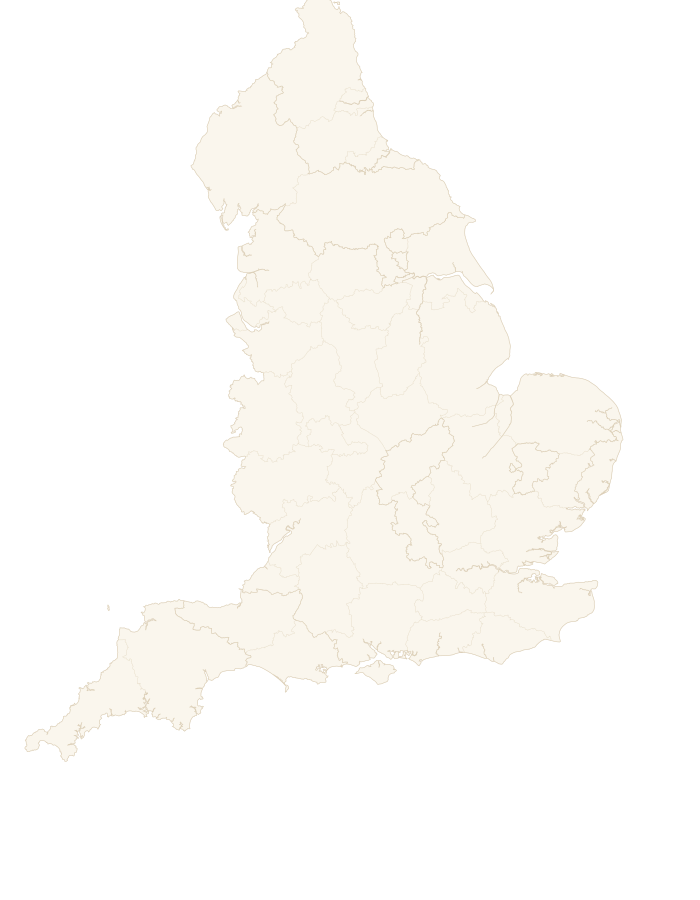
CoreHistoric reach
The seat of Nelson
Seat vacantChief
No one leads the Nelson community yet. When the movement opens, you can stand for its leadership, or help elect whoever does.
Current mission
No shared goal set yet. Once Nelson has leadership, it sets the public focus: a restoration, a gathering, a real-world project that helps its own.
The Nelson clan is being rebuilt. Join the waiting list for the movement today, and you help decide who leads it and what it does.
Help rebuild the Nelson clan →What does the Nelson name mean?
Patronymic, son of Niel or Nels (Scandinavian Niall); strong in Norfolk and the Danelaw before Admiral Nelson made it anthemic.
The history of Nelson
Neil's son, and the road that brought Neil to England
Nelson means what it looks like it means: the son of Nel. The interest is in who Nel was. The oldest reading of the name takes that first element as Niel or Nels, the Scandinavian handling of Niall, a Gaelic given name. Read that way, Nelson is English in its grammar, since the -son ending is English and not Gaelic at all, but built on an Irish personal name that reached English soil by way of Scandinavian settlement. Three peoples stand inside one word, and none of them borrowed it politely from the others.
That is not the only reading, and an honest page says so. The standard surname account derives Nelson from Nell, and also lists it as a baptismal name meaning the son of Eleanor, a matronymic rather than a patronymic, a man known in his parish by his mother. What that tells a reader is worth holding on to: a common modern spelling is a funnel, not a family tree.
The geography backs the Scandinavian reading. Nelson sits heavily in Norfolk and across the northern and eastern counties, which is the old Danelaw, the half of England where Scandinavian settlement went deepest. The evidence is written into the map: the Norman conquest of 1066 barely disturbed English place names, because the names of the north and east had already been changed by the earlier Scandinavian invasions. A surname that clusters exactly where those settlers put down their farms and their words is not clustering there by accident.
The century in which a byname hardened into a surname
For most of the early Middle Ages an English villager had one name and a way of being told apart from the other men who shared it. He was the smith, or he was from the hill, or he was Nel's son. None of it was inherited. It described him, and it died with him. The introduction of family names in England is generally attributed to the Domesday Book of 1086, and they were taken up first among the feudal nobility and gentry, spreading only slowly down through the rest of society. The historian Christopher Daniell puts the first surname recorded as inherited across generations at about 1140.
By the 14th century most English and most Scottish people used surnames; in Wales the change waited for the union under Henry VIII in 1536. That hardening is where the surname Nelson actually begins, and it is stranger than it sounds. It is the point at which a man called Nel's son handed the name to a son whose father was not called Nel, at which a description became an inheritance, and a living fact about one household became a label that would outlive everyone who knew what it referred to. Every Nelson alive is downstream of that switch.
A four-year study led by the University of the West of England, concluded in 2016, worked through sources from the 11th to the 19th century and found that over 90 per cent of the 45,602 surnames in its dictionary are native to Britain and Ireland. Its leader Richard Coates counted the patronymics, those which originally enshrined the father's name, among the great classes of English naming. Nelson sits there with Wilson, Jackson, Nicholson and Robinson: the same simple machine, run on a different first name.
Nilsson, Nielsen, Nilsen: the other road to the same spelling
There is a second and separate family of Nelsons, and a diaspora reader ought to know which one they are before buying a print of a Norfolk church. Nelson is also the anglicised form of the Scandinavian names Nilsen, Nielsen and Nilsson. In Denmark, Norway and Sweden the patronymic was not a surname at all but a live piece of grammar: the son of Nils was Nilsson, and his own son was not, because his own son was the son of whatever his father was called. The name moved forward one generation at a time and never accumulated. Iceland has never stopped, and Icelandic names still carry the gender-specific endings, -son for a son and -dottir for a daughter.
The freezing of that system has real dates attached. In 1526 King Frederik I of Denmark-Norway ordered that noble families take up fixed surnames, and many reached into their own coats of arms for one: the Rosenkrantz family a wreath of roses, the Gyldenstierne family a gold star. Ornamental names like those are commonest where surnames came late, by adoption or by order, as they did across Scandinavia through the 18th and 19th centuries. The nobility froze first; the farm families ran the old patronymic for centuries after.
When those families emigrated, Nilsson and Nielsen were flattened into Nelson by clerks, neighbours and the gravity of an English spelling that looked near enough. One surname now wears two unrelated ancestries. By 1990 Nelson ranked 39th commonest in the United States, and a good share of that ranking is Scandinavian rather than English in origin.
Burnham Thorpe rectory: the making of a sea officer
The name's most famous bearer was born in a Norfolk rectory on 29 September 1758, the sixth of eleven children of the Reverend Edmund Nelson, rector of Burnham Thorpe, and Catherine Suckling, a great-niece of Sir Robert Walpole. His mother died when he was nine. At twelve, in January 1771, his uncle Captain Maurice Suckling took him to sea as a midshipman aboard HMS Raisonnable. There followed an apprenticeship on every vessel the navy could put a boy onto: a West Indies merchantman, an Arctic ship that carried him in 1773 to within ten degrees of the North Pole, and an East Indies tour that left him so wrecked with malaria he was invalided home from Bombay. He was made post-captain at twenty in June 1779, and married Frances Nisbet on Nevis on 11 March 1787.
Then the war ended and the navy had no use for him: five years on half-pay at Burnham Thorpe, 1788 to 1793, walking his father's parish and reading what naval history he could get in three languages. War with revolutionary France put him back to sea in January 1793 as captain of HMS Agamemnon. He lost the sight of his right eye at the siege of Calvi in Corsica on 12 July 1794. At Cape St Vincent on 14 February 1797 he broke the line of battle on his own initiative and boarded the San Nicolas and then, across her deck, the San Josef behind her, in an action he afterwards called the patent bridge for boarding first-rates. He was knighted and made rear-admiral for it, and lost his right arm at Santa Cruz de Tenerife on 25 July 1797.
Aboukir Bay, and a Sicilian dukedom with a shadow on it
In May 1798 he was told to find and destroy the expedition Bonaparte had embarked at Toulon. He chased it for seventy-three days and missed it twice at Alexandria. On the evening of 1 August 1798 he found Vice-Admiral Brueys with thirteen French ships of the line at anchor in Aboukir Bay, and attacked at dusk, in shoal water, on a coast for which he had no chart he trusted. Captain Foley of HMS Goliath found water at the head of the French line, and the ships that followed him inside the anchorage caught the French between two fires. The flagship Orient blew up at twenty-two minutes past ten and the shock was felt at Rosetta twenty miles away. Eleven of the thirteen French sail of the line were taken or destroyed, Bonaparte's army was left in Egypt without a fleet, and the Mediterranean closed against France for the remaining seven years of the war.
The rewards came from three courts. The Sultan in Constantinople sent the chelengk, a diamond plume from his own turban; the King of the Two Sicilies created him Duke of Bronte in perpetuity; his own government made him Baron Nelson of the Nile. The Sicilian title has a shadow across it that belongs on the page. When the short-lived Parthenopaean Republic in Naples collapsed in 1799, Nelson arrested the leaders of the revolution on the restored monarchy's order and handed them over for execution: Francesco Caracciolo, Mario Pagano, Ettore Carafa and Eleonora Fonseca Pimentel. It was for that service that Ferdinand made him Duke of Bronte.
The seat that came with it stands on the eastern foothills of Etna, on the ground of the Benedictine Abbey of Santa Maria of Maniace, built in 1174 by William II of Sicily. It was the ducal seat from 1799, passing to his elder brother William Nelson, 1st Earl Nelson (1757–1835), and through William's daughter into the Hood family, until the 7th Duke sold house and estate to the Commune of Bronte in 1981, closing 182 years in which an English line held a Sicilian title on an Italian mountainside.
The blind eye at Copenhagen, the last morning off Trafalgar
At Copenhagen on 2 April 1801, sent into the Baltic against the armed neutrality of the northern powers under Sir Hyde Parker, Nelson led the inshore attack on the moored Danish line off the city. It is often reckoned the hardest fight of his life, and three hours in Parker hoisted the signal to break off. Nelson put his telescope to his blind right eye, said by his flag-captain's account that he really did not see the signal, and won. Denmark left the League of Armed Neutrality, and he was created Viscount Nelson of the Nile and of Burnham Thorpe in May 1801.
In May 1803 he took the Mediterranean command and the blockade off Toulon, which held him at sea until Villeneuve broke out in April 1805 and ran for the West Indies. Nelson chased him across the Atlantic and back and cornered thirty-three enemy ships of the line at Cadiz with twenty-seven of his own. On 21 October 1805, off Cape Trafalgar, he attacked in two columns driven at right angles into the enemy line, a plan he had laid out to his captains a fortnight earlier in the great cabin of HMS Victory and called, in writing, the Nelson touch. At twenty minutes to twelve he told his signal-lieutenant John Pasco that he would now amuse the fleet with a signal: England confides that every man will do his duty. Pasco asked leave to substitute expects, which was in the signal vocabulary where confides would have to be spelt out letter by letter. Twelve flags went up the mizzen halyard.
Victory struck the enemy line astern of Villeneuve's flagship Bucentaure at twelve minutes past noon, and the French Redoutable locked alongside her with the gun muzzles touching. A marine in the Redoutable's mizzen-top, fifteen yards away and never named, fired down onto the quarterdeck and hit him. He died in the cockpit at twenty past four, having been told the day was won. Eighteen of the combined fleet were taken or sunk and not one British ship of the line was lost. The threat of a French invasion of Britain ended in those four hours and a quarter, and did not return in his century or the next.
The Nelsons who crossed the Atlantic
The American Nelsons are not one family, which is exactly what a patronymic surname predicts: several unrelated lines that arrived separately and rose separately. A reader tracing the name backwards should expect to land on a farm or a parish rather than on a single trunk. The New York Nelsons are the branch that kept an unbroken line of descent, unusual among them. Their first known ancestor was John Nelson, of Puritan stock, believed to have come from Norfolk to New York between 1660 and 1665; he settled at Flat Lands and later Mamaroneck, and the family spread across the United States and Canada. His great-great-grandson William Nelson represented New York in Congress from 1847 to 1851, a Whig and a friend of Henry Clay, Daniel Webster and Abraham Lincoln; Homer Augustus Nelson, of the sixth generation, was a Union officer in the Civil War and served a term in the House of Representatives.
The Virginia Nelsons produced Thomas Nelson Jr. (1738–1789), who sat in the colony's House of Burgesses in 1774, went as a delegate to the Continental Congress in 1775–77 and again in 1779, and was Governor of Virginia in 1781; his son Hugh Nelson (1768–1836) was a judge of the Virginia General Court and Minister to Spain in 1823–24. The Maryland line ran from Roger Nelson (1759–1815), congressman and justice, to his son John Nelson (1791–1860), Attorney General of the United States from 1843 to 1845 and acting Secretary of State in 1844; in Maine, John E. Nelson sat in Congress from 1922 to 1933 and his son Charles P. Nelson from 1949 to 1957. Four states, four separate Nelsons, no common grandfather.
Nelson's Column, and a surname loose on the map of the world
The admiral's body came home in a cask of brandy and lay in state at Greenwich in a coffin made from the timbers of the Orient, the French flagship he had blown up at the Nile seven years before. The funeral procession through the City of London to St Paul's on 9 January 1806 was three miles long. He lies in the crypt beneath the dome, in a black sarcophagus carved for Cardinal Wolsey three centuries earlier.
The name then went into the fabric of London. The square cleared south of the old royal stables from 1826 was to have been named for William IV; around 1835 it was named after the battle instead, at the suggestion of the architect George Ledwell Taylor. In 1838 a Nelson Memorial Committee proposed a monument paid for by public subscription, and William Railton's winning design was a Corinthian column of 218 feet 3 inches, which drew such objection that when building went ahead from 1840 the height was cut to 145 feet 3 inches. The statue was raised in November 1843; Edwin Landseer's four seven-ton lions followed only in 1867.
After that the surname simply escaped. There is a Nelson in Lancashire and another in Caerphilly, a city of Nelson in New Zealand, a Nelson in British Columbia, a Nelson River running to Hudson Bay, a Fort Nelson and a Cape Nelson; Nelson's Pillar stood in Dublin until it did not; and there is a Nelson in fifteen American states. The Royal Navy has kept the name in commission almost continuously, from a first-rate of 1814 and an armoured cruiser of 1876 to the battleship HMS Nelson and the stone frigate of that name at Portsmouth.
Nelson was also popularised as a given name by the admiral, so for two centuries families with no connection to Norfolk have handed the surname forward as a first name out of sheer admiration. Trafalgar Day is still kept by the Royal Navy on 21 October, and the same twelve flags still go up the mizzen halyard of HMS Victory in dry dock at Portsmouth, in the order Pasco sent them. Whether your Nelson came out of the Danelaw, out of a Danish or Swedish farmstead as a Nielsen or a Nilsson, or out of a Virginia courthouse, the name you carry is the one England reached for, with the whole language to choose from, when it wanted a word for doing your duty.
Champions of the Nelson name
The bearers whose lives are inseparable from this surname. Each has their own page, biography, achievements, geography, connection to the family.
Historic Places, Rebuilt
Explore the streets and seats the Nelson name knew, rebuilt with AI as they stood in history.
Historic Places, Rebuilt · New
Nelson's 104-gun flagship cleared for action off Cape Trafalgar, the gun decks, the quarterdeck where he fell, and the signal flying.
Historic Places, Rebuilt · New
The greatest naval dockyard on earth as Nelson sails for Trafalgar, building slips, the great ropehouse and the fortified harbour.
Castles the Nelson held
Strongholds this name held for a decade or more, look one up, or rebuild it to explore.
- Castello Nelson
Seat of the Dukes of Bronte from 1799, when Admiral Horatio Nelson was created Duke of Bronte by Ferdinand III of Sicily and Naples; the title passed through his brother Earl Nelson's line.
Castles that share the Nelson name
The same name on the map, look one up, see what it looked like in its prime, and recreate it to explore.

All castles in England → · Strongest castles in England → · Castles of Europe
Play As Your Clan
Hold a real castle against whatever you choose to send at it, take a ship out in her own service years, or stand at the shoulder of someone the record remembers. The chronicler sets the scene; the deeds are yours.
Notable bearers of the Nelson name
- Horatio Nelson (1758–1805), vice-admiral
Stories of Nelson
Trafalgar and “England expects”
1805On the morning of the twenty-first of October 1805, twenty-seven British ships of the line under Vice-Admiral Lord Nelson met thirty-three French and Spanish ships of the line under Vice-Admiral Pierre-Charles de Villeneuve about twelve miles west-north-west of Cape Trafalgar on the south-western coast of Spain. Nelson signalled his fleet at 11:45, England expects that every man will do his duty. The action that followed lasted five hours and broke the combined fleet, eighteen of the enemy taken or sunk, none of the British. At about a quarter past one, on the quarterdeck of HMS Victory with the Redoutable yard-arm to yard-arm with him, Nelson was hit by a musket-ball fired from the Redoutable's mizzen-top by a French marine. He was carried below. He died at twenty past four, in the cockpit, with the Victory's surgeon Beatty and his chaplain Scott and his flag-captain Hardy beside him. The signal that ended the threat of a French invasion of Britain.
Read the story →
The Battle of the Nile
1798On the evening of the first of August 1798, having chased Bonaparte's invasion fleet across the Mediterranean for ten weeks and missed it twice, Rear-Admiral Sir Horatio Nelson found the French battle fleet under Vice-Admiral Brueys anchored in line in Aboukir Bay on the Egyptian coast east of Alexandria. The wind was favourable. The light was failing. Brueys had not believed Nelson would attack at dusk in shoal water on an unsurveyed coast. Nelson did. Captain Foley of the Goliath led half the British line through a gap between the head of the French line and the shoals to take the French from the inshore side. The French were caught between two fires. At twenty-two minutes past ten the French flagship L'Orient, 120 guns, blew up. Eleven of the thirteen French ships of the line were taken or destroyed. Bonaparte's army was stranded in Egypt. The Mediterranean closed against France for the remainder of the war.
Read the story →