Newton
The new farm, half of England is a Newton.
- Origin
- East Midlands, England
- Famous bearer
- Sir Isaac Newton (1643–1727), mathematician and natural philosopher
- Register
- English family
The Newton arms and country

Coat of armsArms of Newton of NewtonThe chief's own arms: the surname doubled is the designation of the head of the name, not of a branch.Aergia · CC BY-SA 4.0 
Coat of armsArms of Newton of LondonAergia · CC BY-SA 4.0


- Coat of arms: Granted to an individual and inherited down that one documented line. These are the arms of particular families of the name, not of everyone who shares the surname.
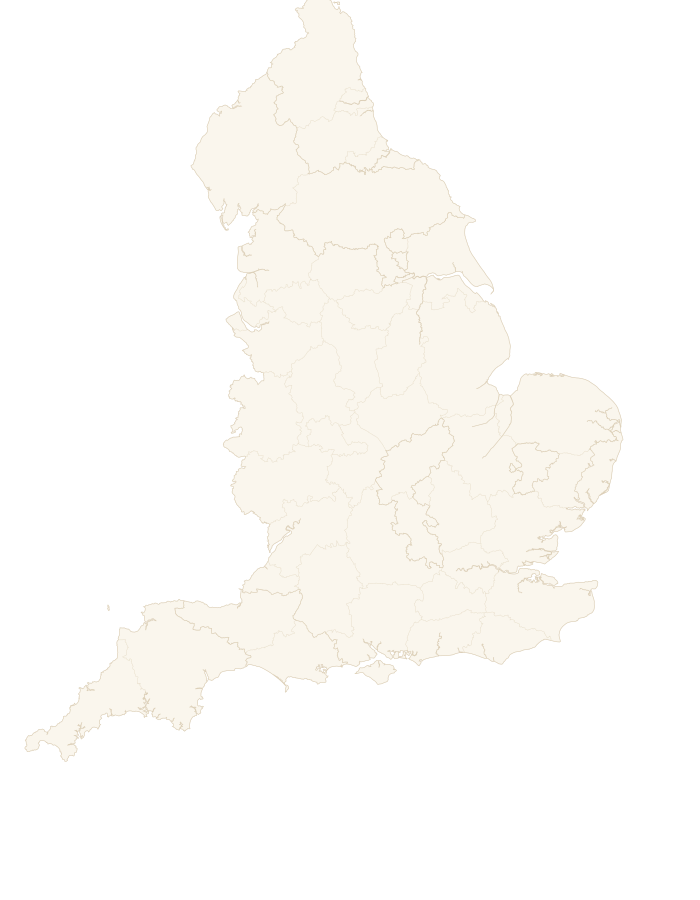
CoreHistoric reach
The seat of Newton
Seat vacantChief
No one leads the Newton community yet. When the movement opens, you can stand for its leadership, or help elect whoever does.
Current mission
No shared goal set yet. Once Newton has leadership, it sets the public focus: a restoration, a gathering, a real-world project that helps its own.
The Newton clan is being rebuilt. Join the waiting list for the movement today, and you help decide who leads it and what it does.
Help rebuild the Newton clan →What does the Newton name mean?
Locative, the new settlement. Old English nēowe tūn.
The history of Newton
Nearly every county has its Newton
The name is toponymic, taken from a place name repeated all over England: New-town, Old English neowe tun. The second element is slippery. Tun could mean an enclosure in one place name and a farmstead, a village, a manor or a whole estate in others. What a Newton always meant was newer than the one already there, and every wave of English settlement that broke fresh ground beside an older holding had the label ready made.
The consequence is written into the surname. As nearly every county has its Newton, many independent families share the name and none of them descend from the others. Habitational surnames cluster around small communities rather than great cities, because medieval migration ran from hamlet into town and a new arrival needed something to be called. Washington is thought to mark the homestead of the family of Wassa. Newton is the flattest of these, recording where a man had come from and nothing else whatever.
How a farm's name got stuck to a family
English surnames were not decreed into existence. Christopher Daniell places the earliest recorded surname carried by more than one generation in 1140. Hereditary family names in England are generally credited to the preparation of the Domesday Book in 1086, and the feudal nobility and gentry adopted them first. Norman incomers put de before the name of their village or estate in France; an English tenant of a place called Newton reached the same result without the French.
It spread downward slowly. By the 14th century most English and Scottish people used surnames, and by 1400 most families in England and Lowland Scotland had hereditary ones, though compulsory surnames were resisted in late medieval England because people associated them with taxation. A four-year study led by the University of the West of England, concluded in 2016, found more than 90 per cent of the 45,602 surnames in its dictionary native to Britain and Ireland. Its leader Richard Coates sorted them by trade, by father, by description and by place. Newton is the last kind, and because the place was the most ordinary place in the country, the name multiplied faster than any single kindred could.
The posthumous son at Woolsthorpe
Isaac Newton was born at Woolsthorpe Manor near Grantham in Lincolnshire on Christmas Day 1642 by the old English calendar, the fourth of January 1643 by the modern one. His father, a yeoman farmer, had died three months earlier; his mother left him in his grandmother's care soon after. At twelve he was sent to the King's School at Grantham and lodged with the apothecary Mr Clark, where he filled a notebook with mechanical drawings, cut sundials into the walls and built a working windmill driven by a mouse on a treadwheel.
He went up to Trinity College, Cambridge in June 1661 as a subsizar, paying his keep by waiting on wealthier students, and took his Bachelor of Arts in 1665, at which moment the university closed for the plague. He was back by 1667, elected a fellow of Trinity that autumn, and in 1669 succeeded Isaac Barrow as Lucasian Professor of Mathematics at twenty-six.
From the Lucasian chair to the Royal Mint
In 1668 Newton built the first practical reflecting telescope, a six-inch instrument that beat the chromatic aberration of refractors by replacing the objective lens with a curved mirror, and the Royal Society admitted him on the strength of it in 1672. His paper of that year on the dispersion of light through a prism is the founding document of modern optics. The Philosophiae Naturalis Principia Mathematica followed in three Latin books in July 1687, printed at Edmond Halley's expense, deriving the orbits of the planets, the motion of the Moon and the paths of comets. The Opticks of 1704 he wrote in English, for a wider public.
In 1696 he left Cambridge for London to become Warden of the Royal Mint, and from 1700 its Master, reforming the coinage and prosecuting the great recoinage with an administrator's exactness. He was elected President of the Royal Society in 1703 and kept the chair for life. Queen Anne knighted him at Trinity in April 1705, the first man of science raised to a knighthood for his work. He died at Kensington on the thirty-first of March 1727 and lies in Westminster Abbey under a monument that names him the glory of the human race.
Birds, bones and the sky: the other scientific Newtons
Other Newtons went into science out of households with no known link to Woolsthorpe. Alfred Newton (1829–1907) was a British zoologist and ornithologist, Edwin Tulley Newton (1840–1930) a British palaeontologist, Hubert Anson Newton (1830–1896) an English astronomer. The line carried on into the twentieth century with Margaret Newton (1887–1971), Canadian plant pathologist and mycologist, Martha Elizabeth Newton (1941–2020), British bryologist and botanist, and Ian Newton, born 1940, the English ornithologist.
The name even duplicated its most famous holder. A second Isaac Newton (1800–1867) was an American agriculturalist, and a third was Director of Medical Services of Hong Kong from 1947 to 1950. The physicist is still the man meant when anyone says Newton without qualification, a measure of how completely one farm boy annexed a label many unconnected families already carried.
Painters, a photographer and a Plymouth Brother
The arts take the name without ever pooling it in one workshop. Gilbert Stuart Newton (1795–1835) and Algernon Newton (1880–1968) were British artists, as was Irene Newton (1915–1992). Sydney Newton (1875–1960) was an English photographer. In the United States, Clara Chipman Newton (1846–1936) painted china and Amanda Newton, born about 1860 and dead in 1943, worked as a botanical illustrator.
Benjamin Wills Newton (1807–1899) was an English theologian and an early leader of the Plymouth Brethren. A. Edward Newton (1864–1940) was an American industrialist who wrote books and collected them. Joy Newton (1913–1996) was an English ballet dancer and teacher, and Mark Charan Newton, born 1981, is a British fantasy author.
A Victoria Cross, a Somerset cricketer and a baronetcy
William Ellis Newton (1919–43) was an Australian recipient of the Victoria Cross. Basil Newton (1889–1965) served as a British ambassador. Sir Harry Newton, 2nd Baronet (1875–1951), was a British politician, so even a name with no single kindred behind it threw up a hereditary title of its own.
In sport the Newtons are as scattered as everywhere else. Arthur Newton (1862–1952) played for Somerset and Oxford University, one of several English cricketers to carry it. Two athletes called Arthur Newton were born in the same year on opposite sides of the Atlantic: the British Arthur F. H. Newton (1883–1959) and the American Arthur L. Newton (1883–1956). Keith Newton (1941–1998) was an English international footballer, Samuel Newton (1881–1944) a Canadian sport shooter, and Wes Newton, born 1977, an English darts player.
The name that sailed
Newtons emigrated in numbers, and several of the best known settled in Australia. Olivia Newton-John (1948–2022) was an English-Australian singer, songwriter, actress, entrepreneur and activist. Bert Newton (1938–2021) was an Australian television personality, married to Patti Newton, born 1945; Maxwell Newton (1929–1990) was an Australian media publisher. Peter Newton (1926–2008) went the other way, an English-born winemaker in America.
Champions of the Newton name
The bearers whose lives are inseparable from this surname. Each has their own page, biography, achievements, geography, connection to the family.
Historic Places, Rebuilt
Explore the streets and seats the Newton name knew, rebuilt with AI as they stood in history.
Castles that share the Newton name
The same name on the map, look one up, see what it looked like in its prime, and recreate it to explore.

All castles in England → · Strongest castles in England → · Castles of Europe
Play As Your Clan
Hold a real castle against whatever you choose to send at it, take a ship out in her own service years, or stand at the shoulder of someone the record remembers. The chronicler sets the scene; the deeds are yours.
Notable bearers of the Newton name
- Sir Isaac Newton (1643–1727), mathematician and natural philosopher
Stories of Newton
The plague year and the apple
1666In the summer of 1665 the plague took London and Cambridge in the same season, and the colleges sent the undergraduates home. Isaac Newton went back to his mother's house at Woolsthorpe in Lincolnshire, where he had been born in the year his father died, and stayed for most of two years. He was twenty-two. He had read mathematics for one year. In the orchard at Woolsthorpe, by the tradition his niece Catherine Conduitt told to William Stukeley in 1726, he watched an apple fall from a tree and asked himself, in earnest and not for a moment, why it should fall straight down rather than sideways or up. The notebook from those two years contains the binomial theorem, the method of fluxions, the first formulation of the inverse-square law of gravity and the decomposition of white light. Cambridge calls them the anni mirabiles. Stukeley's account is the only first-hand source for the apple, and Stukeley wrote it down sixty years after the fact.
Read the story →
Halley's question
1684In August 1684 the astronomer Edmond Halley rode up to Cambridge on a question that had been arguing the Royal Society into a circle for eighteen months. If the planets are pulled toward the Sun by a force that diminishes with the square of the distance, what shape would their orbits take? Robert Hooke had said an ellipse and could not prove it. Christopher Wren had offered Halley a forty-shilling prize for the proof. Halley took the question to Newton, who had spent the years since Woolsthorpe in retreat from the world. Newton answered him at once. He had calculated it. He could not, on the spot, find the paper. He sent it down to London three months later as a nine-page treatise, De Motu Corporum in Gyrum, and Halley, reading it on a bench at the Society in November, sat very still for ten minutes before going to find the President.
Read the story →