Theatre · England · Still standing
London Palladium
The London Palladium is a Grade II* West End theatre on Argyll Street in Soho, London, designed by Frank Matcham and opened in 1910. It is a large variety and musical theatre venue whose auditorium seats over 2,200 and which has hosted major televised variety shows and the Royal Variety Performance many times.
First raised
1910
Its prime
1910
Today
Still standing
As it stood in 1910
What London Palladium looked like in its prime.
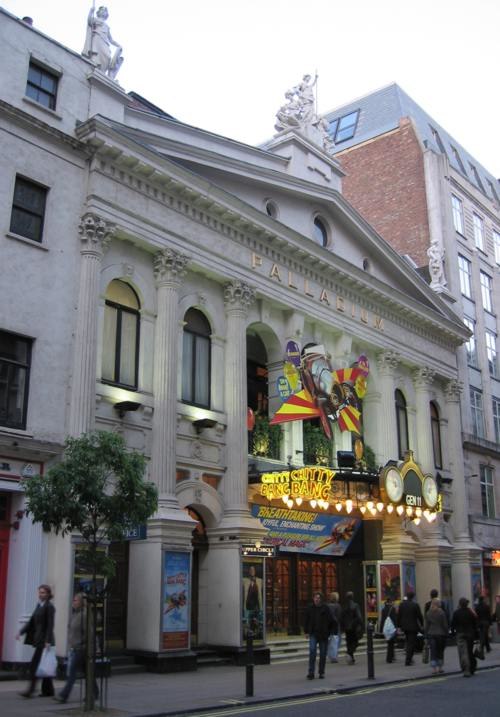
The Palladium presents a double-height classical stone-faced façade: a triangular pediment and roofline statues above an entablature, supported by paired fluted columns with ornate capitals. The first-floor register has tall round-arched windows; the central recessed entrance sits beneath a shallow balcony and wide archways framed by poster boards and period lamps. Behind the classical frontage a high mansard and a tall fly-tower rise above the narrow Soho street, the masonry whole and freshly finished.
Its story
The story of London Palladium.
From the Corinthian Bazaar to Matcham's Theatre, Opened 1910
The theatre occupies ground on Argyll Street, in the Soho district of London, once held by Argyll House, which was demolished in the 1860s and which gave the pub opposite its name, the Argyll Arms. The frontage dates back to the nineteenth century. The site formerly carried a temporary wooden building called the Corinthian Bazaar, which featured an aviary and set out to draw customers from the recently closed Pantheon Bazaar in Oxford Street. A year later the building was rebuilt by Fredrick Hengler, the son of a tightrope walker, as a circus arena, and the entertainments staged there included promenade concerts, pantomimes and an aquatic display in a flooded ring. It later became the National Skating Palace, a rink with real ice.
The rink failed. The site that had previously housed Hengler's Circus was then redesigned by Frank Matcham, the theatrical architect who had also designed the London Coliseum. Walter Gibbons, an early moving-pictures manager, intended the Palladium to compete with Sir Edward Moss's London Hippodrome and Sir Oswald Stoll's London Coliseum. It opened on Boxing Day 1910. The auditorium holds 2,286 people, and among the theatre's fittings were a revolving stage and a telephone system of its own, so that the occupants of the boxes could call one another.
Variety, Cine-Variety and the George Black Revival, 1910–1945
The house started out as The Palladium, a premier venue for variety, and pantomime featured there as well: footage survives of the 1926 pantomime, in which Lennie Dean played Cinderella. It is especially linked with the Royal Variety Performance, many of which have been held there. In 1928 the theatre spent three months running as a cinema, and after that cine-variety episode it fell dark for a short period in the autumn of the same year.
From 3 September 1928 it reopened under the direction of the impresario and producer George Black, as part of the General Theatre Corporation. Black took over a theatre close to bankruptcy and revived its fortunes by returning to the original ethos of the Palladium, staging large variety shows. Alongside Britain's homegrown acts he brought over American stars for two-week engagements: Duke Ellington and his Orchestra, whose appearance on 12 June 1933 was his first ever concert hall performance, together with Adelaide Hall, Louis Armstrong and Ethel Waters. Before long the Palladium was again being praised as 'The World's Leading Variety Theatre'.
In 1935 Black began the Crazy Gang revues, the work for which he is chiefly remembered, with Life Begins at Oxford Circus. They continued as an annual event until they transferred to the Victoria Palace theatre in 1940. The climax of Alfred Hitchcock's 1935 spy thriller The 39 Steps was filmed at the Palladium. Black managed the theatre until his death in 1945.
The Parachute Mine and the George Medal, 1941
On 11 May 1941 the theatre was hit by an unexploded German parachute mine, which fell through the roof and became lodged over the stage. A Royal Navy bomb disposal team was sent to deal with it. Once the mine had been located, the fuse locking ring had to be turned to allow access to the fuse itself, and the fuse began ticking as soon as it was touched, causing a rapid evacuation of the immediate area. The mine did not detonate. Two members of the team returned cautiously, extracted the fuse and removed the other hazardous components, rendering the mine safe; it was then lowered to the stage and disposed of.
Sub Lieutenant Graham Maurice Wright was given the George Medal for gallantry and undaunted devotion to duty for his action in the Palladium that night. He was killed on 19 August 1941, while en route for Gibraltar aboard the troopship SS Aguila, which was torpedoed.
Val Parnell, Sunday Night at the London Palladium and the 1966 Takeover, 1945–1966
Val Parnell took over as managing director after Black's death in 1945. He adopted a controversial but very successful policy of presenting high-priced, big-name American acts at the top of the bill, among them Carmen Miranda, Judy Garland, Sophie Tucker, Bing Crosby, Danny Kaye, Bob Hope, Lena Horne, Ella Fitzgerald, Peggy Lee, Frank Sinatra, Sammy Davis Jr and Johnnie Ray. British stars of the day were frozen out and relegated to second billing.
From 1955 the theatre was the setting for the top-rated ITV network variety show Sunday Night at the London Palladium, broadcast live every week by ATV, which was owned by the theatrical impresario Lew Grade, with Parnell producing; accounts of the run give its end at the theatre variously as 1967 and 1969. It was hosted first by Tommy Trinder, then by Bruce Forsyth, Norman Vaughan and Jimmy Tarbuck, and six programmes aired as special episodes in the United States on NBC between May and August 1966. British acts on the show included Cliff Richard and the Shadows, Petula Clark, the Rolling Stones and the Beatles. The Beatles' first appearance, on 13 October 1963, was watched by 15 million viewers; their publicist Tony Barrow said that Beatlemania took off in the UK after it, and one national paper's headlines in the days that followed coined that term for the increasingly hysterical interest in the band.
By 1965 the Wine Society was operating out of a cellar under the Palladium, alongside others at Joiner Street under London Bridge Station and at St James's Bond in Rotherhithe, which flooded at high tide. Parnell, by then associated with a property development company, had begun to sell Moss Empires' theatres for redevelopment. When it became known in 1966 that the same fate awaited the London Palladium, the Victoria Palace and even the Theatre Royal, Drury Lane, Prince Littler organised a take-over to save the theatres, and Parnell retired to live in France. The new managing director of Stoll-Moss was Louis Benjamin, who took on the role while continuing as managing director of Pye Records within the ATV Group.
Stoll Moss, the Really Useful Group and Grade II* Protection
In 1968 Sammy Davis Jr starred in Golden Boy, the first book musical to be produced in the venue, and a Johnny Cash album recorded there the same year was never released by Columbia Records, though bootlegs of the performance are in circulation. Jose Feliciano recorded the double LP Alive Alive O! for RCA in April 1969, and Dorothy Squires gave a concert on 6 December 1970 that was recorded for an LP released the following year. The glam rock band Slade played a gig in January 1973 that left the balcony close to collapse. Cass Elliott performed for two weeks in July 1974 and died in her sleep at her rented flat in Mayfair 48 hours after her final performance. Bing Crosby played two weeks from 21 June 1976, and the resulting live album reached number nine in the UK album charts in November 1977; Marvin Gaye recorded a concert in October 1976 that became the double LP Live at the London Palladium, released in 1977. Kate Bush appeared in 1979 on her first concert tour, the Tour of Life.
In 1981 the cellars housed a waxworks museum called The Palladium Cellars. In the late 1980s the theatre was once again the setting for an ITV variety show, Live From the Palladium, compered by Jimmy Tarbuck; it was then owned by the Stoll Moss Theatres Group and run by Margaret and David Locke, both major shareholders in Stoll Moss at the time. Musical productions followed: a new production of Joseph and the Amazing Technicolor Dreamcoat in 1991 with Jason Donovan in the title role and Linzi Hateley as the Narrator, Cameron Mackintosh's revival of Lionel Bart's Oliver! in 1994, directed by Sam Mendes with Jonathan Pryce as Fagin, and a stage adaptation of Saturday Night Fever in 1998. Ownership changed again in 2000, when Stoll Moss was acquired by Andrew Lloyd Webber's Really Useful Group.
The King and I ran from 3 May 2000 to 5 January 2002, having taken more than seven million pounds at the box office before it opened; after it closed, the revolving stage was removed to make way for more modern technology. Chitty Chitty Bang Bang followed from April 2002 to 4 September 2005 and proved the most successful show in the theatre's history, reuniting the choreographer Gillian Lynne, fifty years on, with the house where she had been the Palladium's Star Dancer in the early 1950s. The theatre turned 100 on Boxing Day 2010, marked by an hour-long BBC Two programme on 31 December that year. In 2014 the Really Useful Group split in two and the entity owning the theatre became the Really Useful Theatres Group. The annual Christmas pantomime returned in December 2016 for the first time in 29 years with Cinderella, produced and directed by Michael Harrison, and the 2017 pantomime, Dick Whittington, won the Laurence Olivier Award for Best Family Show. On the first anniversary of his death in 2018, Sir Bruce Forsyth's ashes were laid to rest under the Palladium's stage, with a blue plaque commemorating him on a nearby wall. The theatre has hosted the Royal Variety Performance 43 times, most recently in 2019. It retains many of its original features, is a Grade II* listed building, and carries Heritage Foundation commemorative plaques honouring Lew Grade and Frankie Vaughan.
Step inside
8 places to explore in 1910.
The record describes 8 distinct spots at London Palladium, including 6 interiors: main entrance and poster cases, auditorium stalls looking toward the stage, dress circle and private boxes and more. Create your own photoreal reconstruction and explore every one, more scenes means more photos, more angles and more of the immersive experience.
Build Your Own Castle
Recreate London Palladium with AI to explore it.
The artist rebuilds it as it stood in 1910, a photoreal reconstruction that belongs to you alone. Pay with coins, no subscription needed.
Recreate Theatre to Explore →Nearby
Castles within reach of London Palladium.


Landmarks within reach of London Palladium.


More landmarks of England


Explore the city


