Historic Cities · Denmark
Copenhagen through the ages
Copenhagen is the capital and most populous city of Denmark, with a population of 671,714 people in the municipality and 1.4 million in the urban area. The city is situated mainly on the island of Zealand (Sjælland), with a smaller part on the island of Amager. Copenhagen is separated from Malmö, Sweden, by the Øresund strait. The Øresund Bridge connects the two cities by rail and road.

Copenhagen in 1650
Christian IV's Copenhagen
Copenhagen in 1650 is the builder-king's newly enlarged harbour city, ringed by earth ramparts, bastions and windmills and marked by recent royal and mercantile works. Walkers will see Christian IV's major projects (Rosenborg and the King's Garden, the Round Tower and Trinitatis complex, the dragon‑tailed spire of the Børsen), and the everyday harbour streets, dockyards and navy rows where sailors, craftsmen and merchants keep the port alive.
Red brick and timber-framed houses cluster under shallow red-tile roofs and Dutch gables; the Round Tower rises as a grey brick cylinder beside the low Trinitatis church. The Børsen's entwined dragon spire pierces the harbour skyline, while Rosenborg's pale stone and the yellow rows of Nyboder stand against the ochre earthworks of the ramparts. Windmills turn on the glacis; wooden masts, tarred ropes and canvas fill the harbour.
The route: 21 streets, squares and views
The Øresund Approach → Østerport (East Gate) → Nyboder Rows → Øster Vold Ramparts → Vester Vold and Windmills → King's Garden (Kongens Have) → Rosenborg Castle Exterior → Round Tower and Trinitatis → Købmagergade → Gammeltorv Market → …
Step inside, 13 interiors
Sailor's Single Room · Windmill Milling Floor · Marble Chamber · Spiral Ramp · Trinitatis Library Hall · Silversmith's Workshop · Council Chamber · Altar Chapel · Exchange Trading Hall · Great Ordnance Hall · Sailmakers' Loft · Church Nave · Shipwrights' Timber Hall
Planned from the Wikipedia record: History of Copenhagen.
Copenhagen in 1840
Golden Age Copenhagen
This is Copenhagen during the Danish Golden Age: a compact city still bound by its old ramparts where Neoclassical facades, church spires and narrow cobbled streets frame cafés, workshops and dockside life. The walk moves from the harbour into the heart of the city, past Nyhavn parlours, the Royal Theatre and the sites chosen for Thorvaldsen's museum and the new Tivoli, with oil lamps and night watchmen on the streets.
Copenhagen in 1840 is a low, intimate city of pale Neoclassical stone and stucco, punctured by church spires and the square mass of Christiansborg. Rooflines are mostly tile and slate; the harbour and canals cut bright reflections through streets of cobbles and narrow quays. Colour arrives in painted shopfronts, sailors' jackets, and the yellow wooden rows of Nyboder. Evening falls early under oil lamps patrolled by watchmen.
The route: 21 streets, squares and views
Øresund Approach → Søndre Toldbod → Kvæsthus Pier → Nyhavn Canal Mouth → Nyhavn Quayside → Kongens Nytorv → Charlottenborg → Amagertorv → Vimmelskaftet → Købmagergade Approach → …
Step inside, 13 interiors
Toldbod Counting Room · Kvæsthus Sailors' Hall · Nyhavn Sailor's Parlour · Royal Theatre Auditorium · Charlottenborg Exhibition Hall · Rundetårn Observatory Hall · University Lecture Theatre · Fishmongers' Market Cellar · Thorvaldsen's Cast Hall · Christiansborg Palace Stair · Børsen Trading Hall · Nyboder Corporal's Sitting Room · Vesterport Gate Guardroom
Planned from the Wikipedia record: Danish Golden Age.
Copenhagen in 1900
Turn-of-century Copenhagen
Copenhagen at the turn of the century is a bustling national‑romantic capital, its new city hall rising in red brick while steamers and sailing ships fill the harbour. The walk moves from the Øresund approach through waterfront piers, market streets and new museum façades to a high city tower, showing both merchant traffic and the civic projects shaped by late‑19th‑century wealth.
The skyline is a band of red brick, copper domes and slender church spires against a cool Baltic sky; new National Romantic masonry contrasts with older gabled houses. Streets are cobbled and narrow in the medieval centre, broader and tree‑lined where 19th‑century expansion spread. Harbours and canals teem with steamers, barges and sailing craft; cyclists and electric trams thread between horse traffic while dock cranes and warehouse signs mark the city’s mercantile pulse.
The route: 25 streets, squares and views
Øresund Approach → Langelinie Quay → Østerport Station → Kastellet Gate → Nyboder → Esplanaden → Kongens Nytorv → Nyhavn Canal → Gammel Strand → Børsen (Stock Exchange) → …
Step inside, 14 interiors
Langelinie Ferry Saloon · Naval Mess Room · Theatre Foyer and Stair · Harbour Inn Taproom · Børsen Trading Hall · Rådhus Great Hall · Glass Hall Concert Room · Carlsberg Brewhouse Floor · Glyptotek Palm Court · Central Station Waiting Hall · Carpenter's Workshop · Freeport Customs Office · Mariners' Inn Taproom · Rundetårn Observatory Chamber
Planned from the Wikipedia record: History of Copenhagen.
Its story
The story of Copenhagen.
Merchants' Harbour and the Herring Trade, 1020–1368
The city takes its name from what it did: the Old Norse Kaupmannahǫfn, merchants' harbour, worn down by about 1400 to something close to the modern København. Archaeological work puts the first town in the 11th century, in two settlements: one in the western part of the later medieval city, roughly on the coastline of the time, and a smaller one at what is now Kongens Nytorv, where excavation during work on the city's rail system uncovered the remains of a large merchant mansion of about 1020. The natural harbour and good herring stocks seem to have drawn seasonal fishermen and merchants from the 11th century and more permanently from the 13th. Saxo Grammaticus, in the earliest written mention, called the place Portus Mercatorum.
Around 1160 Valdemar I gave control of the town to Absalon, Bishop of Roskilde; where other towns in the realm answered to the king, this one answered to a bishop, and a letter of Pope Urban III in 1186 records the grant of the castle of Hafn and its lands. The city's founding has traditionally been dated to Absalon's building of a modest fortress on the islet of Slotsholmen in 1167, put up against the Wendish pirates then attacking the coast; the Wends destroyed it, and it was replaced by Copenhagen Castle. The town then grew roughly tenfold. Its wealth came from the herring fishery, which supplied much of Catholic Europe with salted fish for Lent, and in 1254 Bishop Jakob Erlandsen granted a city charter, buying the support of the fishing merchants against the king with special privileges. A stone wall went up in the 13th century (Copenhagen was the second Danish town after Kalundborg to be walled and towered), and from about 1290 until the middle of the 19th century everything entering or leaving passed through one of four city gates or the harbour. Its position on the approach to the Baltic made it both rich and a target: the Hanseatic League besieged and laid it waste repeatedly, invading successfully in 1368. The Black Death is thought to have reached the town in the late summer of 1350.
From Bishop's Town to Royal Capital, 1416–1581
The crown took the town from the bishopric in 1416, when Eric of Pomerania moved his seat to Copenhagen Castle, and by about that date Copenhagen had emerged as the capital of Denmark. Craft guilds were established, foreign merchants settled, and on 1 June 1479 Christian I inaugurated the University of Copenhagen with the approval of Pope Sixtus IV, the oldest university in Denmark. The Reformation cost the city dearly. It stayed loyal to the Catholic Christian II and was besieged in 1523 by the forces of Frederik I, who supported Lutheranism; it later backed Christian II's alliance with Malmö and Lübeck, and a siege lasting from July 1535 to July 1536 forced it to capitulate to Christian III. Prosperity returned in the second half of the century on Baltic trade carried in Dutch shipping, and in 1581 Christoffer Valkendorf oversaw the largest expansion of the ramparts in the city's history, the earthworks having to be pushed far out to answer the invention of cannon.
Christian IV's Naval Capital and the Siege of 1658–59
By Christian IV's coronation in 1596 the town was rich, and the new king set out to make it the economic, military, religious and cultural centre of the whole Nordic region. He chartered trading companies with sole rights to trade overseas, among them the East India Company in 1616, and set up factories at home to hold down imports. Two new districts were added: Nyboder for the navy's growing personnel, and Christianshavn, a merchants' quarter of canals and ramparts modelled on Amsterdam and meant as a fortified trading centre. On Slotsholmen he completed the Tøjhus arsenal and Børsen, the stock exchange, and he brought in German and Dutch architects and craftsmen for buildings intended to enhance his prestige, Rosenborg and the Rundetårn among them. A modern fortification of earthworks and bastions was thrown around the whole enlarged town.
By Christian IV's death in 1648 Copenhagen was Denmark's principal fortification and naval port, the administrative frame of the kingdom and a trading centre in northern Europe. In 1658-59 it withstood a severe siege by the Swedes under Charles X Gustav and repelled a major assault. By 1661 it had asserted its position as the capital of Denmark and Norway, holding all the major institutions, the fleet and most of the army; its defences were completed with the Citadel in 1664 and the extension of Christianshavns Vold in 1692, which created the new fleet base at Nyholm.
Plague, Fire and the Danish West India Trade, 1700–1806
A combined Dutch, English and Swedish fleet bombarded Copenhagen in July 1700 without doing much damage. Worse came from inside: plague from June 1711 to March 1712 killed some 22,000 of the city's 65,000 people. The fire that began on the evening of 20 October 1728 and burned until the morning of the 23rd destroyed 28 per cent of the city and 47 per cent of its medieval part, leaving about a fifth of the population homeless; with the fire of 1795, which destroyed roughly a quarter of the city and made 3,500 homeless, it is the reason so little of the old town survives. Christian VI pulled down the old Copenhagen Castle in 1731–32 and replaced it with Christiansborg Palace, finished in 1745, and from 1749 Nicolai Eigtved laid out the district of Frederiksstaden with the mansions that now form Amalienborg Palace at its centre.
The wealth that paid for much of this came partly from the Atlantic slave trade. Between 1660 and 1806 Danish merchants, many of them based in Copenhagen, transported some 120,000 enslaved Africans to the Danish West Indies. They were mostly attached to the Danish West India Company and the Danish Asiatic Company, both headquartered in the city, and buildings including the Moltke Mansion, the Yellow Palace and the Vestindisk Pakhus were funded with the profits. In the second half of the 18th century Denmark's neutrality in the wars between the European powers let Copenhagen take a large share of the trade around the Baltic, and by the end of the century its commerce stood higher than it ever had.
The British Bombardments and the Golden Age, 1801–1849
To keep Denmark from allying with France, Britain sent Admiral Sir Hyde Parker against the Dano-Norwegian fleet, which he found anchored off Copenhagen on 2 April 1801. Vice-Admiral Horatio Nelson led the main attack and, in the episode in which he was said to have put the telescope to his blind eye, ignored Parker's signal to cease fire; the defence was heavy enough that the battle is often reckoned Nelson's hardest fought. The British won, sinking or capturing most of the fleet, and Denmark left the League of Armed Neutrality.
Six years later Britain returned to take the fleet outright. After the Danes refused a demand to surrender it, a force of 30,000 men landed and surrounded the city, and Admiral James Gambier's ships bombarded it from 2 to 5 September 1807, using Congreve rockets. The bombardment killed 195 civilians and wounded 768, and burned roughly a thousand buildings including the Church of Our Lady; the city's old defence line was useless against artillery that outranged it, and Danish casualties came to some 3,000. Virtually the whole Dano-Norwegian fleet was surrendered, burnt or sailed to Britain, and the Gunboat War that followed ran until the Treaty of Kiel in 1814. Where the previous 25 years had been a boom, the next 25 were a period of poverty, though the same decades produced the Danish Golden Age, with C. W. Eckersberg and his students in painting and C. F. Hansen and Gottlieb Bindesbøll giving the city its neoclassical face. After the European revolutions of 1848, Denmark became a constitutional monarchy on 5 June 1849.
Out Past the Ramparts, 1852–1901
The built area inside the ramparts had barely changed since Christian IV while the population had quadrupled; buildings had grown taller, space per resident had shrunk and sanitation was bad. In the early 1850s the ramparts were opened for housing around the Lakes to the west, and in 1852 unrestricted permission to build beyond them was granted. Nørrebro, Vesterbro and Frederiksberg grew quickly, taking in people arriving from the provinces for the city's industrialisation. A new quarter rose on Gammelholm between 1861 and 1877 as the naval base moved to Nyholm. The Second War of Schleswig of 1864, in which Denmark lost a third of its territory, was the main reason the old ramparts were replaced by the newer Fortification of Copenhagen; the decision to remove them was taken in 1868 and from 1872 the glacis was turned over to housing. Flattening the western rampart from 1886 allowed the harbour extensions that produced the Freeport of 1892-94. Electricity arrived in 1892 and electric trams in 1897. The population outside the old ramparts rose from 120,000 in 1840 to 400,000 by 1901, the year the city absorbed communities of some 40,000 people and left Frederiksberg an enclave inside it.
Occupation, Operation Carthage and the City After 1945
German troops occupied Copenhagen from 9 April 1940 until 4 May 1945. The occupiers at first sought an agreement with the Danish government, and the 1943 parliamentary election was allowed to go ahead with only the Communist Party excluded; but in August 1943 the collaboration collapsed, the Royal Danish Navy sank several of its own ships in the harbour to keep them from the Germans, and the Nazi authorities began arresting Jews, although most managed to escape to Sweden.
In 1945 Ole Lippman, who led the Danish section of the Special Operations Executive, asked the Royal Air Force to attack the Gestapo and Sicherheitsdienst headquarters in the former Shell Oil offices. Political prisoners were held in the attic to deter an air raid, so the bombers had to hit the lower floors. Operation Carthage came on 22 March 1945 in three small waves. All six aircraft of the first wave hit the target, but one crashed near Frederiksberg Girls School, and four planes in the following waves took the burning school for the target and bombed it, killing 123 civilians, 87 of them schoolchildren. Eighteen of the 26 political prisoners in the Shell Building escaped and the Gestapo archives were destroyed. On 8 May 1945 the city was formally liberated by British troops under Field Marshal Bernard Montgomery, who took the surrender of the 30,000 Germans around the capital.
The Finger Plan of 1947 set new housing and business along five corridors running out from the centre on the suburban rail lines, with green wedges between them. Student unrest led to the occupation of the former Bådsmandsstræde Barracks in Christianshavn and the founding of Freetown Christiania in September 1971; trams gave way to buses in 1972; and from the 1960s, on the initiative of the architect Jan Gehl, pedestrian streets and cycle tracks were laid through the centre. The Holmen naval base closed and port activity fell away. Conditions in the central city deteriorated through the 1980s and 1990s, with de-industrialisation, flight to the suburbs, high unemployment and dilapidated housing, and the municipality verged on bankruptcy; recovery came by 2010 on a service- and knowledge-based economy. Metro construction began in 1992 and the Ørestad development on Amager in 1993, with the metro opening in 2002. Since the summer of 2000 the Øresund Bridge has carried rail and road traffic to Malmö, inaugurated that July by Carl XVI Gustaf of Sweden and Margrethe II of Denmark and making Copenhagen the centre of a metropolitan area spanning two countries. The Municipality of Copenhagen had 644,431 inhabitants in 2022, of whom 26.3 per cent were immigrants or the children of recent immigrants; the urban area held 1,280,371 people at the start of 2016.
From the archive
Copenhagen on paper: the old town as it was mapped.
A period plan or bird's-eye view of the old town, drawn between 1500 and 1850, the streets this page's reconstructions walk. Public domain, with its source named.
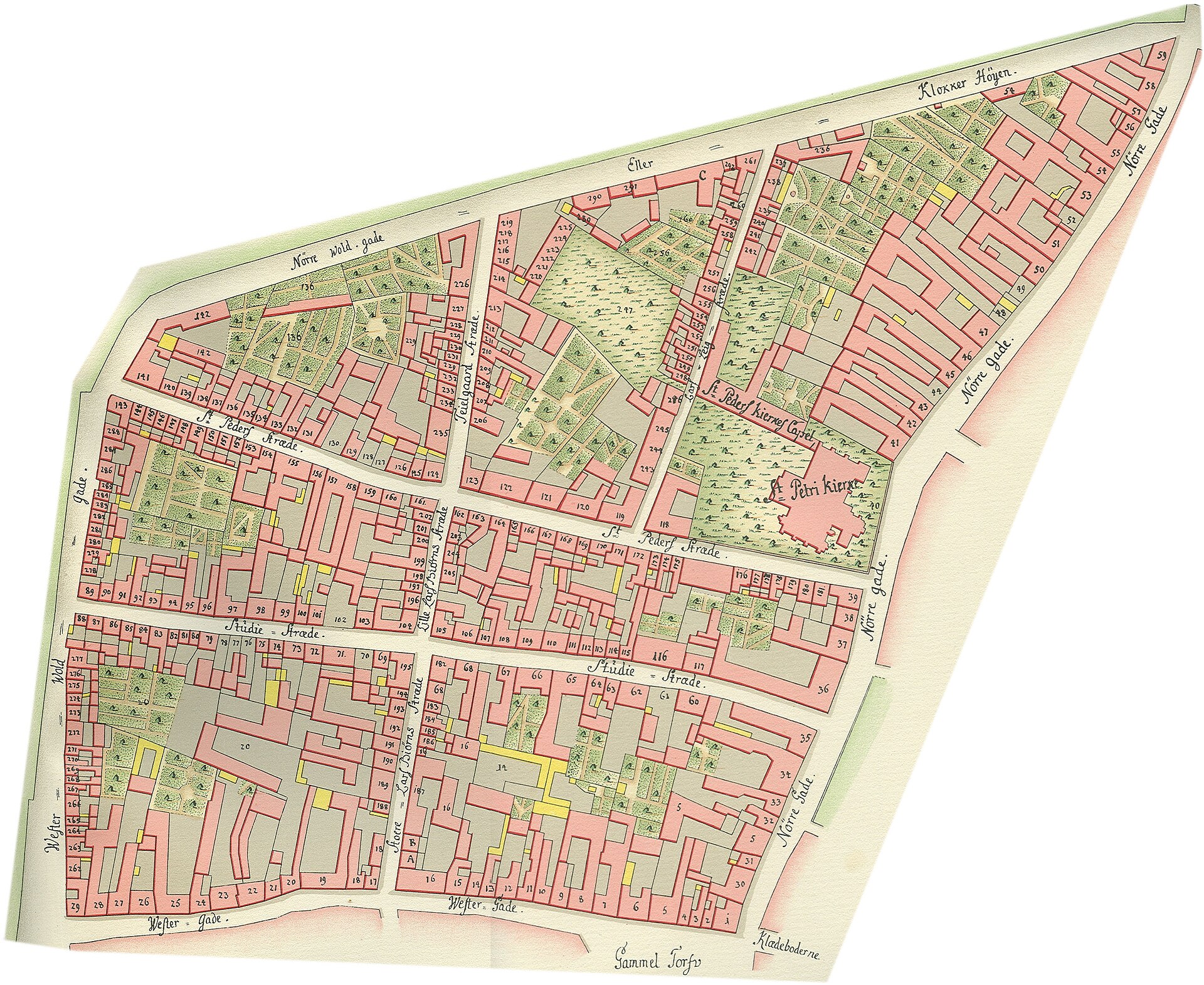
Plan of Copenhagen, Nørre Kvarter (from Gedde's 1757 map)
Detailed plan of Copenhagen's Nørre Quarter showing streets, numbered house plots, small gardens, Trinitatis Church and nearby St‑Petri, and the line of the old ramparts (Nørre Voldgade).
1757 · Ib Rasmussen · Wikimedia Commons
Public domain (plate dated 1757)
In this city
Landmarks of Copenhagen, see each in its prime


Ships tied to Copenhagen
- German cruiser Nürnberg: Ran out of fuel at Copenhagen in January 1945 and was taken over there by the British
- German cruiser Prinz Eugen: Reached Copenhagen on 20 April 1945 and was surrendered there on 8 May
Castles of Copenhagen


More cities to explore
 GermanyLübeckExplore it in 1500 · 1900
 GermanyRungholtExplore it in 1361
 NetherlandsUtrechtExplore it in 1400 · 1700
 EnglandLondonExplore it in AD 200 · 1390 · 1600 · 1885
Castles of Europe · Landmarks of Europe · create your own reconstruction.