Attenborough
From the East Saxon woman's fort, broadcasting dynast roots.
- Origin
- East Midlands, England
- Famous bearer
- Sir David Attenborough (b. 1926), broadcaster
- Register
- English family
Where the Attenborough name comes from
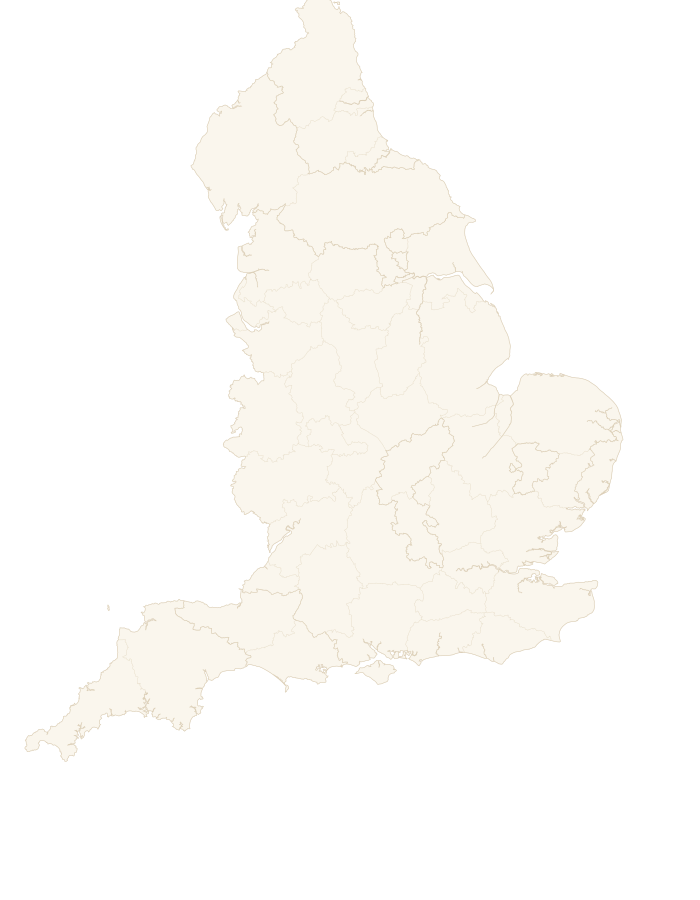
CoreHistoric reach
The seat of Attenborough
Seat vacantChief
No one leads the Attenborough community yet. When the movement opens, you can stand for its leadership, or help elect whoever does.
Current mission
No shared goal set yet. Once Attenborough has leadership, it sets the public focus: a restoration, a gathering, a real-world project that helps its own.
The Attenborough clan is being rebuilt. Join the waiting list for the movement today, and you help decide who leads it and what it does.
Help rebuild the Attenborough clan →What does the Attenborough name mean?
Locative, Attenborough in Nottinghamshire; Old English Ēadburg's burh.
The history of Attenborough
Eadburg's burh, and the village that kept her name
Attenborough is a locative surname, and unusually for an English name it can be pointed at a single place: Attenborough in Nottinghamshire. The older form behind it is Old English, Eadburg's burh, the fortified place belonging to a woman called Eadburg. Habitation surnames are built from exactly this material, the second element naming the kind of settlement: homestead, farm, enclosure, village, hamlet, cottage, stronghold. A single element like tun could mean enclosure in one name and farmstead, manor or estate in another.
What makes the village worth pausing over is who is fossilised in it. Eadburg was a woman, named when Old English personal names were still ordinary. They did not stay ordinary: after 1066 the ruling class spoke Anglo-Norman, and names current in France displaced the Anglo-Saxon ones, William, Robert and Richard becoming common quickly. But the conquest had little effect on English placenames. So the personal name went out of use among the living, survived on the map, and walked back into circulation as a surname.
How a village of that size ends up as a family name
The introduction of family names in England is generally attributed to the preparation of the Domesday Book in 1086, following the Norman Conquest. Surnames were adopted first among the feudal nobility and gentry and spread slowly to the rest of society, some incoming Norman lords marking themselves with a 'de' before the village or estate they came from.
The habitation name is a name you acquire by leaving. Nobody in Attenborough needed to be called Attenborough; the name only works once the man carrying it stands somewhere else. That is why surnames drawn from small communities outnumber those drawn from great cities: the medieval flow of people ran from small settlements towards the towns, and a new arrival needed something to be known by. By the 14th century most English and most Scottish people used surnames, and by 1400 most English families, and those of Lowland Scotland, held them as heritable property, though a fixed name was resisted where it was understood, correctly, as a tax instrument.
Henry VIII (reigned 1509–1547) ordered that marital births be recorded under the father's surname, and the parish register turned custom into paperwork. The four-year study that concluded in 2016, published as the Oxford English Dictionary of Family Names in Britain and Ireland, found that over 90 per cent of its 45,602 surnames are native to Britain and Ireland, and its leader, Richard Coates, sorted them into occupational names like Smith, patronymics like Jackson, descriptive ones like Brown, and names linked to a place. Attenborough belongs to the last group, with a precision most of them cannot manage.
The Victorian bearers in the record
The documented Attenboroughs surface in the 19th century in two places English public life recorded ordinary men, the cricket field and politics. Thomas Attenborough (1833–1907) played as an English cricketer; Walter Attenborough (1850–1932) is recorded as a British politician. Geoffrey Attenborough, born in 1951, played his cricket in South Australia.
The sources carry no kinship between the three, and none should be assumed: that is the ordinary condition of a habitation surname, fed into circulation by one village rather than one household.
The principal's house on College House Lane
Frederick Attenborough (1887–1973) was an academic and the principal of University College Leicester, later the University of Leicester. His wife, Mary Clegg, was a senior administrator of the same college. Their three sons were Richard, born in 1923, David on the eighth of May 1926 at Isleworth in Middlesex, and John in 1928. Within a year of David's birth the family moved into the principal's residence on College House Lane in Leicester, and all three were raised there, in a household academic rather than moneyed.
David was schooled at Wyggeston Grammar School in Leicester, took a place at Clare College, Cambridge, in 1945 to read natural sciences, and on graduating in 1947 served two years of National Service in the Royal Navy as a sub-lieutenant. Richard went to the screen as an English film actor, director and producer, was ennobled as Lord Attenborough, and directed Gandhi and A Bridge Too Far. John (1928–2012) went into business, as an executive at Alfa Romeo and later a financial adviser.
Alexandra Palace, 1952, and a format nobody had yet made
David Attenborough joined the BBC at Alexandra Palace in 1952 as a junior trainee producer in the new and very small Television Talks department. By 1954 he had launched Zoo Quest, in which he and Jack Lester, the London Zoo's senior reptile-keeper, travelled each year to remote ecosystems (Sierra Leone, British Guiana, Indonesia, Madagascar, New Guinea) to collect specimens and film the animals in the wild. It ran ten years, to 1963, and laid down the grammar the natural-history documentary has used since: the presenter on location, the commentary spoken to camera, the cut away to the animal itself.
In 1965 he was appointed Controller of BBC2, the youngest network controller in BBC history, and over four years commissioned the slate that defined the channel: Civilisation, The Ascent of Man, The Forsyte Saga, Match of the Day in colour, Pot Black. In 1969 he was promoted to Director of Programmes. Then, in 1973, he resigned the management career outright to go back to making programmes himself.
Life on Earth and the four decades after it
Life on Earth, a thirteen-part survey of the evolutionary history of the natural world, was broadcast in 1979 to a global audience estimated at the time at half a billion viewers. The Living Planet, on the major biomes of the world, followed in 1984, and The Trials of Life, on animal behaviour, in 1990. Five further series completed the Life suite: The Private Life of Plants (1995), The Life of Birds (1998), The Life of Mammals (2002), Life in the Undergrowth (2005) and Life in Cold Blood (2008).
The marine and global sequence began with The Blue Planet in 2001 and ran through Planet Earth (2006), Frozen Planet (2011), Africa (2013), Planet Earth II (2016) and Blue Planet II (2017). Our Planet, in 2019, was the first major Netflix natural-history commission, and A Perfect Planet followed in 2021. He has worked on into his hundredth year.
From commentary to campaign
The later work turned from description to argument: climate change, biodiversity loss, the great migrating bird and mammal populations, and the protection of the high seas under the United Nations Convention on the Law of the Sea. Our Blue Planet, the 2017 campaign against ocean plastic pollution, led directly to the United Kingdom Plastics Pact and the European Union's Single-Use Plastics Directive.
The honours accumulated alongside the work: election to the Royal Society in 1983, a BAFTA Fellowship in 1980 and a second in 2005, the Royal Geographical Society's Founders' Medal and a knighthood in 1985, Companion of Honour in 1996, the Order of Merit in 2005 (held by only twenty-four living people at a time) and the United Nations Champion of the Earth Award in 2020. Twenty species new to science carry his name, among them the Attenborough beetle, the Attenborough pitcher-plant and the Attenborough echidna, matched by no other living biologist.
Three generations on the stage and the screen
Richard Attenborough's children carried the surname straight into the theatre. Michael Attenborough, born in 1950, became an English theatre director; Jane Attenborough (1955–2004) was an English arts administrator and manager; Charlotte Attenborough, born in 1959, is a British actress. Michael's sons continued it: Tom Attenborough, born in 1986, is a British theatre director, and Will Attenborough, born in 1991, is a British actor.
That is three consecutive generations of one Leicester household working in the same trades, with the natural-history broadcaster alongside them. For a name that began as a way of saying which village a stranger had walked in from, it is a remarkable place to have arrived, and it still maps back to one small place in Nottinghamshire.
Champions of the Attenborough name
The bearers whose lives are inseparable from this surname. Each has their own page, biography, achievements, geography, connection to the family.
The castles of the homeland
The great strongholds of the homeland, look one up, see what it looked like in its prime, and recreate it to explore.
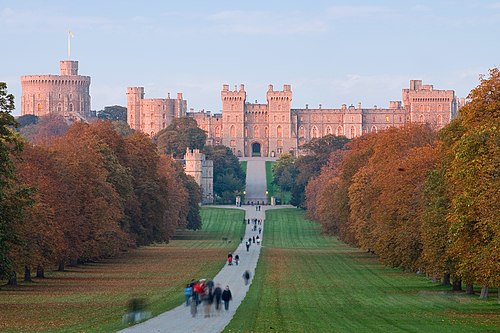 Windsor CastleRestored · prime 1820
 Tower of LondonRestored · prime 1285
 Bamburgh CastleRestored · prime 1904
All castles in England → · Strongest castles in England → · Castles of Europe
Play As Your Clan
Hold a real castle against whatever you choose to send at it, take a ship out in her own service years, or stand at the shoulder of someone the record remembers. The chronicler sets the scene; the deeds are yours.
Notable bearers of the Attenborough name
- Sir David Attenborough (b. 1926), broadcaster
- Richard Attenborough (1923–2014), actor and director