Dixon
also Dickson, Dixson
Son of Dick, a Borders patronymic.
- Origin
- North East, England
- Famous bearer
- Jeremiah Dixon (1733–1779), surveyor of the Mason–Dixon Line
- Register
- English family
The Dixon arms and country

Coat of armsCoat of arms of the Lord Dixon of GlentoranBorne by the Lord Dixon of Glentoran: the ennobled line of the name, not the name at large.User:Qpeezee · CC BY-SA 3.0

- Coat of arms: Granted to an individual and inherited down that one documented line. These are the arms of particular families of the name, not of everyone who shares the surname.
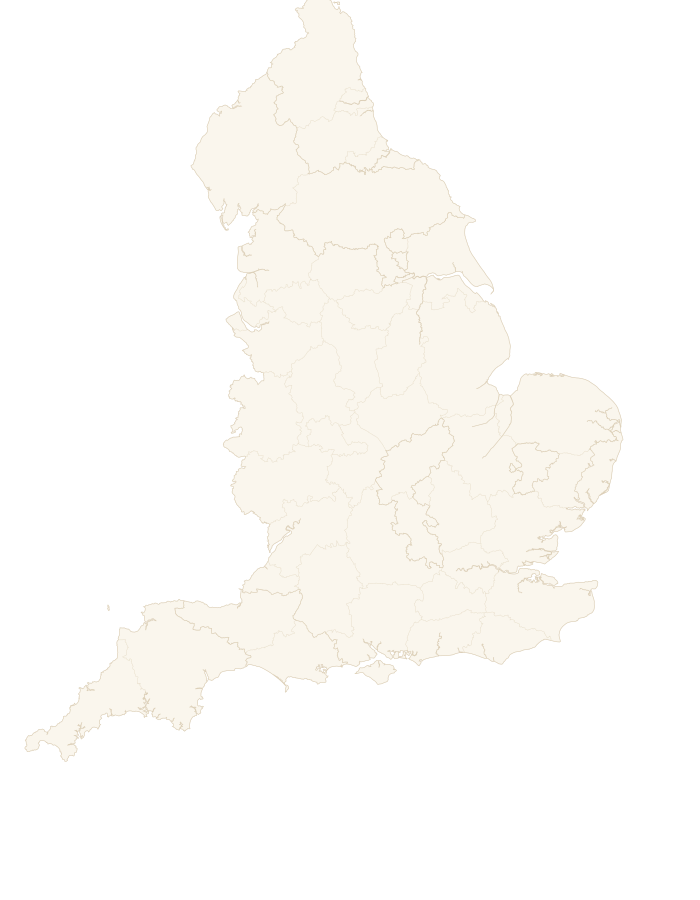
CoreHistoric reach
The seat of Dixon
Seat vacantChief
No one leads the Dixon community yet. When the movement opens, you can stand for its leadership, or help elect whoever does.
Current mission
No shared goal set yet. Once Dixon has leadership, it sets the public focus: a restoration, a gathering, a real-world project that helps its own.
The Dixon clan is being rebuilt. Join the waiting list for the movement today, and you help decide who leads it and what it does.
Help rebuild the Dixon clan →What does the Dixon name mean?
A patronymic, son of Dick, where Dick is the medieval rhyming pet-form of Richard. The name is densest along the far north of England and the Scottish Borders, where the Dickson spelling shades into the contracted Dixon; both descend from the same Richard's-son root planted in the thirteenth and fourteenth centuries.
The history of Dixon
Dick's son, and the Marischal's claim
The surname is a patronymic built on Dick, the medieval rhyming pet-form of Richard, one of the great Norman-introduced font-names. In the Lowlands the affix -son did the work that Mac did in the Highlands, so Richard's son became Dick's son, and Dick's son became Dickson; the contracted Dixon shades out of the same root, and in England it became the ordinary spelling. Nisbet, in his Heraldry printed at Edinburgh in 1722, gave the name a grander parentage than a pet-name deserves: "The Dicksons are descendants from Richard Keith, said to be a son of the family of Keith, Earls Marischals of Scotland", offering as proof that the Dicksons carry the chief of Keith Marischal in their arms.
The pedigree Nisbet defends runs through Richard Keith, son of Hervey de Keith, Earl Marischal of Scotland, and Margaret, daughter of the 3rd Lord of Douglas. Richard was commonly called Dick, and his son Thomas was styled after him, spelled Dicson in the earliest record. Set against that is the plainer evidence from the other side of the frontier: the patronym Dikson first appears in the Subsidy Rolls of Cumberland in 1332, and that Cumberland crop appears to have nothing to do with the Earl Marischal's house. Both can stand at once. A name meaning no more than Dick's boy needed no single ancestor to invent it, and got several.
The man who held his wound shut at Douglas
Thomas Dickson (1247–1307) is the first bearer with a story attached to him rather than a rent-roll. He was associated in some way with William Wallace, and early records place Thomas Dicson, a follower of the Douglas clan, at the re-capture of Douglas Castle in 1307. Robert the Bruce had made him Castellan of Castle Douglas the year before. He was killed by the English in 1307, defending the place he had been given to keep.
The tradition attached to his death is unusually physical. Slashed across the abdomen, he is said to have fought on holding the wound closed with one hand until he finally dropped dead. He lies in the churchyard of St Brides at Douglas, and the marker keeps that posture: a sword in one hand, his belly held in the other. Whatever the pedigree disputes, the grave is where the name's own account of itself begins.
The arms carry both sides of the tradition, the Keith pallets gules beside the Douglas mullets argent. Clan Dickson is reckoned a sept of Clan Keith through Thomas's paternal line, and in July 2012 the Clan Douglas Society of North America recognised Dickson and Dixon as a sept and allied family of Douglas as well, through Margaret his mother, and through his faithfulness to his second cousin William, 7th Lord Douglas, and William's son the good Sir James, 8th Lord Douglas. Even the mottoes split by spelling: "Fortes fortuna juvat" and "Coelum versus" for Dickson, and for Dixon the flatly unmoveable "Quod dixi dixi", what I have said I have said.
Carberry Tower, and a baillie in the Jacobite year
Around 1689 Carberry Tower was transferred to Sir Robert Dickson of Inveresk, coming to him from Sir Adam Blair of Lochwood's family, who had held it only thirty years since 1659. The estate carried far more history than its square tower. The lands are first recorded in the 11th century, when David I granted "Caerbairin" to the monks of Dunfermline Abbey; John de Crebarrie was the first landowner or lessee, though the Johnstone family were the first owners of the tower itself.
It was ground that had already seen a kingdom change hands. In June 1567, on Carberry Hill within the estate, Mary, Queen of Scots faced an army assembled by a confederation of her lords, surrendered to them, and was taken into imprisonment. The Riggs who held Carberry afterwards were merchants as much as lairds: in 1599 Mungo Rigg of Carberry and James Rigg went to law over a ship called the Angel and its cargo of Norwegian timber.
The Dickson years put the family into local office rather than legend. Sir Robert's son Robert was Chief Baillie of Musselburgh in 1745, the year Jacobite troops passed between Carberry and Musselburgh on their way to Prestonpans: the burgh's senior magistrate with an army walking through his ground. Carberry passed into the Elphinstone family in 1801, and William, 15th Lord Elphinstone, who succeeded in 1861, was largely responsible for redesigning the estate; by then the simple tower house had grown into a substantial residence with formal gardens and an arboretum.
The Cumberland rolls and the Durham surveyor
The English weight of the name sits hard on the far north. Northumberland, Durham and Cumberland carry the heaviest concentration, with the surname thinning southward into the Tees valley, the Yorkshires and Lancashire. Tradition holds that the Dixons of England descend from the Scottish line of Thomas Dickson, living in 1268, and are of one origin with the Scottish Dicksons; the 1332 Cumberland subsidy roll shows how early the frontier form had settled into something a tax clerk could write down without hesitating.
County Durham's most travelled bearer was Jeremiah Dixon (1733–1779), the surveyor and astronomer whose name was fastened permanently to a boundary he ran with Charles Mason across colonial America. Under the other spelling, Jeremiah Dickson (c.1775–1848) served as a British Army officer. The north also produced writers who worked the name into print: Henry Hall Dixon, the British sporting writer; William Hepworth Dixon, the British historian; and Richard Watson Dixon, the English poet.
Two women of the name are recorded for the eye rather than the pen. Annie Dixon (c.1817–1901) worked as an English painter, and Alice Dixon Le Plongeon (1851–1910) as an English photographer and archaeologist, at a period when neither field made room easily. Ella Hepworth Dixon (1857–1932) wrote novels and edited under her own name and as "Margaret Wynman", and Ailsa Dixon (1932–2017) composed.
Timber, rails, and the nursery beds
The name went into trade early and it went abroad with it. The Swedish record carries three Dicksons: James Dickson (1784–1855), the Scottish-Swedish merchant, industrialist, banker and philanthropist; James Jameson Dickson (1815–1885), a Scottish-Swedish logging industrialist and philanthropist; and Beatrice Dickson (1852–1941), a Swedish philanthropist.
At home the Dicksons and Dixons attached themselves to things that were built or grown. John Dickson (1819–1892) owned a British railway-construction company. James Dickson (1738–1822) worked as a Scottish nurseryman and naturalist, and Alfred Herbert Dixon (1857–1920) as a British businessman. Robert Dickson (1765–1823) made his living as a Canadian fur trader, and William Dickson (1769–1846) as a businessman, lawyer and politician in Upper Canada. The line runs on into the laboratory: Dr Olaf George Dixon of ICI patented the Dixon ring in 1943 for use in laboratory distillation.
Belfast, Glentoran, and the Presbyterian pulpit
In Ulster the name became civic. Sir Daniel Dixon, 1st Baronet (1844–1907), was mayor of Belfast, and the barony of Glentoran then ran through three holders of the surname: Herbert Dixon, 1st Baron Glentoran; Daniel Dixon, 2nd Baron Glentoran; and Robin Dixon, 3rd Baron Glentoran, born in 1935. Around them sat a long bench of Irish and Northern Irish politicians of the Dickson spelling: Samuel Auchmuty Dickson (1817–1870), Conservative; Samuel Dickson (1776–1850), Peelite; Thomas Alexander Dickson (1833–1909); the unionist James Hill Dickson (1863–1938); and later Anne Dickson, born 1928, and Stewart Dickson, born 1950.
The Irish Dicksons also stocked the pulpit and the consulting room. William Steel Dickson (1744–1824) was an Irish Presbyterian minister, James Dickson, who died in 1787, an Irish Anglican priest. Emily Winifred Dickson (1866–1944) became the first female Fellow of a Royal College of Surgery. Henry Horatio Dixon and Hal Dixon (1928–2008) worked as Irish biologist and Irish biochemist respectively, and Brice Dickson as an Irish legal academic.
Two Victoria Crosses and an early airman
For a border name, service came naturally. Archibald Dickson (c.1739–1803) reached Royal Navy admiral, and Edward Stirling Dickson (1765–1844) served as a British naval officer. Alexander Dickson (1777–1840) and Lothian Sheffield Dickson (1806–1894) were British Army officers, the latter also a campaigner, and Edward Thompson Dickson (1850–1938) rose to British Army general. Two bearers took the Victoria Cross under the two spellings: Collingwood Dickson (1817–1904) and Matthew Charles Dixon.
The next century moved the name into the air and onto the bridge. Bertram Dickson (1873–1913) was a Scottish airman in the earliest years of flight; Euan Dickson (1892–1980) flew as a New Zealand bomber pilot in the First World War; James Bell Dickson (1923–1944) was a US Army Air Force pilot in the Second. Archibald Dickson (1892–1939) was a Welsh sea captain. Further out, H. R. P. Dickson (1881–1959) served as a British colonial administrator, and Violet Dickson (1896–1991) worked as an English botanist, writer and Orientalist.
Maggie Dickson's rope, and the name since
Not every bearer left an office behind them. Maggie Dickson is remembered in eighteenth-century Scotland for one thing only: she survived her own hanging. Beside her the scholarly Dicksons are almost sedate: David Dickson (1583–1662), Scottish theologian and minister; Thomas Dickson (1825–1904), Scottish antiquary; William Purdie Dickson (1823–1901), Scottish minister and theologian; and James Douglas Hamilton Dickson (1849–1931), a Scottish mathematician and expert in electricity. The brothers Alfred Cardew Dixon (1865–1936) and Arthur Lee Dixon (1867–1955) were both mathematicians.
The modern spread of the name follows the emigrant routes out of the Borders and the northern counties. Sir Owen Dixon became Chief Justice of Australia, and Brian Dickson (1916–1998) Chief Justice of Canada from 1984 to 1990. Lee Dixon, born 1964, the Arsenal and England full-back, and Kerry Dixon were English footballers; Rod Dixon ran and Scott Dixon races for New Zealand; Ngila Dickson, born 1958, designs costume there. Barbara Dickson, born 1947, sings and acts in Scotland, Reginald Dixon played the theatre organ in Britain, and William Kennedy Dickson (1860–1935) worked as a British-American inventor. Seven centuries on from a castellan bleeding at Douglas, the name is still doing what a patronymic does: turning up everywhere, in everything.
Castles the Dixon held
Strongholds this name held for a decade or more, look one up, or rebuild it to explore.
- Carberry Tower
Transferred to Sir Robert Dickson of Inveresk around 1689; his son was Chief Baillie of Musselburgh in 1745.
The castles of the homeland
The great strongholds of the homeland, look one up, see what it looked like in its prime, and recreate it to explore.
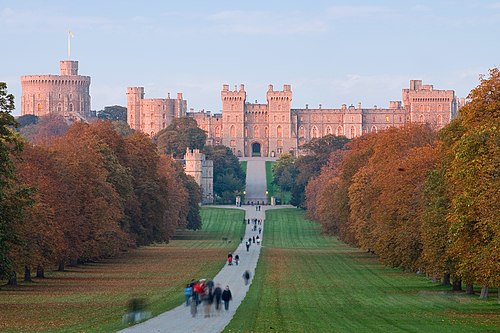 Windsor CastleRestored · prime 1820
 Tower of LondonRestored · prime 1285
 Bamburgh CastleRestored · prime 1904
All castles in England → · Strongest castles in England → · Castles of Europe
Play As Your Clan
Hold a real castle against whatever you choose to send at it, take a ship out in her own service years, or stand at the shoulder of someone the record remembers. The chronicler sets the scene; the deeds are yours.
Notable bearers of the Dixon name
- Jeremiah Dixon (1733–1779), surveyor of the Mason–Dixon Line
- Lee Dixon (b. 1964), footballer