Elgar
Malvern Hills in orchestration.
- Origin
- West Midlands, England
- Famous bearer
- Sir Edward Elgar (1857–1934), composer
- Register
- English family
Where the Elgar name comes from
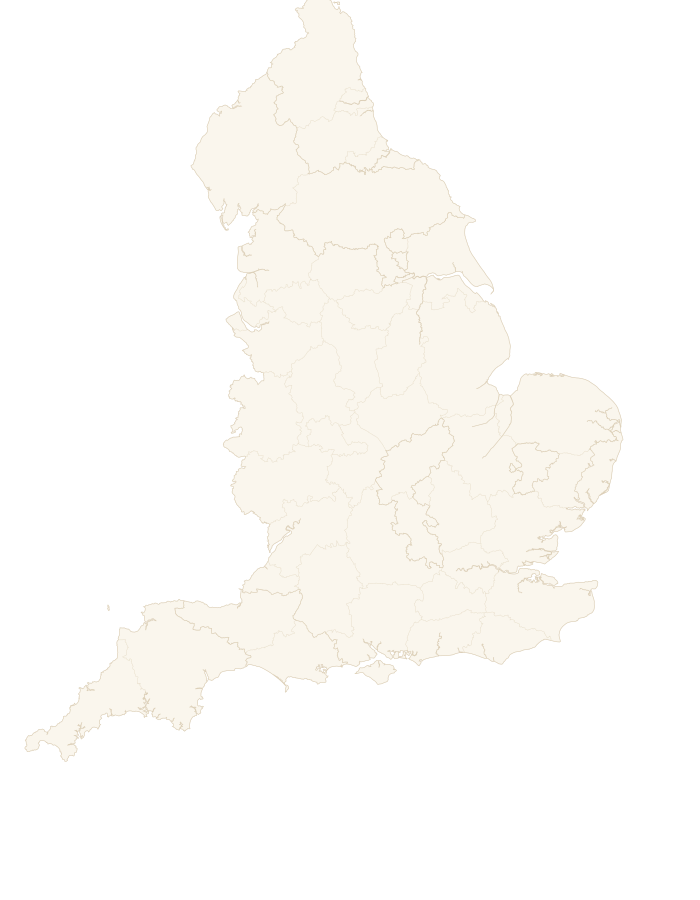
The seat of Elgar
Seat vacantChief
No one leads the Elgar community yet. When the movement opens, you can stand for its leadership, or help elect whoever does.
Current mission
No shared goal set yet. Once Elgar has leadership, it sets the public focus: a restoration, a gathering, a real-world project that helps its own.
The Elgar clan is being rebuilt. Join the waiting list for the movement today, and you help decide who leads it and what it does.
Help rebuild the Elgar clan →What does the Elgar name mean?
Uncertain, possibly Æthel-gār or lost Anglo-Saxon personal name; Worcestershire concentration.
The history of Elgar
A lost Anglo-Saxon name that never left two counties
Elgar is not a trade name, not a patronymic, and not a village anyone can point at. The origin is unresolved: it may be the worn remnant of an Old English personal name, possibly the Æthel-gār of the pre-Conquest name stock, carried into hereditary use long after the personal name itself had gone. The name is concentrated in Worcestershire and Herefordshire, and it is those two counties, rather than any one village, that it belongs to.
William Elgar's shop at 10 High Street, Worcester
William Henry Elgar (1821-1906) was raised in Dover and apprenticed to a London music publisher. In 1841 he moved to Worcester, worked as a piano tuner, and set up a shop selling sheet music and instruments, the Elgar Brothers premises at 10 High Street. In 1848 he married Ann Greening, a farm worker's daughter from Weston in Herefordshire, and they raised seven children in the rooms above the shop. He was a violinist of professional standard and held the post of organist of St George's Roman Catholic Church in Worcester from 1846 to 1885, thirty-nine years in one loft.
He played the violin in the orchestra of the Three Choirs Festival, and it was at his instigation that masses by Cherubini and Hummel were first heard there. He tuned the pianos of the grand houses of Worcestershire and took a son along, so a shopkeeper's boy played in front of the important people of the county. Ann Elgar had converted to Roman Catholicism shortly before the birth of her fourth child, and the children were brought up in that faith to their father's disapproval. All were raised to music: Frank became an oboist with a wind band of his own, and from 1878 to 1881 he and Edward played in a wind quintet that Edward wrote and arranged for constantly.
The boy who learned his music out of the cathedral library
Edward William Elgar was born on 2 June 1857 at The Firs, a cottage at Lower Broadheath outside Worcester, and the household moved into the High Street within a year. He had piano and violin lessons by eight. "My first music was learnt in the Cathedral," he said later, "from books borrowed from the music library, when I was eight, nine or ten." He learned German hoping to reach the Leipzig Conservatory; his father could not afford to send him.
He left Littleton House school in 1872 for a clerk's desk in a Worcester solicitor's office and did not stay long. He taught, worked in the shop, and conducted for the first time at the Worcester Glee Club alongside his father. At twenty-two he took the conductorship of the attendants' band at the Worcester and County Lunatic Asylum at Powick, three miles out, and held it five years from 1879. The band was an odd assortment of wind, a few strings and a piano, and he wrote quadrilles and polkas for exactly the instruments in front of him. That is where the orchestration came from. From 1882 he played every concert for seven years in William Stockley's Birmingham orchestra, where, he said, he "learned all the music I know".
A first professional hearing, and Alice Roberts disinherited
On 13 December 1883 Stockley's players gave his Sérénade mauresque at Birmingham Town Hall, the first outing of anything of his by a professional orchestra; Elgar refused to conduct and insisted on playing his own part, so he had to stand up in the fiddles, instrument in hand, to take the applause. In April 1884 he wrote to a friend, "My prospects are about as hopeless as ever." At twenty-nine he took on a new pupil, Caroline Alice Roberts, daughter of the late Major-General Sir Henry Roberts, eight years his senior. Her family was horrified that she meant to marry an unknown musician who worked in a shop and was a Roman Catholic, and she was disinherited.
They married on 8 May 1889 at the Brompton Oratory, and his engagement present was Salut d'Amour. From that day until her death she was his business manager and social secretary, absorbed his moods and read his music with a critic's ear. "The care of a genius is enough of a life work for any woman," she wrote in her diary. Their only child, Carice Irene, a contraction of Caroline and Alice, was born at West Kensington on 14 August 1890. The London years failed, and the one commission that mattered came from home: a short orchestral piece for the Three Choirs Festival of 1890, which he conducted at Worcester that September as Froissart. For want of work he brought his wife and daughter back in 1891 to Great Malvern, where Alice had lived before her marriage, and to Forli, a small villa at Malvern Link under the hills.
The nineteenth of June 1899
Through the 1890s he built a reputation as a composer for the choral festivals of the English Midlands, with The Black Knight in 1892, King Olaf and The Light of Life in 1896 and Caractacus in 1898. He counted for enough locally to recommend the young Samuel Coleridge-Taylor to the Three Choirs for a commission that made the younger man's career. He was still barely getting by, and in 1898 called himself "very sick at heart over music". The Variations on an Original Theme, fourteen portraits of his friends over a theme with a hidden counter-melody he never explained, were given at the St James's Hall in London on 19 June 1899 under Hans Richter. He was forty-two.
He dedicated the set "To my friends pictured within"; the best known of them, Nimrod, is his friend August Jaeger, who had spent years talking him out of despair. Inside a year the Enigma Variations had made him the pre-eminent British composer of his generation. The Dream of Gerontius, on Cardinal Newman's poem about a soul after death, followed at the Birmingham Festival in October 1900 with a chorus so poorly prepared that it sang badly, and Germany rescued it: Julius Buths conducted it at Düsseldorf in 1901 and 1902, and Richard Strauss rose in Elgar's presence to toast "the first English progressive musician, Meister Elgar". At home the Catholic text offended. Stanford said the work "stinks of incense", and the dean of Gloucester banned it from his cathedral in 1901.
Land of Hope and Glory, and a knighthood at Buckingham Palace
The first Pomp and Circumstance March was composed in 1901 and first performed at Liverpool on 19 October under Alfred Rodewald. Of the slow trio Elgar had told his friend Dora Penny, "I've got a tune that will knock 'em, will knock 'em flat." At a London Promenade Concert under Henry Wood the audience "rose and yelled" and gave the only double encore ever accorded an orchestral item at the Proms. Clara Butt persuaded him words would fit; A. C. Benson wrote them; the tune went into the Coronation Ode for the gala at the Royal Opera House on 30 June 1902 and then out on its own as Land of Hope and Glory.
In March 1904 Covent Garden staged a three-day festival of his works, an honour never before given to an English composer, and he was knighted at Buckingham Palace that 5 July. The following month the family moved to Plas Gwyn, a large house on the edge of Hereford above the Wye, where they stayed until 1911. The First Symphony of 1908 was played within weeks of its premiere in New York, Vienna, St Petersburg and Leipzig, and took a hundred performances in just over a year. The Violin Concerto of 1910 was commissioned by Fritz Kreisler and written with technical advice from W. H. Reed of the London Symphony Orchestra. The Order of Merit followed in June 1911.
Brinkwells, the Cello Concerto, and the loss of Alice
The Second Symphony of 1911, which ends quietly rather than in splendour, was received politely and no more; Elgar turned to Reed and asked, "What is the matter with them, Billy? They sit there like a lot of stuffed pigs." In the war he served as a special constable and joined the Hampstead Volunteer Reserve, and wrote Carillon for Belgium, Polonia for Poland and three settings of Laurence Binyon as The Spirit of England. His health broke at the end of it, and Alice rented Brinkwells, a house near Fittleworth in Sussex, from the painter Rex Vicat Cole. He recovered there and in 1918 and 1919 wrote the Violin Sonata, the Piano Quintet, the String Quartet, and the Cello Concerto in E minor.
The concerto had a ruinous premiere at the opening concert of the London Symphony Orchestra's 1919-20 season, because Albert Coates overran his rehearsal time at Elgar's expense; Ernest Newman wrote that the work itself was lovely stuff of a pregnant simplicity and that the orchestra had made a lamentable exhibition of itself. It is now among the most played works in the cello repertoire, Jacqueline du Pré's 1965 recording of it one of the best-selling classical records ever made. Alice died of lung cancer on 7 April 1920, at seventy-two, and he completed no more major work of his own. He sold the Hampstead house and came home to Worcestershire, to Kempsey from 1923 to 1927 and then to Marl Bank in Worcester.
What Carice kept, and what Worcestershire kept
He was appointed Master of the King's Musick on 13 May 1924, and from 1926 recorded his own music in a long series of gramophone sessions, the first composer to take the medium seriously. In November 1931 he was filmed conducting the first Pomp and Circumstance March at the opening of the Abbey Road studios, asking the players to "play this tune as though you've never heard it before", and the same year was created a baronet, of Broadheath in the County of Worcester. He died on 23 February 1934 and was buried beside Alice at St Wulstan's Roman Catholic Church, Little Malvern.
His daughter Carice helped found the Elgar Birthplace Museum at The Firs in 1936, left it her collection of his letters, and placed the manuscripts deliberately: the Cello Concerto to the Royal College of Music, The Kingdom to the Bodleian. The reputation sank for a generation and came back from the 1960s on new recordings; the sketches of the unfinished Third Symphony were elaborated into a complete score by Anthony Payne in 1997. Few English surnames are pinned so exactly to their own ground. His statue stands at the end of Worcester High Street facing the cathedral, only yards from where his father's shop stood, and around sixty-five roads in the United Kingdom carry the name, six of them in the two counties it never left.
Champions of the Elgar name
The bearers whose lives are inseparable from this surname. Each has their own page, biography, achievements, geography, connection to the family.
The castles of the homeland
The great strongholds of the homeland, look one up, see what it looked like in its prime, and recreate it to explore.
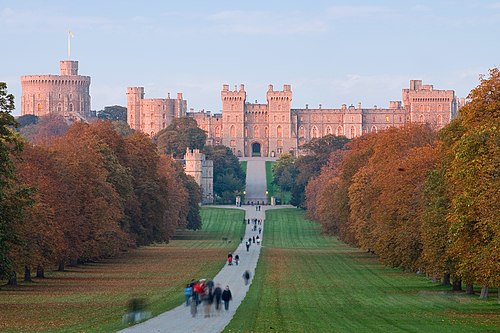 Windsor CastleRestored · prime 1820
 Tower of LondonRestored · prime 1285
 Bamburgh CastleRestored · prime 1904
All castles in England → · Strongest castles in England → · Castles of Europe
Play As Your Clan
Hold a real castle against whatever you choose to send at it, take a ship out in her own service years, or stand at the shoulder of someone the record remembers. The chronicler sets the scene; the deeds are yours.
Notable bearers of the Elgar name
- Sir Edward Elgar (1857–1934), composer