Hayes
The enclosure, hedged common.
- Origin
- North West, England
- Register
- English family
The Hayes arms and country

Coat of armsEscutcheon of the Hayes baronets of Westminster (1797)Borne by the Westminster line, one branch of the name rather than all of it.Charles Matthews · CC BY-SA 4.0 
Coat of armsEscutcheon of the Hayes baronets of Drumboe Castle (1789)Borne by the Drumboe Castle line, one branch of the name rather than all of it.Charles Matthews · CC BY-SA 4.0
.svg)
.svg)
- Coat of arms: Granted to an individual and inherited down that one documented line. These are the arms of particular families of the name, not of everyone who shares the surname.
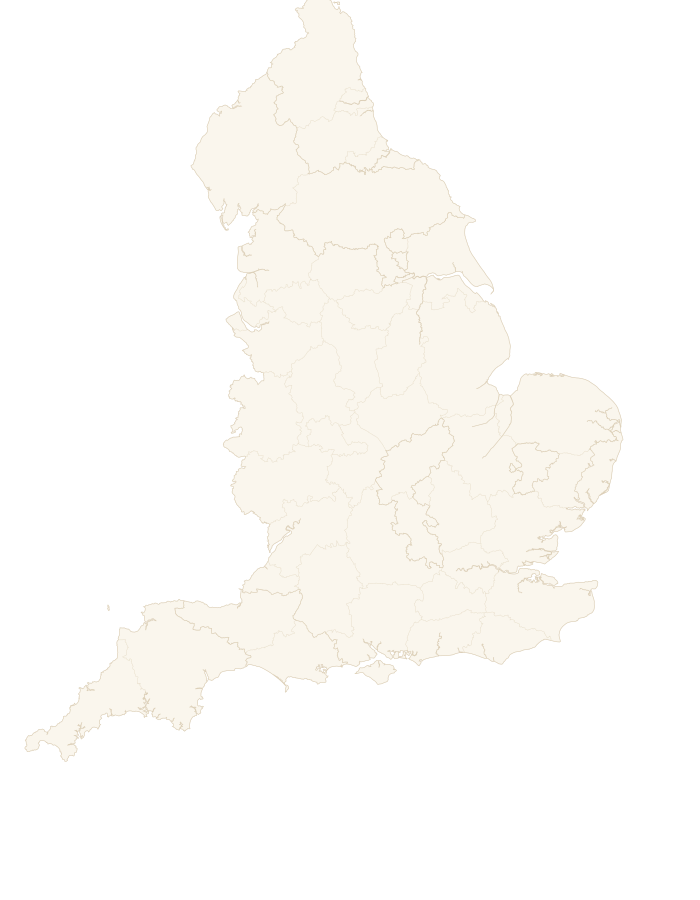
CoreHistoric reach
The seat of Hayes
Seat vacantChief
No one leads the Hayes community yet. When the movement opens, you can stand for its leadership, or help elect whoever does.
Current mission
No shared goal set yet. Once Hayes has leadership, it sets the public focus: a restoration, a gathering, a real-world project that helps its own.
The Hayes clan is being rebuilt. Join the waiting list for the movement today, and you help decide who leads it and what it does.
Help rebuild the Hayes clan →What does the Hayes name mean?
Locative, the enclosure (hay) or brushwood (haes).
The history of Hayes
Two families, one spelling
Hayes is not one surname wearing different hats. It is two separate names that reached the same spelling from opposite sides of the Irish Sea, and a reader tracing the line back needs to know which is theirs first.
The English Hayes is topographic: it comes from the ground a family lived on (brushwood, hedge, enclosed field) and from the several places named for that ground, in Kent and Middlesex among others. The Irish Hayes is a patronymic, Ó hAodha, descendant of Aodh, built on a personal name so common in early Ireland that the surname formed independently in county after county, with no kinship between the bearers.
The quickest test is geography plus cousins. If the family came out of Munster, Wexford or the Irish midlands, and the older records show O'Hea or Hughes beside Hayes, the root is Ó hAodha. If it is anchored to a southern English parish and the early name attaches to a place rather than a father, the root is the hedge.
The hedge, the brushwood and the enclosure
The English name is built on Old English ground words. One line runs from haes, brushwood or underwood, the scrub at the edge of cleared land; the other from hege, a hedge, and the enclosure a hedge makes. Hay here is enclosure, hedged meadow, not grass mown and stored for winter: the family was named for a boundary, not a crop.
That put Hayes families on the inside of the hedge that kept sheep out of the lord's corn. The later enclosure acts rewired those hedges across England, but the surname kept the old geometry long after the fields it described had been redrawn.
The oldest record of the surname is dated 1197, in the Eynsham Cartulary of Oxfordshire, written Heise, a monastic land record, which is where a name of this kind surfaces first, because a topographic byname gets written down when somebody grants or witnesses land. By 1400 most English families, and those of Lowland Scotland, had settled into hereditary surnames, and the byname that described one man's field had become his descendants'.
Aodh, the fire, and why so many share the name
Ó hAodha means descendant of Aodh. Aodh, Aed in its older form, means fire, and belonged to an Irish god before it belonged to any man. It was among the commonest given names in early Ireland, and that single fact explains the whole Irish story: where a name is that common, the patronymic built on it forms everywhere at once.
This is what makes the Irish Hayes polygenetic. Septs in most counties carried Ó hAodha independently, descending from different men named Aodh in different provinces. A Hayes of one county and a Hayes of the next are not, by default, kin. That is not a gap in the record; it is the record. The name stands on public record in County Wexford as early as 1182.
The English spelling was chosen by whoever did the anglicising, and it varied by place. Across most counties Ó hAodha became Hayes. In County Cork it became O'Hea. In Ulster it became Hughes, through Hugh, the anglicised form of Aodh itself, so a family with Hayes on one branch and Hughes or O'Hea on another is looking not at coincidence but at one name written down twice.
Under the Dalcassian banner and among the men of Cian
Because the name arose in so many places, the Irish Hayeses attach to more than one older kindred rather than to a single chief. In County Cork, within Munster, Hayes falls under the banner of the McNamara clan among the Dalcassian septs. Other Irish Hayeses are associated with Clan Cian, the kindred of the O'Carrolls who ruled in southern Ireland.
Those are affiliations of allegiance, not proof of descent from one man, and an honest page says so. Nineteen coats of arms have been assumed by or granted to bearers of this surname or a close variant, and nineteen is the giveaway: one chiefly house produces a single arms with cadet differences; a name formed in a dozen places produces a scatter of unrelated grants.
The Norman hedge, and a name that only looks the same
A third root exists, worth naming so readers do not chase it by mistake. In Scotland, Hayes is a Scoto-Norman name, a translation of the Norman locational surname de la Haye, of La Haye, the hedge, the name of several towns on the Cotentin Peninsula in Normandy. The first Norman bearer to reach Scotland was William II de la Haye, at the time of the Norman invasion, and Clan Hay descends from him.
So the hedge appears twice, once in Old English and once in Norman French, with nothing in common but the object described. Measured in 1881 and again in 1998, Hayes holds much the same shape in Great Britain, concentrated in areas of England well separated from Scotland: the English Hayes did not come down from Clan Hay. A fourth, smaller root sits outside these islands: Hayes can also render the Yiddish name Khaye, meaning life.
Drumboe, and a voice out of Limerick
The name rose into the landed classes on the Irish side. Drumboe Castle was home to the Hayes baronets from 1789 to 1912, a hundred and twenty-three years of a Hayes family holding a castle and a title in the north-west of Ireland.
Its most far-travelled bearer came from the other end of the country and from nothing at all. Catherine Hayes, a Limerick seamstress's daughter, was heard singing on a balcony at nineteen. She trained in Paris and Milan, sang at La Scala by twenty-six, and became the first Irish-born soprano to tour the world.
Where the name stands now
Hayes is the 191st most common surname in Great Britain, with 42,475 bearers. Its densest ground is Kent, 73rd there with 4,828 bearers, and Buckinghamshire, 34th with 3,304, both in the old topographic heartland. There are strong Welsh concentrations in Caerphilly and Carmarthenshire, and industrial weight in Merseyside (79th, 3,252) and Lancashire (177th, 3,370).
The name has gained ground since 1881, though it stays below rank 150 in Britain. Abroad it did far better: in the United States census of 1990, Hayes was the 100th most common surname in the country, the arithmetic of Irish emigration written into a name list. Carry it and you carry one of two old European ideas: a boundary in the English landscape, or the word for fire an Irish family gave a son and then gave his descendants.
Champions of the Hayes name
The bearers whose lives are inseparable from this surname. Each has their own page, biography, achievements, geography, connection to the family.
Historic Places, Rebuilt
Explore the streets and seats the Hayes name knew, rebuilt with AI as they stood in history.
Castles the Hayes held
Strongholds this name held for a decade or more, look one up, or rebuild it to explore.
- Drumboe Castle
Home of the Hayes baronets of Drumboe Castle, 1789–1912.
The castles of the homeland
The great strongholds of the homeland, look one up, see what it looked like in its prime, and recreate it to explore.
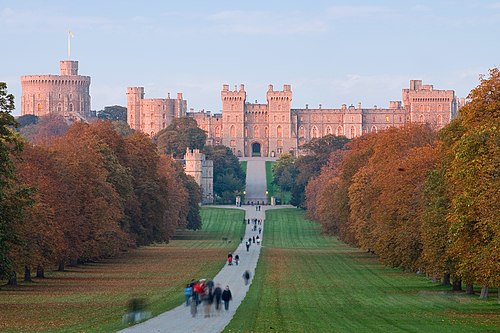 Windsor CastleRestored · prime 1820
 Tower of LondonRestored · prime 1285
 Bamburgh CastleRestored · prime 1904
All castles in England → · Strongest castles in England → · Castles of Europe
Play As Your Clan
Hold a real castle against whatever you choose to send at it, take a ship out in her own service years, or stand at the shoulder of someone the record remembers. The chronicler sets the scene; the deeds are yours.