Lucas
also Luke, Lucase
From Luke the Evangelist, a church name made surname.
- Origin
- East of England, England
- Famous bearer
- George Lucas (b. 1944), American filmmaker
- Register
- English family
The Lucas arms and country

Coat of armsArms of LucasWikimandia · CC BY-SA 4.0

- Coat of arms: Granted to an individual and inherited down that one documented line. These are the arms of particular families of the name, not of everyone who shares the surname.
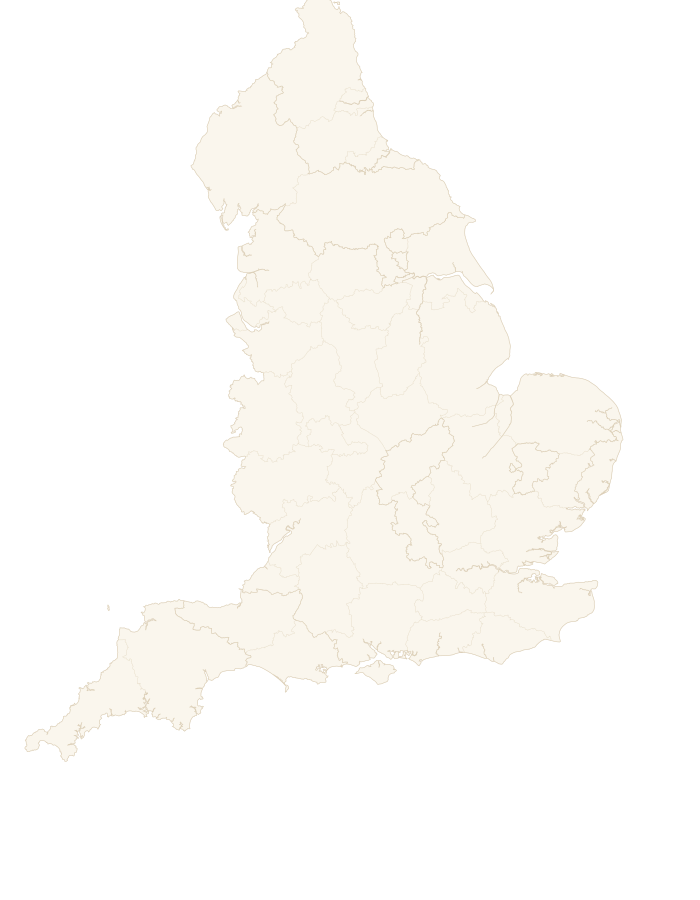
CoreHistoric reach
The seat of Lucas
Seat vacantChief
No one leads the Lucas community yet. When the movement opens, you can stand for its leadership, or help elect whoever does.
Current mission
No shared goal set yet. Once Lucas has leadership, it sets the public focus: a restoration, a gathering, a real-world project that helps its own.
The Lucas clan is being rebuilt. Join the waiting list for the movement today, and you help decide who leads it and what it does.
Help rebuild the Lucas clan →What does the Lucas name mean?
From the Latin personal name Lucas, the form of Luke (the Evangelist) used in the medieval Latin church and spread by the Normans. The name was carried by families across England from the twelfth century onward and is also a European-Jewish surname in some lines; the vernacular doublet is Luke.
The history of Lucas
The evangelist's name, written the way clerks wrote it
Lucas is the Latin of the man English readers call Luke, and the Latin behind it is the vocabulary of light. Luke is the English form and diminutive of Lucas, which descends from Lucius; Lucius in turn is traced to lux, genitive lucis, meaning light, and to the verb lucere, to shine. The name has been read as 'the bright one' or 'the one born at dawn'. A rival proposal derives Lucius from the Etruscan Lauchum, king, which passed into Latin more directly as Lucumo. The much-repeated gloss of the Greek Loukas as 'man from Lucania' is not supported by reliable sources.
The mechanism that put the Latin form into English mouths was the conquest of 1066. Anglo-Norman, a northern dialect of Old French, displaced Old English among the ruling classes, and names current in France replaced Anglo-Saxon ones; William, Robert and Richard soon became common. At the same moment the language of official documents shifted from Old English to Latin, so the clerk who entered a man in a roll entered him in the Latin register. A boy baptised for the gospel-writer could be Luke in the lane and Lucas on the parchment.
Hereditary surnames hardened around that split. Christopher Daniell dates what may be the first recorded modern surname inherited by several generations to 1140, and the habit began with the feudal nobility and gentry before working downward; by 1400 most English families, and most in Lowland Scotland, used a fixed name. Because the saint existed in two registers at once, one font-name produced two distinct surnames, Lucas and Luke. And because every Latin church in Europe used the same form, Lucas settled on French, Portuguese, Dutch and German families as readily as English ones, and stands in some lines as a European-Jewish surname.
Three brothers, one war, and the barony of Shenfield
The tightest Lucas family group in the record is a set of brothers on the Royalist side of the English Civil War. Sir John Lucas (1606-1671) was made 1st Baron Lucas of Shenfield. His brother Charles Lucas (1613-1648) was a soldier. A third brother, Thomas Lucas, recorded simply as an English Cavalier, died in 1649. John, the ennobled brother, outlived both.
Their generation put other Lucases into public life. Henry Lucas (c.1610-1663) sat as a member of Parliament and is remembered as a benefactor. Benjamin Lucas served as an Anglo-Irish soldier in the same century. A century later Thomas Lucas (c.1720-1784) sat as member for Grampound while trading as a West Indies merchant, the parliamentary seat and the counting house held together in one career.
A title called Lucas, carried by six different surnames
The barony of Lucas of Crudwell is the strangest thing the name did. Mary Grey, Countess of Kent, held it first as 1st Baroness and died in 1702. Henry Grey, 1st Duke of Kent (1671-1740), followed as 2nd Baron, and Anthony Grey, Earl of Harold (1695-1723), as 3rd. Jemima Yorke, 2nd Marchioness Grey (1722-1797), took it as 4th Baroness, the second woman in four holders.
After her the title moved sideways again and again: Thomas de Grey, 2nd Earl de Grey (1781-1859), as 6th Baron; Francis Cowper, 7th Earl Cowper (1834-1905), as 8th; Auberon Herbert (1876-1916) as 9th; and a Palmer holds it as 12th. Read down the list and the family names are Grey, Yorke, de Grey, Cowper, Herbert and Palmer, while the title stayed Lucas throughout. The name outlived every surname that held it.
A separate and much later dignity, Lucas of Chilworth, ran the other way round, with the surname and the title matching: Michael William George Lucas (1926-2001) held it as 2nd Lord.
An Irish physician in politics, and two Victoria Crosses
Charles Lucas (1713-1771) was an Irish politician and a physician.
The name then produced two Victoria Crosses. Charles Davis Lucas (1834-1914), an Anglo-Irish officer of the Royal Navy, received the decoration; John Lucas (1827-1892), an Irish soldier, received his after action in New Zealand.
The Lucas sequence and a continental spread
The French line produced the one Lucas whose surname became technical vocabulary. Édouard Lucas (1842-1891) studied the Lucas numbers and the closely related Fibonacci numbers, both of them examples of what mathematicians now call a Lucas sequence. Few surnames end up as a defined term in mathematics; his did.
Around him stands a substantial French cohort. Hippolyte Lucas (1814-1899) worked as an entomologist. Hippolyte-Julien-Joseph Lucas (1807-1878) wrote and reviewed. Charles Lucas (1838-1905) practised as an architect. Pauline Ramart, born Lucas (1880-1953), was a chemist and a politician. Earlier than all of them, Jean Jacques Étienne Lucas (1764-1819) served as a French naval officer.
The same church-Latin form threw the name well past France. Vicente Lucas (1935-2026) played football for Portugal. Ove Lucas, born about 1960, works as a curator and director in the Netherlands. Anthony Francis Lucas (1855-1921), born in Croatia, made his career as an oil-field engineer, and Peter J. Lucas, born 1962, is a Polish and American actor.
Abolition presses and the Victorian platform
Nineteenth-century Britain gave the name a reforming edge, mostly in print. Samuel Lucas (1811-1865) was an abolitionist and a newspaper editor, campaigning through the press. Frederick Lucas (1812-1855) worked as a journalist in the same decades. Margaret Bright Lucas (1818-1890) took the platform instead, as a temperance activist and a suffragist. The other Samuel Lucas (1805-1870), known as Senior, was a brewer who painted.
The literary and artistic Lucases run on from there into the twentieth century. E. V. Lucas (1868-1938) wrote for a living; St John Lucas (1879-1934) published poetry and edited anthologies; Frank Lucas (1894-1967) worked as a literary critic. Richard Cockle Lucas (1800-1883) sculpted, John Seymour Lucas (1849-1923) and Caroline Byng Lucas (1886-1967) both worked as artists, and Charles Lucas (1808-1869) played the cello.
Wiring, reinforced concrete and Tutankhamun's tomb
Joseph Lucas (1834-1902) founded the British automotive electrical components manufacturer that carried the surname, trading eventually as Lucas Automotive and LucasVarity. Ralph Lucas (1876-1955) worked the other end of the same industry as a designer of early motor cars. Between them the name attached itself to the British motor trade at the moment that trade was being invented.
Alfred Lucas (1867-1945), an English analytical chemist, is known for his part in the excavation of Tutankhamun's tomb, the chemistry rather than the digging. In building, Colin Anderson Lucas (1906-1984) was a modernist architect and a pioneer of reinforced concrete construction, while Geoffry Lucas (1872-1947), recorded also as Thomas Geoffry Lucas and frequently mis-spelt Geoffrey, practised as an architect.
The name that left by ship
Australia received the name in both directions. Nathaniel Lucas (1764-1818) arrived as an English convict, transported. Arthur Henry Shakespeare Lucas (1853-1936) arrived as an English-born schoolmaster and scientist, and Thomas Pennington Lucas (1843-1917), Scottish-born, practised medicine there. Much later Trevor Lucas (1943-1989) made his name as an Australian folk-rock musician.
Canada took Clarence Lucas (1866-1947), a composer, and Isaac Benson Lucas (1867-1940), a politician. The United States took Robert Lucas (1781-1853), who served as a governor, and Scott W. Lucas (1892-1968), who rose to Senate Majority Leader from Illinois. John P. Lucas (1890-1949) commanded as an American general in the Second World War, and Alfred Lucas (1822-1896) had served earlier as an English staff officer in the British Indian Army. The clerical Latin name that the Normans brought to England finished as a name on rolls in four continents.
Historic Places, Rebuilt
Explore the streets and seats the Lucas name knew, rebuilt with AI as they stood in history.
The castles of the homeland
The great strongholds of the homeland, look one up, see what it looked like in its prime, and recreate it to explore.
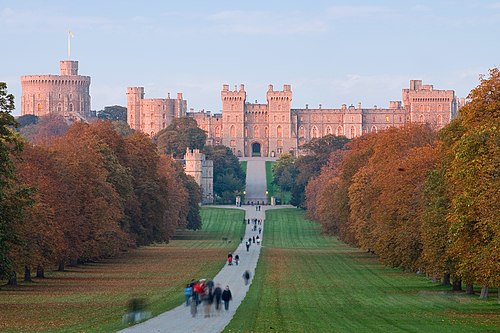 Windsor CastleRestored · prime 1820
 Tower of LondonRestored · prime 1285
 Bamburgh CastleRestored · prime 1904
All castles in England → · Strongest castles in England → · Castles of Europe
Play As Your Clan
Hold a real castle against whatever you choose to send at it, take a ship out in her own service years, or stand at the shoulder of someone the record remembers. The chronicler sets the scene; the deeds are yours.
Notable bearers of the Lucas name
- George Lucas (b. 1944), American filmmaker
- Matt Lucas (b. 1974), comedian and actor