Perry
Pear-orchard or Peter's kin.
- Origin
- West Midlands, England
- Famous bearer
- Fred Perry (1909–1995), three-time Wimbledon men's singles champion (1934, 1935, 1936) and three-time US Open champion
- Register
- English family
Where the Perry name comes from
CoreHistoric reach
The seat of Perry
Seat vacantChief
No one leads the Perry community yet. When the movement opens, you can stand for its leadership, or help elect whoever does.
Current mission
No shared goal set yet. Once Perry has leadership, it sets the public focus: a restoration, a gathering, a real-world project that helps its own.
The Perry clan is being rebuilt. Join the waiting list for the movement today, and you help decide who leads it and what it does.
Help rebuild the Perry clan →What does the Perry name mean?
Pear tree (perry cider country) or pet form of Peter, context in parish distinguishes.
The history of Perry
The man at the pear tree, and the three other Perrys
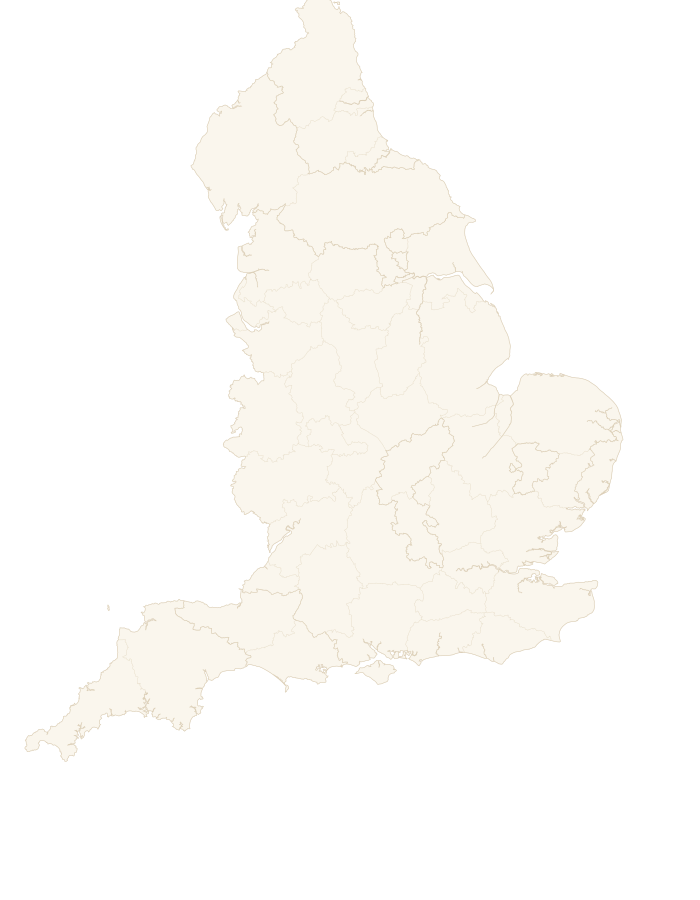
The commonest Perry is an address rather than a trade or a father. Behind it stands the Old English pyrige, a pear tree, and the man a clerk set down as being of the pear tree was told apart from his neighbours by the nearest landmark. That is why the name multiplied with no founding line behind it: any settlement with a pear standing at the end of a lane, in a hedge or over a boundary stone could produce a Perry of its own, and the surname's English heartland settled in the counties where that fruit paid, the western shires of Herefordshire and Worcestershire, Gloucestershire and Somerset, with the Black Country beside them drawing labour off the same ground. The pears those orchards pressed gave their name to perry, so the drink and the family name come off the same tree.
Three other Perrys share the spelling and none of them is about fruit. In Wales the name arose as a patronymic, worn down from ap Harry, son of Harry, which is where Parry comes from as well, so a Perry on the marches may be a Harry's son whose Welsh prefix an English clerk clipped off. From Norman French comes perrieur, a quarry, and with it the man who cut stone rather than the man who lived beside a tree. And Perry did duty as a pet form of Peter, standing beside the Perkin lines that came off the same font name. Orchard, quarry and church all end in the same six letters, and only the parish book says which one a particular family came out of.
A fourth route is the one a diaspora reader is most likely to be standing on. As of 2014 sixty-seven per cent of all known bearers of Perry were living in the United States, and a share of them did not bring the name across at all. Portuguese Pereira means pear tree in its own language, and Portuguese immigrants to America, above all in Massachusetts and around San Francisco Bay, Americanised Pereira into Perry at the counter and kept it. The Italian Perri, which belongs with Peter rather than with the orchard, was taken the same way. An English Perry, an Azorean Pereira and a Calabrian Perri can sit in one American telephone book under one spelling, and only a ship's list or a baptism separates them.
From a Devon parish to a farm in South Kingstown
The English record for the name is unglamorous and all the better for it. Perry is documented as a surname from the late sixteenth century in the villages around Colchester in Essex, at Lexden and at Copford: not a charter, not a forfeited barony, not a seat with a gatehouse, but ordinary people entered in ordinary books. What the name has instead of a castle is a crossing, and everything the Perrys are remembered for on the far side of the Atlantic runs back through one man leaving the West Country.
Edward Perry came out of Devon in 1637 and settled at Sandwich in Massachusetts, where he married Mary Freeman in 1653. He is the ancestor the American Perrys count back to, and within two generations his line had moved south into Rhode Island and into the professions. His grandson James Freeman Perry (1732-1813) was a physician and surgeon who served in the Revolutionary War and sat as a local magistrate, Judge of the Court of Washington County and President of the Town Council of South Kingstown.
Judge Perry's wife brought the older colonial pedigree. Mercy Hazard (1739-1810) descended in the seventh generation from Captain Richard Raymond (1602-1692), thought to have been born in Essex and landed at Salem about 1629, possibly with the contingent led by the Reverend Francis Higginson, later a founder of Norwich in Connecticut. Through her the family also ran back to Thomas Prence (1599-1673), co-founder of Eastham and governor of Plymouth, and to two passengers of the Mayflower who signed its compact, the Pilgrim elder William Brewster and George Soule. A Devon pear-tree name had married into the founding stock of New England within a century of arriving.
The prison ship, the barracks at Newry, and the wife he carried home
Christopher Raymond Perry was born at Newport, Rhode Island, on 4 December 1761, and he went to the Revolution as a boy. He enlisted at fourteen in a local militia company called the Kingston Reds, then took to the sea in privateers, first under a Captain Reed and then aboard the Mifflin under George Wait Babcock. The Mifflin was taken by the British and Perry was shut for three months in the notorious prison hulk Jersey in New York harbour. He got out by escaping.
In 1779 he joined the Continental Navy as a seaman aboard the frigate Trumbull under Captain James Nicholson, and on 1 June 1780 the Trumbull fought the British letter of marque Watt in an action so hard and so inconclusive that both sides claimed it: the Trumbull lost eight killed and thirty-one wounded, the Watt thirteen killed and seventy-nine wounded. Perry then shipped in another privateer, which was captured off the coast of Great Britain, and he was carried as a prisoner to the barracks at Newry in Ireland. There he met Sarah Wallace Alexander (1768-1830), a County Down woman descended from an uncle of the Scottish patriot William Wallace.
He escaped a second time by passing himself off as a British seaman, took passage to St Thomas in the Virgin Islands and from there to Charleston, reaching America shortly before the war ended in 1783. Then he went back for her. Serving as mate in a merchantman bound for Ireland, he brought Sarah to the United States, and they were married at Philadelphia on 2 August 1784. The couple settled at South Kingstown on his parents' two hundred acres, and their first child, Oliver Hazard Perry, was born in August 1785. Christopher Perry rose to captain in the United States Navy and died at Newport on 1 June 1818.
Midshipman at thirteen, and the wreck that nearly ended it
Oliver Hazard Perry was the eldest of five boys, taught to read and write by his mother and baptised at Trinity Episcopal Church in Newport by the Reverend William Smith on 1 April 1794, at the age of nine. Through his father's influence he was warranted a midshipman on 7 April 1799, aged thirteen, and sailed that June in the General Greene on her maiden voyage under his father's command, escorting American merchantmen out of Havana. He first came under fire on 9 February 1800 off the coast of Haiti during the Quasi-War with France, still fourteen years old.
The Barbary Wars gave him his schooling as an officer. He served in the Adams, was first lieutenant of the Nautilus, and served under Captain John Rodgers in the Constitution and the Essex before being put in charge of building gunboats at Newport and Westerly. From April 1809 he commanded the sloop Revenge, enforcing the Embargo Act and cutting out an American ship held in Spanish territory in Florida.
On 9 January 1811 the Revenge ran aground off Rhode Island and was lost. Seeing quickly that the ship could not be saved, Perry turned to saving the crew, handed them down ropes over her stern and left her last; the court-martial that followed cleared him entirely and put the blame on the pilot. Divers claimed to have found her remains in January 2011, and the United States Navy salvaged her cannon in 2017. Given leave after the verdict, Perry married Elizabeth Champlin Mason of Newport on 5 May 1811, a woman he had met at a dance four years before.
Presque Isle, and the tenth of September 1813
At the opening of the War of 1812 the Royal Navy held the Great Lakes and the American squadrons were small enough to make the whole western war look lost. Perry asked for the Lake Erie command and got it. The Secretary of the Navy, Paul Hamilton, had charged the merchant seaman Daniel Dobbins with building a fleet on Presque Isle Bay at Erie in Pennsylvania, and Perry went out as chief naval officer to finish it: timber into hulls, hulls over the sandbar, five vessels rescued from Black Rock, and a month of blockade laid on British supplies before a shot was fired in the battle itself.
He wanted a flag as well as a fleet. Captain James Lawrence of the Chesapeake had died in June saying do not give up the ship, and Perry named his new brig the Lawrence and had Margaret Forster Steuart of Erie, helped by her two daughters, three nieces and a cousin, sew those words onto a battle ensign within a few days. His fighting instructions to his captains were plain to the point of bluntness: keep station in the line, stay as near the Lawrence as possible, engage your designated adversary in close action at half a cable's length.
On 10 September 1813 his squadron met Robert Heriot Barclay's smaller British force. The gunnery went against him early and the Lawrence was shot to pieces, so badly that Barclay expected her flag to come down and sent a boat to ask for it. Perry fired the last salvo from her himself with only the chaplain and the purser still able to serve a gun, then had himself rowed half a mile through the firing to the Niagara, sent her captain Jesse Elliott off to bring up the schooners, and drove the fresh brig straight through the British line. Barclay's ships were pounded until they could not answer.
Perry took the surrender on the deck of the recaptured Lawrence rather than aboard the ship he had won in, so that he would see what his own men had paid. His report to General William Henry Harrison ran to a single famous line: we have met the enemy and they are ours, two ships, two brigs, one schooner and one sloop. Six captured vessels went back to Presque Isle. The victory opened Canada to invasion, secured the Ohio Valley, and led directly to Harrison's win at the Thames and the breaking of Tecumseh's confederacy. On 6 January 1814 Congress gave Perry its Thanks, a Gold Medal, one of twenty-seven Congress authorised for that war, and the rank of captain at twenty-eight.
The quarrel that outlived both men, and the Orinoco
Victory brought a feud with it. Junior officers accused Jesse Elliott of holding the Niagara back while the Lawrence took the whole British fire for two and a half hours, and Perry's sailing master William Vigneron Taylor wrote to his wife that they had not been supported as they ought to have been. Elliott received a Gold Medal of his own, which sharpened everything, and spent thirty years campaigning against the verdict of the battle. Perry finally filed formal charges on 8 August 1818, six of them with twenty-one specifications, including conduct unbecoming an officer.
He was a man who would not be manoeuvred. In 1815, commanding the frigate Java in the Mediterranean during the Second Barbary War, he struck the ship's Marine commander, Captain John Heath, over what he called insolent conduct to a superior; the court-martial reprimanded both mildly, and Heath called him out. They met on 19 October 1817 at Weehawken in New Jersey, on the same ground where Aaron Burr had shot Alexander Hamilton. Heath fired first and missed. Perry declined to fire at all, and the Marine's honour was held to be satisfied. When Elliott in turn challenged him, Perry refused the duel and went to law instead.
Rather than have two decorated heroes tried in public, Secretary of the Navy Smith Thompson and President James Monroe offered Perry a diplomatic mission to South America in exchange for dropping the charges. He sailed from Annapolis on 7 June 1819 in the frigate John Adams, shifted his flag to the shallow-draught schooner Nonsuch and went up the Orinoco to Angostura, and on 11 August a treaty against piracy was signed with Vice President Francisco Antonio Zea, Simón Bolívar being away at the liberation of New Granada. Yellow fever took the crew on the way downriver. Perry died aboard the Nonsuch on 23 August 1819, his thirty-fourth birthday, as she came into the Gulf of Paria, and was buried at Port of Spain until his remains were brought home to Newport in 1826. Ten Perry counties in the United States carry his name, and the memorial at Put-in-Bay in Ohio, built between 1912 and 1915, stands on the world's most massive Doric column.
The father of the steam navy
Matthew Calbraith Perry, born at Newport on 10 April 1794, was Oliver's younger brother and took his midshipman's warrant in 1809 into his brother's own ship, the Revenge. He moved to the President as aide to Commodore John Rodgers, was aboard for the Little Belt affair and for the inconclusive fight with the Belvidera on 23 August 1812, in which one of the President's guns burst and wounded him among others. After the Treaty of Ghent he served in the Mediterranean under Commodore William Bainbridge in the Second Barbary War, then off Liberia in the Cyane in 1819 and 1820, and afterwards against piracy and the slave trade in the West Indies.
Commanding the twelve-gun schooner Shark from 1821, he sailed her to Key West on 25 March 1822 and planted the United States flag there, claiming the Florida Keys as American territory; he renamed Cayo Hueso as Thompson's Island for the Secretary of the Navy and the harbour as Port Rodgers, and neither name held. In 1843 he took command of the Africa Squadron, whose work under the Webster-Ashburton Treaty was to interdict the slave trade, and held it into 1844. In between, at Kronstadt in Russia, he was offered a commission in the Imperial Russian Navy and declined it.
His lasting argument was about machinery and schooling. Promoted captain, he oversaw the building of the navy's second steam frigate, the Fulton, commanded her, ran the first United States naval gunnery school from her off Sandy Hook between 1839 and 1841, and organised America's first corps of naval engineers, which is why he is called the father of the steam navy. He pressed for an apprentice system to train seamen and helped shape the curriculum of the United States Naval Academy. In the Mexican war he captained the Mississippi, took Frontera, shared in the capture of Tampico on 14 November 1846, succeeded to command of the Home Squadron, took Tuxpan with his Mosquito Fleet in April 1847, and in June 1847 personally led a landing force of 1,173 men against San Juan Bautista and took the city that had beaten him once already.
Uraga, July 1853
In 1852 President Millard Fillmore gave Perry the mission that made his name known to more people than any other American sailor of the century: to open Japanese ports to American trade, by gunboat diplomacy if it came to it. The pressures were commercial and strategic, the China trade, American whalers in Japanese waters, and European powers taking up the coaling stations of Asia, with the fate of shipwrecked sailors as the humanitarian demand attached. He left Norfolk on 24 November 1852 with the East India Squadron, calling at Madeira, St Helena, Cape Town, Mauritius, Ceylon, Singapore and Hong Kong, where the sinologist Samuel Wells Williams put his letters into Chinese and, at Shanghai, Anton Portman put them into Dutch.
He reached Uraga at the mouth of Edo Bay on 8 July 1853 and refused to be sent away to Nagasaki, the one port open to foreigners. He steamed past the Japanese lines toward the capital, turned his guns on the town, fired blanks from his seventy-three guns and said it was for American Independence Day, and set his boats to surveying the coast over the objections of the officials sent to stop him. With the shogun Tokugawa Ieyoshi ill and the government unable to decide, the senior councillor Abe Masahiro concluded on 11 July that merely accepting a letter broke no principle, and Perry was allowed ashore at Kurihama on 14 July. He handed over the letter and left for Hong Kong, promising to come back for the answer.
He came back early, on 13 February 1854, with ten ships and 1,600 men, and after initial resistance landed at Kanagawa on 8 March. The Convention of Kanagawa was signed on 31 March 1854, Perry for the United States and Hayashi Akira for Japan, and the ports of Shimoda and Hakodate were opened. Congress voted him twenty thousand dollars, part of which he spent publishing his three-volume narrative of the expedition. He died in New York on 4 March 1858. Japan raised a monument on 14 July 1901 at the spot where he had landed, now the centrepiece of Perry Park at Yokosuka, and more than nine in ten Japanese schoolchildren can still name him. When the surrender was signed in Tokyo Bay in 1945, Douglas MacArthur, a blood relation of Perry, had the commodore's own flag brought out from the Naval Academy Museum at Annapolis and hung at the ceremony.
The name worn in front
After the two brothers the name did something unusual: it moved from the back of the name to the front, carried as a forename by daughters' sons who wanted the connection stated. Anna Maria Perry's son became Rear Admiral Christopher Raymond Perry Rodgers (1819-1892), commander-in-chief of the Pacific Squadron, Superintendent of the Naval Academy and President of the United States Naval Institute. Rear Admiral Raymond Perry Rodgers (1849-1925) was naval attaché in France and Russia from 1894 to 1898, executive officer of the battleship Iowa off Santiago de Cuba, second head of the Office of Naval Intelligence, and from 1909 president of the Naval War College.
The same habit put the name into the air. Calbraith Perry Rodgers (1879-1912) went after the fifty-thousand-dollar prize William Randolph Hearst had offered in October 1910 for the first coast-to-coast flight inside thirty days. He persuaded J. Ogden Armour to sponsor him, named his Wright Model EX the Vin Fiz after Armour's grape drink, and flew from 17 September to 5 November 1911, dozens of stops later, with a three-car train of spares and mechanics following the tracks below him. It was the first transcontinental aeroplane flight made, it took far longer than Hearst's thirty days, and it made him a national celebrity; he was killed a few months afterwards at an exhibition in California. His cousin John Rodgers (1881-1926) commanded the flying boat PN-9 No. 1 on the first attempt at a non-stop flight from California to Hawaii, with ten guard ships strung two hundred miles apart across the Pacific behind him.
One branch kept the surname itself. The Right Reverend James De Wolf Perry (1871-1947) was seventh Bishop of Rhode Island from 1911 to 1946 and eighteenth Presiding Bishop of the Episcopal Church from 1930 to 1937. Matthew Perry's daughter Caroline married the financier August Belmont in 1849, and her sons went into Congress under their father's surname with Perry set in front of it, as Perry Belmont, who chaired the House committee on foreign affairs and was made a Commander of the Legion of Honour in 1890, and Oliver Hazard Perry Belmont. Oliver Hazard Perry's granddaughter Margaret Mason Perry married the artist John LaFarge, and that family's next century produced, under its own surname, the writer and anthropologist Oliver Hazard Perry La Farge (1901-1963), whose novel Laughing Boy took the Pulitzer Prize in 1930.
Stockport, Budapest, and the laurel wreath
The most famous Perry of all took the name out of a cotton town. Frederick John Perry was born at Stockport in Cheshire on 18 May 1909, the only son of a mill spinner and Co-operative organiser who was elected Labour member of parliament for Kettering in 1923; the family moved to Ealing in west London on his father's election. There was no money for tennis subscriptions, so the boy started with the cheaper indoor game, and in January 1929, at nineteen, he won the World Table Tennis Championships at Budapest.
He changed sports that summer on the reasoning that table tennis and lawn tennis rewarded the same wrist and eye, a crossover his contemporaries thought anatomically improbable. The Lawn Tennis Association took him into its development squad in 1930. He won the United States Championships at Forest Hills in 1933, and on 6 July 1934 beat Jack Crawford in straight sets on the Centre Court for the Wimbledon men's singles title, then won it again in 1935 and again in 1936. No British man took it after him until Andy Murray in 2013, seventy-seven years later.
Between 1933 and 1936 he won eight Grand Slam singles titles, three at Wimbledon, three in the United States, one Australian and one French, and carried Great Britain to four consecutive Davis Cup victories. He turned professional in 1936 and toured the American circuit, took United States citizenship in 1939 and served in the Army Air Force through the war. The second career outlasted the first: with the Austrian coach Tibby Wegner he designed a slim white cotton tennis shirt with a laurel wreath at the chest, the first came off a Manchester line in 1952, British mod and skinhead subcultures took it up in the 1960s, and it has been in continuous production ever since. He commentated into his eighties and died at Melbourne on 2 February 1995, aged eighty-five, having gone out to cover the Australian Open. A pear-tree name had reached a Stockport spinner's house, and from there both ends of a seventy-seven-year drought and a shirt that is still made.
Champions of the Perry name
The bearers whose lives are inseparable from this surname. Each has their own page, biography, achievements, geography, connection to the family.
The castles of the homeland
The great strongholds of the homeland, look one up, see what it looked like in its prime, and recreate it to explore.
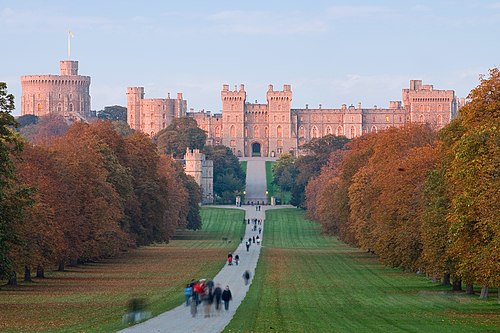 Windsor CastleRestored · prime 1820
 Tower of LondonRestored · prime 1285
 Bamburgh CastleRestored · prime 1904
All castles in England → · Strongest castles in England → · Castles of Europe
Play As Your Clan
Hold a real castle against whatever you choose to send at it, take a ship out in her own service years, or stand at the shoulder of someone the record remembers. The chronicler sets the scene; the deeds are yours.
Notable bearers of the Perry name
- Fred Perry (1909–1995), three-time Wimbledon men's singles champion (1934, 1935, 1936) and three-time US Open champion