Tice
also Tyas, Tyce, Theis
The German, a Norman byname for an incomer.
- Origin
- West Midlands, England
- Famous bearer
- George Tice (1938–2025), American photographer
- Register
- English family
Where the Tice name comes from
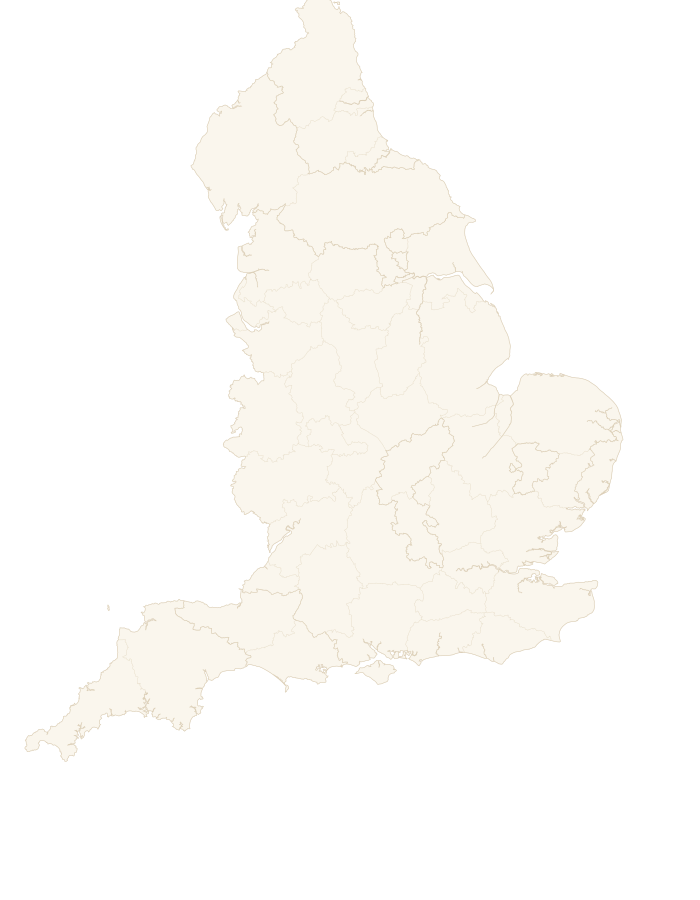
CoreHistoric reach
The seat of Tice
Seat vacantChief
No one leads the Tice community yet. When the movement opens, you can stand for its leadership, or help elect whoever does.
Current mission
No shared goal set yet. Once Tice has leadership, it sets the public focus: a restoration, a gathering, a real-world project that helps its own.
The Tice clan is being rebuilt. Join the waiting list for the movement today, and you help decide who leads it and what it does.
Help rebuild the Tice clan →What does the Tice name mean?
From the Anglo-Norman byname le Tieis (also Tyas, Tyeis), Old French tieis, 'the German' or 'the Teuton', a name given to a settler of German or Low-Countries origin, from the same Frankish root, thiudisk 'of the people', that gives Deutsch. A second strand contracts the church-name Matthias. The German layer makes Tice a textbook in-scope cross-European name, carried into the surname by Rhineland and Flemish incomers to medieval England.
The history of Tice
The byname that simply meant 'the German'
Tice descends from the Anglo-Norman byname le Tieis, written also as Tyas and Tyeis, from Old French tieis, 'the German' or 'the Teuton'. Behind it stands the Frankish thiudisk, 'of the people', the same root that gives Deutsch. It was not a compliment or an insult, only a label: English towns and manors absorbed German and Flemish weavers, merchants and soldiers, and the clerk who had to write such a man down in a roll wrote down where he had come from. The Warwickshire village of Tysoe preserves the related sound.
A second and quite separate strand contracts the church-name Matthias, and those lines fold into the same small pool. The name never became numerous in England. It stayed thin but persistent through the home counties and the east midlands: London, Kent, Essex and the Hertfordshire and Bedfordshire border early on, and later Warwickshire, Leicestershire and Rutland, and Northamptonshire.
The Rosetree, 1663, and the making of Ticetown
The best-documented Tice line did not stay in England at all. In 1663 a family from Liege, in Belgium, crossed on the ship Rosetree and settled in what is now Brooklyn. Their firstborn son, Peter Tyson, moved south to Monmouth County, New Jersey, in 1709, and as the family's last name shifted over the generations the district he settled became known as Ticetown. The surname pool in America was broader than that one crossing: Dutch and German Theis and Thys families anglicised their name on arrival in New Netherland and Pennsylvania and came out of the process as Tices, which is why the name reads as a recognisably American one today, and is denser there than in Britain.
In 1848 Jacob S. Tice built a homestead in that same New Jersey ground, and it housed four generations of a family of farmers and boatmen. By the time it was rediscovered it was dilapidated, and it came down completely in 2005. None of this was folk memory. It was established in 1992 by the family's best-known bearer, who went looking for the Tices and found them in a Belgian city rather than in the nineteenth-century Germany his own father had always believed in.
A Newark boy with a Kodak Brownie
George Andrew Tice was born in Newark, New Jersey, on 13 October 1938, the son of the insurance underwriter William S. Tice and of Margaret Robertson, a Traveller of Irish, Scottish and Welsh ancestry with a fourth grade education. He was raised by his mother and went regularly to his father for advice until William died, when George was nineteen. His first contact with photography was in his father's albums of family pictures, which gave him the wish to make images of his own, and he began with a Kodak Brownie.
In 1953 he bought a Kodak Pony, which gave him some command of exposure and focus, and a Kodak developing kit, and joined the Carteret Camera Club, where his photographs of homeless men on the Bowery took second place in the black-and-white print competition. That decided him on a career. He attended Newark Vocational and Technical High School in 1955 and studied commercial photography briefly under Harve Wobbe, then quit at sixteen for a job as darkroom assistant at Classic Photo, a Newark portrait studio. He was also a stock boy at Kresge's department store and an office boy in the circulation department of the Newark Evening News, where a clipping told him the actor James Dean was dead.
The explosion aboard the Wasp
Tice enlisted in the United States Navy in 1956. He scored well on the service IQ test but was refused admission to the Navy's photography school because he had not graduated from high school, and was put to work as a messenger instead. He talked a superior officer into transferring him, and came out of it a Photographer's Mate Third Class. After boot camp and two years at Naval Air Station Memphis he was sent to sea aboard the aircraft carrier USS Wasp.
One frame he made on that deck, Explosion Aboard the U.S.S. Wasp, 1959, ran on the front page of the New York Times. Edward Steichen, then Director of Photography at the Museum of Modern Art, was struck by it and asked for a print for the museum's collection. Tice received an honourable discharge the same year.
Reinventing a printing process the war had killed
In 1968 Tice met Lee Witkin, and the two of them pooled what they knew of the history of photography to found the Witkin Gallery in New York. That same year he turned to platinum printing, an art lost since the First World War, when wartime platinum prices drove the manufacturers of the special paper out of the business. William Willis's patents described that paper too poorly to work from, so Tice reinvented the process himself and set out what he had done in a 1970 issue of the British journal Album. In 1972 he went further back still, printing a photogenic drawing of leaves in a contact frame under sunlight on paper he had hand-sensitised with diluted silver nitrate, in the manner of Henry Fox Talbot's calotype negatives.
The reputation this built was as a printer as much as a photographer. Edward Steichen, in the last year of his life, appointed Tice the printer of his negatives, a duty Tice carried out until 1998 across several portfolios, including Twenty-Five Photographs in 1982 and In the Studio in 1984. He also printed the work of Frederick H. Evans, Francis Bruguiere and Edward Weston for the Witkin Gallery.
Paterson, and the working man's New Jersey
From 1960 Tice made short trips to Lancaster County, Pennsylvania, to photograph the Amish and Mennonite communities, work that became The Amish Portfolio in 1968 and Fields of Peace: A Pennsylvania German Album, published by Doubleday in 1970 with a text by Millen Brand. He photographed the Californian ghost town of Bodie, on the edge of the Sierra Nevada, and made studies of ice formations and aquatic plants; the 8 x 10 Deardorff view camera he bought with his Doubleday advance stayed his preferred instrument.
His first pictures of Paterson, New Jersey, date from 1967, and that city carried him. Rutgers University Press published Paterson in 1972, the Metropolitan Museum of Art gave him a solo exhibition of the work the same year, and the book took the Grand Prix du Festival d'Arles. Urban Landscapes: A New Jersey Portrait followed from Rutgers, an expansion of the same eye for the industrial cities and the scenes of the working man's environment that were then surviving only precariously. In 1977 he made Artie Van Blarcum: An Extended Portrait, following a Tri-County Camera Club member, then fifty-two, a third-generation factory worker sharing the family house with his brother. William Paterson University, which holds the Blarcum archive Tice gave it, exhibited it in 2015.
Lincoln, Hometowns and the grey skies of Yorkshire
Reading Carl Sandburg's biographies of Abraham Lincoln in 1981, and then coming across the Lincoln Motel and Abe's Disco in Newark, sent Tice off on a series cataloguing how Americans depict Lincoln, from the Lincoln Memorial down to painted murals in Lincoln, Illinois; Rutgers published it in 1984. In 1983 he went to the Midwest to photograph the hometowns of James Dean at Fairmount, Indiana, Ronald Reagan at Dixon, Illinois, and Mark Twain at Hannibal, Missouri, looking for both the fabric that had produced them and what the towns still remembered. That became Hometowns: An American Pilgrimage in 1988.
Ansel Adams recommended him for a Field Museum of Natural History commission to make a pair of sixty-foot murals of Sapelo Island, and Life sent him to Hutchinson, Kansas, and to Iowa on assignment. In 1990 a joint fellowship from the National Museum of Photography, Film and Television and Ilkley College took him to Bradford, and the atmospheric views of countryside and coast he made there were published as Stone Walls, Grey Skies: A Vision of Yorkshire, with an expanded edition in 1993.
Ticetown, photographed at last
Tice resumed the family research in 2004 and turned it into pictures. Lodima Press published Ticetown in 2007, his photographs of the New Jersey ground his ancestors had worked since 1709, and the record of a homestead that no longer stood. The whole of it, from Liege to Brooklyn to Monmouth County, had been established and then photographed by a bearer of the name.
The honours came in behind the work. He was inducted into the New Jersey Literary Hall of Fame in 1987, took fellowships from the National Endowment for the Arts and the Guggenheim Foundation, and was given the Lucie Award for Lifetime Achievement at Carnegie Hall in October 2015. A documentary, George Tice: Seeing Beyond the Moment, premiered at the Newark Museum in 2013 during his seventy-fifth birthday celebrations. He died at Middletown Township, New Jersey, on 16 January 2025, at eighty-six. His prints are held by the Art Institute of Chicago, the J. Paul Getty Museum, the Metropolitan Museum of Art, the Museum of Modern Art, the San Francisco Museum of Modern Art and the Whitney.
Historic Places, Rebuilt
Explore the streets and seats the Tice name knew, rebuilt with AI as they stood in history.
The castles of the homeland
The great strongholds of the homeland, look one up, see what it looked like in its prime, and recreate it to explore.
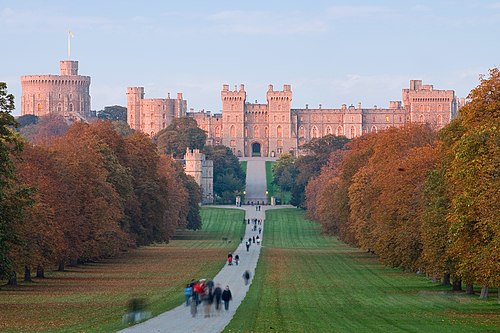 Windsor CastleRestored · prime 1820
 Tower of LondonRestored · prime 1285
 Bamburgh CastleRestored · prime 1904
All castles in England → · Strongest castles in England → · Castles of Europe
Play As Your Clan
Hold a real castle against whatever you choose to send at it, take a ship out in her own service years, or stand at the shoulder of someone the record remembers. The chronicler sets the scene; the deeds are yours.
Notable bearers of the Tice name
- George Tice (1938–2025), American photographer