Watkins
also Watkin, ap Watkin
Son of little Walter, the Norman first name that took Welsh root.
- Origin
- Gwent, Wales
- Famous bearer
- Vernon Watkins (1906–1967), poet, friend of Dylan Thomas
- Register
- Welsh family
The Watkins arms and country

Coat of armsArmorial Bearings of the WATKINS of HerefordshireBorne by the Herefordshire line, one branch of the name rather than all of it.Rs-nourse · CC BY-SA 4.0

- Coat of arms: Granted to an individual and inherited down that one documented line. These are the arms of particular families of the name, not of everyone who shares the surname.
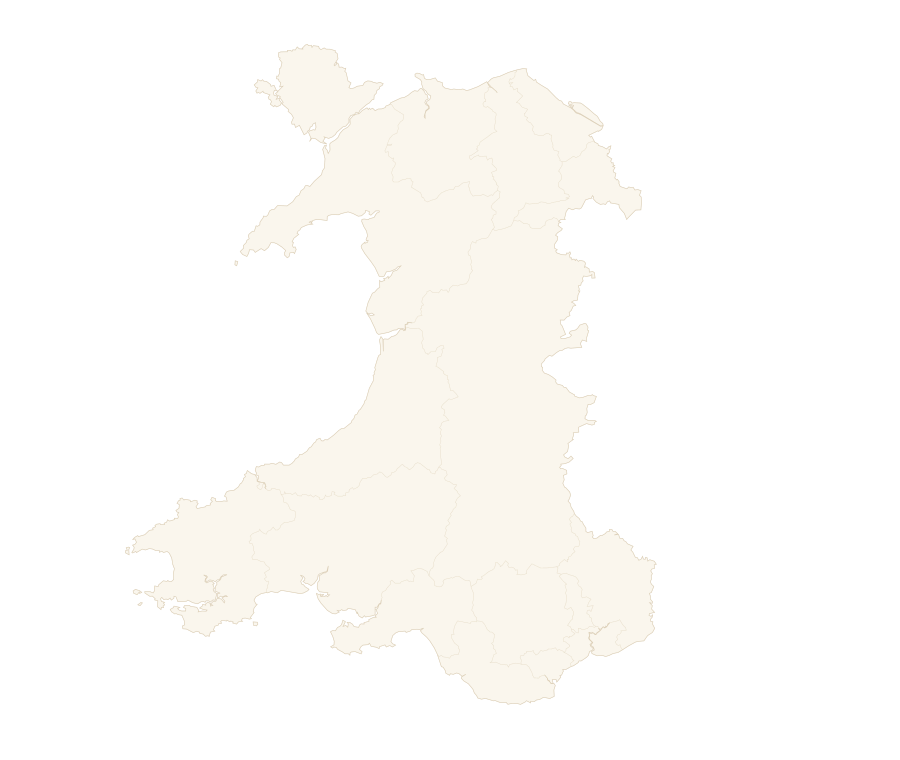
CoreHistoric reach
The seat of Watkins
Seat vacantChief
No one leads the Watkins community yet. When the movement opens, you can stand for its leadership, or help elect whoever does.
Current mission
No shared goal set yet. Once Watkins has leadership, it sets the public focus: a restoration, a gathering, a real-world project that helps its own.
The Watkins clan is being rebuilt. Join the waiting list for the movement today, and you help decide who leads it and what it does.
Help rebuild the Watkins clan →What does the Watkins name mean?
From ap Watkin, son of Watkin, a diminutive of Walter (the Norman name Wat + the diminutive -kin). Imported via the Anglo-Norman administration of the Welsh Marches in the 12th–13th centuries, Watkin became a frequent first name across the Welsh borderland from Hereford to Brecon. The patronymic ap Watkin compressed into Watkins under Tudor naming policy, carrying the genitive 's' that distinguished the Welsh form from the English Walters of the same root.
The history of Watkins
Where ap Watkin lost its ap
In 1292 forty-eight per cent of recorded Welsh names were patronymics, and in some parishes the figure passed seventy per cent. A man was his father's son and not much else: Thomas's boy was Evan ap Thomas, whose son was John ab Evan, whose son was Rees ap John. The strings could be run back seven generations, as in Llewelyn ap Dafydd ab Ieuan ap Gruffudd ap Meredydd, a spoken genealogy that Welsh law needed because descent from a common ancestor decided who held what. Watkin, a diminutive of the Norman Wat, reached that system through the Anglo-Norman administration of the Marches and became a frequent baptismal name from Hereford to Brecon.
The system broke first where England pressed hardest. Fixed surnames spread in Wales from the 15th century, became hereditary among the gentry in the reign of Henry VIII, and were general after the unification of 1536; town families, the wealthy and the border districts had gone over earlier still. Some Welsh names kept the ap as a stub, giving Powell from ap Hywel, Pryce from ap Rhys and Bowen from ab Owen. The Marches families took the English genitive instead, and ap Watkin closed up into Watkins. The consequence is a small stock of surnames shared by unrelated households: two Watkins families in one Monmouthshire village need not have a grandfather in common.
The Hereford brewer's son on his fortnightly circuit
Alfred Watkins was born at the Imperial Hotel, Hereford, on 27 January 1855, son of a Hereford hotelier, brewer and miller. He left school at fourteen, entered the family brewery at fifteen, and stayed in the brewing and hotel business as a partner for the next forty-five years. The day job made a traveller of him. From 1875 he worked a fortnightly circuit by horse and trap as the brewery's representative through Herefordshire, Shropshire, Gloucestershire, Monmouthshire and the Welsh Marches.
He had taken up photography in 1872, and the circuit turned into an archive. Parish churches, dolmens, Roman roads, market towns and working country went onto his plates, and he built the most extensive single photographic record of the late-Victorian Welsh-Marches landscape made by any working photographer of the period, all of it on the side of a full-time trade. About three thousand of his surviving plates are held at the Herefordshire Records Office and the Hereford City Museum.
The instrument came out of the same problem. Plate photography in the 1880s and 1890s asked the operator to judge exposure by rule of thumb from light, aperture, plate sensitivity and reflectance. Watkins worked out a calculation system for his own landscape work and in 1890 produced a clockwork device, the Bee Meter, which gave the reading on a dial. Patented in 1891 and made at his Hereford workshop, it was the first commercial photographic exposure meter, and by 1930 the Watkins Meter Company was the leading British photographic-instrument firm.
Bredwardine Hill, 30 June 1921
He was sixty-six when the second idea arrived. Riding across Bredwardine Hill in west Herefordshire on 30 June 1921 he stopped on the ridge and took out his Ordnance Survey map. A standing stone, a hillfort, a parish church, a moot-mound and a Roman road stood along a single straight line. He took it as evidence of what he called the ley system: ancient straight tracks across the British landscape, marked by those features and still readable on a modern sheet.
He set it out in 1925 in The Old Straight Track, which has been in print ever since. The book became a foundation text of twentieth-century British landscape writing and of earth-mysteries publishing, an influence running from the countercultural 1970s through to the Glastonbury and Stonehenge landscape tradition of the present day. Watkins died at his Hereford house on 7 April 1935, aged eighty, and is buried in Hereford Cathedral cemetery. A Marches brewer's family name, ap Watcyn worn down to Watkins, sits on both the first exposure meter and one of the most durable popular ideas about Britain's landscape.
A Victoria Cross, an Arctic explorer and a Medal of Honor
Tasker Watkins (1918–2007) was a Welsh judge and a Victoria Cross recipient. Gino Watkins (1907–1932) took the name the other way, out of Britain and onto the ice, as a British Arctic explorer. Oscar Ferris Watkins (1877–1943) served as a British colonial administrator.
American bearers of the name carried it into the same uniforms. Guy H. Watkins (1831–1864) was a lawyer and army officer, and Travis E. Watkins (1920–1950) received the Medal of Honor. Samuel R. Watkins (1839–1901) wrote as an American author and humorist.
Welsh internationals, and the name in other codes
Leonard Watkins (1859–1901) and Stuart Watkins (born 1941) were Welsh international rugby players, and Matthew Watkins (1978–2020) played rugby union for Wales. On the association side, Alfred Ernest Watkins (1878–1957), Mart Watkins (1880–1942) and Barry Watkins (1921–2004) were all Welsh footballers, and Allan Watkins (1922–2011) and Ryan Watkins (born 1983) were Welsh cricketers.
The name turns up in other codes and other countries. Eric Watkins (1880–1949) was a New Zealand rugby footballer and Les Watkins (1914–1974) an Australian rules footballer, while Nora Watkins played football in New Zealand. Chloe Watkins (born 1992) is an Irish field hockey player and Anna Watkins (born 1983) an English rower. Edgar Watkins (1887–1960) was a British gymnast; in the United States, Fenwick Watkins (1887–1943) was an athlete and coach and Harvey Watkins (1869–1949) a baseball manager.
Out of Glamorganshire
Wales held 587,000 people in 1801, 1,163,000 in 1851 and 2,421,000 by 1911, and most of the increase came in the coal mining districts. Glamorganshire alone went from 71,000 in 1801 to 232,000 in 1851 and 1,122,000 in 1911. The Watkins name sat thickest along the Welsh-Marches axis from Monmouthshire and Brecon north into Powys, and through the modern era it stayed tied to the iron and coal valleys of Gwent, Pontypool and Tredegar and Ebbw Vale, and to the Black Mountains farming country north of them.
What the pits did not hold, the ships took. Welsh families moved to Liverpool and Ashton-in-Makerfield during the Industrial Revolution; contract miners went to the coal towns of the Pas-de-Calais in the late nineteenth and early twentieth centuries; the Albion sailed from Cardigan for New Brunswick in 1819 with twenty-seven Cardiganshire families aboard. Emigration went in particular to Pennsylvania, where the Watkins diaspora settled in the anthracite communities, and to the Australian gold-rush districts of Ballarat and Bendigo; Jackson County, Ohio, was known as Little Wales and Malad City, Idaho, began as a Welsh Mormon settlement. Bearers of the name turn up across the same English-speaking world: Arnold Hirst Watkins (1851–1926), an English-born South African politician; Benjamin Watkins (1884–1963), an Australian politician; Daniel Watkins (1918–1982), a New Zealand businessman; J. Elfreth Watkins (1852–1903), an American engineer.
Desperate Dan, the sound stage and the operating theatre
Dudley D. Watkins (1907–1969) was the English comics artist who created Desperate Dan. Maurine Dallas Watkins (1896?–1969) was an American dramatist; Elizabeth Watkins (1923–2012) was an English author; Islwyn Watkins (1938–2018) was a Welsh artist. Alan Watkins (1933–2010) worked as a Welsh journalist and Kathleen Watkins (1934–2024) as an Irish broadcaster, actress and musician.
Two more of the name made their living from the plate and the print: Carleton Watkins (1829–1916), American photographer, and Margaret Watkins (1884–1969), Canadian photographer. A. W. Watkins (1895–1970) was an English sound engineer, Charlie Watkins (1923–2014) a British audio engineer, Peter Watkins (1935–2025) an English film director and Ronald Watkins (1904–2001) a British drama teacher. In the laboratory and the clinic the name belongs to Winifred Watkins (1924–2003), British biochemist, Arthur E. Watkins (1898–1967), English botanist, Sid Watkins (1928–2012), English surgeon and race doctor, and Calvert Watkins (1933–2013), the American linguist.
Champions of the Watkins name
The bearers whose lives are inseparable from this surname. Each has their own page, biography, achievements, geography, connection to the family.
Historic Places, Rebuilt
Explore the streets and seats the Watkins name knew, rebuilt with AI as they stood in history.
The castles of the homeland
The great strongholds of the homeland, look one up, see what it looked like in its prime, and recreate it to explore.
 Caernarfon CastleRestored · prime 1330
 Conwy CastleRuin · prime 1287
 Pembroke CastleRestored · prime 1280
All castles in Wales → · Strongest castles in Wales → · Castles of Europe
Play As Your Clan
Hold a real castle against whatever you choose to send at it, take a ship out in her own service years, or stand at the shoulder of someone the record remembers. The chronicler sets the scene; the deeds are yours.
Notable bearers of the Watkins name
- Vernon Watkins (1906–1967), poet, friend of Dylan Thomas
- Tom Watkins (1949–2022), music manager (Pet Shop Boys, Bros, East 17)
- Geraint Watkins (b. 1950), keyboardist and singer
Frequently asked
What does the surname Watkins mean?
Where does the Watkins family come from?
Where did the Watkins family historically hold territory?
Is Watkins Welsh or English?
How old is the Watkins surname?
What is the Watkins family known for?
Is there a Watkins family crest or coat of arms?
Who is the most famous Watkins?
Who are some famous Watkinses?
Is Watkin the same family as Watkins?
Is ap Watkin the same family as Watkins?
Where is the Watkins surname found today?
What does the Clan Rising page for the Watkins family cover?
Who is the head of the Watkins family today?
Neighbouring clans
- EvansSon of John, by the Welsh road, the cousin name of Jones.
- LewisLlywelyn anglicised, a princely name carried into common use across the Marches and the south.
- OwenThe princely name, Owain in Welsh, the surname of the last revolt and the first Tudor.
- LloydLlwyd, the grey one, the great descriptive surname of the central Welsh ridge.