Weston
The western farm, toponym epidemic.
- Origin
- South West, England
- Register
- English family
The Weston arms and country

Coat of armsWeston (of Sutton Place) ArmsBorne by the Sutton Place line, one branch of the name rather than all of it.Lobsterthermidor · CC BY-SA 3.0
_Arms.png)
- Coat of arms: Granted to an individual and inherited down that one documented line. These are the arms of particular families of the name, not of everyone who shares the surname.
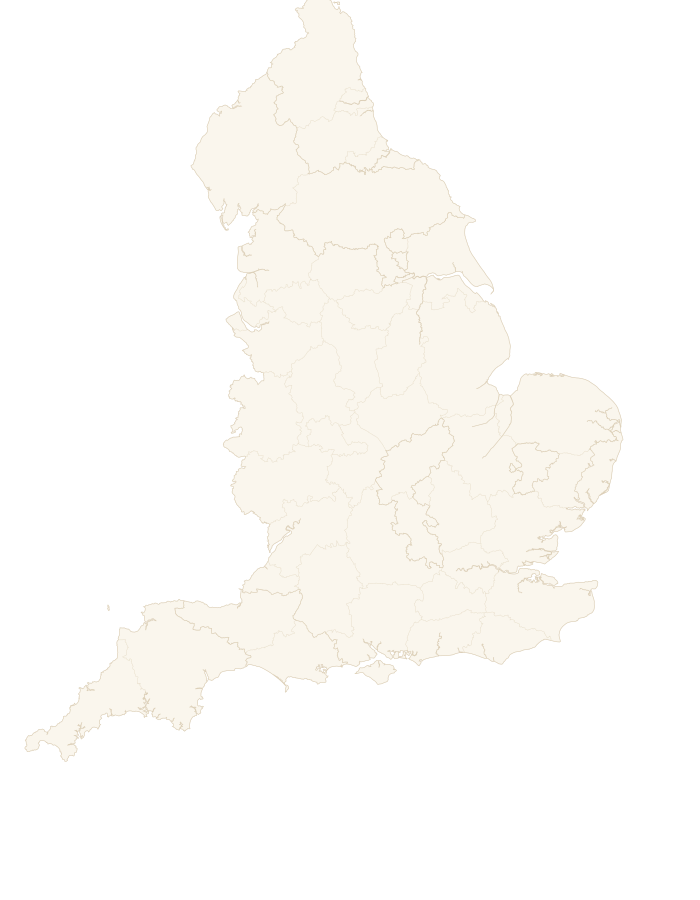
CoreHistoric reach
The seat of Weston
Seat vacantChief
No one leads the Weston community yet. When the movement opens, you can stand for its leadership, or help elect whoever does.
Current mission
No shared goal set yet. Once Weston has leadership, it sets the public focus: a restoration, a gathering, a real-world project that helps its own.
The Weston clan is being rebuilt. Join the waiting list for the movement today, and you help decide who leads it and what it does.
Help rebuild the Weston clan →What does the Weston name mean?
Locative, west farm or west enclosure. Dozens of Weston placenames.
The history of Weston
The western farm that England built a thousand times
Weston is one of the plainest place names in England and one of the most repeated. It is Old English west joined to tun, and tun never settled on a single meaning: in one name it carries the sense of an enclosure, in others a farmstead, a village, a manor or a whole estate. Any settlement lying west of the church or the manor house could be the west tun to the people east of it, which is why the surname sits behind dozens of separate places, thickest through Gloucestershire and Somerset.
None of those villages had surnames when they were named. Hereditary family names in England are generally dated to the making of the Domesday Book in 1086, after the Norman Conquest, and they began at the top: some of the Norman nobility who came over with William marked themselves out by putting de, meaning of or from, before the name of their village or estate. That territorial surname was a consequence of feudal landownership, and it is the mould Weston was poured into.
Inheritance came slowly, spreading from the gentry down through the rest of society, and some resisted it in the late Middle Ages because a fixed name meant taxes. By 1400 most English families had hereditary surnames, carried by children who had never seen the ground the name described. A man written down as de Weston had not belonged to a family; he was the man from the western farm. The name was coined afresh at each of those villages, so two Westons in a medieval roll are likelier to be strangers than kin.
A royal attendant, two Earls of Portland and the parliamentary Westons
The earliest bearer the record names is Francis Weston (c. 1513–1536), an English royal attendant. Edward Weston (1566–1635) served as an English priest, and Stephen Weston (1665–1742) rose to be an English bishop and educator.
In the 17th century the name held an earldom: Jerome Weston, 2nd Earl of Portland (1605–1662), an English nobleman, and Charles Weston, 3rd Earl of Portland (1639–1665). Parliament saw Westons too, in Samuel Weston, an English politician who died in 1716, and Edward Weston (1703–1770), a British politician of the 18th century.
The Arthurian scholar, the linguist and the clergyman on the mountain
Stephen Weston (1747–1830) was an English linguist, poet and translator, and a Fellow of the Royal Society. A century later Jessie Weston (1850–1928) was at work as a British writer on Arthurian legend. A second Jessie Weston, no relation given, was a New Zealand novelist and journalist who lived from 1867 to 1939; that coincidence is the point of a habitation surname.
Walter Weston (1861–1940) was an English clergyman and mountaineer. Margaret Weston (1926–2021) directed a British museum, and Anthony Weston, born 1954, is an American philosopher and author.
King Caesar's shipyard and the hyphen in Hunter-Weston
Ezra Weston II (1772–1842) was an American shipbuilder, known also as King Caesar. Joseph Dodge Weston (1822–1895) was an English merchant, shipping magnate and politician, and Charles Weston (1922–1999) took the name into the modern Royal Navy as president of the Royal Naval College at Greenwich.
Aylmer Hunter-Weston (1864–1940) was a British general and politician, and his name records a second English habit: the compound surname, formed by adding another family's name, most often as a condition of inheritance. David John Weston, born 1898, was a flying ace of the First World War.
Sir Galahad at Bluff Cove
Simon Weston was born on 8 August 1961 on the council estate at Nelson, on the south side of Caerphilly mountain in Glamorgan. He was working to pay for his school dinners by twelve, took the apprentice form for the Welsh Guards at thirteen, and joined as a sixteen-year-old recruit in 1977, spending his late teens on London ceremonial duty, at Pirbright and on a tour in Berlin.
He was a lance-corporal of twenty when the Welsh Guards embarked for the South Atlantic with 5 Brigade after the Argentine occupation of the Falkland Islands. On 8 June 1982 the logistics ship Sir Galahad lay off Bluff Cove on East Falkland with the Guards aboard waiting to disembark when three Argentine Skyhawks bombed her and the ship caught fire. Forty-eight British servicemen were killed, and Weston was among the most badly burned of the survivors.
What followed is one of the great recoveries in the British public record. More than seventy reconstructive operations at Frenchay Hospital in Bristol over the next decade kept him the use of his hands and rebuilt the structure of his face, and the BBC documentary Simon's War carried the story on the nation's evening news through 1982 and 1983. He came home to Wales in 1985 having decided to turn what he had been through into work for others.
In 1987 he co-founded the Weston Spirit charity in Liverpool with Roger Daltrey and Bob Geldof, on the principle that his own recovery could serve as a model for young people facing their own disruption; it ran for twenty years. In 1991 he met Carlos Cachon in Buenos Aires, the Argentine pilot who had led the attack on the Sir Galahad, and the two have been friends since. He was made OBE in 1992 and CBE in 2016.
A Toronto bakery, Fortnum's counter and the gates of Barretstown
The best documented Weston kindred begins with a shop. George Weston (1864–1924), an American-born Canadian, bought a bakery in Toronto in 1884, and his descendants established themselves in the United Kingdom, Ireland and the United States. Through George Weston Limited and its holding companies the Canadian branch came to own or control over two hundred companies, among them the Loblaws supermarkets and the Shoppers Drug Mart pharmacies.
W. Garfield Weston (1898–1978), son of George, was a Canadian businessman who also sat as a British MP. The British arm runs through Wittington Investments, 79.2 per cent of which belongs to the charitable Garfield Weston Foundation; it holds a majority of Associated British Foods, owner of Primark, and all of Fortnum and Mason and Heal's. In 2021 The Sunday Times named the family among the most charitable people of the previous twenty years, with donations of 1.661 billion pounds.
For ten years the family held Barretstown Castle at Ballymore Eustace in County Kildare, on the site of a late 12th-century Anglo-Norman castle and first recorded in a 1547 inquisition after the Dissolution of the Monasteries. Elizabeth Arden bought it in 1962; after her death in 1967 Garfield Weston took up residence, and in 1977 the family presented the estate to the Irish government. It now hosts the Barretstown camp for sick children.
Aston Villa, the roller-derby track and the long walk west
Percy Weston (1852–1905) played football for England in 1871 and 1872. Tommy Weston (1895–1952) played for Aston Villa and Stoke City, and Rhys Weston, born 1980, is a Welsh footballer. Stanley Weston (1923–2000) and Harry Weston (1928–2008) were British basketball players and brothers, one of the few certain kinships in the whole roll of the name.
The name travelled with the emigrant ships. Edward Payson Weston (1839–1929) was an American pedestrian, a walker by profession; Joan Weston (1935–1997) skated American roller derby; cricket collected Martin Weston and Phil Weston in England, Tim Weston in New Zealand and Daniel Weston in Germany.
Elsewhere the name sits in the arts and the laboratories: the American photographers Edward Weston (1886–1958) and Brett Weston (1911–1993), the American modernist painter Harold Weston (1894–1972), the Australian painter Harry J. Weston (1874–1955), the American chemist Edward Weston (1850–1936), the English acoustician David E. Weston (1929–2001) and the American music arranger Paul Weston (1912–1996).
A surname that began as the dullest description available, the farm on the west side, was carried to Canada, the United States, Australia and New Zealand by families who mostly never met, and who between them left it on a bakery, a burns ward, a shelf of Arthurian scholarship and a castle given away to sick children.
Champions of the Weston name
The bearers whose lives are inseparable from this surname. Each has their own page, biography, achievements, geography, connection to the family.
Historic Places, Rebuilt
Explore the streets and seats the Weston name knew, rebuilt with AI as they stood in history.
Castles the Weston held
Strongholds this name held for a decade or more, look one up, or rebuild it to explore.
- Barretstown Castle
The Weston family held Barretstown from 1967 until presenting it to the Irish state in 1977.
The castles of the homeland
The great strongholds of the homeland, look one up, see what it looked like in its prime, and recreate it to explore.
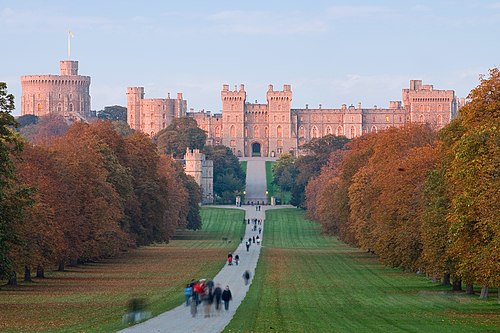 Windsor CastleRestored · prime 1820
 Tower of LondonRestored · prime 1285
 Bamburgh CastleRestored · prime 1904
All castles in England → · Strongest castles in England → · Castles of Europe
Play As Your Clan
Hold a real castle against whatever you choose to send at it, take a ship out in her own service years, or stand at the shoulder of someone the record remembers. The chronicler sets the scene; the deeds are yours.