Cathedral · Russia · Restored
Cathedral of Christ the Saviour
The Cathedral of Christ the Saviour is a Russian Orthodox cathedral on the northern bank of the Moskva River in Moscow. The present building is a full reconstruction completed around 2000 on the site of the 19th‑century cathedral that was demolished in 1931; it serves as a major place of worship and ceremonial events.
First raised
2000
Its prime
2007
Today
Restored
As it stood in 2007
What Cathedral of Christ the Saviour looked like in its prime.
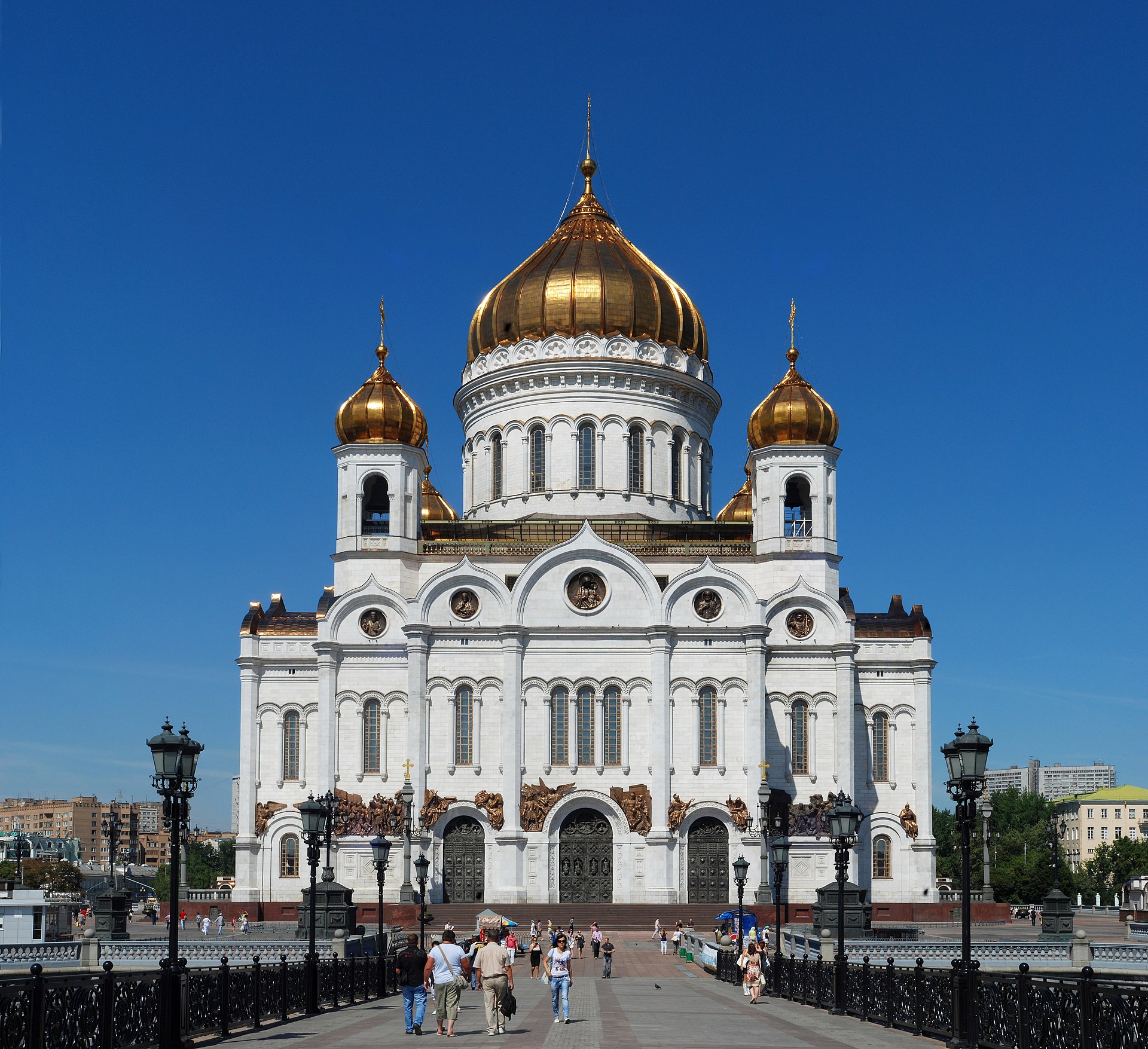
A monumental white stone (ashlar) basilica set on a raised plinth, dominated by a very large central gilded onion dome flanked by four smaller gilded cupolas and twin bell towers. Tall round‑arched clerestory windows ring the drum beneath the main dome; broad stone steps lead up to three deep arched portals with sculptural reliefs and heavy bronze doors. The cathedral sits above the Moskva River with a pedestrian bridge and paved plaza approaching the façade.
Its story
The story of Cathedral of Christ the Saviour.
Alexander I's Vow and Vitberg's Temple on the Sparrow Hills, 1812–1835
The idea of a church raised in thanks for the defeat of Napoleon was first put in December 1812 by General Pyotr Kikin, a companion of Alexander I, who wanted to revive the old Russian practice of the votive church, built after a victory and in memory of those killed in it. On 25 December 1812, after Napoleon's troops had been driven out of Russia, Alexander I signed a manifesto declaring his intention to build a cathedral in Moscow in honour of Christ the Saviour "to signify Our gratitude to Divine Providence for saving Russia from the doom that overshadowed Her", and as a memorial to the sacrifices of the Russian people.
An open international competition drew 38 architects, among them Andrey Voronikhin, Giacomo Quarenghi and Vasily Stasov, and in 1814 the brief was tightened to a cathedral to be finished within ten or twelve years. It was won by Aleksandr Vitberg, a 28-year-old painter and freemason who converted to Orthodoxy in order to have his design approved. His temple was to rise in three tiers on the Sparrow Hills, the highest point in Moscow, a hill Alexander I liked to call the crown of the city, approached by a road between the Smolensk and Kaluga highways, by one of which Napoleon's army had entered Moscow and by the other left it. The design was flamboyantly Neoclassical and full of Masonic symbolism: a pantheon of the war dead, a colonnade of 600 columns cast from captured cannon, and a lowest tier cut into the rock as a place of remembrance for the soldiers killed in 1812. The foundation was laid on 12 October 1817, the fifth anniversary of the liberation of Moscow from the French, before Alexander I, the two empresses, Grand Duke Nikolai Pavlovich, Prince William of Prussia and Archbishop Augustin.
Earthworks began in 1821 under a commission chaired by Metropolitan Serafim of Moscow and the city's military governor-general, and by some accounts more than 20,000 serfs from the Moscow region were bought for the labour. Progress slowed all the same, and after seven years not even the groundworks were done; Vitberg, who had no practical experience of running a building site, kept no proper accounts, wrote his orders in pencil and trusted his contractors. Work stopped when Nicholas I came to the throne in 1825, officially because the ground on the Sparrow Hills was unsound, and a committee under the engineer-general Karl Opperman reported on 17 February 1828 that a building of that size could not be raised there at any bearable cost. The commission was dissolved in 1827, and Vitberg and the site managers were prosecuted for embezzlement in a trial that ran eight years: in 1835 those involved were fined a million roubles for abuse of the emperor's trust and for losses to the treasury, and Vitberg was exiled to Vyatka with his property confiscated. Some historians hold that he was guilty of carelessness and credulity rather than theft. His exile did not last long, and his designs were afterwards used for Orthodox cathedrals in Perm and Tiflis.
Konstantin Thon on the Volkhonka: Building the First Cathedral, 1831–1883
Nicholas I, Orthodox and patriotic in temper, disliked both the Neoclassicism and the Freemasonry of his brother's chosen design. He held no second competition, appointing in 1831 his favourite architect Konstantin Thon, who worked in the Russian-Byzantine style the emperor favoured and took Hagia Sophia in Constantinople as his model; the plan was approved on 10 April 1832. The emperor also chose a new site, on the Volkhonka, then called Chertolye, a few hundred metres from the Kremlin. The buildings there were bought up and cleared, among them the seventeenth-century Alekseyevsky convent, which was moved to Krasnoye Selo, and a story survived in the city that its abbess, angered by the demolitions, cursed the builders and foretold that the place would stand empty. A new commission was appointed under the governor-general of Moscow, Prince Dmitry Golitsyn, and unlike Vitberg's, this cathedral was paid for almost entirely from the treasury.
Work on the foundations began in the summer of 1837, and on 10 September 1839 the cornerstone was laid by Metropolitan Filaret of Moscow before Nicholas I, the stone brought specially from the Sparrow Hills. The walls reached plinth level by 1841 and the vault of the great dome was closed eight years later. The outer scaffolding came down in 1860, but decoration, and the making of the embankment and the square, went on for another twenty years. Thon's pupil Iosif Kaminsky ran the site, Evgraf Sorokin oversaw the painting, and Vasily Surikov, Ivan Kramskoi, Vasily Vereshchagin and Fyodor Bruni of the Imperial Academy of Arts worked on the interior for two more decades. The great dome was gilded by the new method of gold electroplating in place of the older and less secure mercury gilding. The building took its official name as the cathedral of Christ the Saviour in 1880, and when Thon died in 1881 the work passed to his pupil Alexander Rezanov.
The lower gallery around the inner sanctum was made a memorial to the war. Its walls carried more than 1,000 square metres of Carrara marble plaques listing the commanders, regiments and battles of the Patriotic War of 1812 with the awards and casualties appended: 71 engagements fought on Russian soil in 1812 and 87 fought abroad, the sequence closing with the manifestos on the taking of Paris, the fall of Napoleon and the peace in Europe. The 117 plaques were finished in 1879, and the officers named on them made the building a collective cenotaph for the soldiers of the imperial army who fell against Napoleon. Tchaikovsky's 1812 Overture, written with the cathedral's completion in mind, was first performed in August 1882, in the cathedral under the baton of Ippolit Altani by one account and in a tent outside the unfinished building by another. The consecration followed on 26 May 1883, performed by Metropolitan Ioannikiy of Moscow and attended by Alexander III within days of the emperor's coronation in the Kremlin, though the accounts differ over whether it fell just before the coronation or just after. At 103.5 metres the cathedral was then the tallest building in Moscow and the most capacious church in the country, holding up to 7,200 people, and had cost the treasury around 15 million roubles, with more than 20 puds of gold given by the merchants of Moscow for the gilding. Not everyone admired it: the battle painter Vasily Vereshchagin thought Thon a rather untalented architect and the cathedral a direct reproduction of the Taj Mahal at Agra.
Soviet Moscow: Closure, Demolition and the Palace of the Soviets, 1917–1994
On 5 November 1917 it was in the cathedral, after the liturgy, that the name of the new patriarch was announced, the elder Alexy of the Zosima Hermitage drawing the lot bearing the name of Metropolitan Tikhon. Alexander Khotovitsky served as key-keeper from August 1917 until his arrest in 1922. The cathedral went on working after the revolution, though from January 1918 the Bolsheviks ended state funding of churches and a brotherhood was formed to keep it open on private donations. The state atheism of the USSR produced the anti-religious campaign of 1921 to 1928, in which many church institutions at local, diocesan and national level were systematically destroyed. The cathedral's clergy and parishioners refused to accept the Higher Church Administration set up by the Renovationists in May 1922, shortly after Patriarch Tikhon was placed under house arrest, and when two Renovationist bishops tried to hold an ordination there the congregation would not allow it. On 6 June 1922 the Higher Church Administration asked the state to investigate counter-revolutionary activity in the cathedral. The request was granted, the Renovationists took the building, and one of their leaders, Metropolitan Alexander Vvedensky, was installed as rector, a post he held until the cathedral was closed in 1931.
In the 1930s the state's development plans needed more money than it had, and government departments began to look at the religious and historical monuments not yet destroyed or turned to other uses as a source of revenue. On 24 February 1930 the economic department of the OGPU wrote to the chairman of the Central Executive Committee asking to strip the gilding from the cathedral's domes, noting that they held over 20 tons of gold of "excellent quality" and that the building was an "unnecessary luxury for the Soviet Union, and the withdrawal of the gold would make a great contribution to the industrialization of the country". The People's Commissariat of Finance raised no objection. The Politburo prepared the decision on 5 June 1931, and on 13 July 1931 a meeting of the Central Executive Committee chaired by Mikhail Kalinin resolved that the site for the Palace of the Soviets was to be the cathedral square, "including the demolition of the cathedral itself and the necessary expansion of the square". Eleven days later the Committee for Cult Affairs ruled that the church was to be liquidated and demolished within ten days, and that the OGPU's petition for the washing of the gold was to go before the secretariat. Dismantling went on for several months, and it was then decided to blow up what was left. Two charges were fired on 5 December 1931; the first brought down the domes and the upper tiers while the shell of the building stood, and witnesses recalled that neighbouring buildings shook and that the blast was felt several blocks away. Clearing the rubble took about a year and a half. In 1937 facing stone from the cathedral was used on the building of the Council of Labour and Defence and on stations then being built on the Sokolnicheskaya line of the metro, and marble from the walls and benches went into metro stations nearby. The original marble high reliefs were preserved and are held at the Donskoy Monastery, where for decades they were the only reminder of one of the largest Orthodox churches ever built.
Sergei Kirov had first proposed a Palace of the Soviets for the capital in 1922, at the First All-Union Congress of Soviets, and after Lenin's death in 1924 Stalin settled on the cathedral's site for it. The design carried modernistic buttressed tiers up to a dome bearing a colossal statue of Lenin with his arm raised, and the building was to house the Supreme Soviet of the USSR. Excavation of the pit began in 1935, and by 1939 the foundation of the high-rise section was complete, 280 steel plates laid on a concrete ring to take the shoes of the frame's columns. The project was given up when Germany invaded the Soviet Union in 1941; part of the steelwork was cut into anti-tank hedgehogs for the defence of Moscow, and the frame that had risen above the foundation was taken apart the following year. Lack of funds and flooding from the Moskva had told against the scheme as well, and it was abandoned altogether in 1956. The flooded foundation pit was turned instead into the Moskva open-air swimming pool, built under Nikita Khrushchev and described as the largest in the world, which lasted until 1994; the water evaporating from it corroded the buildings around, and staff at the Pushkin Museum complained that it was damaging the safety of their exhibits.
Rebuilt on the Old Plinth: Petition, Fund and Consecration, 1988–2000
An action group formed in Moscow in April 1988 to press for the cathedral's rebuilding, putting it as an act of repentance towards the Russian Orthodox Church for the destruction of the monument and circulating material that official Soviet rhetoric did not allow. After the millennium of the baptism of Rus was marked that summer, state policy towards the church softened; in September 1989 the group became an Orthodox community and organised a people's referendum for the rebuilding, which thousands of Soviet citizens supported. A first restoration fund was set up in 1989 under the writer Vladimir Soloukhin, but inflation had wiped out almost everything it collected by 1992. In February 1990 the church received permission from the Soviet government to restore the cathedral, and on 5 December 1990 a granite stone was laid for the log chapel of the Derzhavnaya icon of the Mother of God, the small forerunner church of the complex, finished in 1995. A second fund followed in 1992, meant to work without budget money, though a decree of Boris Yeltsin gave tax relief to donors and to the companies involved. Between 1994 and 2002 money came from hundreds of thousands of Russian citizens and from Russian and foreign firms; about a million Muscovites gave to the project, and 50 million roubles from the Military-Industrial Bank started the building. On 31 May 1994 the Moscow Patriarchate and the city government resolved to begin work, under a council headed by Patriarch Alexy II and the mayor of Moscow, Yuri Luzhkov. Because the icon-painting schools had not operated through the Soviet period and much of the craft had been lost, a department of church-historical painting was opened at the Repin Institute in St Petersburg to train the painters.
The design was drawn by Mikhail Posokhin, Aleksey Denisov and others. Denisov, called in to design a replica, was dismissed from the project after disagreements with the mayor's office and was replaced by Zurab Tsereteli, who finished the work and altered the approved design, replacing the white stone facing with marble and reproducing the lost white marble compositions as bronze high reliefs, criticised as unfaithful to the originals kept at the Donskoy Monastery. The rebuilding went ahead under protest as well as support, with accusations of corruption levelled at the city authorities, and the worth of the new interior painting was disputed too. The art historian Irina Yazykova judged that the intention of restoring the cathedral in its old grandeur had not been met, a concrete church reading differently from a stone one in bulk and silhouette, though she thought far greater historical fidelity had been reached inside. The Moskva pool was dismantled in 1994 and the cathedral was raised on the old plinth in other materials, a two-level building with the church of the Saviour's Transfiguration in the base, consecrated by Alexy II on the feast of the Transfiguration, in August 1996 by one account and in 1997 by another. The upper church was opened to visitors on 31 December 1999, and the great consecration was performed on 19 August 2000 by the bishops of the Council of the Russian Orthodox Church.
Canonisations, Councils and City Custody, 2000–2025
The day after that consecration the cathedral was the setting for the canonisation of the Romanovs, the last tsar Nicholas II and his family, who had been shot by the Bolsheviks in 1918, together with the synaxis of the new martyrs and confessors of Russia. A Bishops' Council held in the Hall of Church Councils in 2004 decided on the restoration of communion with the Russian Orthodox Church Outside Russia, separate since the 1920s, and on 17 May 2007 the Act of Canonical Communion was signed in the cathedral, Patriarch Alexy II and Metropolitan Laurus, First Hierarch of ROCOR, concelebrating the Divine Liturgy for the first time. Boris Yeltsin, who died of heart failure on 23 April 2007, lay in state there before his burial at Novodevichy Cemetery; the first funeral held in the cathedral, before it was consecrated, had been that of Soloukhin, who died in 1997. The funeral of Alexy II took place there on 9 December 2008, the Local Council that met in the cathedral on 27 January 2009 elected Kirill as patriarch, and he was enthroned on 1 February.
On 21 February 2012 five members of the punk group Pussy Riot staged what they called a punk prayer in front of the sanctuary, in protest against Vladimir Putin, singing "Mother of God, please banish Putin!"; three of them, Yekaterina Samutsevich, Maria Alyokhina and Nadezhda Tolokonnikova, were identified and sentenced to two years in a general-regime colony for hooliganism motivated by religious hatred, while the other two left Russia. A service in defence of the faith and of desecrated holy places was held at the cathedral on 22 April 2012, attended by about 65,000 people on the Moscow police estimate, and on 9 September 2012 the church marked the bicentenary of the victory of 1812 there. Relics brought for veneration have drawn very large crowds, among them the Gifts of the Magi from the monastery of St Paul on Athos in January 2014, taken out of Greece for the first time, and the right hand of Spyridon of Trimythous from Kerkyra between 21 September and 14 October 2018, venerated by more than 500,000 people. On 26 November 2025, at a concert in the Hall of Church Councils for the 130th anniversary of Sergei Yesenin, the actor and poet Vadim Dzyuba spoke in support of political prisoners.
The rebuilt cathedral is 103 metres high, the third tallest Orthodox church building in the world, and as of 2018 the largest cathedral of the Russian Orthodox Church, able to hold up to 10,000 people; below the church are a hall for church assemblies and the cathedral museum, and it is designated a tentative cultural heritage site in Russia. Its rector is the Patriarch of Moscow and All Russia and it holds the status of a patriarchal podvorye, but the buildings of the complex and the land under them are the property of the city of Moscow, and the complex is managed by the non-governmental Cathedral of Christ the Saviour Fund under a trust agreement with the city's property department signed on 24 May 2004. The church itself is used by the Russian Orthodox Church free of charge, while the secular parts of the building are rented on ordinary terms; the fund meets the running costs from commercial operations and from city subsidies, which came to 140 million roubles in 2006, 170 million in 2007 and 217 million in 2011.
Step inside
10 places to explore in 2007.
The record describes 10 distinct spots at Cathedral of Christ the Saviour, including 6 interiors: south bell tower (belfry), naos (inner sanctum) and central nave, ground‑floor memorial gallery and more. Create your own photoreal reconstruction and explore every one, more scenes means more photos, more angles and more of the immersive experience.
Build Your Own Castle
Recreate Cathedral of Christ the Saviour with AI to explore it.
Rebuilds stop at 1945, so the artist raises this site as it stood in 1900, not today's building, as a photoreal reconstruction that belongs to you alone. Pay with coins, no subscription needed.
Recreate Cathedral to Explore →
Landmarks within reach of Cathedral of Christ the Saviour.


More landmarks of Russia


Explore the city


