
Scotland · Partial ruin
Mugdock Castle
Mugdock Castle was the medieval stronghold of Clan Graham, located on a steep volcanic mound at the western edge of Mugdock Loch in what is now Mugdock Country Park. The site preserves a 14th-century four-storey tower and fragments of curtain wall, with later domestic ranges and a 19th-century Scottish baronial house built within the old walls. The surviving medieval tower has been conserved and the estate is publicly accessible.
Its prime
1885
Today
Partial ruin
As it stood in 1885
What Mugdock Castle looked like in its prime.
A narrow, roughly rectangular four-storey stone tower of pale grey volcanic sandstone rises from a grassy mound, its two upper storeys projecting on a line of corbels that give a top-heavy profile and a defended parapet along the roofline; small rectangular windows pierce the solid walls. Low stretches of curtain wall, arched gate remains and rubble-built domestic ranges cluster around a central courtyard. By the late 19th century a three-storey L-shaped Scottish baronial house stood against the tower linked by a wide-arched covered passage; the setting is parkland beside the loch.
Its story
The story of Mugdock Castle.
The Grahams Take Mugdock, Mid-13th Century to 1458
The lands of Mugdock passed to the Grahams in the middle of the 13th century, when David de Graham of Dundaff acquired them from the Earl of Lennox. The castle itself may have been raised by his descendant Sir David de Graham, who died in 1376, or by that man's son in 1372. It was set on a steep-sided natural mound of hard volcanic rock at the western edge of Mugdock Loch, then a broader sheet of water than it is now.
The plan may have been shield-shaped, towers ranged around a courtyard and linked by curtain walls and blocks of building, with the main gate in the middle of the south wall. Of that early castle only the south-west tower survives complete: a narrow four-storey block entered at first-floor level by exterior steps on the east side, its basement vaulted and a single room to each storey. In 1458 the lands were erected into the Barony of Mugdock, and the castle was probably enlarged at about that time, an outer wall taking in most of the mound as an outer courtyard with its own entrance on the south, beside the south-west tower.
Montrose, the Covenant and Two Sackings, 1505–1650
The Grahams were created Earls of Montrose in 1505. The most famous of them, James Graham, 1st Marquess of Montrose, may have been born at Mugdock in 1612.
During the Bishops' Wars, a prelude to the Wars of the Three Kingdoms, Montrose briefly supported the Covenanters. In 1641 he was imprisoned in Edinburgh for intrigues against Archibald Campbell, 1st Marquess of Argyll, who was to become his arch-enemy, and while he was held there Lord Sinclair sacked Mugdock. He returned to the castle until 1644, when he began his Royalist revolt as the King's commander in Scotland; Mugdock was sacked again that year. Following the defeat of Charles I, Montrose was executed in 1650 and the lands were forfeited to Argyll.
The Grahams Recover Mugdock, 1661–1682
In 1661 Argyll was himself executed, and Mugdock was returned to the Grahams. They spent two years restoring the castle, raising a mansion inside the old walls. In 1682 the family bought Buchanan Auld House near Drymen, a dwelling more fitting the title of Marquess, though their official seat was kept at Mugdock for some time afterwards.
John Guthrie Smith's Baronial House, 1820s–1880s
A terraced walled garden with a summer house was laid out east of the castle in the 1820s. From 1874 the house was leased by the local historian John Guthrie Smith (1834–1894), a relation of the Smith family of nearby Craigend Castle. He had the 17th-century mansion demolished and commissioned a three-storey house in the Scottish baronial style within the ruins of the old castle, extended to designs by James Sellars in the 1880s. Whatever remained of the eastern towers was obliterated by the work; the surviving south-west tower was tied to the new house by a covered first-floor passage carried over a wide-arched bridge.
The Frasers and the Making of Mugdock Country Park
The house was requisitioned for government use during the Second World War. In 1945 Hugh Fraser, later Lord Fraser, owner of the large retail chain now known as House of Fraser, bought Mugdock from the Duke of Montrose. The 19th-century Mugdock House burned down in 1966 along with the remaining 16th-century outbuildings, and was mostly demolished to its foundations the following year, though some of its walls still stand to first-floor level.
In 1981 Lord Fraser's son Sir Hugh Fraser, 2nd Baronet, gifted the castle and the surrounding estate to Central Regional Council for use as a country park. Mugdock has been protected as a scheduled monument since 1969. The estate remains Mugdock Country Park, the ruins are publicly accessible, and the surviving 14th-century tower has been renovated as a museum.
Step inside
10 places to explore in 1885.
The record describes 10 distinct spots at Mugdock Castle, including 3 interiors: vaulted basement of the tower, upper-storey single rooms, chapel at the north extent of the courtyard. Create your own photoreal reconstruction and explore every one, more scenes means more rooms, more angles, and more of the place to stand in.
Build Your Own Castle
Recreate Mugdock Castle with AI to explore it.
The artist rebuilds it as it stood in 1885, a photoreal reconstruction that belongs to you alone. Pay with coins, no subscription needed.
Recreate this castle →Defend this castle →Whose castle
Clans who held Mugdock Castle.
The families that held Mugdock Castle for a decade or more across its history, follow a name to its clan.
From the archive
Mugdock Castle on paper: the measured plan and period views.
The survey plan and photographs below are the ground truth this page's reconstructions are checked against, drawn and photographed while the castle was still a working garrison. Every image is public-domain or openly licensed, with its source named.
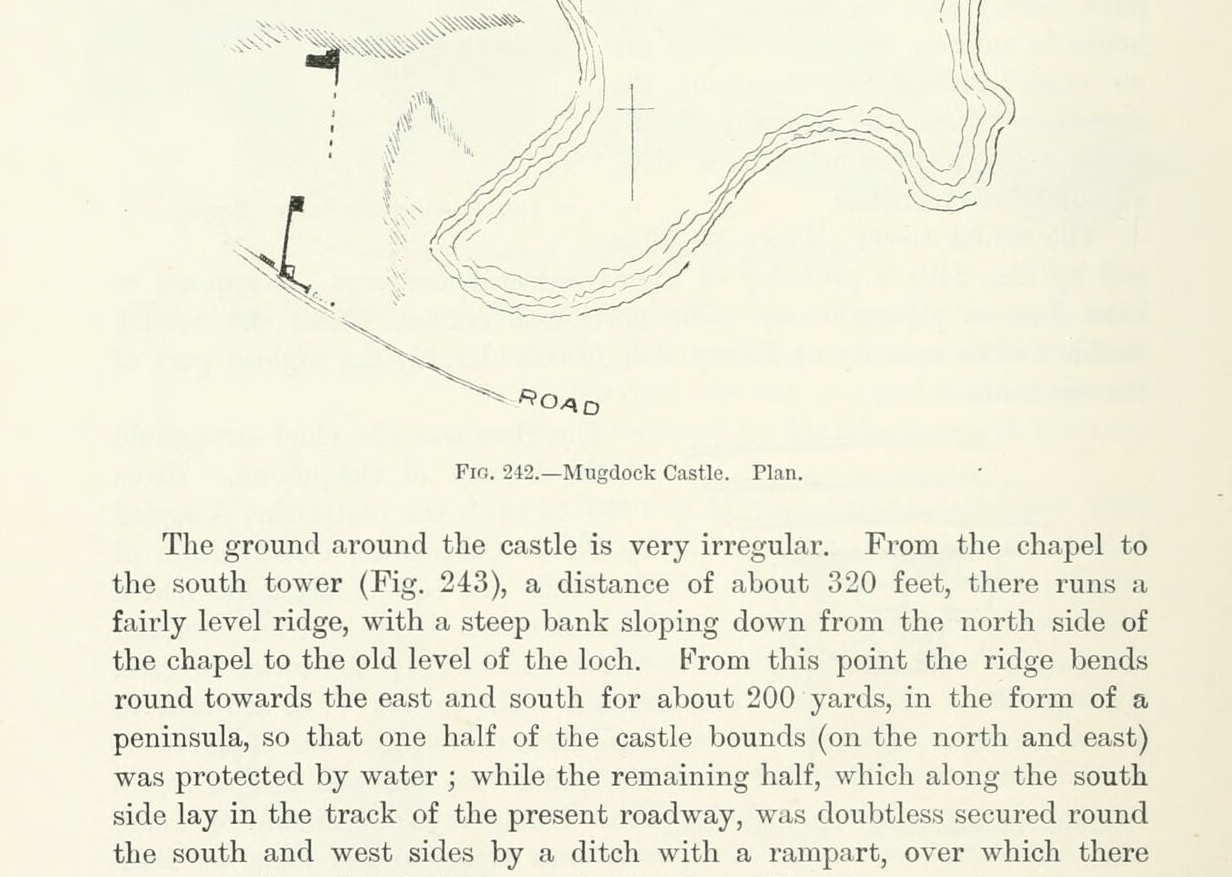
Fig. 242. Mugdock Castle. Plan.
1889 · MacGibbon & Ross, vol. 3 (1889)
Public domain
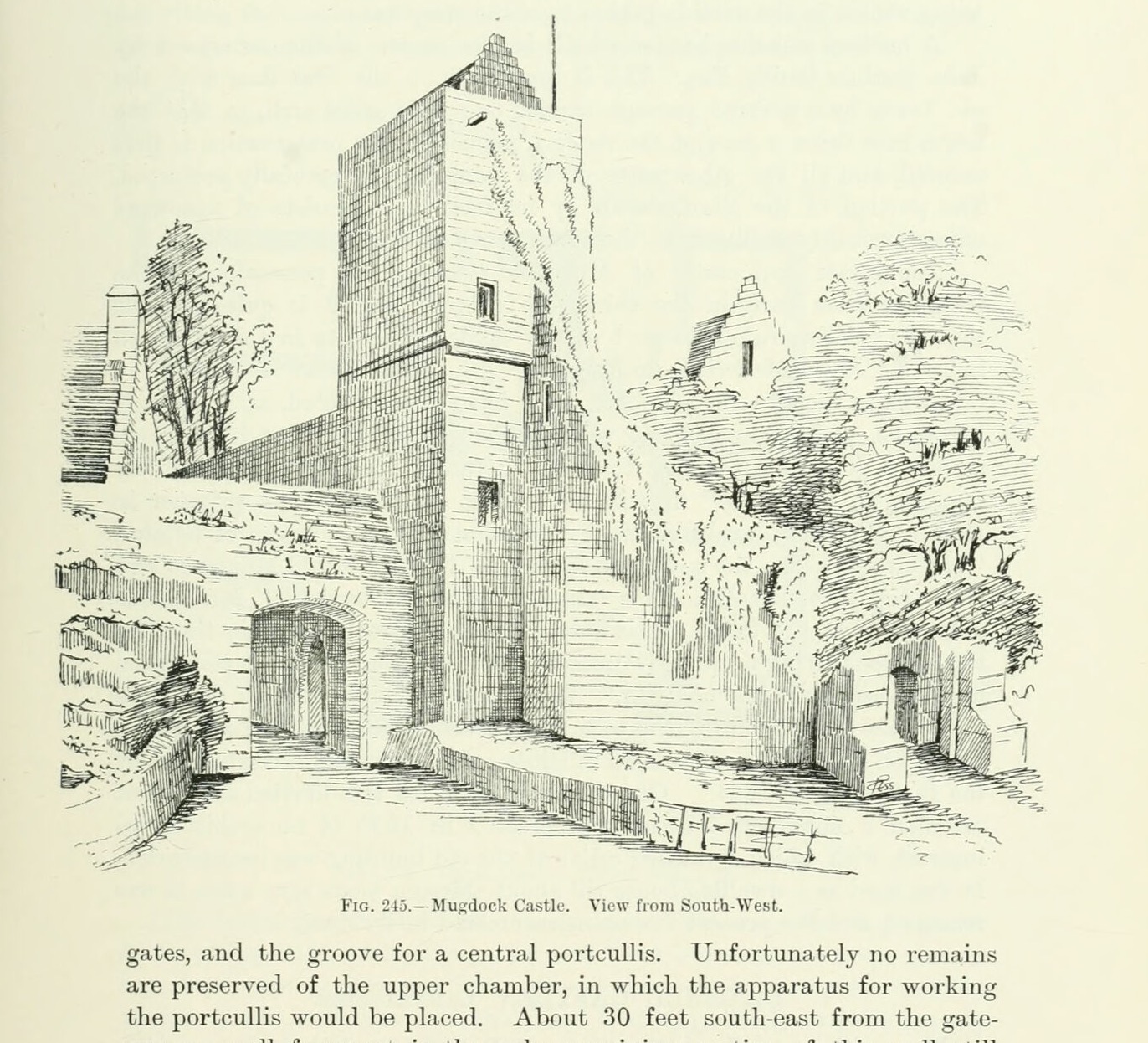
Fig. 245. Mugdock Castle. View from South-West.
1889 · MacGibbon & Ross, vol. 3 (1889)
Public domain
Nearby
Landmarks within reach of Mugdock Castle.


Questions about Mugdock Castle
What is the history of Mugdock Castle?
What is inside Mugdock Castle?
Why was Mugdock Castle built, and what was it used for?
Where is Mugdock Castle?
When was Mugdock Castle built?
Was Mugdock Castle ever attacked or besieged?
Which family or clan held Mugdock Castle?
What did Mugdock Castle look like in its prime?
Is Mugdock Castle still standing or is it a ruin?
Who built Mugdock Castle?
Can you visit Mugdock Castle?
More castles of Scotland


Explore the city


