Clan Fraser
Of Lovat, 'I am ready'.
- Origin
- The Highlands & Islands, Scotland
- Motto
- Je suis prest
- Famous bearer
- Simon Fraser, 11th Lord Lovat
- Register
- Scottish clan
The Fraser arms, crest badge, tartan and country

Crest badgeClan member crest badge - Clan FraserMostEpic · CC BY-SA 4.0 
Crest badgeClan member crest badge - Clan Fraser of lovatBorne by the Lovat line, one branch of the name rather than all of it.Czar_Brodie ( Czar_Brodie @ english wikipedia), Celtus · CC BY-SA 3.0 
TartanFraser tartanMicheletb · CC BY-SA 4.0 
TartanFraser Hunting tartanThe hunting sett: the same pattern in muted browns and greens, worn in the field where the brighter colours would show.Micheletb · CC BY-SA 4.0 
Coat of armsArms of FraserBorne by the Fraser line, one branch of the name rather than all of it.MostEpic · CC BY-SA 4.0 
Coat of armsFraser of lovat armsBorne by the Lovat line, one branch of the name rather than all of it.czar brodie · CC BY-SA 3.0


- Crest badge: The chief's crest inside a belt and buckle: the badge a clansman wears to show whose following he is in.
- Tartan: The checked cloth the family is known by.
- Coat of arms: Granted to an individual and inherited down that one documented line. These are the arms of particular families of the name, not of everyone who shares the surname.
What is the Fraser clan tartan?
Two Fraser setts are shown above, one of them the hunting sett, in muted browns and greens. They are not rival claims to be picked between; they are different records, and different weaves, of the same family cloth. A sett is the block of coloured bands the cloth is built from, repeated in both directions; the whole plaid is that one square enlarged.
Almost no clan tartan is medieval. Highland dress was proscribed from 1746 until 1782, and when it returned it returned as ceremony rather than everyday cloth, so the surname-to-sett map was fixed after the break, by the Bannockburn weavers’ pattern books, the royal visit to Edinburgh in 1822, and the Vestiarium Scoticum of 1842. The Frasers wore tartan long before any of that. What the registers fixed was which one. Nobody polices any of it. Wearing the Fraser sett declares allegiance to the name, not descent from any particular line of it.
The seat of Clan Fraser
Seat vacantChief
No one leads the Clan Fraser community yet. When the movement opens, you can stand for its leadership, or help elect whoever does.
Current mission
No shared goal set yet. Once Clan Fraser has leadership, it sets the public focus: a restoration, a gathering, a real-world project that helps its own.
The Fraser clan is being rebuilt. Join the waiting list for the movement today, and you help decide who leads it and what it does.
Help rebuild the Fraser clan →Motto
Je suis prest
“I am ready”
What does the Fraser name mean?
From the Old French 'fraisier', strawberry plant, surviving on the family arms as a fraise. Anglo-Norman in origin, settling in Scotland in the 12th century.
The history of Clan Fraser
The strawberry, the ribbon merchant, and a name no French village answers to
The arms carry a fraise, and the obvious reading follows it: Old French fraisier, the strawberry plant, with the family placed by tradition in the County of Anjou in the 11th century. The Oxford Dictionary of Family Names took the ground out from under that in 2016: no place name in France matches the earliest spellings the records give, de Fresel, de Friselle and de Freseliere, and it raises the possibility of a Gaelic name corrupted beyond recognition by Anglo-French scribes. A rival reading makes Fraser an altered form of the patronymic Fresel, Old French for ribbon or braid, a likely nickname for merchants in them; the Gaelic Frisealach is a straight borrowing from that Anglo-French word. The motto is Je suis prest, I am ready.
Four men carry the name in the earliest Scottish record. Simon Fraser, active between about 1160 and 1202, held lands at Keith in East Lothian and left an only daughter, Eda, who married Hugh Lorens before 1210. Gilbert, probably his brother, attended the court of William the Lion and witnessed charters at Roxburgh, Coldingham and Melrose between 1164 and 1182. Bernard, a third probable brother, appears at Haddington in 1179 and held Drem in 1186. The fourth mattered most: Udard Fraser married a sister of Oliver fitz Kylvert, founder of Oliver Castle in upper Tweeddale, and carried the name off the East Lothian farmland into the Tweed valley.
Sheriffs of Tweeddale, and the strawberries on the Neidpath arch
Oliver Castle is mentioned in a document of about 1200, one of the line of peel towers strung along the Tweed in upper Tweeddale, and it was first associated with the Frasers; it may be named for Oliver Fraser, who gave lands to Newbattle Abbey. Sir Bernard Fraser and Sir Gilbert Fraser each in turn held the hereditary office of Sheriff of Tweeddale from it.
Simon Fraser of Oliver Castle built the first castle at Neidpath, probably between 1263 and 1266, while holding office as High Sheriff of Tweeddale. The barony left the family in the early 14th century through the heiress Margaret, daughter of the sheriff's son Simon Fraser of Oliver and Neidpath, who married into the Hays. The transfer is still legible in the stone: the archway carries both the goats' heads of the Hays and the strawberries of the Frasers.
The chamberlain who married Bruce's sister
Another Simon Fraser, five generations on, was captured fighting for Robert the Bruce and executed in 1306 by Edward I of England. His cousin Alexander Fraser of Cowie served Bruce as chamberlain and married the king's sister, Mary. Alexander's younger brother, yet another Sir Simon Fraser, is the ancestor of the chiefs of Clan Fraser of Lovat: from that pair of brothers descend two separate clans with two separate chiefs, one Lowland and one Highland, both officially recognised by the Standing Council of Scottish Chiefs.
The Cowie line then married north. A grandson of that younger Simon, Sir Alexander Fraser of Cowie and Durris, took the lands of Philorth and the castle now called Cairnbulg by marriage in 1375 to Joanna, younger daughter and co-heiress of the Earl of Ross, and the castle was rebuilt in 1380. Older southern holdings went the other way. Aboyne, a motte and bailey raised before 1233 to control a Mounth crossing near the Dee, left the Frasers of Cowie by marriage to Sir William de Keith, Great Marischal of Scotland, around 1355, and the 13th-century tower house of the Frasers of Muchalls passed to the Hays in the 15th century, probably in the same transaction as the lands of Ury in 1413.
A charter for a fishing village called Faithlie
In 1592 Sir Alexander Fraser of Philorth received charters from James VI for the fishing village of Faithlie. It became the town of Fraserburgh. The same Sir Alexander was authorised to found a university there; the scheme was short-lived, killed by the religious troubles of the period. Building on that scale ruined the family: the eighth Laird of Philorth built Fraserburgh Castle, the structure that later became the Kinnaird Head lighthouse, and bankrupted himself doing it.
In 1613, after nearly bankrupting themselves, the Frasers of Philorth sold Cairnbulg. It went through other families of the Fraser name, the Frasers of Durris among them, before ending in 1775 with George Gordon, 3rd Earl of Aberdeen, who removed anything of value from it; a fire in 1915 left it almost a ruin, and the Duthie family of Aberdeen restored it. The name returned in 1934, when Lord Saltoun, a direct descendant of the eighth Laird, bought it back after more than three hundred years. At Pitsligo, east of Rosehearty, the Frasers of Philorth left a flanking drum tower with walls nine feet thick, now a scheduled monument.
Carried off the field at Worcester, and a physician in Pepys's diary
The ninth Laird of Philorth married the heiress of the Abernethy Lords Saltoun, and the Philorth Frasers became a peerage family. Alexander Fraser, 11th Lord Saltoun, was severely wounded at the Battle of Worcester in 1651 and survived only because his servant James Cardno pulled him off the battlefield. In 1666 the tenth Lord built Philorth House a mile from Fraserburgh, which remained the family seat until it burned down in 1915. Sir Alexander Fraser of Durris accompanied Charles II on campaign throughout 1650 and became the king's personal physician; after the Restoration he sat in the Scottish Parliament, and he turns up in the diaries of Samuel Pepys.
The Philorth and Saltoun Frasers took no part in the Jacobite risings, whatever their distant Highland relatives in Clan Fraser of Lovat were doing. The sixteenth Lord Saltoun commanded the Light Companies of the First Guards at Waterloo in 1815. The nineteenth was a prisoner of war in Germany during the First World War and took his seat in the House of Lords in 1936. The title runs to Katharine Fraser, 22nd Lady Saltoun, born in 1957.
The charter chest carried out of the fire at Beauly
The Highland branch got its country by marriage too. Simon Fraser married a Bisset heiress in the 13th century, and with her came the castle on the south bank of the River Beauly near Kirkhill, built by the Bissets in the 11th or 12th century as Beauly Castle and known afterwards as Lovat. Hugh Fraser, 3rd Lord Lovat, was said to have fortified its courtyard in the reign of James V with yetts and a great oaken entrance gate.
When fire took hold there, Rory Mackenzie, a nephew of Thomas Fraser, 2nd Lord Lovat, who was staying in the castle, went in and brought out the Fraser charter chest, saving the family's written title to its lands. A second story clung to the place: treasure brought to Lovat by Elizabeth Stewart, bride of Hugh Fraser, 5th Lord Lovat, stolen and hidden by her maid. The castle was dismantled for building materials in 1671, its stone and oak beams ferried across the Beauly to a new site; farm buildings at Wester Lovat stand on the ground.
Dounie razed, Beaufort rebuilt, Moniack never let go
The Lovat chiefs' other stronghold beside the same river was Dounie. The plaque on its one surviving wall records "the ancient stronghold of the Frasers of Lovat, built c. 1400, and destroyed by Cumberland after the battle of Culloden". Simon Fraser, 11th Lord Lovat, known as The Fox, had inherited the estates in 1699 and taken the family deep into the Jacobite cause; the price was the razing of Dounie and the forfeiture of the estate. A later bearer of the designation, Archibald Campbell Fraser of Lovat, who lived from 1736 to 1815, served as a British consul.
The chiefs came back to the same ground. In 1880 a baronial mansion was built for Simon Fraser, 13th Lord Lovat, to designs by James Maitland Wardrop, with a private Roman Catholic chapel inside it; the 15th Lord sold this Category A listed seat in 1994 to the Stagecoach director Ann Gloag to meet inheritance taxes. Dalcross, built by the 6th Lord Lovat in 1621 north-east of Inverness with gunloops and iron yetts on its windows, passed soon afterwards to the Mackintoshes. Moniack alone never left: built in 1580 seven miles west of Inverness, seat of the Moniack Frasers, the clan's largest offshoot, it was given in 1926 to Alastair Fraser by his brother Simon Fraser, 14th Lord Lovat, and is occupied today by Rory Fraser and his family.
Castle Fraser, a Perthshire artist, and the man who bought Mugdock
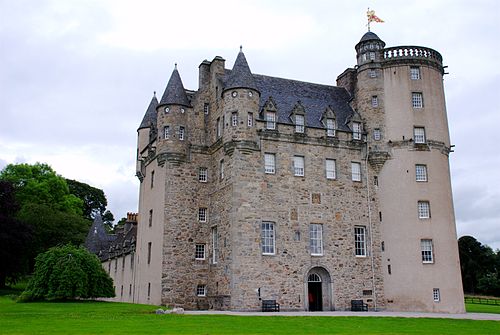
Castle Fraser in Aberdeenshire was built as the home of the Frasers of Muchalls, later the Frasers of Castle Fraser, around an older square tower of about 1400 or 1500. One of the grandest of the Castles of Mar, it is contemporary with Craigievar, Crathes and Midmar, all believed to be the work of the Bell family of master masons. It descended through the Lords Fraser and the Frasers of Inverallochy to the Mackenzies, who took the name Mackenzie Fraser; in 1921 the widow Theodora sold it, lacking a suitable heir, and the Pearson family gave it to the National Trust for Scotland in 1976, still full of Fraser portraits and original contents.
Patrick Allan Fraser, a Scottish artist and architect, built himself a castle instead of inheriting one: Blackcraig, a Baronial mansion of 1856 on the banks of the River Ardle in Perthshire, raised around an earlier 16th-century tower house and extended by him into the 1880s. Hugh Fraser, later Lord Fraser, owner of the retail chain now known as House of Fraser, purchased Mugdock from the Duke of Montrose in 1945, and in 1981 his son Sir Hugh Fraser, 2nd Baronet, gave castle and estate to Central Regional Council for a country park.
The crofter's son from Fearn who spoke for small nations at San Francisco
Peter Fraser was born at Fearn in Ross-shire on 28 August 1884, the son of a crofter and shoemaker, and educated largely by himself through the local library and his own reading. He emigrated to New Zealand in 1910, came up through the trade-union and labour movement, and was a founding figure of the New Zealand Labour Party. As Minister of Education and of Health in the first Labour government he built much of the country's modern public health and education provision.
On the death of Michael Joseph Savage in 1940 he became Prime Minister of New Zealand and held the office until 1949, leading the country through the whole of the Second World War. At the San Francisco conference of 1945 he was among the most influential of the smaller-power statesmen at the founding of the United Nations, arguing for the rights of small nations and for the trusteeship system that committed the organisation to the advancement of dependent peoples.
Others carried the name out along the same routes. Eliza Fraser, born about 1798, survived a shipwreck; Louis James Fraser was a Scottish pioneer in Malaysia whose name stayed on Fraser's Hill; Mary Isabel Fraser taught in New Zealand and campaigned for girls' education; Margaret Marjory Fraser served as a Canadian military nurse and died in 1918. Canada also produced the Auditor General Sheila Fraser, Australia the swimmer Dawn Fraser and the tennis player Neale Fraser.
Champions of the Fraser name
The bearers whose lives are inseparable from this surname. Each has their own page, biography, achievements, geography, connection to the family.
Historic Places, Rebuilt
Explore the streets and seats the Fraser name knew, rebuilt with AI as they stood in history.
Historic Places, Rebuilt · New
The old castle above the River Ness, the market cross and the seven-arched bridge, on the eve of Culloden.
Historic Places, Rebuilt · New
The great castle guarding the Great Glen, newly granted to the Grants of Freuchie, whole above Loch Ness.
Castles the Fraser held
Strongholds this name held for a decade or more, look one up, or rebuild it to explore.
- Beaufort Castle
Seat of the Frasers of Lovat, Dounie Castle, built c. 1400, was razed after Culloden; the present house was built for the 13th Lord Lovat in 1880 and sold in 1994.
- Castle Fraser
Built as the home of the Frasers of Muchalls, later Frasers of Castle Fraser; passed down through the Lords Fraser and the Frasers of Inverallochy.
- Aboyne Castle
Held by the Frasers of Cowie before passing by marriage to the Keiths around 1355.
- Neidpath Castle
Probably built by Simon Fraser of Oliver Castle, 1263–1266; held by the Frasers until the early 14th century.
- Muchalls Castle
The Frasers of Muchalls built the 13th-century tower house core; held until it passed to the Hays in the 15th century.
- Mugdock Castle
Purchased by Hugh Fraser, later Lord Fraser, in 1945; his son gifted castle and estate for a country park in 1981.
- Cairnbulg Castle
Fraser castle from the 1380 marriage of the 5th Earl of Ross's daughter to Sir Alexander Fraser of Cowie; sold in 1613, bought back by Lord Saltoun in 1934.
- Lovat Castle
Held by the Frasers of Lovat from Simon Fraser's 13th-century marriage to a Bisset heiress until the castle was dismantled in 1671.
- Oliver Castle
Originally a Fraser stronghold, perhaps named for Oliver Fraser; Sir Bernard and Sir Gilbert Fraser held the hereditary sheriffdom of Tweeddale from the castle.
- Pitsligo Castle
The Frasers of Philorth built the great flanking drum tower at the north-east angle of the courtyard.
- Moniack Castle
Built by members of Clan Fraser in 1580; seat of the Moniack Frasers, who hold the castle to this day.
- Blackcraig Castle
Built and held by the artist-architect Patrick Allan Fraser from 1856 until his death in 1890.
- Dalcross Castle
The Frasers of Lovat owned the property; the 6th Lord Lovat built the castle in 1621.
Castles that share the Fraser name
The same name on the map, look one up, see what it looked like in its prime, and recreate it to explore.
All castles in Scotland → · Strongest castles in Scotland → · Castles of Europe
Play As Your Clan
Hold a real castle against whatever you choose to send at it, take a ship out in her own service years, or stand at the shoulder of someone the record remembers. The chronicler sets the scene; the deeds are yours.
Notable bearers of the Fraser name
- Simon Fraser, 11th Lord Lovat
- Simon Fraser of Lovat, raiser of the 78th Highlanders