Bowen
also ab Owen, ap Owain
Son of Owen, the patronymic of the great Welsh princely name.
- Origin
- Deheubarth, Wales
- Famous bearer
- Elizabeth Bowen (1899–1973), novelist (The Death of the Heart, The Heat of the Day)
- Register
- Welsh family
Where the Bowen name comes from
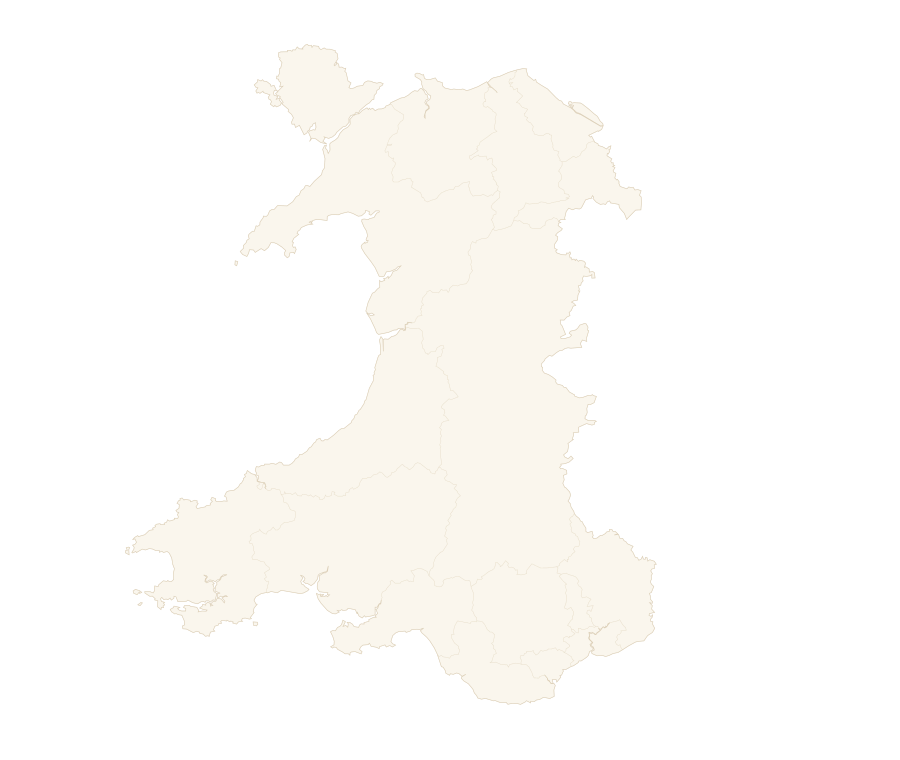
CoreHistoric reach
The seat of Bowen
Seat vacantChief
No one leads the Bowen community yet. When the movement opens, you can stand for its leadership, or help elect whoever does.
Current mission
No shared goal set yet. Once Bowen has leadership, it sets the public focus: a restoration, a gathering, a real-world project that helps its own.
The Bowen clan is being rebuilt. Join the waiting list for the movement today, and you help decide who leads it and what it does.
Help rebuild the Bowen clan →What does the Bowen name mean?
From ab Owen, son of Owain (or Owen). Owain was one of the most prestigious personal names in mediaeval Welsh use, carried by Owain Glyndŵr (c.1359–c.1415), Owain Gwynedd (1100–1170), and several other princely figures. The patronymic ab Owen compressed into Bowen under Tudor naming policy, the b retained from ab and the apostrophe-O dropped. Bowen is overwhelmingly Welsh, with the densest concentrations in Pembrokeshire, Carmarthenshire and Ceredigion.
The history of Bowen
The b at the front is the Welsh word for son
In 1292, 48 per cent of recorded Welsh names were patronymics rather than surnames, and in some parishes the figure passed 70 per cent. A name was a statement of descent that changed with every generation: Evan, son of Thomas, was Evan ap Thomas; Evan's son John was John ab Evan; John's son Rees was Rees ap John. The particle took the form ab before a vowel and ap before a consonant, which is why the name that eventually hardened out of ab Owen begins with a b and the name that hardened out of ap Rhys begins with a p.
The chain could run far past a single father. Names on the pattern of Llewelyn ap Dafydd ab Ieuan ap Gruffudd ap Meredydd were unremarkable, and a patronymic might be extended through grandfathers and earlier ancestors to perhaps the seventh generation, so that a man's name was a recited genealogy of his male line. That habit was tied to Welsh law, under which it mattered a great deal that people could show how they descended from a common ancestor. As those laws decayed through the later Middle Ages, the recited line began to be replaced by a fixed name.
When the fixed names came, several of them kept the particle welded to the front in reduced form: Powell from ap Hywel, Price and Pryce from ap Rhys, Pugh from ap Hugh, Pritchard from ap Richard, Upjohn from ap John, and Bowen from ab Owen. Elsewhere the ap was simply dropped, which is how the plain Owen and Owens lines run parallel to Bowen from the same root. The personal name underneath was one of the most prestigious in mediaeval Welsh use, carried by Owain Gwynedd (1100 to 1170) and by Owain Glyndŵr (c.1359 to c.1415).
Llwyngwair, Nevern, and the year the name stopped moving
The Bowen line is traced to Llwyngwair, near Nevern in Pembrokeshire, in the 11th century, and the surname itself was adopted in 1424. That date is the point of the whole record. It sits a full century before the Tudor settlement made hereditary surnames the norm among the Welsh gentry, and it marks the family as one of the early adopters, gentry enough to want a name that survived the death of a father and stayed the same on a charter, a rent roll and a memorial slab.
The split between the two forms is geographic and still legible. Bowen and Bowens sit thickest in southern Wales, in Pembrokeshire, Carmarthenshire and Ceredigion, with older presence in Powys and Monmouthshire; Owen and Owens run heavier in the north. Two surnames, one personal name, divided by which counties were contracting ab Owen and which were dropping the particle at the moment the names were being frozen.
One spelling covers two Celtic descents. Beside the Welsh ab Owain there is the Irish Ó Buadhacháin, descendant of Bohan, from a root meaning victorious, and the two arrived at the same modern form by separate routes. The heraldic record reflects that scatter rather than a single house: seven distinct Bowen crests are recorded, while the Bowen and Owen families share a tartan, an acknowledgement that the two names are siblings out of the same Welsh personal name.
Upton, the Malefants, and a marriage that changed the name over the door
Upton Castle stands near Cosheston in Pembrokeshire, a 13th-century fortified mansion too small to count as a castle in the strict sense, though unusually strong for its type: three early towers joined by short lengths of curtain wall under a plain corbelled parapet. Its first known holders were the Norman Malefant family, and the associated chapel of the 12th and 13th centuries keeps their effigies, among them William Malefant, who died in 1362 and lies carved in chain mail.
The Malefants held Upton until the 15th century, when it passed by marriage to a line that thereafter took the name Bowen. That is the ordinary mechanism by which a Welsh patronymic family acquired a Norman seat in Pembrokeshire, and it happened in the same century as the 1424 adoption of the name at Llwyngwair. An heiress carried the stone, and the incoming husband's new fixed surname carried it forward, so the tomb effigies in the chapel are Malefant while the household that prayed over them was Bowen.
Upton has changed hands remarkably rarely since. In December 1789 it was bought for 7,000 pounds by John Tasker of the East India Company, Master Attendant of the Port of Bombay, who is thought to have built the walled garden. The sale of 1927, only the second in the property's history, took it to Stanley Neale, a Cardiff ship owner who landscaped the terraces and planted the arboretum. The house is still privately held, while the gardens are listed on the Cadw and ICOMOS Register of Parks and Gardens of Special Historic Interest in Wales and open to visitors.
Why a Pembrokeshire parish register fills up with the same few names
In the reign of Henry VIII surnames became hereditary among the Welsh gentry, and the custom spread slowly downward to commoners after the unification of 1536. The change did not arrive evenly. Districts under strong English influence abandoned patronymics earliest, along with town families and the wealthy, while in rural areas the old ap and ferch construction was still in use into the early 19th century. A Bowen fixed in 1424 and a neighbour still calling himself ap Owen in 1790 were living in the same country under two different naming regimes.
The effect of freezing a patronymic system is a very small stock of surnames, made smaller again by the Protestant Reformation's narrowing of the range of baptismal names in use. Evans, Jones, Williams, Davies and Thomas were all in the top ten surnames recorded for England and Wales in 2000. The consequence for anyone tracing a Bowen is blunt: Welsh communities hold families of the same surname who are not related, and two bearers in one village cannot be assumed to descend from a single ancestor.
That crowding produced its own workaround. Through the 19th century a fashion grew for double surnames formed by prefixing the name of a house, a parish or the mother's family, as in Cynddylan Jones, later often hyphenated on the pattern of Griffith-Jones. The scale behind the problem is measurable: an analysis commissioned by the Welsh Government found 718,000 people in Wales, close to 35 per cent of the population, carrying a family name of Welsh origin, against 5.3 per cent in the rest of the United Kingdom, 4.7 per cent in New Zealand, 4.1 per cent in Australia and 3.8 per cent in the United States, some 16.3 million people in all.
Bowen's Court: the Pembrokeshire line that became Anglo-Irish
A Welsh Bowen line settled in County Cork with the Cromwellian plantation of the 17th century and built its house at Farahy, near Kildorrery in the north of the county. Bowen's Court gave the family the standing of a planted Anglo-Irish gentry house holding land among a population it had not come from, and it kept the Welsh surname unchanged for three centuries in Ireland.
The last proprietor in the male line was Henry Charles Cole Bowen, an Anglo-Irish barrister who married Florence Colley of Carlow. Their only child, Elizabeth Dorothea Cole Bowen, was born at 15 Herbert Place in Dublin on 7 June 1899. Her father broke down in 1905 under the strain of work at the Land Commission and the seven-year-old was taken by her mother through a long series of rented seaside lodgings on the Kent coast at Folkestone, Hythe and Dover. Her mother died of cancer in 1912; the girl was placed with relatives and schooled at Downe House in Kent.
Elizabeth inherited Bowen's Court on her father's death in 1930, held it through the war and made it her principal residence from 1952 to 1959. Her memoir Bowen's Court, published in 1942, is the fullest documentary account of a Cromwellian plantation family in late survival, written by the person watching the survival end. Death duties forced the sale in 1960 to a local farmer who, in the agricultural economics of the time, pulled the house down for its stone. She went back to a small cottage at Hythe, on the same Kent coast her mother had taken her to in 1905.
The novelist who wrote the burning of the big houses
Elizabeth Bowen published her first collection of short stories, Encounters, in 1923, the year she married the educational administrator Alan Cameron and took a writing residence at Old Headington outside Oxford. The novels came steadily: The Hotel in 1927, then The Last September in 1929, the elegy for the Anglo-Irish country houses burned during the War of Independence of 1919 to 1921, written by a woman who would inherit one of them the following decade. Friends and Relations followed in 1931, To the North in 1932 and The House in Paris in 1935.
Her central pre-war novel, The Death of the Heart, appeared in 1938: the Henry James-inflected London book of the orphaned Portia and the Quayne household at Windsor Terrace, and a fixture on modern lists of the significant English novels of the late inter-war years. In 1935 Cameron was appointed Secretary of the BBC Central Council for Schools Broadcasting and the couple moved to London, taking the small house at 2 Clarence Terrace overlooking Regent's Park that became the address of her London writing life.
The war made her the novelist of the Blitz. She served as an air-raid warden in Marylebone and as a Ministry of Information rapporteur on Irish neutrality, crossing repeatedly to Dublin to write confidential reports to the British government on the Irish position, then wrote the London the raids had made: the collections Look at All Those Roses in 1941 and The Demon Lover and Other Stories in 1945, holding In the Square and Mysterious Kor, and the novel of wartime London, The Heat of the Day, worked at from 1944 to 1948 and published in 1949. She was appointed CBE in 1948, took honorary doctorates from Trinity College, Dublin, in 1949 and Oxford in 1956, and died at University College Hospital, London, on 22 February 1973.
Bowens at sea, from a Red Sea pirate to the founder of Hobart
The earliest Bowen of any notoriety on blue water was John Bowen, who died in 1704 after a career as a pirate in the Indian Ocean and the Red Sea. The Royal Navy generation that followed put the name on the quarterdeck instead: James Bowen (1751 to 1838) and Richard Bowen (1761 to 1797), both Royal Navy officers.
Another John Bowen, an English sailor who lived from 1780 to 1827, founded Hobart. George Bowen (1803 to 1889) went out as a military officer and settler to New South Wales. Sir George Bowen (1821 to 1899) served as a British colonial administrator, and his wife Diamantina Bowen (c.1832 to 1893) carried the name with him.
The missionary and clerical line ran on the same shipping routes. John Bowen (1815 to 1859) died as bishop of Sierra Leone; Thomas Jefferson Bowen (1814 to 1875) worked as an American Baptist missionary in West Africa; George Bowen (1816 to 1888) spent his career as an American missionary in India. Herbert Wolcott Bowen (1856 to 1927) served as a diplomat and wrote poetry, and Harold G. Bowen Sr (1883 to 1965) rose to admiral in the United States Navy.
Members for Pembrokeshire, a baronetcy, and three parliaments
The Bowens held political weight in their home county for generations. James Bevan Bowen (1828 to 1905) sat as member of parliament for Pembrokeshire; George Bevan Bowen (1858 to 1940) was a Welsh Conservative landowner and county officer; James Bevan Bowen (1883 to 1969) served as an RAF officer. Three bearers carried the Bevan compound name, exactly the 19th-century double-surname device the crowded Welsh name stock had made necessary.
The Bowen baronetcy began with Sir Albert Bowen, 1st Baronet (1858 to 1924), a British-Argentinian businessman, and has run through six holders: Sir Edward Bowen, 2nd Baronet (1885 to 1937); Sir John Edward Mortimer Bowen, 3rd Baronet, who died in 1939 at twenty-one; Sir Thomas Frederic Charles Bowen, 4th Baronet (1921 to 1989); Sir Mark Edward Mortimer Bowen, 5th Baronet (1958 to 2014); and Sir George Edward Michael Bowen, 6th Baronet, born in 1987.
In law and legislature the name spread with the diaspora. Charles Bowen, Baron Bowen (1835 to 1894) sat as an English judge; John William Bowen was member of parliament for Crewe from 1929 to 1931. Australia produced Lionel Bowen (1922 to 2012), Nigel Bowen (1911 to 1994), lawyer, politician and judge, and Chris Bowen, born 1973; New Zealand had Charles Bowen (1830 to 1917). In the United States the name reached the Senate with Thomas M. Bowen (1835 to 1906), the House with Rees Bowen (1809 to 1879) and Henry Bowen (1841 to 1915) of Virginia, and the governorship of Indiana with the physician Otis Bowen (1918 to 2013).
The engraver, the Archdruid and the harp
Emanuel Bowen (1694 to 1767) was a Welsh engraver whose maps put the name on the printed sheets by which 18th-century Britain pictured itself, and Thomas Bowen, who died in 1790, was another map engraver. James Bowen, who died in 1774, worked as an English painter and topographer, and John Bowen (1756 to 1832) combined painting with genealogy and antiquarian work, a fitting trade in a country where descent had been the substance of a name.
The chapel and the eisteddfod carried the name through the Welsh-language centuries. David Bowen of Felinfoel (1774 to 1853) was a Baptist minister; Thomas Bowen (1756 to 1827) an Independent minister; David Glyn Bowen (1933 to 2000) a Congregationalist minister and missionary. Geraint Bowen (1915 to 2011) was a Welsh-language poet and Archdruid of the Eisteddfod; the younger Geraint Bowen, born 1963, directs the Hereford Three Choirs Festival. Robin Huw Bowen, born 1957, plays the Welsh triple harp, and Kenneth Bowen (1932 to 2018) sang as a tenor, while York Bowen (1884 to 1961) composed in England.
In scholarship the name settled hard on Wales itself. E. G. Bowen (1900 to 1983) was a Welsh geographer, Collin Bowen (1919 to 2011) an archaeologist and landscape historian, David James Bowen (1925 to 2017) a Welsh scholar, and Edward George Bowen (1911 to 1991) a Welsh physicist. Abroad the name went into the sciences at the same pitch: Norman L. Bowen (1887 to 1956), Canadian geochemist and petrologist; Ira Sprague Bowen (1898 to 1973), astronomer; Murray Bowen (1913 to 1990), psychiatrist; the pathologist David Bowen (1924 to 2011); William G. Bowen (1933 to 2016), president of Princeton; and the historian Catherine Drinker Bowen (1897 to 1973).
What a frozen patronymic looks like at full spread
A surname that began as one man's father's name and then multiplied across three southern Welsh counties ends up attached to every trade at once, and the Bowen record in print shows it. Ashley Bowen (1728 to 1813) wrote as an American sailor; Francis Bowen (1811 to 1890) worked as a philosophical writer and educationalist; Henry Chandler Bowen (1813 to 1896) built a business and John Eliot Bowen (1858 to 1890) wrote as an author. William Bowen (1877 to 1937) took a Newbery Honor for children's fiction, Robert Sidney Bowen (1900 to 1977) flew in the First World War before turning journalist and author, and Robert O. Bowen (1920 to 2003) wrote novels and essays.
The name reached the Canadian shelf through Gail Bowen (1944 to 2026), mystery writer, playwright and teacher, and Lynne Bowen, born 1940, historian and journalist, with John C. Bowen (1872 to 1957) in the pulpit and Oliver Bowen (1942 to 2000) in engineering. On the British stage it goes back to the Restoration actor William Bowen (1666 to 1718) and forward to the playwright and novelist John Bowen (1924 to 2019) and the actor Christopher Bowen, born 1959, while Michael Bowen (1930 to 2019) served as a Roman Catholic archbishop and Edward Ernest Bowen (1836 to 1901) as a Harrow schoolmaster.
In the laboratory and the clinic the spread is the same. Edmund Bowen (1898 to 1981) worked as a British chemist and Humphry Bowen (1929 to 2001) as a botanist and chemist; John Templeton Bowen (1857 to 1940) practised as an American dermatologist; Thomas Ambrose Bowen (1916 to 1982) devised the bodywork method that still carries the family name as the Bowen technique; Jonathan Bowen, born 1956, works in computer science. Stephen Bowen, born 1964, flew as an American astronaut, and Richard M. Bowen III put the name into the record as the Citigroup whistleblower.
Little Wales, Y Wladfa and the modern crowd
Movement out of Wales began inside Britain. The Industrial Revolution drew thousands into Liverpool and Ashton-in-Makerfield, which is why families in England, Scotland and Ireland carry Welsh surnames without any memory of why. In the late 19th and early 20th centuries a smaller wave of contract miners crossed to northern France and clustered around their chapels in the coal towns of the Pas-de-Calais. In 1819 the ship Albion sailed from Cardigan for New Brunswick carrying 27 Cardiganshire families, most of them farmers.
Further out, the settlements kept the language longer than Wales expected. Jackson County in Ohio was known as Little Wales, one of several places where Welsh went on being spoken; Malad City in Idaho, begun as a Welsh Mormon settlement, claims a higher proportion of Welsh descent than anywhere outside Wales; and Y Wladfa in Patagonia remains the most deliberate of the transplants. Around 1.75 million Americans and 458,705 Canadians at the 2011 census reported Welsh ancestry, against 2.9 million people living in Wales.
The modern name is loudest on a field. Welsh rugby produced the international half back George Bowen (1863 to 1919), William Bowen (1862 to 1925), Harry Bowen (1864 to 1913), Cliff Bowen (1875 to 1929), who also played cricket, Billy Bowen (1897 to 1960) in both codes, and Benjamin John Bowen (1915 to 2009). Football took Dave Bowen (1928 to 1995), Mark Bowen, born 1963, Jason Bowen, born 1972, and Jarrod Bowen, born 1996. Off the field, Jeremy Bowen, born 1960, works as a British journalist and television presenter, and James Bowen, born 1979, wrote A Street Cat Named Bob.
Champions of the Bowen name
The bearers whose lives are inseparable from this surname. Each has their own page, biography, achievements, geography, connection to the family.
Historic Places, Rebuilt
Explore the streets and seats the Bowen name knew, rebuilt with AI as they stood in history.
Castles the Bowen held
Strongholds this name held for a decade or more, look one up, or rebuild it to explore.
- Upton Castle
Gained Upton by marriage from the Malefants in the 15th century.
The castles of the homeland
The great strongholds of the homeland, look one up, see what it looked like in its prime, and recreate it to explore.
 Caernarfon CastleRestored · prime 1330
 Conwy CastleRuin · prime 1287
 Pembroke CastleRestored · prime 1280
All castles in Wales → · Strongest castles in Wales → · Castles of Europe
Play As Your Clan
Hold a real castle against whatever you choose to send at it, take a ship out in her own service years, or stand at the shoulder of someone the record remembers. The chronicler sets the scene; the deeds are yours.
Notable bearers of the Bowen name
- Elizabeth Bowen (1899–1973), novelist (The Death of the Heart, The Heat of the Day)
- Jim Bowen (1937–2018), comedian, host of Bullseye
- Roger Bowen (1932–1996), actor (M*A*S*H film, Lt Col Henry Blake)
Stories of Bowen
Frequently asked
What does the surname Bowen mean?
Where does the Bowen family come from?
Where did the Bowen family historically hold territory?
Is Bowen Welsh or English?
How old is the Bowen surname?
What is the Bowen family known for?
Is there a Bowen family crest or coat of arms?
Who is the most famous Bowen?
Who are some famous Bowens?
What stories are told about the Bowen family?
What is the story of Elizabeth Bowen and The Last September?
Is ab Owen the same family as Bowen?
Is ap Owain the same family as Bowen?
Where is the Bowen surname found today?
What does the Clan Rising page for the Bowen family cover?
Who is the head of the Bowen family today?
Neighbouring clans
- JonesSon of John, and roughly one in twenty Welsh-descended people in the world.
- DaviesSon of David, born of the patron saint's name and densest in his own corner of Wales.
- ThomasThe fifth Welsh surname, son of Thomas, on the same Tudor-era road as Jones and Williams.
- ReesFrom Rhys, the name of the most consequential prince of 12th-century Wales.