Clan Forbes
also Clan Forbes
Lord Forbes, Scotland's senior baron, of Aberdeenshire.
- Origin
- Grampian & the North-East, Scotland
- Motto
- Grace me guide
- Famous bearer
- Duncan Forbes of Culloden (1685–1747), Lord President of the Court of Session
- Register
- Scottish clan
The Forbes arms, tartan and country

TartanForbes tartanMicheletb · CC BY-SA 4.0 
TartanForbes Ancient tartan“Ancient” colours: the softer shades vegetable dyes produced. The same pattern, not an older one.Micheletb · CC BY-SA 4.0 
Coat of armsArms of Forbes of NeweBorne by the Newe line, one branch of the name rather than all of it.MostEpic · CC BY-SA 4.0 
Coat of armsArms of Forbes of PitsligoBorne by the Pitsligo line, one branch of the name rather than all of it.MostEpic · CC BY-SA 4.0 
Clan plateForbes (R. R. McIan)Robert Ronald McIan (1803-1856). · Public domain


.jpg)
- Tartan: The checked cloth the family is known by.
- Coat of arms: Granted to an individual and inherited down that one documented line. These are the arms of particular families of the name, not of everyone who shares the surname.
- Clan plate: Period portrait art of the clan, from the great 19th-century illustrated surveys.
What is the Forbes clan tartan?
Two Forbes setts are shown above, one of them the same pattern in “ancient” colours, the softer shades vegetable dyes gave. They are not rival claims to be picked between; they are different records, and different weaves, of the same family cloth. A sett is the block of coloured bands the cloth is built from, repeated in both directions; the whole plaid is that one square enlarged.
Forbes is a north-eastern name, and Aberdeenshire and Moray sit across the Highland line (Gaelic up the straths, Scots along the coast), so the tartan story runs both ways at once. Highland dress was proscribed from 1746 until 1782, and when it returned it returned as ceremony rather than everyday cloth. The surname-to-sett map was fixed after that break, by the Bannockburn weavers’ pattern books, the royal visit to Edinburgh in 1822, and the Vestiarium Scoticum of 1842, and whether the Forbeses wore tartan before it depended on which side of the line the branch farmed. Nobody polices any of it. Wearing the Forbes sett declares allegiance to the name, not descent from any particular line of it.
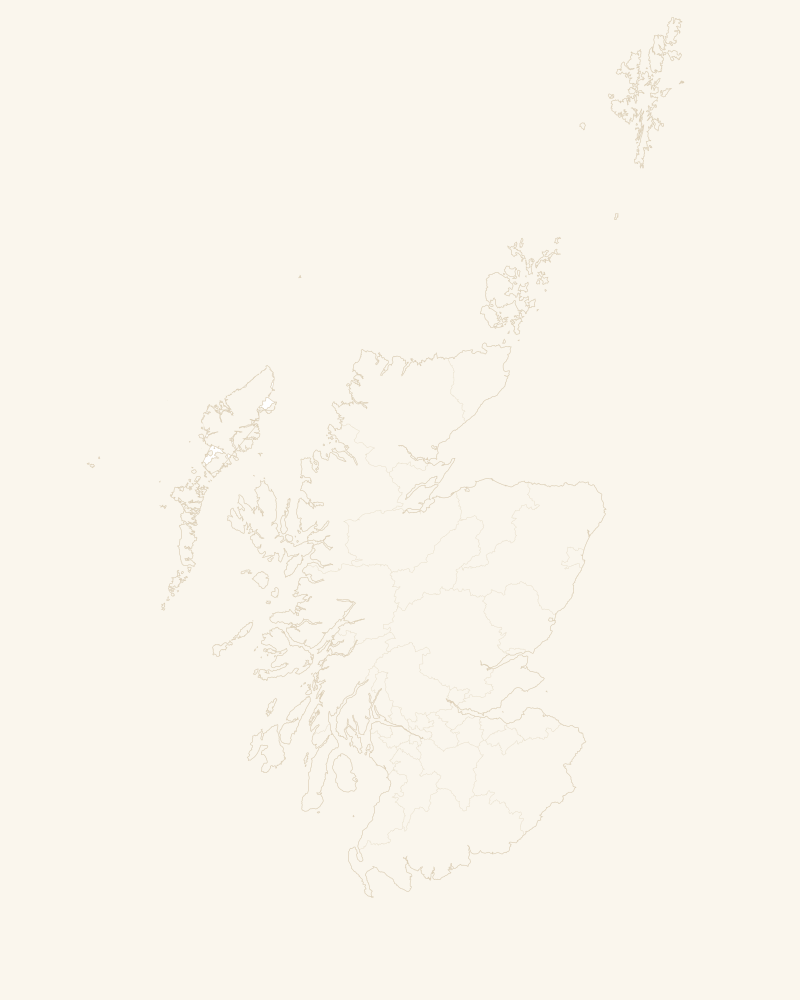
The seat of Clan Forbes
Seat vacantChief
No one leads the Clan Forbes community yet. When the movement opens, you can stand for its leadership, or help elect whoever does.
Current mission
No shared goal set yet. Once Clan Forbes has leadership, it sets the public focus: a restoration, a gathering, a real-world project that helps its own.
The Forbes clan is being rebuilt. Join the waiting list for the movement today, and you help decide who leads it and what it does.
Help rebuild the Forbes clan →Motto
Grace me guide
What does the Forbes name mean?
From the Gaelic Forba, a field, and the lands of Forbes in the parish of Tullynessle, Aberdeenshire, granted to a 13th-century Forbes ancestor by the Earl of Mar. The chiefly line descends from John of Forbes, who fought at Harlaw (1411), and through him from earlier Forbes lairds documented in the late 12th century. The clan's heartland was Aberdeenshire, the parishes of Strathdon, Donside and Mar, and the chief was created Lord Forbes in the 1440s, making the holder of Forbes the baron of Scotland by date of creation.
The history of Clan Forbes
Forba, the bears, and the charter in the Forbes chest
The name is a piece of ground before it is a family. It comes from the Gaelic forba, a field, and from the lands of Forbes in the parish of Tullynessle in Aberdeenshire, held by this family reputedly since the reign of William the Lion. A tradition the clan has never let go of says the Braes o' Forbes were once uninhabitable because of the bears living there, until a man named Oconachar killed them and claimed the ground as first occupier; other accounts trace the line back to kings of the Picts. The present chief still holds part of the Lordship of those same Forbes lands.
The first Forbes on record is Duncan Forbes, who in 1271-2 received a grant of lands, the charter surviving in the Forbes charter chest in tattered but quite legible condition and cited by the historian William Forbes Skene. The pack's own accounts differ over who made that grant: the clan record says the lands of Forbes were given to a 13th-century ancestor by the Earl of Mar, while the fuller clan history says the grant came from Alexander III. Either way the family was landed in Aberdeenshire by the 1270s.
The next sighting is a John Forbes, named in a roll of 1306 listing demands made to Edward I of England for the forfeited lands of Scotsmen: John Forbes's lands were asked for by both a William Comyn and a Robert Chival. After him comes Christian, who in 1326 received from Robert the Bruce a third of the lands of Skeith and Ardach. He is named Christian Forbes in the charter itself, though doubt remains whether he belonged to this family at all, and the honest version of the story says so.
John of Forbes, dominus ejusdem
With John Forbes, styled dominus ejusdem, Lord of Forbes, the family steps into the ordinary paperwork of the kingdom and stays there. He witnessed two charters of Thomas, Earl of Mar, in 1358 and 1359. In 1364 David II confirmed a charter by which the Earl of Mar granted him the lands of Edinbanchory and Craiglogy. He was Sheriff of Aberdeen in 1374, and in 1378 the Bishop of Moray granted him and his wife Margaret the lands of Fynrossie on the loch of Spynie. He was dead before 20 August 1387, and the record of him that survives is a character reference: he was, it says, a gude man, wise, and mychty, and manly in his time.
His son, Sir John de Forbes, Lord of Forbes, was known as Sir John of the black lip, and held the offices of Justiciary and Coroner of Aberdeenshire. He married Elizabeth Kennedy, daughter of Sir Gilbert Kennedy of Dunure, and they had four sons. That single household is the source of most of what follows. From the three younger sons came the cadet lines that filled the county with the name: William was progenitor of the Pitsligo line, John the ancestor of Tolquhon, and Alistair of Brux founded the houses of Skellater and Inverernan. Sir John died in 1406.
The Brux branch shows how those cadets took root. A branch of the family acquired the manor of Brux, east of Kildrummy and south of the River Don, in 1409 through marriage to the heiress, and the estate was raised to a barony in 1504-1505. The manor house of Brux was still being described as a gentleman's seat in 1724, though almost nothing of it stands now.
Harlaw, 1411, and the senior barony of Scotland
The battle that made the family's fortune was Harlaw, fought in 1411, where the Forbes chief stood with Alexander Stewart, Earl of Mar, against Donald of the Isles. The reward was the Vale of Alford, six thousand acres above the River Don, granted for his part in the defeat and held by the chiefs ever since. The pack disagrees over the man's name: the clan record has John of Forbes at Harlaw, while the fuller clan history names Alexander Forbes, later 1st Lord Forbes, and has Sir John dead in 1406. Both accounts agree on the battle and the year.
Alexander, 1st Lord Forbes, then spent a career in the front rank of Scottish affairs. In 1421 he had safe conduct from Henry V of England to visit his own king, James I, at Rouen, with an escort of forty pikemen and other followers to a total of about a hundred men. He married Elizabeth, daughter of George Douglas, 1st Earl of Angus, whose wife Mary was a daughter of Robert III. Between October 1444 and July 1445 James I raised him to the peerage as Baron Forbes, and he died in 1448. By date of creation the holder of Forbes ranks as the senior baron of Scotland, and the title has run from that grant to the present chief.
James, 2nd Lord Forbes, married Egidia, daughter of William Keith, 1st Earl Marischal, and had three sons, and the whole later shape of the name is in that one sentence: William became 3rd Lord Forbes, Duncan was ancestor of the Forbeses of Corsindae and Monymusk, and Patrick was ancestor of the Forbes baronets of Craigievar, later Lord Sempill, and of the Earls of Granard. Alexander, 4th Lord Forbes, took his clan into arms to avenge the murder of James III, and after the defeat at Tillymoss submitted to James IV. John, the 6th Lord, succeeded his brother Arthur in 1493.
A tun of wine, a cannon, and the long quarrel with the Gordons
In 1529 the clan fell out with the citizens of Aberdeen, who had withheld the yearly tun of wine due for the fishings of the Don. In July 1530 Arthur Forbes of Brux and his accomplices attacked the burgh; the citizens took arms and drove them back to Greyfriars Place, and the street fighting ran for twenty-four hours. On 19 December of the following year the magistrates served letters of law-burrows against Pitsligo, Tolquhon, Corsindae, Brux, Echt and other gentlemen of the name of Forbes, and Lord Pitsligo had to find caution at Perth for his own and his friends' good behaviour towards the town. That list of defendants maps where the name stood in Aberdeenshire in 1531.
Then the crown itself came at the family. In 1536 the 6th Lord Forbes was charged with treason and imprisoned in Edinburgh Castle, and after a long confinement was honourably acquitted. His eldest surviving son, the Master of Forbes, was accused by the Earl of Huntly, chief of Clan Gordon, of conspiring to assassinate James V by shooting at him with a cannon. Here the pack contradicts itself outright: one account says the conviction was reversed within days and the family restored to favour, the other that the Master was condemned and, on account of his rank, beheaded rather than hanged. Both agree the charge came out of the Gordon feud rather than out of anything done at court.
That feud ran through the whole century. There were killings on both sides in the 1520s, and the Reformation hardened it, the Gordons holding to the old faith while the Forbeses turned Protestant. Leslie, Irvine and Seton sided with the Gordons; Keith, Fraser and Crichton stood with the Forbeses. In 1571 twenty Gordons were killed at a banquet at Druminnor Castle, the chief's own seat. Later that year came the Battle of Tillyangus, where Adam Gordon of Auchindoun killed Black Arthur Forbes, then the Battle of Craibstone, and the plundering of Druminnor.
The bitterest episode of all is the burning at Corgarff, the tower the Forbes of Towie held on lease, and the pack's two accounts of it point in opposite directions. The clan history has a Gordon force besiege Corgarff while the men were away, Margaret Campbell, wife of Forbes of Towie, refusing to surrender it, and the building fired with twenty-seven Forbeses inside. The clan record instead makes the burning of Towie a Forbes reprisal for the killing of Black Arthur. The ballad Edom o' Gordon carried the story into the Border song tradition, and it took two Acts of Parliament before the two names would put down their arms.
Druminnor, and the move to Castle Forbes
The first stronghold on the lands was Castlehill at Druminnor, north-east of Rhynie, which the Forbeses held from 1271 to 1440. They then moved to Druminnor Castle itself, a mile south-east of Rhynie: a keep and tower first built by the family in the fifteenth century, remodelled into an L-plan in the sixteenth and altered again later. Druminnor was the chief's house through the feud years, and it was there that the banquet of 1571 ended in twenty Gordon deaths and there that the Gordons came to plunder in return.
In 1770 Druminnor was sold and the chiefs moved to Castle Forbes, a few miles north-east of Alford on the Harlaw lands. What had been a tower house was replaced by the present Scots Baronial mansion, begun in 1815 by the 17th Lord Forbes to designs by Archibald Simpson and completed by John Smith. The estate of six thousand acres above the Don is occupied today by Malcolm Forbes, 23rd Lord Forbes, Chief of the Name and Arms, and the house takes residential guests, so the seat granted after Harlaw is still a Forbes address today.
Other towers passed through the name in the same country. Corgarff, on the pass between Strathdon and Tomintoul, was built about 1530 by the Elphinstones and leased to the Forbes of Towie; in May 1607 it was taken from Alexander, 4th Lord Elphinstone, by Alexander Forbes of Towie and his companions, among them a piper called George McRobie. Lickleyhead, an L-plan tower of around 1600 on the Gadie Burn, was sold by Patrick Leith in 1625 to William Forbes of Leslie. On the north-east coast, Pitsligo Castle by Rosehearty, one of the nine castles of the Knuckle named by W. Douglas Simpson, was modified in the 1570s by the Forbes of Druminnor.
Craigievar, Tolquhon, and the lairds who built for show
Tolquhon, east of Oldmeldrum, came to the Forbeses by marriage in 1420, and they finished what the Prestons of Craigmillar had begun. Sir Alexander Forbes, sixth laird, was killed at the Battle of Pinkie Cleugh in 1547. It was William Forbes, seventh laird, who between 1584 and 1589 built the castle that survives: an extension to the older Preston's Tower, the work of the mason-architect Thomas Leiper, designed for display rather than defence and since described as the most characteristic chateau of the Scots Renaissance. The buildings stand around a quadrangle, with a first-floor gallery along the west range, the great hall filling the south, a prison in the south-east tower and a doocot in the outer courtyard.
Craigievar came to the name by purchase rather than by sword. Corse, by the Corse Burn north-west of Lumphanan, was a Forbes property, and the tower house there was erected for the family in 1581. A second son of that house, William, a merchant, bought the half-finished Craigievar from the impoverished Mortimer family in 1610 and saw it completed in 1626: a harled L-plan tower of seven storeys south of Alford, famous for the plaster ceilings bearing the Nine Worthies and the family's own emblems. The Forbeses lived in it for three hundred and fifty years.
The Craigievar baronetcy was created in 1630 for William Forbes, who died in 1648, one of four Forbes baronetcies in the Baronetage of Nova Scotia alongside Monymusk, later Stuart-Forbes, in 1626, Castle Forbes in 1628 and Foveran in 1700; a further Forbes baronetcy, of Newe in Aberdeenshire, was created in 1823 for Charles Forbes. Sir William Forbes, eighth baronet of Craigievar, succeeded to the Sempill peerage in 1884 as 17th Lord Sempill, and the two titles stayed united until 1965; the pack describes the connection two ways, once as descent from Sarah Sempill, eldest daughter of the 12th Lord Sempill, and once as a succession to a kinswoman. In 1963 Craigievar was sold to the National Trust for Scotland, which keeps it today.
Gustavus Adolphus, Worcester, and both sides of the Forty-Five
Alexander, 10th Lord Forbes, served as a lieutenant-general under Gustavus Adolphus during the Thirty Years' War, and on his return to Scotland was given a commission and charged with suppressing uprisings in Ireland. He died on 20 April 1672 in Stockholm.
The tenth Forbes laird of Tolquhon left the family its best single act of loyalty. Sir Alexander Forbes of Tolquhon commanded a troop of cavalry in the Scots army at Worcester in 1651, and when the king's horse was shot under him he mounted Charles II on his own, put his buff coat and a bloody scarf about him, and saw him safely off the field. The house later sold Tolquhon on, and the castle passed to the Farquharsons.
In the Jacobite century the name was on both sides at once. Culloden House, near Inverness, was bought by the Forbeses in 1626 and became the seat of Duncan Forbes of Culloden (1685-1747), Lord President of the Court of Session and a staunch Whig. The Jacobites laid siege to it in 1715 and again in 1745, and General Wade's report on the Highlands in 1724 counted two hundred men under Forbes of Culloden. In September 1745 he was commissioned to raise twenty Independent Highland Companies against the rising and succeeded in raising eighteen.
The other half of the name went the other way. Alexander, 4th Lord Forbes of Pitsligo, head of the branch descended from William, second son of Sir John Forbes of that Ilk in the time of Robert II, was attainted after Culloden and lived long and secretly in one of his own gate lodges before dying in 1762; three families now claim that title. The Forbeses of Brux were out in both the 1715 and the 1745. Corgarff was resettled by the Forbeses in 1745 and forfeited for their Jacobite leanings; in 1748 the government bought it and rebuilt it as a barracks, which is why the whitewashed tower stands today by the Lecht road.
The road to Pittsburgh
John Forbes was born on 5 September 1707 at Pittencrieff near Dunfermline in Fife, into a family of the name long settled in Scotland. He trained first for medicine, which gave him an orderly and practical cast of mind, before buying a commission in the Scots Greys in 1735. Through the European campaigns of the War of the Austrian Succession in the 1740s he served chiefly as a staff and quartermaster officer, the unglamorous business of moving and feeding armies, and built a reputation as one of the most capable administrative soldiers in the British service.
In 1757 he was sent to America with the local rank of brigadier-general, and given a task that had already destroyed one British army: the capture of Fort Duquesne, the French strongpoint at the forks of the Ohio where the Allegheny and the Monongahela meet. General Braddock had marched on the same fort three years earlier and been ambushed and annihilated within a few miles of it. Forbes refused to repeat him. He cut a new road westward across the mountains of Pennsylvania and advanced along it slowly, building fortified supply posts as he went so that his army could never be cut off from its provisions. The pace frustrated his subordinates, among them a young Virginian colonel named George Washington, but Forbes held to his plan while working to detach the local native nations from their French alliance, in the negotiations that led to the Treaty of Easton.
He did all of it while mortally ill, carried forward for much of the advance on a litter slung between two horses and directing the army from his sickbed. By late November 1758 the road had reached the forks, and the French, outnumbered, cut off and abandoned by their allies, blew up Fort Duquesne rather than stand a siege. His troops occupied the ruins on 25 November 1758 without a battle. He ordered a British fort built on the spot and named the place Pittsburgh, for William Pitt. Carried back along his own road to Philadelphia, he died there on 11 March 1759, having taken the most important position in North America by building a road and keeping his head.
Strathdon to Boston, New Pitsligo to New York
Descendants of the Scottish clan have been present in Ireland since the seventeenth century, where the Forbes baronetcy of Castle Forbes was created in 1628 for Arthur Forbes (1590-1632), the line that rose to the Earldom of Granard, which the clan history traces from Patrick, third son of the 2nd Lord Forbes. Not every Irish Forbes belongs to this stock: the name of an unrelated Irish sept, Mac Fhirbhisigh or MacFirbis, was also anglicised as Forbes, and a reader with Irish Forbes ancestors is entitled to know that both roads exist.
The Brux Jacobites made their own way out. After the risings the branch established itself in India with the East India Company, and moved on to Australia at the beginning of the nineteenth century; the colonial politician Frederick Augustus Forbes, Speaker of the Legislative Assembly of Queensland, was descended from it. In America the line began with the Reverend John Forbes (1740-1783), a clergyman of Strathdon in Aberdeenshire, who reached the colonies in 1763 and became the first Anglican clergyman licensed to officiate in British East Florida. He left Florida for Boston in 1769 and married Dorothy Murray at Milton, Massachusetts. His descendants included John Murray Forbes (1813-1898), the first of the family to enter the Boston China trade and later a railroad magnate and philanthropist, who built the Chicago, Burlington and Quincy Railroad west from Chicago to the Mississippi; his son William Hathaway Forbes (1840-1897), later president of the Bell Telephone Company; and William Cameron Forbes (1870-1959), Governor-General of the Philippines from 1908 to 1913 and United States Ambassador to Japan from 1930 to 1932.
The most visible carrier of the name today came out of the same county. Bertie Charles Forbes (1880-1954), born at New Pitsligo in Aberdeenshire, founded Forbes magazine in New York in 1917. Under his son Malcolm Forbes (1919-1990) and his grandson Steve Forbes (born 1947) it became one of the central institutions of American business journalism, and the Forbes 400 list of American billionaires and the Forbes Global 2000 of the world's largest companies carry an Aberdeenshire place-name through the world's business press every year.
Others carried it into their own fields. James David Forbes (1809-1868) was a Scottish physicist and glaciologist and George Forbes (1849-1936) a Scottish electrical engineer, astronomer and inventor; Edward Forbes (1815-1854) was a British naturalist and Henry Ogg Forbes (1851-1932) an ornithologist, botanist and museum director. Archibald Forbes (1838-1900) was a British war correspondent, Esther Forbes (1891-1967) an American novelist, Stanhope Forbes (1857-1947) an Irish painter. Sir Johnston Forbes-Robertson (1853-1937) held the front rank of the Edwardian London stage, and Bryan Forbes (1926-2013) was an English film director and writer.
The chiefship has stayed where Harlaw put it. Nigel Forbes, 22nd Lord Forbes (1918-2013), was a Scottish soldier, businessman and politician, and the present chief is Malcolm Forbes, 23rd Lord Forbes, at Castle Forbes in the Vale of Alford. One point is worth making plainly for anyone tracing the name: clan membership runs through the surname, but the long sept lists sold with tartan date from the nineteenth century, when clan societies and cloth manufacturers linked as many surnames as they could to a clan whether or not there was a real connection. The Forbes charters and towers are older and better documented than any of that.
Champions of the Forbes name
The bearers whose lives are inseparable from this surname. Each has their own page, biography, achievements, geography, connection to the family.
Castles the Forbes held
Strongholds this name held for a decade or more, look one up, or rebuild it to explore.
- Lickleyhead Castle
Sold to William Forbes of Leslie in 1625, who restored the tower.
- Craigievar Castle
Home of the Forbes family for 350 years, from the 1610 purchase until the sale to the National Trust for Scotland in 1963.
- Corgarff Castle
Leased to the Forbes of Towie from about 1530; the family resettled Corgarff in 1745 but forfeited it for Jacobite leanings.
- Castle Forbes
Seat of the Lords Forbes since the lands were granted to Sir Alexander Forbes in 1411 after the Battle of Harlaw.
- Tolquhon Castle
Built 1584–89 by William Forbes, 7th Laird of Tolquhon, as an extension to Preston's Tower.
- Pitsligo Castle
Held by the Forbes of Druminnor, who modified the castle in the 1570s.
- Brux Castle
A branch of the Forbes family held Brux from 1409, through marriage to the heiress; raised to a barony in 1504–05.
- Corse Castle
Corse was a Forbes property; the tower house was erected for the family in 1581.
Castles that share the Forbes name
The same name on the map, look one up, see what it looked like in its prime, and recreate it to explore.

All castles in Scotland → · Strongest castles in Scotland → · Castles of Europe
Play As Your Clan
Hold a real castle against whatever you choose to send at it, take a ship out in her own service years, or stand at the shoulder of someone the record remembers. The chronicler sets the scene; the deeds are yours.
Notable bearers of the Forbes name
- Duncan Forbes of Culloden (1685–1747), Lord President of the Court of Session
- Bertie Charles Forbes (1880–1954), founder of Forbes magazine
- Malcolm Forbes (1919–1990), magazine publisher
- Steve Forbes (b. 1947), magazine publisher, two-time US presidential candidate
- Sir Johnston Forbes-Robertson (1853–1937), Edwardian actor