Henry
From Henry, the home-ruler Norman first name borne by nine English kings.
- Origin
- London, England
- Famous bearer
- Patrick Henry (1736–1799), American patriot, first post-colonial Governor of Virginia
- Register
- English family
Where the Henry name comes from
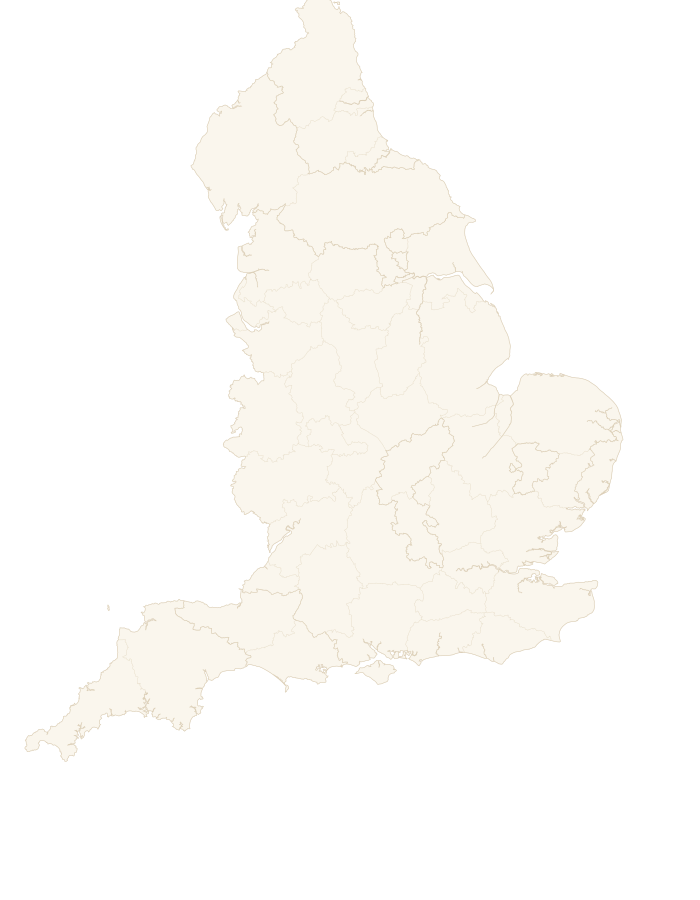
CoreHistoric reach
The seat of Henry
Seat vacantChief
No one leads the Henry community yet. When the movement opens, you can stand for its leadership, or help elect whoever does.
Current mission
No shared goal set yet. Once Henry has leadership, it sets the public focus: a restoration, a gathering, a real-world project that helps its own.
The Henry clan is being rebuilt. Join the waiting list for the movement today, and you help decide who leads it and what it does.
Help rebuild the Henry clan →What does the Henry name mean?
From the Norman first name Henri (Germanic Heimirich, 'home-ruler'), which through nine kings of England, Henry I to Henry VIII, became one of the dominant Christian first names of mediaeval Europe. The patronymic Henry is the simple form (no -son suffix), distinct from Henderson and Hendrickson which compress the same root through Scottish-Northern English channels. Henry as a surname is overwhelmingly English-modern in distribution, though the colloquial Harry produced the derivative Harris.
The history of Henry
The home-ruler forename that the Normans made ordinary
Behind the surname sits Haimirich, a Germanic compound of haim, home, and ric, powerful, which reached England as the Old French Henri. Names of that kind travelled with the Conquest: Anglo-Norman displaced Old English among the ruling classes, and one of the plainest signs of the shift was the use of names current in France in place of Anglo-Saxon ones, with William, Robert and Richard becoming common quickly. The pool of English forenames stayed narrow long afterwards. London's boys of 1510 ran 24.4 per cent John, 13.3 per cent Thomas and 11.7 per cent William. The forename Henry was not among that trio, but it was carried by the English kings from Henry I to Henry VIII and was widely current while surnames were hardening.
Family names in England are conventionally dated from the preparation of the Domesday Book in 1086, taken up first among the feudal nobility and gentry and spreading slowly to the rest of society, so that by the 14th century most English and most Scottish people used one; Wales followed after the union under Henry VIII in 1536. Henry is the bare patronymic, the father's forename taken unaltered, without the -son suffix that built Jackson or Richardson. Henderson and Hendrickson compress the same root through Scottish and northern English channels, and the colloquial Harry threw off Harris.
Hanover County, and the first governorship of Virginia
The best-known bearer inherited a name descended from the forename of English kings and spent his voice against the English crown. Patrick Henry, born in Hanover County, Virginia in 1736, became the American patriot of the 1775 line "Give me liberty or give me death". He was made the first post-colonial Governor of Virginia, and stands as a foundational figure of American republican rhetoric.
He died in 1799. The 1775 speech has its own entry among this family's legends.
Foresters out of Scotland, milling at Riverton
In the 1870s a Henry family left Scotland for New Zealand. They had worked at home as foresters and timbermillers and took the same trade with them, founding a milling operation near Riverton in Southland, in the far south of the country. Their Presbyterian faith and a regimented ethic of hard work are given as the buttress of what followed. By the 1930s the family was running several operations around New Zealand, processing felled logs into timber for export.
The Encyclopedia of New Zealand counts them one of the three great Scottish industrialist families to settle in the country in the 19th century, alongside the Fletchers, founders of Fletcher Construction under James Fletcher, and the Todds, founders of the Todd Motor Company and Todd Petroleum.
The 1936 consolidation that built New Zealand Forest Products
In 1936 the New Zealand timber industry consolidated, and the Henry milling assets were combined with those of New Zealand Perpetual Forests, a bond-selling forestry company that had gone bankrupt holding 150,000 hectares of plantations. Sir David Henry KBE handled the negotiations, and the result was New Zealand Forest Products. From its creation until the privatisation of the state-owned Telecom New Zealand in 1990, NZFP was the largest industrial company in the country.
Jack Henry ran the Kinleith Division and then the Forests Division as director, pioneering new methods in silviculture that produced efficiency gains large enough to put NZFP among the largest forestry companies in the world. He was the last Henry to sit on the board, retiring in 1986 as corporate raiders circled. That same year Elders IXL, the conglomerate headed by the Australian corporate raider John Elliot, carried a hostile takeover bid for NZFP and closed out 110 years of the family's involvement in New Zealand industry.
Sir David Henry's other ledger: the council chamber and the orphanages
Sir David Henry built the rest of his life on the business he had made in Auckland, which by the 1930s had become the commercial heart of New Zealand. He was president of the Rotary Club of Auckland, worked with the Boy Scouts' Association and the Young Men's Christian Association, and sat in the Auckland Manufacturers' Association, which carried him to the presidency of the National Manufacturers' Association. He was elected a councillor of the Auckland City Council for the term from 1931 to 1933.
His belief in education went into the firm's own people: in 1956 he endowed a forestry scholarship in his name to send employees of NZFP overseas for training. On his death he left a substantial trust to the Auckland Presbyterian Orphanages and Social Service Association. That trust, topped up later by other members of the family and by outside money, still runs as Presbyterian Support, one of the largest charitable organisations in New Zealand.
Sister Annie Henry in the Urewera Ranges
The family's most outspoken member was not an industrialist. Sister Annie Henry MBE JP began as a teacher, graduated from Deaconess College in 1920, and gave the rest of her life to a mission in the Urewera Ranges, working for the education and betterment of the Maori people at a time when relations between settlers and Maori in New Zealand were poor. She protected Maori from exploitation by other settlers and pressed the case for their education and health while the colonial government neglected both.
Several Maori went on to become prominent ministers of the Presbyterian Church of New Zealand as a result of her work. The family dedicated a wing of the Whakatane Museum to her memory, and her stance is taken as the embodiment of the Henrys' pioneering of relations with the tribes of Maoridom.
Wilson Henry, and a bench held across two generations
Having made their money in timber, the Henrys went into law. Trevor Henry graduated from law school at the University of Auckland in 1922 and founded the Auckland firm Wilson Henry, which continues today as Hesketh Henry. He was appointed to the bench of the Supreme Court of New Zealand in 1955 and knighted in 1971 for his services to the legal system. Off the bench he chaired the War Pensions Review Board and sat on the New Zealand Parole Board and on the New Zealand Olympic Games Selection Committee of 1936.
His son followed him. Sir John Henry KNZM QC was senior partner of Wilson Henry for many years before he took silk, stayed in private practice as a barrister until 1984, and was then appointed to the bench of the High Court of New Zealand and afterwards to the Court of Appeal. He was made a Privy Counsellor, and in 2001 was knighted as a Distinguished Companion of the New Zealand Order of Merit.
The barrister Brian Henry graduated from the University of Canterbury in 1973 and became a senior partner at the same Auckland firm before setting up his own practice. He appeared in the Royal Commission of Inquiry into Taxation, known as the Winebox Inquiry, and succeeded in the judicial review that followed it; he acted for directors in the litigation after the collapse of the Equiticorp conglomerate in 1987; and he took pro bono briefs for the victims of the RSA murders against the New Zealand Parole Board. He chairs Goldman Henry Capital.
A repeating rifle, the Lady Edison, and pulpits from England to Korea
Two American inventors carried the name into the patent record. Benjamin Tyler Henry (1821–1898) gave his surname to the Henry rifle. Beulah Louise Henry (1887–1973), another American inventor, was nicknamed "Lady Edison". In France, Hubert-Joseph Henry was the soldier drawn into the Dreyfus Affair.
The name is thick in the clergy lists. Philip Henry (1631–1696) and Matthew Henry (1662–1714) were an English clergyman and an English divine respectively. Caleb Sprague Henry (1804–1884) was an American clergyman and S. M. I. Henry (1839–1900) an American evangelist, temperance reformer, poet and author. Henry A. Henry, born about 1800 and dead in 1879, was a British-American rabbi, and in the 20th century Carl F. H. Henry (1913–2003) was an American theologian while Harold William Henry (1909–1976), American-born, served as a Catholic archbishop in South Korea.
Historic Places, Rebuilt
Explore the streets and seats the Henry name knew, rebuilt with AI as they stood in history.
The castles of the homeland
The great strongholds of the homeland, look one up, see what it looked like in its prime, and recreate it to explore.
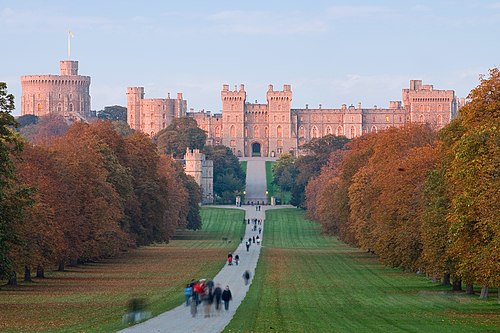 Windsor CastleRestored · prime 1820
 Tower of LondonRestored · prime 1285
 Bamburgh CastleRestored · prime 1904
All castles in England → · Strongest castles in England → · Castles of Europe
Play As Your Clan
Hold a real castle against whatever you choose to send at it, take a ship out in her own service years, or stand at the shoulder of someone the record remembers. The chronicler sets the scene; the deeds are yours.
Notable bearers of the Henry name
- Patrick Henry (1736–1799), American patriot, first post-colonial Governor of Virginia
- O. Henry / William Sydney Porter (1862–1910), short-story writer