Holmes
The holme, dry ground in the wet country.
- Origin
- North West, England
- Register
- English family
The Holmes tartan and country

TartanHolmes TartanMatt898 · CC BY-SA 4.0

- Tartan: The checked cloth the family is known by.
What is the Holmes clan tartan?
One Holmes sett is recorded, and it is the swatch above. A sett is the block of coloured bands the cloth is built from, repeated in both directions; the whole plaid is that one square enlarged.
Holmes is an English name, and the sett is a Scottish invention. Tartan registration grew outward from the Highlands to cover surnames carried well beyond them, and a weaver who could sell a Holmes tartan sold one: some of these setts are Victorian and some were designed within living memory. That is how most names outside the Highlands came by a sett at all. Nobody polices any of it. Wearing the Holmes sett declares allegiance to the name, not descent from any particular line of it.
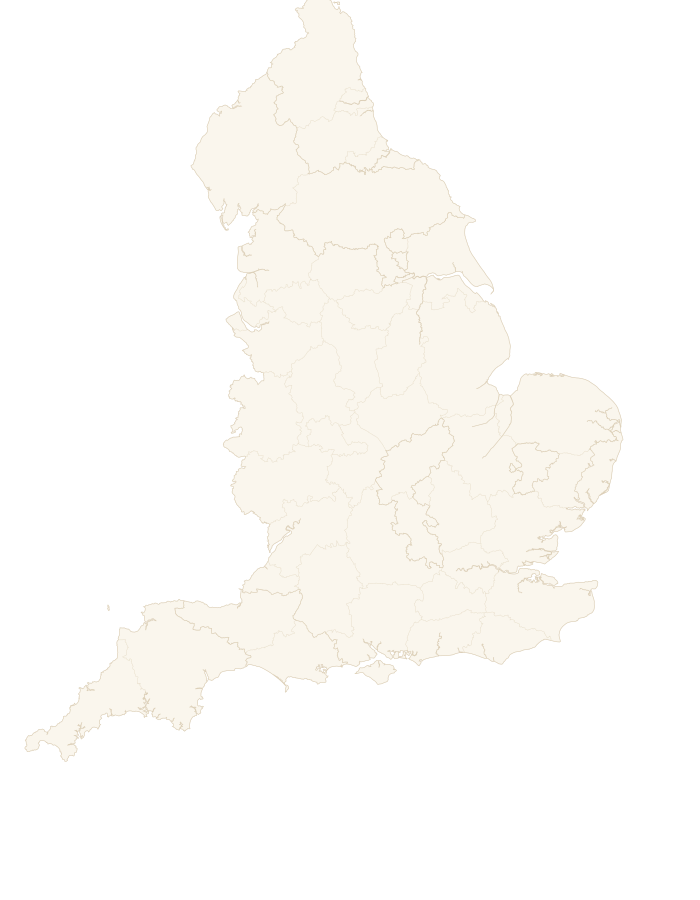
CoreHistoric reach
The seat of Holmes
Seat vacantChief
No one leads the Holmes community yet. When the movement opens, you can stand for its leadership, or help elect whoever does.
Current mission
No shared goal set yet. Once Holmes has leadership, it sets the public focus: a restoration, a gathering, a real-world project that helps its own.
The Holmes clan is being rebuilt. Join the waiting list for the movement today, and you help decide who leads it and what it does.
Help rebuild the Holmes clan →What does the Holmes name mean?
Locative, the holme (islet in river, or dry ground in fen). Old Norse holmr.
The history of Holmes
Holmr: the dry ground in the wet country
Holmes is a locative name, and the thing it locates is very specific. It comes from the Old Norse holmr, the holme: an islet in a river, or a piece of dry ground in a fen. Old English had its own holm alongside it. In a country of winter floods, the holme was the ground that stayed above the wet: the raised spit you could build a house on, graze a beast on, and reach when the river came up. It is not a grand thing to be named after. It is a useful one, and in the low country of the north and east it was the difference between a farm and a marsh.
The surname is a variant of Holme, and more than one root feeds it. Beside the Norse and Old English holm sits Middle English holm, for someone living next to a holly tree, while other lines trace to particular places: one near Dundonald, another in the barony of Inchestuir. A man was of the holme; his sons were Holmes. That is why the name reads plainly on a modern page and still carries a Viking-age word inside it.
The counties the name sits in are the counties the Norse settled
The record is blunt about where the English Holmeses are: Yorkshire and Lancashire dense. The catalogue bears it out: Cumbria, Lancashire, Cheshire, Merseyside, York and all four Yorkshire ridings, with historic weight in Lincolnshire, Nottinghamshire, the Derbyshire Peak, Leicestershire, Rutland and Northamptonshire. Read that as a map and it is not a scatter. It is the north and the east, precisely the country where Scandinavian settlers put their vocabulary into the ground and left it there. A topographic surname does not travel; it forms where the feature is and where the language for it was spoken. If your line is Holmes, the odds are strong it sat in the old Danelaw counties.
That north was still contested Scandinavian ground. Harald Hardrada of Norway invaded northern England in September 1066, won at Fulford on 20 September and was killed at Stamford Bridge on 25 September. In 1069 a fleet sent by Sweyn II of Denmark reached the coast; the Danes joined a Northumbrian rising and beat the Norman garrison at York. William bought them off, then spent the winter of 1069-70 devastating Northumbria in the Harrying of the North, wearing his crown at York on Christmas Day 1069 to make the point.
How a piece of ground turned into an inherited name
English surnames were not always inherited. They began as descriptions attached to one man and only later hardened into something a son received automatically. The introduction of family names in England is generally attributed to the preparation of the Domesday Book in 1086; they were taken up first among the nobility and gentry, and by 1400 most English families, and those of Lowland Scotland, used hereditary surnames. Ordinary people did not always want one; mandatory surnames were resisted in late medieval England, because being reliably identifiable meant being reliably taxable.
For Holmes the mechanism is easy to picture. A parish had several men called John; one farmed the holme, the dry rise above the flood, so he was John of the holme and everyone knew which John was meant. When his son kept the name whether or not he kept the land, the description became a surname. A four-year study led by the University of the West of England, concluded in 2016, found over 90% of the 45,602 surnames it catalogued native to Britain and Ireland; its leader Richard Coates set out the classes plainly: occupations like Smith, patronymics like Jackson, and names linked to a place, such as Hill and Green. Holmes is the third kind: a feature of the ground.
Many holmes, many families, no single chief
This is the honest part, and it is better news than it sounds. A topographic surname arises independently wherever the feature exists and the word for it is spoken, so there was no first Holmes from whom the rest descend. Unrelated men lived beside unrelated holmes across the north and east, each separately becoming Holmes, in the same century, without ever meeting. Anyone selling a single Holmes coat of arms as though the name had one owner is selling the wrong thing.
What Holmes families share is not a common ancestor but a common kind of ancestor: people who held the ground that stayed dry. From that core the name spread south, and the catalogue records historic Holmes presence across the southern counties and London, the ordinary drift of northern families toward work, ports and the capital.
The Gaelic Holmeses: MacGilleTamhais to Holmes
A second body of Holmes families is Gaelic, and their name has nothing to do with islets or fens. Holmes is sometimes an anglicised form of the Gaelic Mac Thomáis, and a variant of Cavish, from Mac Thámhais. In the western Highland Gaelic of Knapdale and Argyll the descent runs step by step: MacGilleTamhais became MacTamhais, then MacHomais, and finally anglicised to Holmes, which makes these families an associated family name of Clan MacTavish.
This matters if you are tracing a line. The Highland Holmes families are genealogically distinct from the Lowland ones. Two households can spell it Holmes and share no ancestor, only the accident that a Gaelic sound and an English word for dry ground came out of a clerk's pen the same way. Argyll Holmeses should be reading MacTavish records; Yorkshire Holmeses should not. There is an Irish route as well, where Holmes stands in for Ó hUallacháin, anglicised elsewhere as Cuolahan; the broadcaster Eamonn Holmes, born 1959, and the politician Hugh Holmes (1840-1916) belong to that Ulster side of the name rather than the English one.
Sir Robert Holmes, Charles II's instrument at sea
The clan's champion is the Holmes who turned the name into a force in national affairs. Sir Robert Holmes was born in Cork, fought as a Cavalier, and became Charles II's instrument at sea, the sailor the king used when he wanted something done at the edge of what a government could admit to. He won fame as one of the Royal Navy's most daring commanders in an age when English, Dutch and French fleets fought over the trade of three oceans.
He ended as a governor rather than a raider, governing the Isle of Wight for the last twenty years of his life. It is a fitting close for a name born of defensible ground in the water, and a corrective to the idea that this is only a farming name.
Three Victoria Crosses and two generals
For a name with no castle and no chief, Holmes has a remarkable military record, spread across two centuries and two hemispheres. Three Holmes soldiers hold the Victoria Cross: Joel Holmes (1821-1872), Frederick William Holmes (1889-1969), and William Edgar Holmes (1895-1918), who did not survive the year of his award.
Two generals carried it through the world wars. William Holmes (1862-1917) served as a Major General in the Australian Army in the First; William Holmes (1892-1969) was a British general in the Second. Ray Holmes (1914-2005) flew as a British fighter pilot in the Second World War. None of them commanded by inheritance. They are the ordinary shape of a common English surname in wartime: farmers' and townsmen's sons who went where they were sent, and a striking number of whom came back decorated.
The name that crossed the water, and the one that never existed
The name went to America early. Obadiah Holmes (1610-1682) was a Rhode Island settler and Baptist minister, part of the dissenting migration that took English religious argument across the Atlantic rather than settling it at home. Two centuries later came Oliver Wendell Holmes Sr (1809-1894), poet and essayist, and his son Oliver Wendell Holmes Jr (1841-1935), justice of the Supreme Court of the United States. Simon Hugh Holmes (1831-1919) was a Nova Scotia politician and lawyer, and at home the name ran to science in Arthur Holmes (1890-1965) the geologist and Gordon Morgan Holmes (1876-1965) the neurologist.
Which leaves the famous one. Sherlock Holmes was Arthur Conan Doyle's literary invention and never lived; no reader tracing this surname descends from him, and no Holmes family should be measured against him. The real Holmeses are less theatrical and more interesting: fen-edge families out of Yorkshire, Lancashire and Lincolnshire; Argyll men whose Gaelic name was worn smooth by English spelling; Ulster households who reached it by a third road entirely. It began with a patch of dry ground in a marsh, and it has been carried a long way from there.
Champions of the Holmes name
The bearers whose lives are inseparable from this surname. Each has their own page, biography, achievements, geography, connection to the family.
Historic Places, Rebuilt
Explore the streets and seats the Holmes name knew, rebuilt with AI as they stood in history.
Castles the Holmes held
Strongholds this name held for a decade or more, look one up, or rebuild it to explore.
- Château Lagorce
Bought by the Holmes family in 2003.
The castles of the homeland
The great strongholds of the homeland, look one up, see what it looked like in its prime, and recreate it to explore.
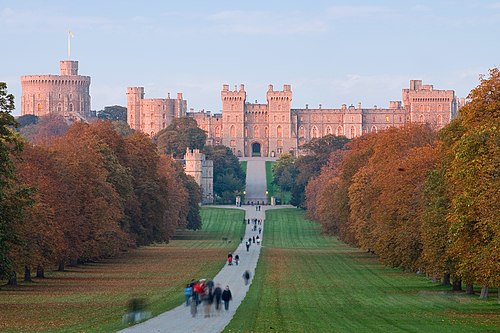 Windsor CastleRestored · prime 1820
 Tower of LondonRestored · prime 1285
 Bamburgh CastleRestored · prime 1904
All castles in England → · Strongest castles in England → · Castles of Europe
Play As Your Clan
Hold a real castle against whatever you choose to send at it, take a ship out in her own service years, or stand at the shoulder of someone the record remembers. The chronicler sets the scene; the deeds are yours.