Lawrence
Laurence of Rome, England's Registers repeat him.
- Origin
- South West, England
- Famous bearer
- T. E. Lawrence (1888–1935), "Lawrence of Arabia", soldier and writer
- Register
- English family
The Lawrence arms and country

Coat of armsLawrence (of Iver, Buckinghamshire, baronet) armsBorne by the Iver line, one branch of the name rather than all of it.Lobsterthermidor · CC BY-SA 3.0 
Coat of armsEscutcheon of the Lawrence baronets of Iver (1628)Borne by the Iver line, one branch of the name rather than all of it.Charles Matthews · CC BY-SA 4.0
_arms.svg)
.svg)
- Coat of arms: Granted to an individual and inherited down that one documented line. These are the arms of particular families of the name, not of everyone who shares the surname.
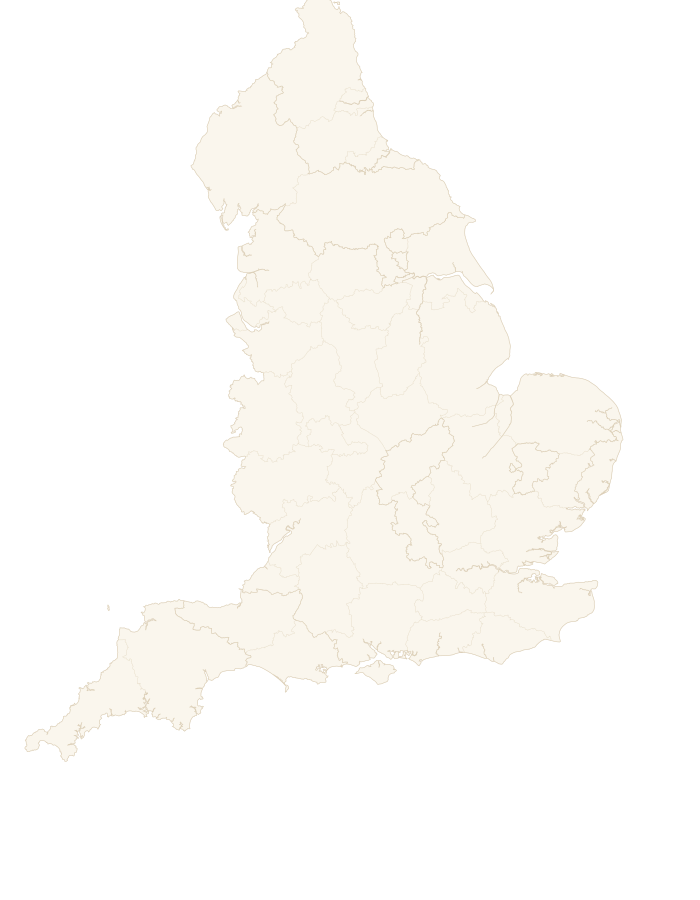
CoreHistoric reach
The seat of Lawrence
Seat vacantChief
No one leads the Lawrence community yet. When the movement opens, you can stand for its leadership, or help elect whoever does.
Current mission
No shared goal set yet. Once Lawrence has leadership, it sets the public focus: a restoration, a gathering, a real-world project that helps its own.
The Lawrence clan is being rebuilt. Join the waiting list for the movement today, and you help decide who leads it and what it does.
Help rebuild the Lawrence clan →What does the Lawrence name mean?
From Laurence, Roman laurel-crowned martyr; spread by the Church.
The history of Lawrence
A name out of the font, made hereditary by the clerk
England's supply of first names was narrow. Of boys born in London in 1510, 24.4 per cent were christened John, 13.3 per cent Thomas and 11.7 per cent William; across the early modern period the three commonest male names accounted for close to half the male population. A parish working from so short a list needed a second word to tell one man from another, and that word was often the first name of his father. Lawrence is that kind of name: a given name that stopped being given and started being inherited.
The machinery that froze it was Norman. The conquest put a dialect of French in the mouths of the elite and stripped the English Church of its senior men: after Wulfstan died in 1095 no bishopric in England was held by an Englishman. The Domesday survey of 1086 is credited with introducing family names to England, first among the nobility and gentry and only slowly downward; by 1400 most English families used hereditary surnames, and Henry VIII ordered marital births recorded under the father's surname.
Ashton Hall, the walls of Acre, and a pedigree carried across an ocean
The family's own reckoning of itself begins at Ashton Hall in Lancashire with Sir Robert Lawrence, knighted by Richard the Lionheart in 1191 for conduct at the siege of Acre during the Third Crusade. The significant fact is not the crusade but the keeping: from Sir Robert the descent to John Lawrence of Wissett in Suffolk is traced directly.
That northern ground still shows. Lancashire, Cheshire, Cumbria, Merseyside, Staffordshire and London hold the name's historic weight; the living weight sits south and west, through Cornwall, Devon, Dorset, Kent, Surrey, Hampshire and Oxfordshire.
John Lawrence builds at Lawrencetown, 1585
Ballymore Castle in County Galway began as a tower house of the O'Maddens. In 1585 John Lawrence built the castle there on land that came to him by marriage to a daughter of O'Madden, Lord of Longford: the surname arriving in Ireland by settlement and a marriage contract rather than by conquest. His eldest son Walter married Cecily Moore in 1603, a granddaughter of Richard Burke, 2nd Earl of Clanricarde. A dwelling house was added to the tower in 1620.
The place kept the name after the family lost the place. During the Williamite wars Patrick Sarsfield, 1st Earl of Lucan, sent Ulick Burke, 1st Viscount Galway, to hold Ballymore. It passed afterwards through Newcomen's stepson Nicholas Cusack of Cushinstown, who sold it about 1720 to John Eyre of Eyrecourt, and much of the estate went at last to the Irish Land Commission. The townland is still Lawrencetown.
Wissett to Watertown: the crossing of 1635
John Lawrence was baptised at Wissett in Suffolk on 8 October 1609 and emigrated to Watertown, Massachusetts in 1635. Watertown was barely five years old. The Arbella had reached Salem in June 1630 carrying Sir Richard Saltonstall and the Reverend George Phillips; from Salem they went on to Charlestown and then some four miles up the Charles River to begin the fourth settlement in the colony. On the earliest list of Watertown proprietors the name John Lawrence of Wissett appears.
He married Elizabeth and had thirteen children by her. In 1662 the household moved out to Groton, where the American line takes root; Elizabeth died the following year and John married Susannah Batchelder. Every Lawrence in the later Boston story (merchant, minister, minuteman, bishop) measures descent from that one Suffolk baptism.
An ensign's commission and the first man of the line at Harvard
Nathaniel Lawrence, son of the emigrant, was born at Watertown in 1639 and made his career at Groton. Governor Simon Bradstreet commissioned him ensign of a company there; the town elected him deacon; and in 1692 it sent him as its representative to the General Court of assembly begun at Boston. He married first Sarah Morse, daughter of Joseph Morse and Hannah Phillips.
William Lawrence, born at Groton on 7 May 1723, was the first of John of Wissett's descendants to enter Harvard College, admitted in July 1739 and graduated in 1743. In February 1750-51 he married Love Adams, daughter of John Adams, himself a great-grandson of Henry Adams of Devonshire, who had settled at Quincy. William became the first minister of the church at Lincoln and held the office for thirty-one years, dying on 11 April 1780.
Ploughing at Groton when the word came from Lexington
Asa Lawrence, youngest son of Deacon Peleg Lawrence, was born on 14 June 1737 and married Abigail King at Littleton on 27 July 1757. As captain of one of the Groton companies of minutemen he hurried his men to Cambridge the moment the Lexington alarm sounded, and later fought at Bunker Hill. He died on 16 January 1804.
Samuel Lawrence, born at Groton on 24 April 1754, was behind the plough when the first notice of Lexington and Concord reached the town: General Oliver Prescott rode up and shouted at him to notify his men, the British were coming. He served as a corporal in a Groton minuteman company. Afterwards he helped found Lawrence Academy at Groton, the third oldest boarding school in Massachusetts, and was its trustee for twenty-seven years; he married Susannah Parker in 1777 and died on 8 November 1827. He is the patriarch from whom the Boston Lawrences are counted.
The brothers who put the name on two cities and a Kansas prairie
Amos Lawrence, born at Groton, and his younger brother Abbott, born there on 16 December 1792, built A. & A. Lawrence and Co. into one of the greatest wholesale mercantile houses in the United States. Amos spent his later years giving the money away: more than $639,000 in 1840s dollars, including $40,000 to Williams College and gifts to Wabash, to Kenyon, to the seminary at Bangor in Maine, and to the completion of the Bunker Hill Monument. He founded Lawrence, Massachusetts, and through the New England Emigrant Aid Company founded Lawrence, Kansas, and the university there.
Abbott went into politics with the same appetite. He represented Massachusetts at the Harrisburg protectionist convention of 1827, was elected a Whig congressman to the 24th Congress in 1834, and worked for William Henry Harrison's campaign in 1840. When Zachary Taylor offered him his choice of posts he turned down the cabinet and took the ministry to Great Britain. He gave $50,000 to found the Lawrence Scientific School at Harvard and as much again in his will, and died in Boston on 18 August 1855 aged sixty-two.
Amos Adams Lawrence, son of Amos, born in Boston on 31 July 1814, entered Harvard in 1831. He became a key figure in the abolition movement before the Civil War and pushed the building of the University of Kansas at Lawrence and of Lawrence University at Appleton, Wisconsin; he died at Nahant in 1886. Of his children by Sarah Elizabeth Appleton, William Lawrence (1850-1941) became Bishop of Massachusetts and Harriet Dexter Lawrence Hemenway (1858-1960) co-founded the Massachusetts Audubon Society.
Aqaba taken from the side no one thought possible
Thomas Edward Lawrence was born at Tremadog in north Wales on 16 August 1888 and grew up chiefly in Oxford, schooled in the city and then at Jesus College. He wrote his undergraduate thesis on Crusader castles and walked alone across Syria and Palestine to look at them, then joined the British Museum's excavations at Carchemish on the Euphrates, learning Arabic and the peoples of the Near East as few Europeans of his generation did. Posted to the intelligence staff in Cairo and then attached to the Arab forces in revolt, he argued that the Arabs should fight the war that suited them (mobility, raiding, the cutting of the Hejaz railway) rather than be thrown at entrenched modern troops.
In July 1917 he brought an Arab force on a long march inland through waterless desert to Aqaba, a fortified Red Sea port whose guns all faced the water, and took it in a single charge from the landward side. The capture opened a supply line and secured the flank of the British advance toward Palestine. He went on with the Arab forces to the entry into Damascus, then wrote Seven Pillars of Wisdom. Uncomfortable with the Lawrence of Arabia figure the journalist Lowell Thomas had built around him, he twice withdrew under assumed names into the ranks. He died on 19 May 1935 of injuries from a motorcycle accident near his cottage in Dorset, at forty-six.
The other Lawrence of that generation fought a quieter war with his own country. D. H. Lawrence (1885-1930), novelist and poet, did not live to see the trial that settled his standing: Lady Chatterley was acquitted in 1960, thirty years after his death.
Champions of the Lawrence name
The bearers whose lives are inseparable from this surname. Each has their own page, biography, achievements, geography, connection to the family.
Historic Places, Rebuilt
Explore the streets and seats the Lawrence name knew, rebuilt with AI as they stood in history.
Castles the Lawrence held
Strongholds this name held for a decade or more, look one up, or rebuild it to explore.
- Ballymore Castle
John Lawrence built the castle in 1585 on land acquired by marriage to a daughter of O'Madden; his heirs added the house in 1620.
The castles of the homeland
The great strongholds of the homeland, look one up, see what it looked like in its prime, and recreate it to explore.
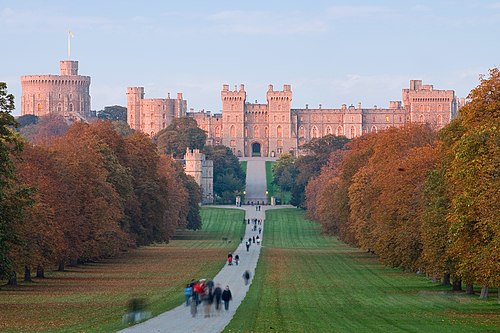 Windsor CastleRestored · prime 1820
 Tower of LondonRestored · prime 1285
 Bamburgh CastleRestored · prime 1904
All castles in England → · Strongest castles in England → · Castles of Europe
Play As Your Clan
Hold a real castle against whatever you choose to send at it, take a ship out in her own service years, or stand at the shoulder of someone the record remembers. The chronicler sets the scene; the deeds are yours.
Notable bearers of the Lawrence name
- T. E. Lawrence (1888–1935), "Lawrence of Arabia", soldier and writer
- D. H. Lawrence (1885–1930), novelist and poet
Stories of Lawrence
T. E. Lawrence at Aqaba
1917On the morning of the sixth of July 1917, after a 600-mile camel march across the Nefud desert from Wejh on the Red Sea coast through the eastern flank of the Hejaz, Captain T. E. Lawrence of the British liaison mission to the Arab Revolt entered the port of Aqaba at the head of a force of about two thousand bedouin under Auda abu Tayi of the Howeitat. The Turkish garrison, whose guns were sited to defend the port from the seaward side, had been taken from the desert side at Aba el Lissan two days earlier in a charge by Auda's horse. The garrison at Aqaba surrendered without firing on the British and Arab force coming down out of the hills behind them. The capture opened the Red Sea coast to British supply and turned the Arab Revolt from a Hejaz sideshow into a strategic flank of Allenby's Palestine campaign. Lawrence was twenty-eight years old. He had been on a camel for two months. He rode another four hundred miles, in the heat of July, alone with two bedouin escort, to bring the news to Allenby in Cairo.
Read the story →
Lady Chatterley acquitted
1960Penguin Books published the unexpurgated text of D. H. Lawrence's Lady Chatterley's Lover in Britain on the sixteenth of August 1960. Lawrence had died in 1930. The novel had been printed in Florence in 1928 and had circulated in unexpurgated foreign editions for thirty-two years. Penguin's first British printing was 200,000 copies; not one was distributed; the firm sent twelve copies to the Director of Public Prosecutions on publication day. The DPP charged Penguin under the new Obscene Publications Act of 1959, which for the first time allowed an obscenity defence on grounds of literary merit. The trial at the Old Bailey ran from the twentieth of October to the second of November. The prosecution called no expert witnesses. The defence called thirty-five, including E. M. Forster, Richard Hoggart, the Bishop of Woolwich, and a 25-year-old Cambridge don called Helen Gardner. The jury of three women and nine men returned not guilty in three hours. Penguin sold two hundred thousand copies on the third of November and three million copies in the next twelve months. The verdict ended literary censorship in Britain.
Read the story →