Martin
The saint's name, English and Norman registers alike.
- Origin
- South West, England
- Famous bearer
- Sir Theodore Martin (1816–1909), Scottish biographer of Prince Albert; commissioned by Queen Victoria
- Register
- English family
The Martin arms and country

Coat of armsCoat of Arms of MartinPublic domain

- Coat of arms: Granted to an individual and inherited down that one documented line. These are the arms of particular families of the name, not of everyone who shares the surname.
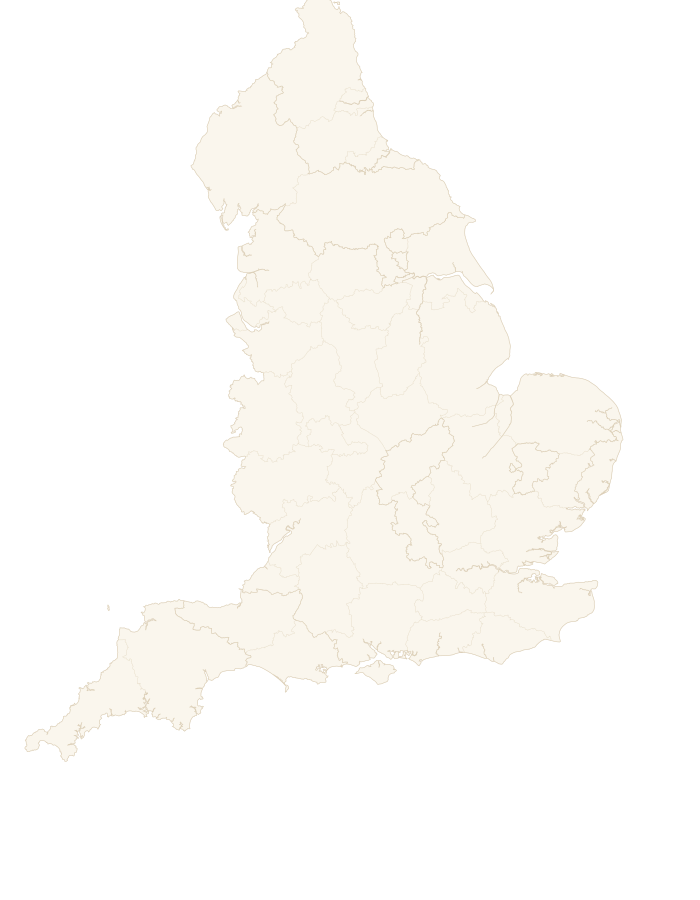
CoreHistoric reach
The seat of Martin
Seat vacantChief
No one leads the Martin community yet. When the movement opens, you can stand for its leadership, or help elect whoever does.
Current mission
No shared goal set yet. Once Martin has leadership, it sets the public focus: a restoration, a gathering, a real-world project that helps its own.
The Martin clan is being rebuilt. Join the waiting list for the movement today, and you help decide who leads it and what it does.
Help rebuild the Martin clan →What does the Martin name mean?
From Martinus, Martin. St Martin of Tours made the name a christening staple; surname fixation follows by the late Middle Ages.
The history of Martin
The soldier who cut his cloak in two
Martin comes from the Latin Martinus, built on the name of Mars, god of war, and read as 'of Mars' or 'warlike'. What turned a pagan war-name into a standard christening name of Latin Europe was one man: Martin of Tours, the soldier-saint remembered for cutting his cloak in half to clothe a beggar. Protestant families kept it for a second reason, Martin Luther.
In England the saint came with a date attached. Martinmas, the eleventh of November, closed the medieval agricultural year: labour contracts turned over, the autumn-killed beef went into salt, and the hiring fairs ran through the market towns. A name pinned to that point in the working calendar did not fade, and by the 1841 census Martin stood among the twenty commonest English given names and the fifty commonest English surnames.
Why two Martin families have no reason to be related
The machinery is simple. A man was baptised Martin, his son was known as Martin's son, and when bynames hardened into inherited surnames the christening name froze onto a family. Because every parish in Latin Christendom was baptising Martins, the same surname was made independently in a hundred places, from hundreds of unrelated men. Over ninety Italian surnames are reckoned to descend from the given name Giovanni alone; Martin did that in more countries at once.
The counts stack up in every direction. Martin is the most common surname in France, with more than 230,000 bearers, and was the sixteenth most reported surname in the 1990 United States census. It is common in Veneto, Friuli-Venezia Giulia and Piedmont, and among the commonest names in Spain. Scandinavia made Martinsen and Martinsson, keeps Morten as its local form of the name, and Bulgaria makes Martinov.
France, which has the most Martins of all, is where the explanation breaks down. Martin was never a common medieval Christian name there, unlike Bernard and Thomas, which now rank second and third among French surnames. One suggestion is that Martin was a late surname handed to foundlings, the saint of charity supplying a name to children with no father's name to take. Even within England the routes differ, since some Martins carry a place name instead, from one of the settlements called Merton. Two families of this name meeting anywhere in the diaspora have no reason to share an ancestor, and this page will not invent one.
Norman ships, Domesday, and the barony of Cemaes
Before the Normans came in the eleventh century, Martin was rare in England. Domesday, completed in 1086, records that only about five per cent of the land south of the Tees was still in English hands. The change showed in names too, French forms displacing Anglo-Saxon ones as William, Robert and Richard became common. Martin came by the same road, and the surname took hold south of the Thames.
Surnames hardened over the next three centuries, first among the nobility and gentry. By 1400 most English families, and those of Lowland Scotland, used one. The pressure was arithmetic: of boys born in London in 1510, 24.4 per cent were named John, 13.3 per cent Thomas and 11.7 per cent William. In a village with four Johns a second word was not decoration, and where the father had been Martin, that word was his name.
One Norman line carried it into Wales. Robert Fitz Martin, an Anglo-Norman knight born in the late eleventh century, settled in the West Country on lands inherited from a grandfather, joined the invasions of Wales, and was awarded the barony of Cemaes between Fishguard and Cardigan, with its caput at Nanhyfer, or Nevern. His son William Fitz Robert Fitz Martin, born about 1155, recovered the family's control of Cemaes after it had been lost to the Welsh. The senior line ended in 1326; cadet lines still flourish in Wales and England.
Davidstow, and the parish that spelled it three ways
In Devon and Cornwall one family could be written Martyn, Martin or Marten by the same clerk within a lifetime, and Davidstow in Cornwall shows the pattern inside a single parish. The Cornwall subsidies of Henry VIII's reign list John Martyn, John Martyn and Joan Martyn there in 1543; the muster roll of 1569 names John Marten and William Marten for the same place; and the register of St Stephens by Launceston records the baptism of two sons of Richard Martin of Dewstowe, Nicholas in May 1584 and John in November 1586.
Then, dated the twenty-seventh of July 1646, comes an administration at Davidstow for John Marten the Elder, late of that parish. It is possible that this is the John baptised in 1586, and possible is as far as the record goes. That is the ordinary condition of a name this common: in one small parish, three spellings and a handful of households, the documents will not quite close the link.
Letterfinlay, Skye, and the tower at Abercorn
Scotland has several unconnected groups of Martins and MacMartins. The MacMartins of Letterfinlay allied themselves with Clan Cameron in the late fourteenth century and merged with the Camerons after the Battle of Lochaber in 1429. As a sept they were among Lochiel's most valued followers, and in the Jacobite rising of 1745 they were out with Lochiel's regiment. Inside their own lands, the Oxford Companion to Scottish History notes, they saw themselves as distinct; outside Lochaber they counted themselves Camerons.
A separate branch of MacMartins came from Strathclyde, the Martins of Skye are traditionally associated with Clan Donald rather than Cameron, and from the twelfth century the Lothians held a powerful family styled de St Martin, which reached the name by a different road again.
The hardest Scottish record of the name is a landholding. Midhope was owned in the fourteenth century by Henry Graham of Mannerstoun and passed to his two daughters when he died without a male heir; in the fifteenth century the lands belonged to the Martin family. In 1537 Sir James Hamilton of Finnart received a grant of half the lands of Midhope and Mannerstoun, and half the mill of Abercorne, from Elizabeth Martin, Lady of Falscastell, who held them of John Lindsay, fifth Lord Lindsay of the Byres. The late sixteenth-century tower house standing there now, at Abercorn west of South Queensferry, is known to television viewers as Lallybroch in Outlander.
The Martyns of Galway, a wholly separate family
Irish surnames are attested from the mid-tenth century, and several distinct Irish families carried a Martin element: Mac Giolla Mhartain, O Maol Mhartain, O Martain, O Mairtin and Mac Mairtin among them. Echmilid mac Mael Martain was Bishop of Down until 1202; Giolla Ernain O Martain, a poet, was Chief Ollam of Ireland and died in 1218. After the Norman invasion of 1169, further and unrelated bearers of the name settled in Ireland alongside them.
The best known Irish bearers spell it Martyn, and they are a merchant house rather than a Gaelic one: one of the fourteen families who became the premier merchant and political families of late medieval Galway, trading with Scotland, England, France, Spain and Portugal. Wylliam Martin, active in 1519, was mayor of Galway and built the Spanish Arch; Thomas Oge Martyn, recorded between 1533 and 1577, built the town's West Bridge; Richard Oge Martyn (1602-1648) was a lawyer and a leader of the Irish Confederates.
Richard Martin (1754-1834) sat with the Irish Volunteers, supported Catholic Emancipation, and founded the Royal Society for the Prevention of Cruelty to Animals. Edward Martyn (1859-1923), arts patron and political activist, co-founded the Abbey Theatre in Dublin. Violet Florence Martin (1862-1915) was a novelist, and the Hungarian artist Ferenc Martyn (1899-1986) descended from the same Galway family. None of this is the English Martins' story: two unrelated families, one saint, one spelling.
Apocalypse painters and a hall on the South Bank
John Martin (1789-1854), born in Northumberland, painted enormous apocalyptic canvases: Belshazzar's Feast, The Great Day of His Wrath, The Last Judgment. His work told on Victor Hugo and on the early French Romantic painters. Sir Theodore Martin (1816-1909), a Scot, wrote the life of Prince Albert on a commission from Queen Victoria herself. Sir Leslie Martin (1908-2000) designed the Royal Festival Hall with Robert Matthew, opened in 1951 and the most influential British public building of the post-war years.
Herbert Henry Martyn (1842-1937) founded H. H. Martyn and Company of Cheltenham; Henry Martyn (1781-1812) was an Anglican priest and a missionary in India and Persia; Damien Martyn (born 1971) is an Australian cricketer; and Steve Martin (born 1945) is an American comedian and actor. No thread of kinship runs through that list, which is the truthful shape of a surname this widely made.
The carpenter's son who signed the Beatles
George Henry Martin was born at 64 Drayton Park in Holloway, north London, on the third of January 1926, son of Henry Martin, a carpenter in the building trade, and Bertha Simpson; the family spent the Depression years in two rooms above a dairy. He taught himself the piano in his teens, served in the Fleet Air Arm from 1944 to 1947, and went on an ex-servicemen's bursary to the Guildhall School of Music and Drama, taking the LRAM in piano and the LGSM in composition in 1950.
He joined Parlophone, the smallest of EMI's three labels, as a junior recording assistant in November 1950 at twenty-four, and when Oscar Preuss retired in 1955 he was made head of the label in his twenty-ninth year, the youngest label head in the British industry. Through the 1950s he produced the comedy records that carried Parlophone: the Goon Show discs of Peter Sellers, Spike Milligan and Harry Secombe, and the cast recording of Beyond the Fringe. He had no interest in rock and roll.
On the sixth of June 1962, at EMI's Abbey Road Studio Three, he auditioned a Liverpool four-piece that Brian Epstein had spent nine months failing to place with the London companies, signed them, and recorded with them until April 1970: twelve studio albums, thirteen number-one UK singles, twenty number-one US singles. The string overdubs on Yesterday and Eleanor Rigby, the orchestral crescendo in A Day in the Life and the long medley across side two of Abbey Road are his arrangements. He left EMI in 1965 for Associated Independent Recording. He was knighted in 1996, won six Grammy Awards, and died at his home in Wiltshire on the eighth of March 2016.
Champions of the Martin name
The bearers whose lives are inseparable from this surname. Each has their own page, biography, achievements, geography, connection to the family.
Historic Places, Rebuilt
Explore the streets and seats the Martin name knew, rebuilt with AI as they stood in history.
Castles the Martin held
Strongholds this name held for a decade or more, look one up, or rebuild it to explore.
- Midhope Castle
Midhope belonged to the Martin family in the 15th century.
The castles of the homeland
The great strongholds of the homeland, look one up, see what it looked like in its prime, and recreate it to explore.
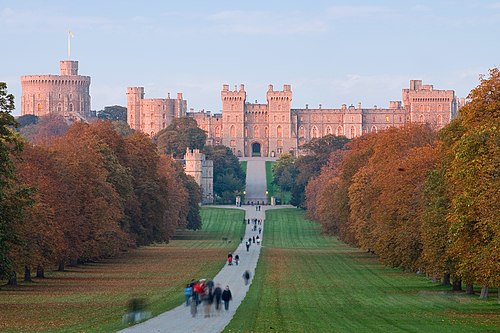 Windsor CastleRestored · prime 1820
 Tower of LondonRestored · prime 1285
 Bamburgh CastleRestored · prime 1904
All castles in England → · Strongest castles in England → · Castles of Europe
Play As Your Clan
Hold a real castle against whatever you choose to send at it, take a ship out in her own service years, or stand at the shoulder of someone the record remembers. The chronicler sets the scene; the deeds are yours.
Notable bearers of the Martin name
- Sir Theodore Martin (1816–1909), Scottish biographer of Prince Albert; commissioned by Queen Victoria
- John Martin (1789–1854), Northumberland-born Romantic painter of The Great Day of His Wrath and Belshazzar's Feast
- Sir Leslie Martin (1908–2000), architect of the Royal Festival Hall (with Robert Matthew, 1951)
- Sir George Martin (1926–2016), record producer of the Beatles; the Fifth Beatle
- Steve Martin (b. 1945), American comedian and actor