Pugh
also Pew, ap Hugh
ap Hugh, the Welsh contraction working on a Norman name.
- Origin
- Powys, Wales
- Famous bearer
- Bunny Pugh, early 20th-century Welsh international rugby player
- Register
- Welsh family
Where the Pugh name comes from
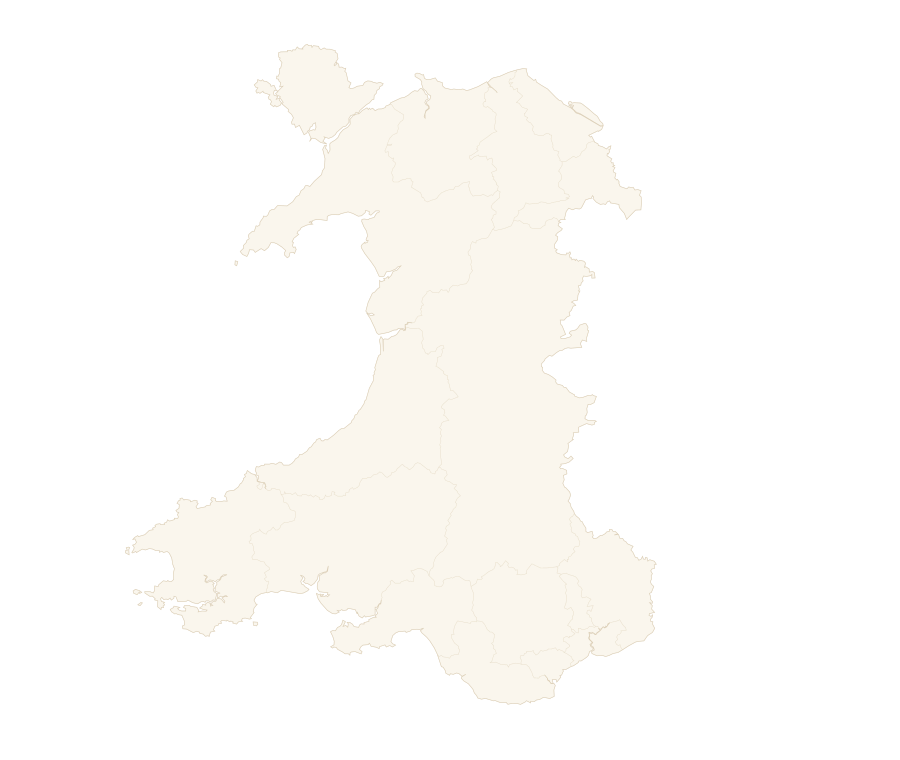
CoreHistoric reach
The seat of Pugh
Seat vacantChief
No one leads the Pugh community yet. When the movement opens, you can stand for its leadership, or help elect whoever does.
Current mission
No shared goal set yet. Once Pugh has leadership, it sets the public focus: a restoration, a gathering, a real-world project that helps its own.
The Pugh clan is being rebuilt. Join the waiting list for the movement today, and you help decide who leads it and what it does.
Help rebuild the Pugh clan →What does the Pugh name mean?
ap Hugh, son of Hugh, contracted in spoken Welsh by the same elision that produced Pritchard (ap Richard) and Powell (ap Hywel). Hugh itself is a Norman name, brought into Wales through the marcher lordships, embedded in the north and the Marches. The variant Pew is the same name with a softer Anglicisation; the older spellings sometimes preserved 'ap Hugh' as two words into the 18th century.
The history of Pugh
A Norman name that came out of the mouth speaking Welsh
Pugh is 'ap Hugh', son of Hugh, worn down to one syllable. Welsh had no inherited surnames while the patronymic system ran: a baptismal name was joined by ap or ab to the father's, and the label was rebuilt every generation. When fixed surnames came in from the fifteenth century, hereditary first among the gentry under Henry VIII, some families kept the ap and swallowed it into the front of the name behind it: Upjohn from ap John, Price from ap Rhys, Bowen from ab Owen, Pugh from ap Hugh.
What sets Pugh apart from its siblings is the name inside it. Pritchard froze the mechanic onto a Norman Richard and Powell onto a native Hywel; Pugh is the case where the Welsh frame closed around an unambiguously imported forename and made it sound as though it had always been there. Older spellings kept the seam visible, writing 'ap Hugh' as two words into the eighteenth century, and Pew is the same name Anglicised a step further.
One forename, two surnames, and a steelworks in the Donbas
Hugh reached Wales through the marcher lordships, the Norman frontier apparatus along the border, and embedded itself in the north and the Marches rather than the south. Once inside the Welsh naming system it could leave by either of two doors. Families that kept the prefix produced Pugh; families that dropped it and added the English possessive -s, the route that gave Wales its Joneses and Robertses, produced Hughes. The two are the same man's son by different arithmetic, which is part of why both cluster in the same counties.
The forename travelled. John Hughes, an engineer from Merthyr Tydfil, founded a steel plant and several coal mines in what is now the Ukrainian city of Donetsk in 1869, and the settlement was named Yuzovka after him, 'Yuz' being as close as Russian and Ukrainian could get to Hughes. That is the other branch of the root, but it measures how far a Welsh Hugh could carry.
Powys, Gwynedd and the counties that kept the language
The name is densest in north and mid-Wales, above all in Powys and Caernarfonshire, where the imported Hugh took root earliest. Its historic ground runs across Denbighshire, Wrexham, Anglesey, Ceredigion and Carmarthenshire, and that list is close to a map of something else: the districts where Welsh survived as a first language, principally Gwynedd, inland Conwy and Denbighshire, northern and south-western Powys, Anglesey, Carmarthenshire, North Pembrokeshire, Ceredigion and parts of western Glamorgan. Pugh belongs to the Welsh-speaking core rather than the anglicised border or the industrial south-east.
What the name cannot tell a reader is descent. The stock of Welsh surnames is small, and it shrank further after the Reformation cut the range of baptismal names in use, so a few forenames run through the patronymic machine supplied a whole country. Two Pughs in one parish are not to be assumed cousins.
The Pughs of Mathafarn and the poets nobody else was paying
The gentry were the first Welshmen to fix their surnames, and the Pughs of Mathafarn in Powys were a house of exactly that kind, established in the sixteenth century as the patronymic chain stopped moving. What they did with the position is the part worth remembering: they were patrons of the Welsh-language poets, and they were paying them at the moment most of their class was turning to English literary patronage instead.
That is a small decision with a long shadow. The bardic order depended on houses willing to keep a poet in food and standing, and after the union of 1536 the pull on a Welsh gentry family ran towards London and English advancement. A house in Powys still buying verse in Welsh held open a door its neighbours were closing.
The Ruthin coach-painter's son who learned to work on ivory
Edward Pugh was born at Ruthin in the Vale of Clwyd, Denbighshire, in 1761, the son of a coach-painter in the town. Apprenticed to his father's trade at thirteen, he was sent at sixteen to Liverpool to study under the miniaturist John Walters, which gave him the foundation of everything that followed: the ivory-and-watercolour portrait miniature of the late Georgian period, a form demanding a steady hand at very small scale.
He returned to Ruthin in 1781 and set up a studio above the family premises. The next twenty-three years went on a circuit through Wrexham, Mold, Denbigh, Conwy, Caernarfon, Bangor and the Welsh-speaking parishes of Anglesey, taking commissions from the local gentry, the parish clergy and the coastal mariners. About a hundred and twenty of his miniatures survive with identified provenance, a recognised speciality of late-Georgian Welsh portrait painting.
Nine years on foot, and the first tour of Wales by a Welshman
The book was the second half of his career. Pugh had read the English-language tours of Wales by Pennant and Wyndham and saw what was missing: no comparable book had been written by a Welshman with native Welsh-language access to the parish and chapel community he was describing. In 1804 he proposed an illustrated tour of the whole country, took an advance of three guineas for each delivered watercolour, and spent the next nine years walking.
He covered about ten miles a day, sketching villages, parish churches, ruined castles, harbour scenes, lead-mining settlements and the ironworks-and-coal communities of the south, writing the text in a bilingual Welsh and English register as he went. Perhaps four hundred watercolour studies came out of it. He died at Ruthin on 19 July 1813, fifty-two years old, the manuscript nearly complete, and was buried at St Peter's alongside his parents.
Cambria Depicta: A Tour Through North Wales, Illustrated with Picturesque Views by a Native Artist appeared in 1816, a folio of some four hundred and twenty pages carrying seventy-one hand-coloured aquatint plates after his watercolours, and the first illustrated travel book on Wales written by a Welshman in his own country. About three hundred and twenty of the original sketches are held at the National Library of Wales, which gave him a monograph and exhibition in 2012.
Cardiganshire in the Commons, and a cap for Wales
The name reached public life on the ground it had always held. Lewis Pugh sat as Liberal member for Cardiganshire from 1880 to 1885, representing the west-coast county at the high point of Welsh Liberalism, when rural Wales was the party's most reliable ground in Britain.
A generation later it turned up in the other national institution. Bunny Pugh played rugby for Wales in the early twentieth century, when a cap was the surest way for a name from the Welsh-speaking counties to be known in every parish that could reach a newspaper.
Eighteen minutes and fifty seconds at the North Pole
A different Lewis Pugh, born at Plymouth on 5 December 1969, is the one who took the name furthest from Wales. His father was a Royal Navy surgeon and the family emigrated to South Africa when he was ten. He read politics and law at the University of Cape Town, returned to England for international law at Jesus College, Cambridge, and spent a decade as a maritime lawyer in the City of London while serving as a reservist in the Special Air Service. He had his first real swimming lesson in 1986, aged seventeen, and a month later swam from Robben Island to Cape Town.
In 2003 he left the law to campaign full-time for the oceans, and the swims became the argument. In 2006 he became the first person to complete a long-distance swim in all five oceans, and the first to swim the whole 325 km length of the Thames, climbing out in London mid-swim to press the case for a low-carbon economy on Tony Blair at Downing Street. In July 2007 he made the first long-distance swim across the Geographic North Pole, a kilometre in water at minus 1.7 degrees, in eighteen minutes and fifty seconds, in nothing but trunks, cap and goggles.
The results were political as much as athletic. He was appointed the first United Nations Patron of the Oceans in 2013, and in 2016 played a part in creating the largest marine reserve in the world, in the Ross Sea off Antarctica, shuttling between the United States and Russia in a campaign the press christened Speedo Diplomacy. In 2018 he swam the full 528 km length of the English Channel, Land's End on 12 July to Dover on 29 August, arguing for 30 per cent of the oceans to be protected by 2030.
Champions of the Pugh name
The bearers whose lives are inseparable from this surname. Each has their own page, biography, achievements, geography, connection to the family.
Historic Places, Rebuilt
Explore the streets and seats the Pugh name knew, rebuilt with AI as they stood in history.
Historic Places, Rebuilt · New
Edward I's walled bastide and mighty castle in North Wales, a generation after the conquest, the banded towers still rising.
Historic Places, Rebuilt · New
Owain Glyndŵr's mountain fortress and court at the high tide of Welsh independence, the English siege lines gathering below.
The castles of the homeland
The great strongholds of the homeland, look one up, see what it looked like in its prime, and recreate it to explore.
 Caernarfon CastleRestored · prime 1330
 Conwy CastleRuin · prime 1287
 Pembroke CastleRestored · prime 1280
All castles in Wales → · Strongest castles in Wales → · Castles of Europe
Play As Your Clan
Hold a real castle against whatever you choose to send at it, take a ship out in her own service years, or stand at the shoulder of someone the record remembers. The chronicler sets the scene; the deeds are yours.
Notable bearers of the Pugh name
- Bunny Pugh, early 20th-century Welsh international rugby player
- Lewis Pugh, MP for Cardiganshire (1880–1885)
Frequently asked
What does the surname Pugh mean?
Where does the Pugh family come from?
Where did the Pugh family historically hold territory?
Is Pugh Welsh or English?
How old is the Pugh surname?
What is the Pugh family known for?
Is there a Pugh family crest or coat of arms?
Who is the most famous Pugh?
Who are some famous Pughs?
Is Pew the same family as Pugh?
Is ap Hugh the same family as Pugh?
Where is the Pugh surname found today?
What does the Clan Rising page for the Pugh family cover?
Who is the head of the Pugh family today?
Neighbouring clans
- WilliamsSon of William, second only to Jones in Welsh density, and first in the north.
- EvansSon of John, by the Welsh road, the cousin name of Jones.
- RobertsStrong in the north, the patronymic of Robert, second to Williams in Caernarfonshire.
- LewisLlywelyn anglicised, a princely name carried into common use across the Marches and the south.