Rogers
Son of Roger, the famous-spear Norman first name.
- Origin
- South West, England
- Famous bearer
- Fred 'Mister Rogers' Rogers (1928–2003), TV presenter, Mister Rogers' Neighborhood
- Register
- English family
The Rogers arms and country

Coat of armsArmorial Bearings of the ROGERS of Broomy Close, Llandinabo, HerefordshireBorne by the Broomy Close line, one branch of the name rather than all of it.Rs-nourse · CC BY-SA 4.0

- Coat of arms: Granted to an individual and inherited down that one documented line. These are the arms of particular families of the name, not of everyone who shares the surname.
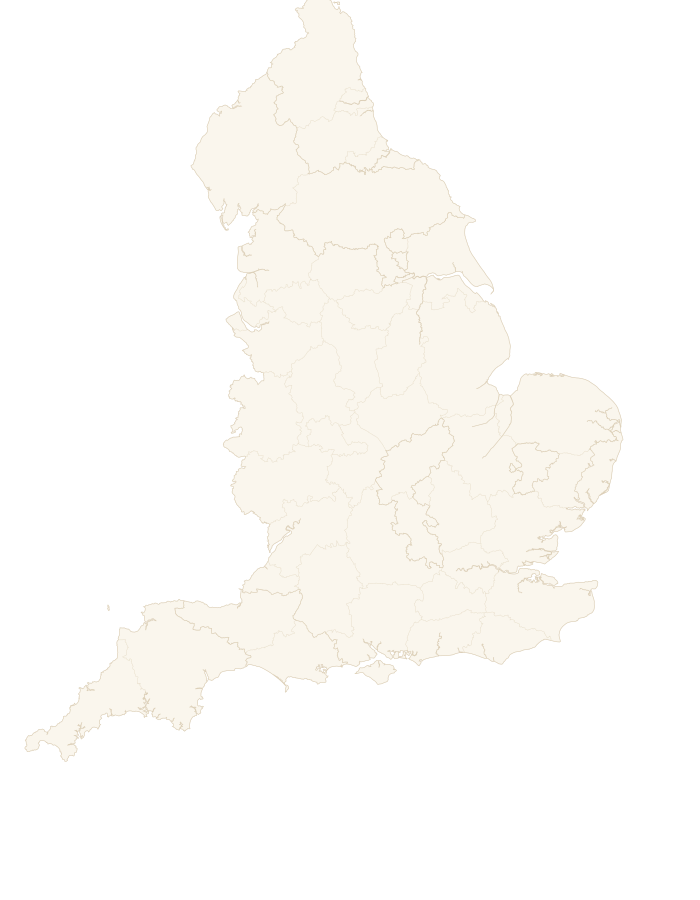
CoreHistoric reach
The seat of Rogers
Seat vacantChief
No one leads the Rogers community yet. When the movement opens, you can stand for its leadership, or help elect whoever does.
Current mission
No shared goal set yet. Once Rogers has leadership, it sets the public focus: a restoration, a gathering, a real-world project that helps its own.
The Rogers clan is being rebuilt. Join the waiting list for the movement today, and you help decide who leads it and what it does.
Help rebuild the Rogers clan →What does the Rogers name mean?
Patronymic, son of Roger (the Norman name Roger, from Germanic hroth + ger, 'famous spear'). Roger was among the most common Norman first names brought to England with the Conquest, carried by Roger of Montgomery (Earl of Shrewsbury), Roger of Salisbury, and dozens of other senior Norman tenants. The patronymic compressed to Rogers and the alternative form Rodgers in the 14th–15th-century surname-fixation era.
The history of Rogers
The famous spear that came over with the fleet
Rogers is a patronymic: it means the son of a man called Roger, and nothing more complicated than that. The given name is Germanic, built from hroth, fame or renown, and ger, a spear: a famous spear, the sort of name a warrior culture gives a boy it has hopes for. Its Old English cousin was Hrothgar, a pre-7th-century name first recorded in the Anglo-Saxon epic Beowulf, so the elements were old in Britain long before the Normans came. But the Roger that fathered this surname arrived with William of Normandy, and the paper trail starts there: the form Rogerus appears in the Domesday Book of 1086.
The Normans who carried it were themselves recent arrivals in France. In 911 the Carolingian ruler Charles the Simple allowed a band of Vikings under Rollo to settle in Normandy by the Treaty of Saint-Clair-sur-Epte, in exchange for guarding the coast against further Viking raids. Those Northmen gave Normandy its name and took the Old French of their new home, adding features of Old Norse to make the Norman language. A 2020 study found that people carrying the surname Rogers are more likely than average to have Viking ancestry, the long tail of that settlement, a thousand years on.
After 1066 the Norman elite did not merely rule England, it replaced the English one. Historians put the number of Norman landholders at around 8,000; Domesday shows that by 1086 only about five per cent of the land south of the Tees remained in English hands. Anglo-Norman, a northern dialect of Old French, became the language of the ruling class, and the fashion in names followed the power. William, Robert, Richard and Roger crowded out the Anglo-Saxon stock within two generations, until Roger was so ordinary that half the villages in England had one.
Richard Roger, 1263: the year a first name became a family name
England had no hereditary surnames before the Conquest. The convention arrived with the Normans and spread downwards: family names in England are generally credited to the administrative habit that produced Domesday in 1086, and were adopted first among the feudal nobility and gentry. The earliest recorded use of a modern surname inherited by more than one generation is dated to about 1140. Below that level a man was still described rather than named (by his trade, his father, his village or his face) and the description did not always pass to his son.
The surname surfaces in the middle of the thirteenth century, in exactly the documents you would expect: tax and court records. The first recorded spelling is Richard Roger, in 1263, in the archaeological records of Kent during the reign of Henry III (1216–1272). William Rogger appears in the subsidy tax rolls of Sussex in 1296, and Henry Rogeres in the same kind of Worcestershire records in 1327. Three men, three counties, three clerks writing down what a neighbour called them; and by 1400 most English families, and those of Lowland Scotland, had hereditary surnames.
The final s is the whole story of the name. It is a possessive: Roger's son, Roger's boy, Roger's man. In England the same construction was sometimes used by a servant taking a modified form of his employer's name: Vickers arose that way, from the servant of a vicar, and a name like Roberts could belong to either the son or the servant of a man called Robert. Rogers was formed in the same workshop. Ordinary people did not welcome the change: in the late Middle Ages mandatory surnames were resisted in England precisely because they were associated with taxes. Being written down was how you got assessed.
The men in the subsidy rolls, and the fields they worked
The world those clerks were taxing was the manor. Each was subject to a lord who held a manorial court governed by public law and local custom, and its land came in three kinds: the demesne the lord farmed for his own household; dependent villein holdings, whose tenants owed labour or a share of their output; and free peasant land paying a fixed money rent. The lord charged for use of his mill and his bakery, for the right to let pigs feed in his woodland, and took a payment every time a holding passed to a new tenant. Villein holdings became hereditary in practice, so a family stayed put, in one village, long enough for a byname to harden into a surname.
The arable was farmed in common: two or three great fields of several hundred acres, cut into narrow strips, with every tenant working strips scattered across them so good and bad ground were shared out. Elton in Cambridgeshire, whose lord was an abbot from a nearby monastery, is the standard example: 1,872 acres of arable worked by 113 tenants, reckoned in hides of 144 acres and virgates of 24. Heavy clay needed a plough and an ox team nobody could afford alone, so beasts and ploughs were shared and everyone conformed to the village norms of cropping and harvest.
These were not comfortable lives. A survey of 104 thirteenth-century English manors found 45 per cent of landholding tenants with less than three acres, and about half the adults on a manor held no land at all. Then the Black Death of 1348–1350 killed between thirty and sixty per cent of Europe's population and the arithmetic reversed: survivors could demand wages, empty land came onto the market, and the unpicking of the open fields into enclosed farms gathered pace after the fifteenth century. Any Rogers family that rose from tenant to yeoman to gentry did it through that gap in the wall.
Rogers on the Welsh march
The name is thick on the Welsh border, and that is a consequence of who was posted there. William gave the frontier to men he trusted with an army: Roger of Montgomery held Shrewsbury as its earl, Roger de Breteuil was Earl of Hereford. It was contested ground from the start. The Shropshire landowner Eadric the Wild allied with the Welsh rulers of Gwynedd and Powys against the Norman forces based at Hereford, and in 1069 his men, with Welsh allies and rebels from Cheshire and Shropshire, attacked the castle at Shrewsbury. Roger de Breteuil ended badly, conspiring with Ralph de Gael in the Revolt of the Earls of 1075 and finishing in prison. Their names stayed in circulation along the border they had been sent to hold.
Wales fixed its surnames late and by law. Where most English and Scottish people were using inherited surnames by the fourteenth century, Wales adopted them following unification under Henry VIII in 1536. Until then a Welshman was named as his father's son, generation by generation, and freezing that system into fixed family names produced the famous Welsh result: a very small stock of surnames covering a very large number of people, most of them patronymics. Jones is simply the Welsh Johnson.
Rogers sits inside that story rather than beside it. It is common across Wales's English-speaking counties rather than in the Welsh-speaking heartland, the distribution typical of a Norman-Welsh marcher surname, arriving with the lordships and settling in the market towns that faced east. Byron Rogers, the essayist and biographer, is one of its modern Welsh voices.
Two different names wearing one spelling in Ireland
Rogers reached Ireland twice by conquest. It came first with the Anglo-Norman invasion of the 1170s, when families that had taken England crossed the Irish Sea, and again with the Cromwellian invasions of the seventeenth century, which planted English names on Irish land wholesale. Those Rogerses are the English surname transplanted, and they can often be traced back across the water.
But a great many Irish Rogerses are not that at all. They are an anglicisation of Mac Ruaidhrí and Mac Ruairí, a Gaelic patronymic from an entirely separate personal name, flattened into Rogers by clerks reaching for the nearest English word that sounded similar. Two unrelated names, one modern spelling, which matters enormously to a descendant with a DNA test and a family story. If your line is Irish, do not assume Normandy until the records say so.
The variant Rodgers, with the double g, carries much of the Scottish and Irish weight of the name, though the two spellings are the same surname. Bearers on the Irish side include the footballer Eamonn Rogers, the goalkeeper Danny Rogers, born in 1994, and the Gaelic footballer Ambrose Rogers.
A top-hundred name, and where it clusters
In England and Wales, Rogers ranks as the 77th most common surname. Its centre of gravity is the south-west (Devon, Cornwall and Somerset) with strong showings across southern and western England generally, and in Scotland and Wales. By the Tudor era it was already a top-thirty English name; by the nineteenth century it had settled into the solid middling gentry.
A four-year study led by the University of the West of England, published in 2016 as the Oxford English Dictionary of Family Names in Britain and Ireland, analysed sources from the eleventh to the nineteenth century and found that over ninety per cent of the 45,602 surnames in the dictionary are native to Britain and Ireland. Its project leader Richard Coates lists Rogers among the patronymics, the surnames that originally enshrined the father's name, the oldest and commonest kind of family name there is.
What Rogerses have done with the name
The English bearers run to scholarship, dissent and salt water. Daniel Rogers, born about 1538 and dead in 1591, was an Anglo-Flemish diplomat; another Daniel Rogers (1573–1652) was an English Puritan clergyman and religious writer. Woodes Rogers (1679–1732) was a British privateer. Samuel Rogers was a British poet and Thorold Rogers an economist, historian and Member of Parliament; Leonard James Rogers and Claude Ambrose Rogers (1920–2005) were mathematicians of standing; Agnes L. Rogers (1884–1943) was a Scottish educator and educational psychologist.
The name's most celebrated modern bearer is Sir Richard Rogers, born in Florence to an Anglo-Italian family and one of the architects who changed what a public building was allowed to look like. With Renzo Piano he designed the Pompidou Centre; he went on to the Lloyd's of London building and the Millennium Dome, and won the Pritzker Prize. Su Rogers is a British architect in her own right, Ruth Rogers one of Britain's best-known chefs, and the Italian architect Ernesto Nathan Rogers carried the name on the continental side of the same profession.
The surname travelled with English colonisation and is now firmly American: it ranked 54th in the 1990 United States census, at 0.12 per cent of the population, and 69th by 2010. Fred McFeely Rogers (1928–2003), a Pittsburgh-born Presbyterian minister, made Mister Rogers' Neighborhood, the longest-running children's programme in American television history at thirty-three years, and turned a common English patronymic into a byword for gentleness. Edith Nourse Rogers sat in the United States Congress; in Canada the name built an industry across three generations, from Edward S. Rogers Sr. to Ted Rogers to Edward Rogers III.
None of them descend from a single Roger. That is the point of a patronymic: it was coined independently in Kent and Sussex and Worcestershire and Devon and along the Welsh march, wherever a man's father happened to be called Roger, and it became one of the commonest names in the English-speaking world without those families being kin. What they share is not blood but a moment: the century when Norman first names had become English ones, and the clerks began writing down whose son you were.
Champions of the Rogers name
The bearers whose lives are inseparable from this surname. Each has their own page, biography, achievements, geography, connection to the family.
Historic Places, Rebuilt
Explore the streets and seats the Rogers name knew, rebuilt with AI as they stood in history.
The castles of the homeland
The great strongholds of the homeland, look one up, see what it looked like in its prime, and recreate it to explore.
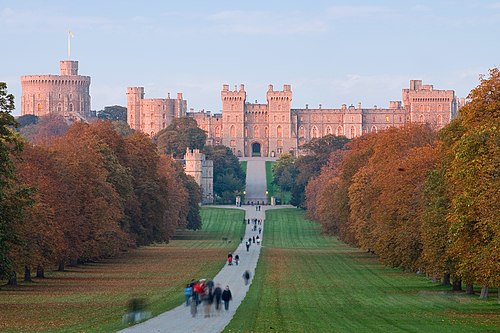 Windsor CastleRestored · prime 1820
 Tower of LondonRestored · prime 1285
 Bamburgh CastleRestored · prime 1904
All castles in England → · Strongest castles in England → · Castles of Europe
Play As Your Clan
Hold a real castle against whatever you choose to send at it, take a ship out in her own service years, or stand at the shoulder of someone the record remembers. The chronicler sets the scene; the deeds are yours.
Notable bearers of the Rogers name
- Fred 'Mister Rogers' Rogers (1928–2003), TV presenter, Mister Rogers' Neighborhood