Clan Ross
also Clan Ross, Mac in tSagart
The promontory clan, earls of the North.
- Origin
- The Highlands & Islands, Scotland
- Motto
- Spem successus alit
- Famous bearer
- Major-General Robert Ross (1766–1814), commander at the burning of Washington
- Register
- Scottish clan
Ranked of all time
The 10 Oldest Clans in Scotland
The Ross arms, crest badge, tartan and country

Crest badgeClan member crest badge - Clan RossCeltus · CC BY-SA 3.0 
TartanClan Ross Red TartanClan Ross · Public domain 
TartanRoss tartan, modern“Modern” colours: the deeper shades chemical dyes produced from the 1860s. The same pattern, not a newer one.SMcCandlish, made with the old Windows program Textile32. · CC0 
Coat of armsArms of the Earl of RossBorne by the Earl of Ross: the ennobled line of the name, not the name at large.Sodacan · CC BY-SA 4.0 
Coat of armsArms of Ross-of-BladensburgBorne by the Ross-of-Bladensburg line, one branch of the name rather than all of it.Arthur Charles Fox-Davies · Public domain 
Clan plateRoss (R. R. McIan)Robert Ronald McIan (1803-1856). · Public domain


.jpg)
- Crest badge: The chief's crest inside a belt and buckle: the badge a clansman wears to show whose following he is in.
- Tartan: The checked cloth the family is known by.
- Coat of arms: Granted to an individual and inherited down that one documented line. These are the arms of particular families of the name, not of everyone who shares the surname.
- Clan plate: Period portrait art of the clan, from the great 19th-century illustrated surveys.
What is the Ross clan tartan?
Two Ross setts are shown above, one of them the same pattern in “modern” colours, the deeper shades chemical dyes gave from the 1860s. They are not rival claims to be picked between; they are different records, and different weaves, of the same family cloth. A sett is the block of coloured bands the cloth is built from, repeated in both directions; the whole plaid is that one square enlarged.
Almost no clan tartan is medieval. Highland dress was proscribed from 1746 until 1782, and when it returned it returned as ceremony rather than everyday cloth, so the surname-to-sett map was fixed after the break, by the Bannockburn weavers’ pattern books, the royal visit to Edinburgh in 1822, and the Vestiarium Scoticum of 1842. The Rosses wore tartan long before any of that. What the registers fixed was which one. Nobody polices any of it. Wearing the Ross sett declares allegiance to the name, not descent from any particular line of it.
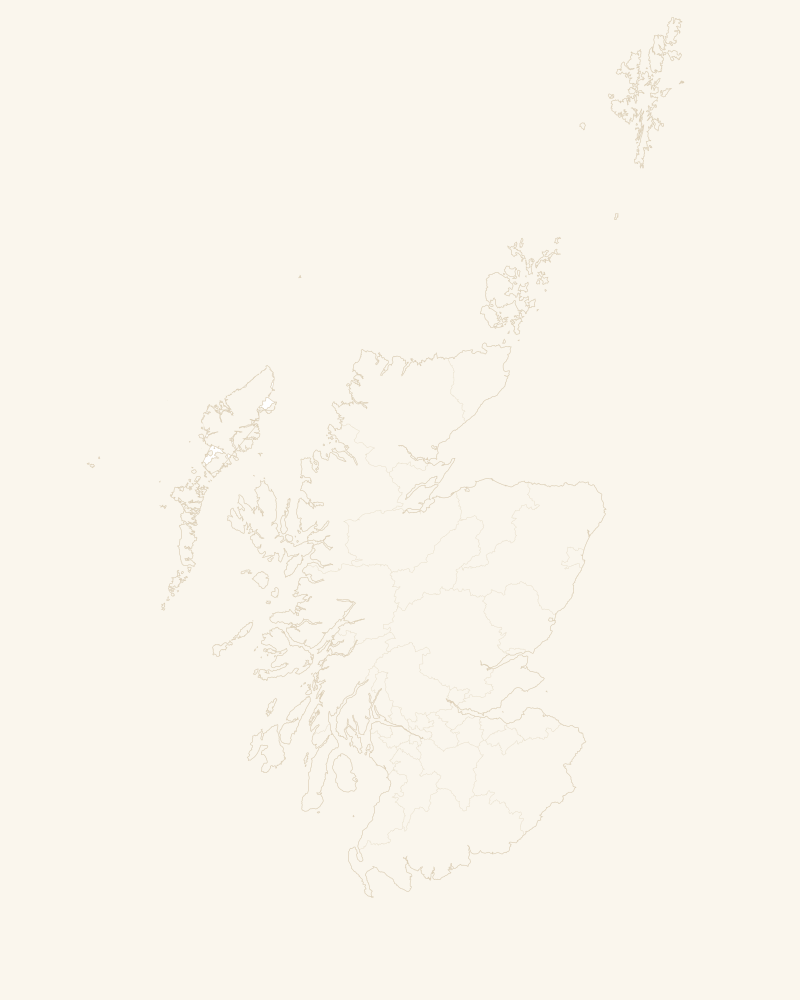
CoreHistoric reach
The seat of Clan Ross
Seat vacantChief
No one leads the Clan Ross community yet. When the movement opens, you can stand for its leadership, or help elect whoever does.
Current mission
No shared goal set yet. Once Clan Ross has leadership, it sets the public focus: a restoration, a gathering, a real-world project that helps its own.
The Ross clan is being rebuilt. Join the waiting list for the movement today, and you help decide who leads it and what it does.
Help rebuild the Ross clan →Motto
Spem successus alit
“Success nourishes hope”
What does the Ross name mean?
From the Gaelic Ros, a promontory or peninsula. The name is locative for the great northern peninsula of Easter Ross and Wester Ross between the Cromarty and Dornoch Firths. The earldom of Ross was created in the 12th century for Ferchar Mac in tSagart ('son of the priest'), and the Mac in tSagart line, Anglicised in time as Ross, held the earldom into the 14th century. The clan's later chiefs descend from Hugh Ross of Balnagown.
The history of Clan Ross
The promontory, and the son of the priest
Ross is the Gaelic ros, a promontory or headland, and the promontory in question is the great northern peninsula lying between the Cromarty and the Dornoch Firths. The land divides into Easter Ross, the seaboard of Tain, Alness and Dingwall, and Wester Ross, the coast to the west; together they named a county, Ross and Cromarty, and the family that ruled it. Most Highland surnames are patronymic, built on mac and a father's name, but a substantial class comes instead from ground and place, and Ross belongs squarely to that class.
Which makes the earliest recorded chief of the clan a small puzzle, because his own name says exactly whose son he was. He appears as Fearchar Mac an t-Sagairt, 'son of the priest', a byname pointing to his O Beollain descent from the hereditary abbots of Applecross. Church office in the Gaelic west ran in families and could pass down like an estate. The Western Church only declared in the 12th century that holy orders made a marriage invalid rather than merely forbidden, and it found that hard to enforce in rural Europe for generations. A priest's son in Applecross was a describable man rather than a scandalous one, and the description stuck to his line.
The Mac an t-Sagairt style was in time anglicised to Ross, taking the name of the province the family governed, and it is under that spelling that the earldom is recorded into the 14th century. In Gaelic the clan is still Clann Anndrais. A clan surname meant something narrower than it later came to: the name was carried by the descendants and dependants of an ancestor rather than by everyone in the clan's country, and only when a non-Gaelic-speaking administration began writing the north down was it applied wholesale to the people of a territory.
Ferchar's earldom and the men of Ross at Bannockburn
Fearchar Mac an t-Sagairt made the family by backing the right king at the right moment. He brought his men out for Alexander II against the rival claimants to the throne who were raising the north, the rebellion associated with Donald Bane and the MacWilliam line, and crushed it. The king knighted him for it. The clan's own record dates the grant of the earldom of Ross to 1226; the title is firmly on record by 1234. From that point the chiefs of Ross were not merely a northern kindred but one of the great magnate houses of Scotland, with strongholds at Delny, Dingwall and Tarradale.
About 1250 the earl's son William was abducted in a revolt against his father's rule, and was got back with the help of the Munros, who were rewarded with lands and bound thereafter to the house that had raised them. That rescue began an alliance which turns up again and again: Ross and Munro stand together at Carbisdale in 1650, retreat together at Alness in 1715, and carve up the parliamentary seats of the north between them afterwards.
At Dunbar in 1296 the Rosses fought the English and their chief, the Earl of Ross, was taken prisoner, and for a period afterwards William II, Earl of Ross, was found on the English side. He came over to Robert the Bruce, and the change was worth having. Dingwall Castle, a Norse foundation of the 11th century turned royal castle, was captured for Bruce by the earl and became the base from which he led the men of Ross south. At Bannockburn in 1314 the clan was led by Ferchar's grandson William.
The reward was land. In 1321 King Robert granted the earl the castle, the town and the lands of Dingwall outright, planting the family in the burgh at the head of the Cromarty Firth. In 1328 Bruce gave the earl a stranger prize, Red Castle above Lunan Bay on the North Sea coast of Angus, forfeited in the reallocation of lands after the wars, so that a Highland earl held a tower on the east-coast lowlands. The price of all this came due at Halidon Hill in 1333, where Hugh, Earl of Ross, was killed.
1374: the earldom goes one way, the chiefship another
The break that shaped every later Ross came when William III, sixth Earl of Ross, died leaving no male heir. The earldom and the chiefship, which had been the same thing since Fearchar, came apart. The chiefship passed to Earl William's brother, Hugh Ross of Rariches, who in 1374 received a charter for the lands of Balnagowan and became first of Balnagown. The title went elsewhere, the clan went with Hugh, and every chief since is reckoned from him.
The earldom itself descended through a female line and became the object of a dispute between the Lord of the Isles and Robert, Duke of Albany. The sources do not agree on the heiress who carried it: one has the earldom conveyed in 1372 by the marriage of Euphemia Ross to Donald MacDonald, while the accounts of Dingwall and of the earldom name Domhnall of Islay's wife as Mariota Leslie, Countess of Ross. What is not in dispute is the fighting. In 1411 Domhnall of Islay took Dingwall in pursuit of the claim, and that year at Harlaw the Clan Ross came out with the Highlanders for the Lord of the Isles against the army of the Earl of Mar, whom Albany had urged on, and beat him.
The Rosses were at Verneuil in 1424, fighting the English in France, and it was the death there of the Earl of Buchan and Ross that let James I claim the earldom for the Crown, although the better right lay with Alexander of Islay. The king restored it to the heiress of line, Mariota, Countess of Ross, and her son Alexander took the title; by 1436 he was living in the castle at Dingwall as Earl of Ross. The Crown confiscated the earldom in 1475 and Dingwall went back to the Crown under Munro governors, abandoned around 1600 and levelled by 1817.
Balnagown, Hawkhead and the houses the name held
Balnagown Castle, eight miles north-east of Alness, was raised by the Rosses in 1375 and enlarged repeatedly afterwards. It is the seat of the clan, and when debt took it out of the chiefs' hands in the 18th century it was bought by the Rosses of Hawkhead, the southern branch of the name, and stayed with the Ross family until 1978. The lesser houses fill in the map around it: Balconie near Alness, held by the Earls of Ross; Shandwick near Balintore, held by the Rosses of Shandwick, the branch from which the present chiefs descend; Caisteal nan Corr, also called Invercassley, near Lairg in Sutherland; and Pitcalnie near Cromarty, which came to the Rosses in the 18th century.
The southern Rosses were a power in their own right. Hawkhead Castle, a mile east of Paisley in Renfrewshire, was built by the family and held from the middle of the 15th century, a strong keep and tower later swallowed into a mansion, and the Lords Ross of Hawkhead took their title from it. In 1629 Lady Ross of Hawkhead bought Stanely from the Maxwells of Calderwood, an L-plan tower of squared freestone on an island in a marsh at the foot of the Gleniffer Braes, where the Hearth Tax return of 1691 counted eleven hearths. The Rosses held it into the 18th century. Since 1837 it has stood half drowned in the Paisley reservoir, visible only when the water is drawn down.
On the Clyde the family took over one of the oldest castle sites in Scotland. The King's Inch at Renfrew, a river islet given by David I to Walter fitz Alan when he was made first hereditary Steward, was granted in the later 15th century to Sir John Ross, who built Inch Castle over the ruins of Walter's motte; the Rosses held it until 1732. Arnage Castle near Ellon in Aberdeenshire, a Z-plan tower house, was sold in 1702 to John Ross, Provost of Aberdeen, whose town house survives as part of the Aberdeen Maritime Museum.
A de Ross family also appears among the earliest holders of several places in the south-west, without the sources setting out any link between them and the northern earls. Sanquhar Castle in Dumfriesshire was built in the 13th century by the Ross family on the southern approach to the royal burgh, above the River Nith, closed by the river to the west, a burn to the north and a deep ditch round the rest. It passed to the Crichtons in the 14th century. Portencross in Ayrshire was held by the de Ross family in its earliest days, when the place was called Arneil, and at Corsehill near Stewarton Godfrey de Ross was an early holder of the castle and lands, having moved his seat there from the castle at Boarland or Dunlop hill.
The name crossed to Ireland as well. Quintin Castle stands on the County Down coast about four kilometres east of Portaferry; the Montgomerys sold it to George Ross, who preferred his own Mount Ross estate outside Portaferry, and it was his descendant Elizabeth Calvert, born Blacker, who inherited it in the early 19th century and had it restored in 1850.
Tarbat, Aldy Charrish and the king's peace of 1496
The long quarrel of the late 15th century was with the Mackays, and it went both ways. At the Battle of Tarbat in 1486 the Rosses beat them and the Mackay chief was killed. At Aldy Charrish the result was reversed, the Rosses defeated and their chief killed along with many of his clan. The sources argue about who else was there. Sir Robert Gordon, writing in the 17th century as a younger son of the 12th Earl of Sutherland, put the Clan Sutherland on the Mackay side at Aldy Charrish; the 19th-century historian Angus Mackay rejected it, the Earl of Sutherland of the day being married to a daughter of the Ross chief of Balnagowan and unlikely to march against his wife's people.
The Crown lost patience in 1496, when the king summoned the two chiefs, David Ross and Iye Roy Mackay, and ordered them before the Earl of Argyll, then Lord High Chancellor of Scotland, to make peace under a penalty of 500 merks. The raids did not stop at once, the civil power in the north being too weak to stop them, but the Mackays were soon drawn into a quarrel with the Sutherlands and the pressure on Ross lifted.
Two records catch individual Rosses here. The Calendar of Fearn, a manuscript kept by the clan, notes a Hugh Ross, cadet of the Rosses of Balnagowan, killed at Achnashellach in 1504 or 1505; the Munro Writs show him acting as procurator for William Munro, 12th Baron of Foulis, who led the royal forces in that fight, another turn of the Ross and Munro connection. In the south, John Ross, 2nd Lord Ross of Halkhead, died at the head of his own men against the English at Flodden on 9 September 1513.
The Covenant, Carbisdale and the watch on Castle Leod
George, 10th of Balnagowan, did something no chief of the name had done before him: he went to university, at St Andrews. He died in 1615. His son David, 11th of Balnagowan, ran the clan lands as a law-abiding man and died in 1632, and the chiefship passed to another David, the 12th, who took the family through the most dangerous decades in Scottish history.
David Ross, 12th of Balnagowan, signed the National Covenant at Inverness on 26 April 1638. He went over to the royalists briefly and then returned to the Covenant, and was present in 1650 at Carbisdale when the royalist army of James Graham, 1st Marquess of Montrose, was destroyed; the Clan Ross and the Clan Munro fought there together for the Scottish government, then led by the Duke of Argyll. In 1651 David led part of the clan south for the last throw of the war and was taken prisoner at Worcester on 3 September. In 1689, when the north was uncertain and the Mackenzies were moving for the exiled Stuarts, a hundred men of Clan Ross occupied Castle Leod and held it as a watch post to report their movements.
Alness, Glen Shiel and the company that held Inverness Castle
In the rising of 1715 the Rosses stood with the Munros, the Mackays and the Sutherlands and were pushed back by a larger Jacobite force under William Mackenzie, 5th Earl of Seaforth, chief of the Mackenzies, in what is remembered as the Skirmish of Alness. The rivalry then moved into politics. The Seaforth earldom was extinguished in 1716, and it appears to have been arranged in the north that while the Clan Ross held the county seat the Munros would take the Tain Burghs, which needed three of the five to carry. Ross control of Tain was never in doubt, and the Munros held Dingwall from 1716 to 1745.
A company of Clan Ross men fought for the government at Glen Shiel in 1719, where the Jacobites and the Mackenzies were beaten. In 1721 the chief William Ross, 6th of the Pitcalnie line, and his brother Robert took a small force to collect rents in Mackenzie country and were outnumbered at Glen Affric. When General Wade surveyed the Highlands in 1724 he put the combined strength of the Rosses and the Munros at 700 men. Further afield, Colonel Charles, 13th Lord Ross of Hawkhead and 15th of Balnagowan, was killed leading men of the clan at Fontenoy on 30 April 1745.
In the rising of 1745 the nominal 18th chief was Alexander Ross of Pitcalnie, a staunch Protestant and firmly for the Hanoverian government, if more tolerant of Jacobites than his father had been. His uncle was Duncan Forbes of Culloden, Lord President of the Court of Session, and between them the two raised an Independent Highland Company and put it into Inverness Castle to hold the town against the rising. On 15 April 1746, the day before Culloden, a Jacobite force of about 200 men brought from the Black Isle was ambushed by pro-government Scots at Littleferry near Golspie. The clan as a whole stood with the government, and the chiefship afterwards ran through the Pitcalnie line, whose head assumed the name Ross and, once Carstairs was sold in 1762, the designation of Balnagowan.
Baffin Bay, the Ross Sea and a mosquito hut at Secunderabad
Major-General Robert Ross (1766-1814) commanded at the burning of Washington in 1814. The two Rosses who put the name on the map, in the most literal sense, were sailors. Sir John Ross (1777-1856) of the Royal Navy led the Arctic expedition of 1818 which re-confirmed the existence of Baffin Bay and probed the entrance to Lancaster Sound, the basis of every later attempt on the Northwest Passage.
His nephew Sir James Clark Ross (1800-1862) went to the other end of the world. The Antarctic expedition he led from 1839 to 1843 charted the sea, the ice shelf and the island that now carry the family name, so that the Ross Sea, the Ross Ice Shelf and Ross Island make a Highland surname the standing vocabulary of Antarctic geography.
The name's greatest bearer worked at a bench rather than a masthead. Ronald Ross was born on 13 May 1857 at the British military cantonment at Almora in the Kumaon Hills, the eldest of ten children of Campbell Claye Grant Ross, a Highland Ross officer whose family came from Glenshiel. He was sent back to Britain in 1865 at the age of eight, schooled in Edinburgh, and entered St Bartholomew's Hospital Medical College in London in 1875, qualifying as doctor and then surgeon by 1881. That year he joined the Indian Medical Service, and for sixteen years was posted about Madras, Burma, the Andaman Islands and Bangalore, treating the cholera, dysentery and malarial fevers of the cantonments.
Malaria killed more British soldiers in India through the second half of the 19th century than anything else, and nobody knew how it travelled; the theories blamed bad air, water and damp ground. On leave in London in 1894 Ross sought out Patrick Manson, the Scottish physician who had shown in 1877 that the filariasis worm was carried by mosquitoes, and Manson laid out for him the idea that malaria might travel the same way. Ross went back to India in April 1895 to prove it and spent two years failing, dissecting mosquitoes by candle in army huts at Secunderabad, Bangalore, Ootacamund and Calcutta. He had the wrong insects. On 16 August 1897, at the Begumpet army hospital outside Secunderabad, his assistant Mahomed Bux brought him a batch of dappled-winged mosquitoes, the Anopheles, fed on malaria patients. Four days later he opened the stomach wall of one of them and found the malaria parasite, in its oocyst form, in the gut tissue. He wrote to Manson that afternoon: 'I have found thy secret out.' The 20th of August is now kept worldwide as Mosquito Day.
He closed the case in Calcutta through 1898, demonstrating the life cycle of the parasite between caged birds and mosquitoes and back, and in 1902 was given the Nobel Prize in Physiology or Medicine, the second ever awarded in the category. He had resigned the Indian Medical Service in 1899 for the chair of Tropical Medicine at the new Liverpool School of Tropical Medicine, which he held until 1912 and from which he sent the first malaria-control expeditions to West Africa, the Suez Canal zone, Mauritius and Greece, turning a finding into drainage, larviciding and netting. He was knighted KCB in 1911 and died on 16 September 1932 at the Ross Institute in London, which carries his name. He was Ross of Shandwick, the branch that holds the chiefship.
The name kept travelling: Marion Ross, born in 1928 at Watertown in Minnesota and known to the world as Marion Cunningham in Happy Days, was Scottish-American Ross on her father's side. At home the clan is still a going concern. Fiona Campbell Ross of Ross and Balnagown was recognised as Chief of Clan Ross by the Lord Lyon King of Arms following the death of David Campbell Ross of Ross and Balnagown in 2024, the clan has three tartans in Red, Dress and Hunting setts, and the Ross centre at Tain Through Time keeps the family's record in the burgh they never let go of. The motto has stood the whole way: Spem successus alit, success nourishes hope.
Champions of the Ross name
The bearers whose lives are inseparable from this surname. Each has their own page, biography, achievements, geography, connection to the family.
Also found in
The Ross name has substantial historical presence beyond Scotland. See it on Ireland.
Historic Places, Rebuilt
Explore the streets and seats the Ross name knew, rebuilt with AI as they stood in history.
Historic Places, Rebuilt · New
The old castle above the River Ness, the market cross and the seven-arched bridge, on the eve of Culloden.
Historic Places, Rebuilt · New
The great castle guarding the Great Glen, newly granted to the Grants of Freuchie, whole above Loch Ness.
Castles the Ross held
Strongholds this name held for a decade or more, look one up, or rebuild it to explore.
- Dingwall Castle
Granted with the town and lands of Dingwall to the Earl of Ross, chief of Clan Ross, by Robert the Bruce in 1321.
- Red Castle, Angus
Given to the Earl of Ross by Robert the Bruce in 1328.
- Stanely Castle
Sold to Lady Ross of Hawhead in 1629; the Rosses held it until the 18th century.
- Sanquhar Castle
Built and held by the Ross family from the 13th century until the 14th.
- Barony and Castle of Corsehill
Godfrey de Ross and the de Ross family were early holders of the castle and lands of Corsehill.
- Portencross Castle
The de Ross family held the site in its earliest days, when it was known as "Arneil".
- Renfrew Castle
The Ross family held Inch Castle on the King's Inch from the later 15th century until 1732.
- Quintin Castle
Held by George Ross and his descendants; his descendant Elizabeth Calvert restored the castle in 1850.
Castles that share the Ross name
The same name on the map, look one up, see what it looked like in its prime, and recreate it to explore.

All castles in Scotland → · Strongest castles in Scotland → · Castles of Europe
Play As Your Clan
Hold a real castle against whatever you choose to send at it, take a ship out in her own service years, or stand at the shoulder of someone the record remembers. The chronicler sets the scene; the deeds are yours.
Notable bearers of the Ross name
- Major-General Robert Ross (1766–1814), commander at the burning of Washington
- Sir John Ross (1777–1856), Arctic explorer, Royal Navy
- Sir James Clark Ross (1800–1862), Antarctic explorer; Ross Sea and Ross Ice Shelf bear his name
- Marion Ross (b. 1928), American actress (Happy Days)