Ruskin
Victorian conscience of craft.
- Origin
- London, England
- Famous bearer
- John Ruskin (1819–1900), critic and social thinker
- Register
- English family
Where the Ruskin name comes from
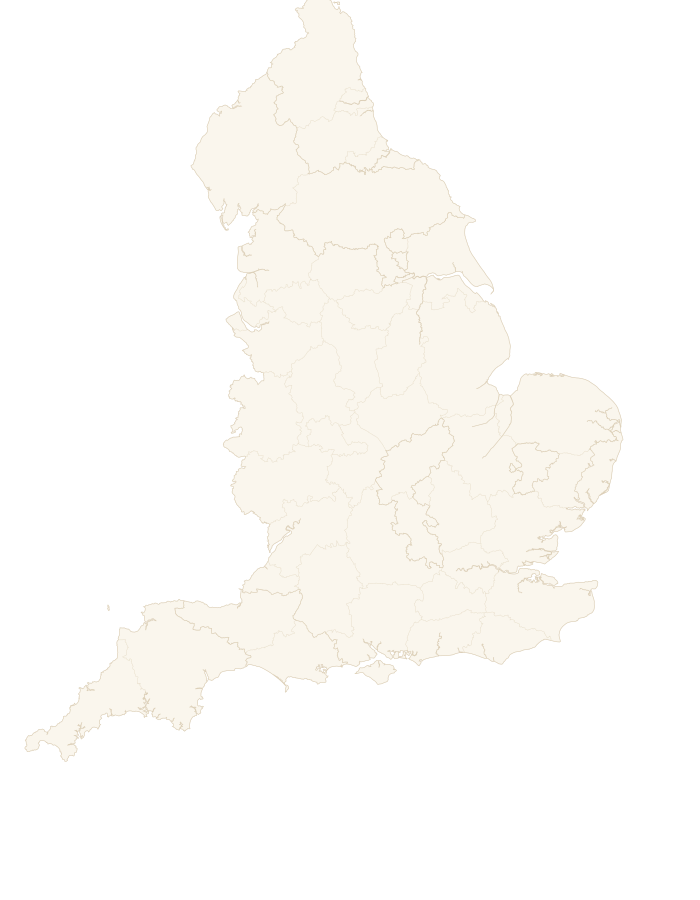
The seat of Ruskin
Seat vacantChief
No one leads the Ruskin community yet. When the movement opens, you can stand for its leadership, or help elect whoever does.
Current mission
No shared goal set yet. Once Ruskin has leadership, it sets the public focus: a restoration, a gathering, a real-world project that helps its own.
The Ruskin clan is being rebuilt. Join the waiting list for the movement today, and you help decide who leads it and what it does.
Help rebuild the Ruskin clan →What does the Ruskin name mean?
Locative, Ruskin family from Germanic roots in Lancashire usage; variant of Roscoe lines in regional form.
The history of Ruskin
Rushes in the wet ground of the northern shires
Ruskin is a name taken from ground rather than from a trade or a father. The sources derive it from an Old Norse element joined to Northern Old English, describing rush plants, the reeds that stand in wet land; a second reading treats it as a variant spelling inside the wider class of topographic names. The recorded English usage sits in Lancashire, where the form stands beside the Roscoe lines.
The Norse element says which part of England. Place-names in England had been reshaped by Scandinavian settlement well before 1066, and the Norman invasion barely altered them, so a name built from Norse and northern English words belongs to that older layer. On the wet edges of the Lancashire country the reeds were label enough, and the man from the rushes is the whole beginning of the surname.
The century in which a byname stopped changing
A byname becomes a surname only when a son inherits it, and in England that shift is tied to the Norman settlement. Surnames are documented among the barons in the eleventh century, the introduction of family names is generally attributed to the Domesday Book of 1086, and Christopher Daniell dates the first recorded surname inherited by multiple generations to 1140. By 1400 most English families, and those of Lowland Scotland, carried hereditary surnames.
Names of place spread hardest when people moved, since migration ran from small communities toward the towns and a newcomer needed a name saying where he came from. The surname is recorded as English, Scottish, French, Danish and German, in the variant spellings Russkin, Ruskina and Russkina, and in Russia, the United States and some Asian countries it is often borne by families of Jewish background.
The sherry merchant's son from Hunter Street
John Ruskin was born at 54 Hunter Street, Brunswick Square, in Bloomsbury on 8 February 1819, the only child of John James Ruskin, a Scottish-born partner in the sherry-importing firm of Ruskin, Telford and Domecq, and of Margaret Cock of Croydon. From his fourth year the family lived at Herne Hill in south London, in the strict Evangelical and Calvinist household his mother kept; she had taken him through the whole of the King James Version twice before he was six.
The wine trade paid for the other half of that education: the family travelled every year of his boyhood on the firm's business through Switzerland and northern Italy, so the landscape and buildings his books would argue about were in his eye long before he wrote about them. He was schooled at private day-schools and at the Reverend Thomas Dale's boarding-school at Camberwell, went up to Christ Church, Oxford, in 1837, took the Newdigate Prize in 1839, and graduated BA in 1842, MA in 1843.
Modern Painters and the defence of Turner
In 1843, in his twenty-fourth year, he published the first volume of Modern Painters: a long critical defence of the living English landscape painter J. M. W. Turner against the academic dismissal Blackwood's Magazine had given Turner's late work. Ruskin argued that those late watercolours and oils continued the great landscape tradition of Claude Lorrain and the Dutch masters of the seventeenth century, and had to be judged on the terms their own ambition set.
The book made two reputations inside eighteen months, its author's and its subject's. Four further volumes followed in 1846, 1856, 1856 and 1860, so that Modern Painters ran seventeen years in the writing and stands as the central English-language theory of landscape painting of the nineteenth century.
The Nature of Gothic and the men who reprinted it
The Seven Lamps of Architecture came in 1849 and the three volumes of The Stones of Venice in 1851 to 1853, the central English-language work on Gothic architecture. Set into the second volume is its sixth chapter, The Nature of Gothic, on the social conditions of the medieval crafts.
It travelled because other men carried it. William Morris's Kelmscott Press printed The Nature of Gothic as a separate pamphlet in 1892, distributed as a founding tract of the Arts and Crafts movement and of the early English labour movement. On the Morris socialist platforms of the 1880s and 1890s it was the most-cited piece of nineteenth-century English prose. A chapter about medieval craftsmen had become an argument about modern work.
The Slade chair and the Hinksey road
Oxford appointed him its first Slade Professor of Fine Art in October 1869, in his fifty-first year. He held the chair until 1879 and again from 1883 to 1885, and the long series of Slade Lectures he gave there constitutes the central English-language university course in art history of the nineteenth century.
He then used the chair for something no professor of art was appointed to do. The Hinksey Road Project of 1874 put Oxford undergraduates to work building a road under his direction, staged as a demonstration that manual labour was dignified. Oscar Wilde, Alfred Milner and Arnold Toynbee were among those who dug.
There is no wealth but life
Across the 1860s and 1870s his subject moved from art to political economy. Unto This Last was serialised in the Cornhill Magazine in 1860 and published as a book in 1862, the foundational English-language critique of the laissez-faire political economy of the Manchester school. In it he set out the distinction between use-value and exchange-value, the just price, the social obligations of the rich, and the proposition that carried furthest: there is no wealth but life.
It became the single most-cited foundational text of the early British labour movement, a remarkable destination for a book by a critic of paintings. Mahatma Gandhi translated it into Gujarati in 1908 and made it the economic text of his ashram and his political programme, and through him the Indian National Congress economic platform of the 1920s and 1930s was substantially built on Ruskin's principles.
Brantwood, the Guild of St George and the last letters
In 1871 he founded the Guild of St George as the institutional form of his political-economic argument. It operated St George's Farm and a small museum at Sheffield, and continues today as a charitable trust. From 1871 to 1884 he wrote Fors Clavigera, ninety-six open letters to the working men of the country, collected in eight volumes.
In 1872 he bought Brantwood, the small country house above Coniston Water in the Lake District, and lived there for the last quarter-century of his life; the three volumes of the autobiographical Praeterita appeared from 1885 to 1889. He died at Brantwood on 20 January 1900, in his eighty-first year, and lies in the parish churchyard at Coniston above the lake.
The other Ruskins, from the reed beds to Max's Kansas City
The name has never been numerous, and its weight in English letters runs far ahead of its frequency in any census. What bearers there are cluster around things made to be looked at or read: Harry Ruskin (1894-1969), American screenwriter and lyricist; Pamela Ruskin (1920-2010), Australian freelance journalist; Sheila Ruskin, born 1946, English actress; Susan Ruskin, American film producer; Morris Ruskin, born 1962, American producer of independent film and television.
Mickey Ruskin (1933-1983) took it into other rooms, running a string of New York establishments, the best known Max's Kansas City. Two men in sport carry the same full name, with no link between them on record: Scott Ruskin, born 1963, an American baseball player, and Scott Ruskin, born 1975, an English cricketer. For a name that began as a description of reed beds in northern England that is a wide scattering, though its weight in English culture still rests on the one bearer born in Bloomsbury and buried at Coniston.
Champions of the Ruskin name
The bearers whose lives are inseparable from this surname. Each has their own page, biography, achievements, geography, connection to the family.
Historic Places, Rebuilt
Explore the streets and seats the Ruskin name knew, rebuilt with AI as they stood in history.
The castles of the homeland
The great strongholds of the homeland, look one up, see what it looked like in its prime, and recreate it to explore.
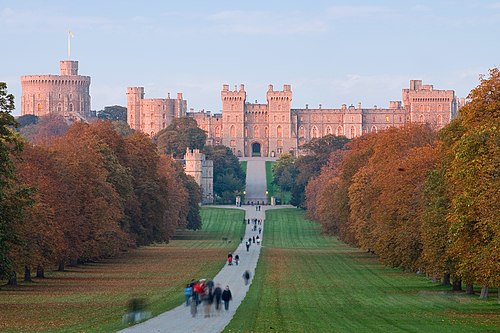 Windsor CastleRestored · prime 1820
 Tower of LondonRestored · prime 1285
 Bamburgh CastleRestored · prime 1904
All castles in England → · Strongest castles in England → · Castles of Europe
Play As Your Clan
Hold a real castle against whatever you choose to send at it, take a ship out in her own service years, or stand at the shoulder of someone the record remembers. The chronicler sets the scene; the deeds are yours.
Notable bearers of the Ruskin name
- John Ruskin (1819–1900), critic and social thinker