Shakespeare
also Shakspere, Shaxper, Shackspeare
Stratford tradesmen before troubadours, the world's best-known syllables on a modest guildman's signboard.
- Origin
- West Midlands, England
- Famous bearer
- William Shakespeare (1564–1616), playwright and poet
- Register
- English family
The Shakespeare arms and country

Coat of armsArms of ShakespeareSodacan · CC BY-SA 4.0

- Coat of arms: Granted to an individual and inherited down that one documented line. These are the arms of particular families of the name, not of everyone who shares the surname.
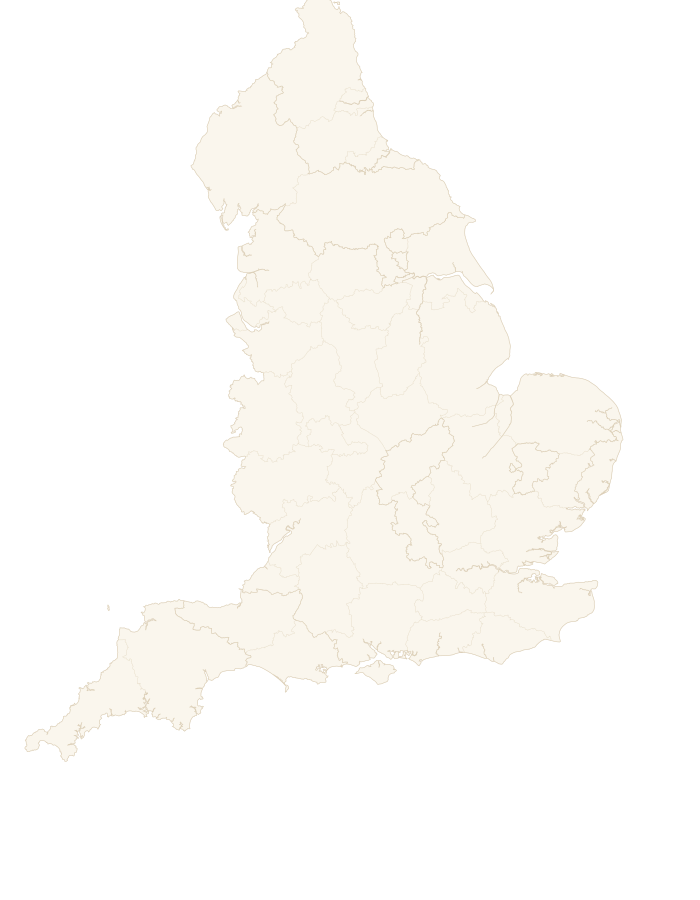
CoreHistoric reach
The seat of Shakespeare
Seat vacantChief
No one leads the Shakespeare community yet. When the movement opens, you can stand for its leadership, or help elect whoever does.
Current mission
No shared goal set yet. Once Shakespeare has leadership, it sets the public focus: a restoration, a gathering, a real-world project that helps its own.
The Shakespeare clan is being rebuilt. Join the waiting list for the movement today, and you help decide who leads it and what it does.
Help rebuild the Shakespeare clan →What does the Shakespeare name mean?
Occupational nickname or showman's by-name. In Stratford registers the same household can appear as Shakespere, Shaxper and Shakespeare within a generation, spellings were not yet fixed. One reading links the second element to spear-work in militia display or stage combat; another treats the first syllable as scribal drift around French or Middle English forms related to shaking or brandishing (specialists disagree). Documentary fact is simpler: in Warwickshire the name was ordinary trade-town currency long before the playwright. John Shakespeare, glover, whittawer and burgess, had a son who would eclipse every other bearer.
The history of Shakespeare
A byname for a man who shook a spear
In the broad class of English surnames that grew out of nicknames rather than trades or holdings, Shakespeare sits among the boldest. The reading usually given takes the two elements at face value and points to spear-work: militia display, muster drill, perhaps rough stage combat. A second reading treats the first syllable as scribal drift around French or Middle English forms for shaking or brandishing. Specialists disagree, and no Stratford document settles it either way.
What is not in dispute is why a household needed such a tag. Given names in early modern England were crowded to the point of uselessness: of the boys born in London in 1510, 24.4 per cent were christened John, 13.3 per cent Thomas and 11.7 per cent William. By 1400 most English families had already taken hereditary surnames, and compulsion was resisted in the late Middle Ages because a fixed name was associated with tax. A martial nickname did work three Williams in one street could not do for themselves.
Shakespere, Shaxper, Shakespeare: one household, three clerks
Richard Shakespeare (1490 to about 1561), the playwright's paternal grandfather, was carrying the name in Warwickshire long before anyone of it wrote for money. In the county it was ordinary trade-town currency, and the parish and borough clerks who wrote it down felt no obligation to spell it the same way twice. Shakespere, Shaxper and Shakespeare all attach to the same household inside a single generation of Stratford registers.
That variation is not evidence of separate families. It is evidence that spelling was the clerk's business rather than the bearer's, and that nothing had yet forced a decision. Print made the decision later: the 1623 folio put one spelling on a title page, and the Warwickshire households that had been Shaxpers in the registers found their name standardised for them.
The whittawer's yard, and why towns kept it downwind
John Shakespeare (about 1531 to 1601) was a glover and a whittawer, which put him at the white-leather end of a trade every town preferred to keep at arm's length. Tanning was classed as an odoriferous trade and pushed to the edge of settlement among the poor; where the old methods survive, the tanneries are still set apart from the towns they serve. Skins arrived stiff and dirty with soil and gore.
The work behind one pair of gloves was foul and skilled in equal measure. Hair was loosened by soaking the skin in urine, by painting it with an alkaline lime mixture, or by letting it putrefy for months and then dipping it in salt, before the tanner scraped it away with a knife. The hide was then bated soft by pounding in dung, dog or pigeon for preference, or by soaking it in animal brains: a fermentation driven by the bacteria the dung carried.
Only then came tanning proper, drawing tannin from oak bark; the medieval Latin tannum behind the craft's name means the bark itself. A whittawer worked the other branch, tawing rather than tanning, dressing skins with alum and salts to get the pale, supple leather a glove needs.
Why gloves paid, in the one century they were worth most
Glovers were slow to control their own trade in England. By 1440 they had become members of the Dubbers, the bookbinders' guild, and there they stayed until they broke away during the reign of Elizabeth I; the Glovers' Company was not incorporated until 1613, after John Shakespeare's death. Paris was two centuries ahead: a corporation of gantiers existed there from the thirteenth century, working in skin and in fur.
John's working life fell in the century when gloves reached their greatest elaboration. Elizabeth I set the fashion for wearing them embroidered and jewelled, and for drawing them on and off during audiences to draw attention to her hands; the 1592 Ditchley portrait shows her holding a pair of leather gloves. Regulation followed the money, Bologna legislating against samite gloves in 1294 and Rome against perfumed gloves in 1560.
Burgess, alderman, wool dealer
John Shakespeare was more than a craftsman. He dealt in wool, held a burgess's place in the borough and sat as one of Stratford's aldermen, and he married Mary Arden of the Wilmcote Ardens (about 1537 to 1608), an heiress to Arden land. The household mixed glove-making, tenant farming and minor municipal office: prosperous enough to matter locally, nowhere near a great estate.
That standing bought a schooling. The son baptised at Holy Trinity on 26 April 1564 went through the King's New School, the Stratford grammar, on the standard Tudor humanist syllabus of Latin grammar with Ovid, Virgil, Plautus, Terence and Cicero read in the original. Every classical reference in the later plays rests on what a corporation town gave the children of its aldermen.
The money travelled back the other way in 1597, when that son bought New Place, the second-largest house in Stratford, and added the lease of the town tithes and a Warwickshire freehold through the 1600s.
Gilbert, Joan and Edmund, the other Shakespeares of Stratford
John and Mary's other children carried the name through the same streets. Gilbert (1566 to about 1612) is a name and two dates in the record and nothing more. Joan (1569 to 1646) married William Hart the saddler, and Hart branches remained in Stratford for centuries afterwards. Edmund, the youngest (1580 to 1607), was an actor, and was dead before he was thirty.
The women of the family outlasted the men. Anne Hathaway (about 1556 to 1623) kept New Place for seven years after her husband's death. Susanna (1583 to 1649) married the physician John Hall; Judith (1585 to 1662), the surviving twin, married Thomas Quiney in February 1616 and lived on into her seventies. Their descendants are kin to the poet's blood, but the surnames they carry are Hall, Quiney and Hart.
A surname that outlived its most famous branch
The Stratford line thinned fast. Hamnet died in August 1596, aged eleven, and no other son followed. Judith's three sons were born and buried in infancy between the spring of 1616 and the next winter, and Susanna's daughter Elizabeth died in 1670 leaving nobody to carry the name on. By 1670 there was no Shakespeare of that house left to point at, which is why genealogists reach for the same correction whenever a direct line is advertised.
The surname itself was never at risk, only that branch of it. It was ordinary Warwickshire currency in Richard Shakespeare's day and it stayed in England long after the Stratford line ended, carried by households that shared the old nickname rather than a proven descent. Fame fixed one spelling in print; it did not multiply one line of blood.
Tenors, painters and a Worcestershire cricketer
Later bearers made their own way under the most quotable name in the language. William Shakespeare (1849 to 1931) was an English singer, teacher and composer. Olivia Shakespear (1863 to 1938) was a British novelist and playwright who carried the name unfixed. Percy Shakespeare (1906 to 1943) was a British painter, and William Harold Nelson Shakespeare (1883 to 1976) kept the name in the county game as an interwar cricketer for Worcestershire.
Emigration took it further out. James Shakespeare (about 1840 to 1912) was an organist in South Australia; Thomas Mitchell Shakespeare (1873 to 1938) was an Australian newspaperman and politician; and Joseph A. Shakspeare (1837 to 1896), carrying yet another spelling of it, served as mayor of New Orleans.
A baronetcy carried the name through the twentieth century. Sir Geoffrey Shakespeare (1893 to 1980), a British Liberal politician, was created first Baronet Shakespeare of Lakenham; his son William Geoffrey (1927 to 1996) held the title as a general practitioner in Aylesbury, and the third baronet, Tom Shakespeare, is a geneticist and sociologist. Craig Shakespeare (1963 to 2024) took it onto an English football touchline as player and manager.
Champions of the Shakespeare name
The bearers whose lives are inseparable from this surname. Each has their own page, biography, achievements, geography, connection to the family.
Historic Places, Rebuilt
Explore the streets and seats the Shakespeare name knew, rebuilt with AI as they stood in history.
The castles of the homeland
The great strongholds of the homeland, look one up, see what it looked like in its prime, and recreate it to explore.
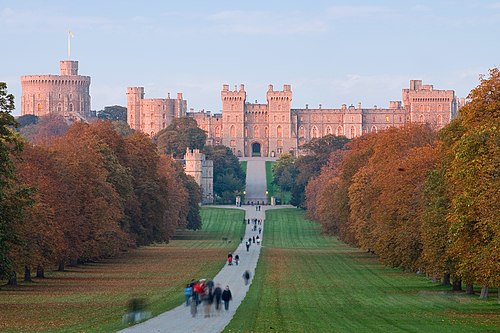 Windsor CastleRestored · prime 1820
 Tower of LondonRestored · prime 1285
 Bamburgh CastleRestored · prime 1904
All castles in England → · Strongest castles in England → · Castles of Europe
Play As Your Clan
Hold a real castle against whatever you choose to send at it, take a ship out in her own service years, or stand at the shoulder of someone the record remembers. The chronicler sets the scene; the deeds are yours.
Notable bearers of the Shakespeare name
- William Shakespeare (1564–1616), playwright and poet
- John Shakespeare (c.1531–1601), glover, alderman, the poet's father
- Mary Shakespeare née Arden (c.1537–1608), heiress to Arden land, the poet's mother
- Anne Hathaway (c.1556–1623), the poet's wife; outlived him at New Place
- Susanna Shakespeare Hall (1583–1649), elder daughter; married John Hall
- Hamnet Shakespeare (1585–1596), twin son; died aged eleven
- Judith Shakespeare Quiney (1585–1662), twin daughter; married Thomas Quiney
- Ben Jonson (c.1572–1637), prefixed the First Folio with the tribute that framed posterity
- John Heminges (1556–1630) and Henry Condell (d.1627), King's Men colleagues who compiled the First Folio
- Richard Burbage (c.1567–1619), leading actor of the Lord Chamberlain's / King's Men; created many of the title roles
Stories of Shakespeare
Mr. William Shakespeares Comedies, Histories, & Tragedies
1623By 1622, six years after William Shakespeare's death, eighteen of his thirty-six plays had never been printed in any form. They existed only as the company's prompt-books and as the drafts the company called the foul papers: paper, ink, the playhouse's only copies. A single fire would have erased Macbeth, Twelfth Night, The Tempest, Antony and Cleopatra, Julius Caesar, As You Like It and a dozen others from the world. The two men who saved them were John Heminges and Henry Condell, both of them senior actors of the King's Men and personal friends of Shakespeare's, who spent the better part of two years assembling and editing the manuscripts at the Jaggard print shop in Barbican. The book they put together is the First Folio.
Read the story →
The Globe burns during Henry VIII
1613On the afternoon of the twenty-ninth of June 1613, the King's Men were performing a new history play, All Is True, later known as Henry VIII and probably co-written by Shakespeare and the younger John Fletcher. In the first act of the play, at the masque entry of King Henry into Cardinal Wolsey's banquet, the company fired theatrical cannon, the chambers used for noise and spectacle. The wadding from one of them, paper or rag, lodged in the thatch above the gallery. The audience saw a wisp of smoke and went on watching the play. By the time anyone in the yard registered fire, the roof was alight in a ring. The Globe Theatre, the wooden O that had hosted the first performances of Hamlet, Othello, King Lear and Macbeth, was on the ground within an hour. Nobody was killed.
Read the story →
Holy Trinity and the grave curse
1616Holy Trinity, Stratford-upon-Avon, kept its dead under the chancel and the nave; when the church ran out of space, the sexton dug up older bones and moved them to the charnel-house in the churchyard. William Shakespeare, who held a half-share of the Stratford parish tithes and had the right to chancel burial, did not want his bones moved when his time came. He was buried inside the church under a flat ledger stone on the twenty-fifth of April 1616. The four lines cut on the slab read: Good frend for Iesvs sake forbeare, To digg the dvst encloased heare. Bleste be ye man yt spares thes stones, And cvrst be he yt moves my bones. Whether he wrote them himself is unrecoverable. The threat held. The slab has not been lifted in four hundred and nine years.
Read the story →