
Square · Vatican City · Still standing
Saint Peter's Square
Piazza San Pietro
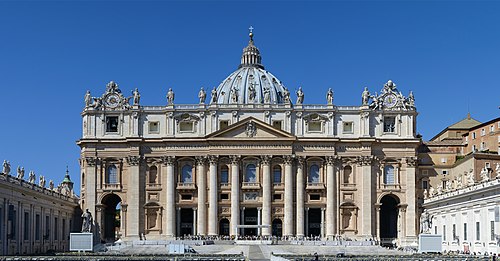
St. Peter's Square is the large forecourt directly in front of St. Peter's Basilica in Vatican City, laid out by Gian Lorenzo Bernini in the 17th century. Its composition unites a trapezoidal approach and a vast ovato tondo embraced by sweeping Tuscan colonnades, with a tall Egyptian obelisk and two matching fountains at the centre.
Its prime
1676
Today
Still standing
As it stood in 1676
What Saint Peter's Square looked like in its prime.
A vast paved expanse formed of a trapezoidal forecourt leading into a large oval (ovato tondo) marked by radiating travertine lines; at the oval’s centre rises a red-granite Egyptian obelisk on a bronze base, flanked by two symmetrical stone fountains. Two monumental, four-columns-deep Tuscan colonnades form embracing semicircles topped by a continuous entablature and a row of marble saints, while behind them the broad travertine steps and Maderno façade of the basilica close the composition.
Its story
The story of Saint Peter's Square.
The Obelisk, from Heliopolis to Fontana's Raising of 1586
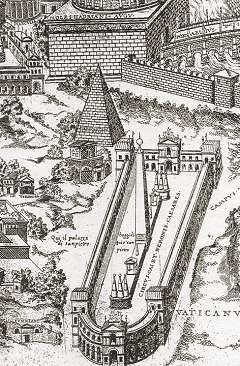
The red granite obelisk at the centre of the square was first put up at Heliopolis in Egypt by a pharaoh whose name is not known. Augustus had it moved to the Julian Forum of Alexandria, where it stood until AD 37; in that year Caligula ordered the forum demolished and the obelisk taken to Rome. He had it placed on the spina that ran down the middle of the Circus of Nero. It is the only obelisk in Rome that has not toppled since antiquity.
In 1586 the engineer-architect Domenico Fontana moved it to the site it occupies now, working under Pope Sixtus V; re-erecting so vast a weight was a feat memorialised in a suite of engravings. Through the Middle Ages the gilt ball on its summit was believed to hold the ashes of Julius Caesar. Fontana later took the ancient metal ball down, and it is now in a Roman museum. What he found inside is not agreed: by the usual account there was nothing but dust, while Christopher Hibbert writes that the ball proved to be solid.
Bernini's Colonnades for Alexander VII, 1667–1676
Bernini had been working on the interior of St Peter's for decades when Pope Alexander VII set him to the open ground in front of it. Between 1667 and 1676 he redesigned that space as a forecourt, laid out "so that the greatest number of people could see the Pope give his blessing, either from the middle of the façade of the church or from a window in the Vatican Palace". He gave the space order with colonnades in the Tuscan order, which avoided competing with Carlo Maderno's palace-like façade, but built them on a colossal scale without precedent, to evoke a sense of awe.
The site left him little freedom. The massed accretions of the Vatican Palace crowded the ground to the right of the façade and had to be masked without obscuring the papal apartments. The obelisk already marked a centre and a granite fountain of 1613 by Maderno stood to one side; Bernini made that fountain read as one of the foci of the ovato tondo that his colonnades embrace. In 1675, five years before his death, he matched Maderno's fountain with a granite one of his own on the other side. The trapezoidal shape of the piazza, praised as a masterstroke of Baroque theatre, is largely a product of those same constraints. Bernini had no influence over the raising of the obelisk, but he took it as the centrepiece of his piazza and added the Chigi arms at its top in honour of his patron.
The Zodiac Stones of 1817 and the Clearing of the Spina, 1936–1950
In 1817 circular stones were laid into the paving to mark the tip of the obelisk's shadow at noon as the sun entered each of the signs of the zodiac, making the obelisk the gnomon of a gigantic sundial.
The spina, the median of buildings that divided the two roads of Borgo Vecchio and Borgo Nuovo, was demolished ceremonially by Benito Mussolini himself on 23 October 1936 and was completely gone by 8 October 1937, opening a long, wide vista from Castel Sant'Angelo to the basilica. Almost all the buildings south of the passetto came down between 1937 and 1950, which obliterated an important medieval and renaissance quarter of the city. The clearance also erased the Baroque surprise of moving suddenly from a confined space into a much larger one, an effect a visitor still meets when entering from Borgo Santo Spirito. The avenue that replaced it, the Via della Conciliazione, which carries the approach from the Ponte Sant'Angelo and is named in honour of the Lateran Treaty of 1929, was completed in time for the Great Jubilee of 1950.
Two Police Forces under the Lateran Treaty
Under the Lateran Treaty the square as far as the foot of the steps leading up to the basilica, though part of the Vatican state, is subject to the authority of the Italian police for crowd control. Article 3 requires the Italian authorities to withdraw beyond the outer lines of the colonnades when the Holy See intends to hold particular functions. On an ordinary day the square is therefore under the police authority of two countries, the Vatican Gendarmerie and the Italian police, which few places anywhere are.
Step inside
10 places to explore in 1676.
The record describes 10 distinct spots at Saint Peter's Square, including 2 interiors: under the colonnade: covered portico walk, entrance to the braccio di costantino and the scala regia corridor. Create your own photoreal reconstruction and explore every one, more scenes means more photos, more angles and more of the immersive experience.
Build Your Own Castle
Recreate Saint Peter's Square with AI to explore it.
The artist rebuilds it as it stood in 1676, a photoreal reconstruction that belongs to you alone. Pay with coins, no subscription needed.
Recreate Square to Explore →Nearby
Castles within reach of Saint Peter's Square.


Landmarks within reach of Saint Peter's Square.


More landmarks of Vatican City

Explore the city


