Allen
Son of Alain, the Breton first name carried to England by William's followers.
- Origin
- North West, England
- Famous bearer
- Cardinal William Allen (1532–1594), Catholic exile, founder of the English College at Douai
- Register
- English family
The Allen arms and country

Coat of armsAllen of Abbeydale EscutcheonBorne by the Abbeydale Escutcheon line, one branch of the name rather than all of it.Robin S. Taylor · CC BY-SA 4.0 
Coat of armsArmorial Bearings of the ALLEN family of Lyonshall, HerefordshireBorne by the Lyonshall line, one branch of the name rather than all of it.Rs-nourse · CC BY-SA 4.0


- Coat of arms: Granted to an individual and inherited down that one documented line. These are the arms of particular families of the name, not of everyone who shares the surname.
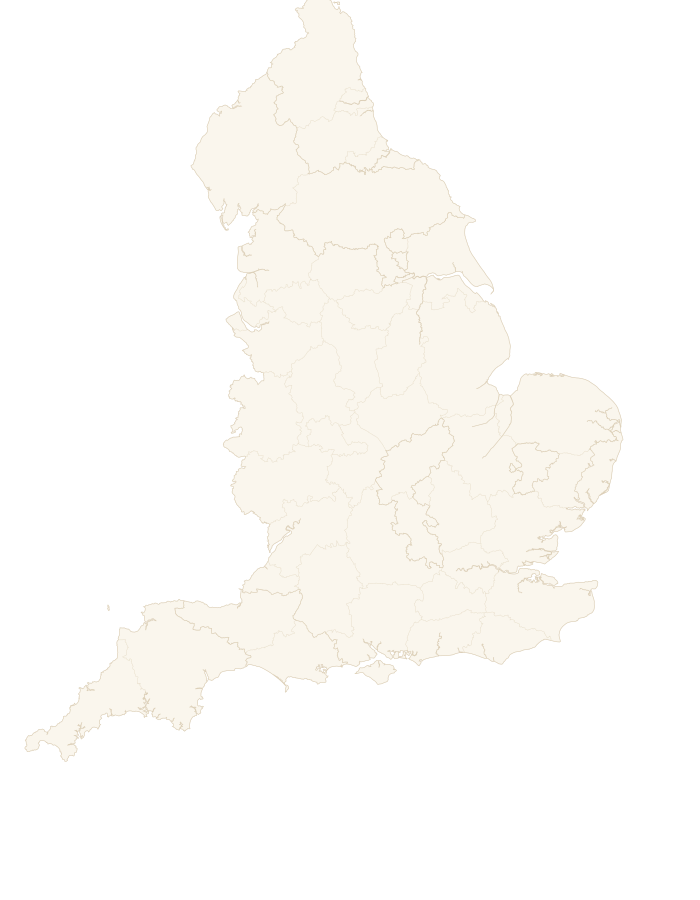
CoreHistoric reach
The seat of Allen
Seat vacantChief
No one leads the Allen community yet. When the movement opens, you can stand for its leadership, or help elect whoever does.
Current mission
No shared goal set yet. Once Allen has leadership, it sets the public focus: a restoration, a gathering, a real-world project that helps its own.
The Allen clan is being rebuilt. Join the waiting list for the movement today, and you help decide who leads it and what it does.
Help rebuild the Allen clan →What does the Allen name mean?
From the Norman first name Alain, itself from the Breton Alan, possibly meaning 'rock' or 'noble'. The name was carried into England with the Conquest and the Bretons who came with William; Alan FitzFlaad, ancestor of the Scottish Stewart line, was a Breton noble. The patronymic 'Alan-son' compressed into Alanson and Allen by the 14th–15th-century surname-fixation era. Some Allen lines descend from the Old English personal name Æþelwine, but the Norman Alain is the principal source.
The history of Allen
The Breton name that crossed the Channel in 1066
The force that landed at Pevensey in Sussex on 28 September 1066 was not simply Norman. It was an army of Norman, French, Flemish and Breton troops, with large contingents from Brittany and Flanders, led by the Duke of Normandy who would be styled William the Conqueror. Sixteen days later, on 14 October, it destroyed Harold Godwinson at Hastings. Among the Bretons in that army, Alan was already an old and common given name, and it is from its Norman form, Alain, that the great majority of English Allens take their surname. The Breton original is usually read as 'rock' or 'noble'.
What followed mattered more to the name than the battle did. An estimated 8,000 Normans and other continentals settled in England, on land confiscated from the resisting English elite. The Domesday survey, completed by 1086, shows how total the transfer was: only about 5 per cent of the land south of the Tees was left in English hands.
One of the plainest effects was on names. Anglo-Norman replaced Old English as the speech of the ruling class, and names common in France were used instead of Anglo-Saxon ones: William, Robert and Richard became common quickly, and Alain travelled with them. The Breton incomers could rise very high: Alan FitzFlaad, a Breton noble, stands at the head of the line that became the Scottish Stewarts. By the early 1160s Ailred of Rievaulx could write that intermarriage between English and newcomers was common at every level of society, and a French given name in an English village had become unremarkable.
From Alan's son to Allen: how the surname froze
England's family names are generally traced to the preparation of the Domesday Book in 1086, beginning among the feudal nobility and spreading slowly downwards. At first they were not inherited at all: a man was described by his trade, his father, his birthplace or his appearance, and his son might be described quite differently. By 1400 most English families, and those of Lowland Scotland, had hereditary surnames. It was not always welcome: in the late Middle Ages mandatory surnames were resisted in England because people associated them with taxation.
Patronymic surnames, formed from the father's given name, are the oldest and commonest class of all, and a single popular given name can throw off a whole family of surnames. For Alan the compression is easy to follow: Alan-son shortens to Alanson and then to Allen across the 14th and 15th-century fixation era, the same period in which most English and Scottish people settled into surnames at all. A smaller strand of English Allens descends instead from the Old English personal name Aethelwine, worn down by the same centuries of speech, but the Norman Alain is the principal source.
Documentary Allens appear before the name had finished settling. Henry Allen was Lord of the Manor of Buckenhall in Staffordshire in 1290, and the Allens of Staffordshire were said to descend from one Alanus de Buckenhall, a claim worth reading as family tradition rather than proof. The name planted itself densely across the English Midlands and the West Country, exactly where Breton followers of William had been settled in the late 11th and early 12th centuries.
Ó hAilín: the Irish Allens are a different name entirely
In Ireland, Allen is not a Breton import at all. It is the anglicisation of the Gaelic Ó hAilín, a native Irish name written down by English-speaking clerks in the nearest English spelling that came to hand, and the resemblance to the English Allen is an accident of that process rather than evidence of shared descent. Ailin, in both Irish and Scottish Gaelic, carries the senses of 'little rock' and 'harmony'; some readings take the name instead from the Celtic Aluinn, meaning 'handsome'. An Irish Allen and a Midlands Allen can share a spelling, a pronunciation and no ancestor at all.
There were also Allens in Ireland who came the other way, as landholders. Dalkey Castle, one of the fortified town houses guarding the harbour south of Dublin, was held by the Allen family until it passed to Sir William Mayne in the mid-18th century.
The Irish line has kept the name visible. Myrtle Allen (1924–2018) and Darina Allen (born 1951) built the reputation of Irish country cooking and Rachel Allen (born 1972) carried it onto television; Dave Allen (1936–2005) made a career of unpicking Irish Catholic childhood in front of British audiences.
MacAllen: the third road to the same spelling
There is a third route. Allen is recorded as a variation of MacAllen, built with Mac, the Gaelic word for son, on the same personal name, the machinery that produced MacDonald, Cameron and Campbell. Lowland Scotland adopted hereditary surnames on England's timetable, most families settled by 1400, while the Gaelic-speaking country kept the older habit of naming a man for his father far longer.
That is why Allen is properly described as a British surname originating in England, Scotland, Wales and Ireland rather than in any one of them. Three naming systems (a Breton given name carried in by conquest, an Irish Ó hAilín flattened by anglicisation, and a Gaelic MacAllen shortened at the front) converged on five letters. A reader tracing an Allen line back to Europe is not choosing between rival theories about one family; they are working out which of three real families they belong to. Rick Allen (1954–2021), the Scottish climber, carried the northern version of it.
Cardinal Allen, Douai, and the century of recusant Allens
The name's greatest figure of the Reformation century chose exile over conformity. William Allen (1532–1594), born in Lancashire, left England rather than accept the Elizabethan settlement, and in exile founded the English College at Douai to train priests for a country that had made their vocation a capital offence. From there he led the Catholic mission to England under Elizabeth I, and was made a cardinal. The seminary he built outlived him and kept an English Catholic clergy in being through the worst of the penal years.
The price was paid at home. Rose Allen was one of the Colchester Martyrs, killed in the Marian persecutions that ran in the other direction, and by the 18th century Allen was recognised as one of the English Catholic recusant family names: families who paid fines, lost office and stayed put for generations rather than change their religion. For a reader whose Allens turn up in Lancashire, that is often why the family left England at all.
Ralph Allen, the cross-post and the stone of Bath
Ralph Allen (1693–1764) was a St Blazey innkeeper's son from Cornwall who rebuilt the way a country talks to itself. The English postal system before him ran everything through London; Allen took on the cross-posts, the routes that carried letters between provincial towns directly, farmed them at his own risk, and made them work. In doing so he turned the General Post Office from a leaking concern into a financially viable one, and laid the foundation of the country-wide service that became the modern Royal Mail.
The fortune it made him went into stone. He bought the Combe Down quarries above Bath and set out to prove what Bath stone could do by building Prior Park from his own material, one of the great Palladian houses of England, and an advertisement standing in full view of the city it supplied. His character reached further than his architecture: Henry Fielding drew Squire Allworthy of Tom Jones from him, a national novel's model of decency wearing the name. Ralph Shuttleworth Allen (1817–1887) later sat as a Conservative Member of Parliament.
The Allens of Porto and the port wine trade
One branch went south instead of west. George Allen, an English trader of the early 18th century, settled in Porto and founded the Portuguese Allen family, whose involvement in the port wine trade is documented back to 1701. He was reckoned a descendant of the same Henry Allen who held Buckenhall in 1290, making the Porto house an offshoot of the Midlands stock rather than a coincidence of spelling.
The family still owns the Quinta de Villar d'Allen, the noble mansion that has been their country estate for more than 180 years, since 1839, and the Museu Allen, a 19th-century museum in Porto, carries the name into Portuguese public life. A British surname's only story abroad is not always the Atlantic one.
Where the name stands now
Allen is the 41st most common surname in England. It is also unusually well documented: a four-year study led by the University of the West of England, concluded in 2016 and published as the Oxford English Dictionary of Family Names in Britain and Ireland, analysed sources from the 11th to the 19th century and found that over 90 per cent of its 45,602 surnames are native to Britain and Ireland. Allen belongs to that native stock several times over.
The name travelled well. Ira Allen (1751–1814) helped found the state of Vermont; Hervey Allen (1889–1949), the Pittsburgh novelist, wrote Anthony Adverse; Frances E. Allen (1932–2020) won computing's Turing Award; Paul Allen (1953–2018) co-founded Microsoft. At home, Lily Allen (born 1985) took the surname into 21st-century British pop with 'Smile' and 'The Fear'.
Whichever of the three roads brought it to your family (a Breton given name landed at Pevensey, an Irish Ó hAilín written down by an English clerk, or a Gaelic MacAllen cut short), the name has been carried by men and women who founded seminaries under sentence of death, moved a nation's letters, cut its stone and named its states. It is worth knowing which one is yours.
Champions of the Allen name
The bearers whose lives are inseparable from this surname. Each has their own page, biography, achievements, geography, connection to the family.
Historic Places, Rebuilt
Explore the streets and seats the Allen name knew, rebuilt with AI as they stood in history.
Castles the Allen held
Strongholds this name held for a decade or more, look one up, or rebuild it to explore.
- Dalkey Castle
Held by the Allen family until it passed to Sir William Mayne in the mid-18th century.
The castles of the homeland
The great strongholds of the homeland, look one up, see what it looked like in its prime, and recreate it to explore.
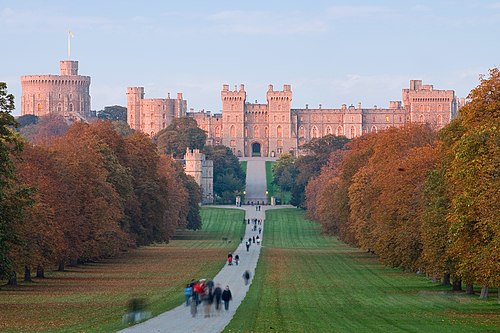 Windsor CastleRestored · prime 1820
 Tower of LondonRestored · prime 1285
 Bamburgh CastleRestored · prime 1904
All castles in England → · Strongest castles in England → · Castles of Europe
Play As Your Clan
Hold a real castle against whatever you choose to send at it, take a ship out in her own service years, or stand at the shoulder of someone the record remembers. The chronicler sets the scene; the deeds are yours.
Notable bearers of the Allen name
- Cardinal William Allen (1532–1594), Catholic exile, founder of the English College at Douai
- Ralph Allen (1693–1764), postal reformer, builder of Prior Park
- Lily Allen (b. 1985), singer