Anderson
also MacAndrew
Son of Andrew, the saint that gave Scotland its flag, and the patronymic that crossed every shire.
- Origin
- Grampian & the North-East, Scotland
- Motto
- Stand sure
- Famous bearer
- Sir John Anderson, 1st Viscount Waverley (1882–1958), Lord Privy Seal, civil-defence reformer
- Register
- Scottish family
The Anderson arms, crest badge, tartan and country

Crest badgeClan member crest badge - Clan AndersonCeltus · CC BY-SA 3.0 
TartanTartan AndersonUnknown author Unknown author · OGL v1.0 
TartanClan Anderson tartan 2Micheletb · CC BY-SA 4.0 
Coat of armsAnderson of Erbury ArmsBorne by the Erbury line, one branch of the name rather than all of it.Czar Brodie · CC BY-SA 3.0 
Coat of armsAnderson of Ardbrake armsBorne by the Ardbrake line, one branch of the name rather than all of it.Czar Brodie · CC BY-SA 3.0


- Crest badge: The chief's crest inside a belt and buckle: the badge a clansman wears to show whose following he is in.
- Tartan: The checked cloth the family is known by.
- Coat of arms: Granted to an individual and inherited down that one documented line. These are the arms of particular families of the name, not of everyone who shares the surname.
What is the Anderson clan tartan?
Two Anderson setts are shown above. They are not rival claims to be picked between; they are different records, and different weaves, of the same family cloth. A sett is the block of coloured bands the cloth is built from, repeated in both directions; the whole plaid is that one square enlarged.
Anderson is a north-eastern name, and Aberdeenshire and Moray sit across the Highland line (Gaelic up the straths, Scots along the coast), so the tartan story runs both ways at once. Highland dress was proscribed from 1746 until 1782, and when it returned it returned as ceremony rather than everyday cloth. The surname-to-sett map was fixed after that break, by the Bannockburn weavers’ pattern books, the royal visit to Edinburgh in 1822, and the Vestiarium Scoticum of 1842, and whether the Andersons wore tartan before it depended on which side of the line the branch farmed. Nobody polices any of it. Wearing the Anderson sett declares allegiance to the name, not descent from any particular line of it.
CoreHistoric reach
The seat of Anderson
Seat vacantChief
No one leads the Anderson community yet. When the movement opens, you can stand for its leadership, or help elect whoever does.
Current mission
No shared goal set yet. Once Anderson has leadership, it sets the public focus: a restoration, a gathering, a real-world project that helps its own.
The Anderson clan is being rebuilt. Join the waiting list for the movement today, and you help decide who leads it and what it does.
Help rebuild the Anderson clan →Motto
Stand sure
“Stand sure”
What does the Anderson name mean?
Son of Andrew, patron saint of Scotland, whose 9th-century association with the Scottish church embedded the name across every parish. The Lowland Scots form Anderson took the standard patronymic 's'; the Highland Gaelic form Mac Andreis became MacAndrew. Both are the same patronymic.
The history of Anderson
The saint who gave Scotland its flag
Anderson is a patronymic and means what it looks like: son of Ander, son of Andrew. The given name behind it travelled a long way before it reached a Scottish font, coming from the Greek Andreas, from a root carrying the sense of man, brave, manly. In most of Europe that would make Anderson an ordinary name, one of hundreds spun off a common Christian forename. In Scotland it made it something closer to a national surname.
Andrew is the patron saint of Scotland, and his diagonal cross is the saltire that became the national flag. A saint at the centre of a country's religious life puts his name into every parish font, generation after generation, and every one of those Andrews had sons. The result is measurable rather than sentimental: Anderson is the eighth most frequent surname in Scotland, and only the fifty-second most common in England. That gap is not a matter of population size. It is the size of the shadow one saint cast over Scottish christening.
The name is thickest in the north-east, the largest grouping running from the Mearns through Aberdeenshire, Banff and Moray. It got there not because one family carried it out of one glen, but because it was invented over and over in different places by different households who happened to have an Andrew at the head of them. The historian Ian Grimble made the point bluntly: although arms were granted to an Anderson of that ilk in the sixteenth century, the name is so widespread that no exact place of origin can be established. For a diaspora reader that is the honest answer, and a better one than a fabricated glen; the name is Scottish to its bones without belonging to a single valley.
Fitz Andreu, Gilleaindreas, and the spellings in between
The name enters Scottish record in the fourteenth century as Fitz Andreu, the Norman-French fitz, son of, because that was the language the clerks wrote in. Alongside it ran the plain Scots construction that eventually won, Andrew's son worn down to Anderson.
Gaelic Scotland built the same idea differently, and more devoutly. The Gaelic derivation is Gilleaindreas, servant of Andrew, and from MacGhilleAndrais, son of the servant of Andrew, come the Highland forms MacAndrew and Gillanders. The clan's Gaelic name is given as Mac Aindrais. It is worth pausing on that difference: the Lowland name says whose son you are, while the Gaelic name says whose servant your father was. Both are the same devotion, filed under two grammars.
England produced the name independently and early: the first recorded spelling of the family name there is probably William Andreu, in the charters of Buckinghamshire, dated 1237. Before the spelling settled, Scottish and English scribes wrote it as Andersonne, Andersoun, Andirsoone, Andresoun, Androson, Andirston, Andresson, Andrewson, Andison and Andresen. Anyone working back through parish registers should expect every one of those, and should not treat a change of spelling as a change of family.
A clan with no chief, and why that is not a demotion
Clan Anderson is a Lowlands Scottish clan, and it is armigerous: it has no chief currently recognised by the Court of the Lord Lyon. Under Scots law that matters, because a clan or family becomes a legally recognised noble incorporation only through an officially recognised chief. Without one there is no head of the name, and strictly speaking no cadet branches either, since cadency is measured from a chief's arms.
What the name has instead is a set of identified principal houses: Anderson of Ardbrake and Westerton, whose crest, an oak tree Proper, is the crest the whole name wears on its clansman's badge; Anderson of Kinneddar, a scion of the Ardbrake line; and Anderson of Noth, of Newbiggin and Kingask, of Dowhill and Stobcross, of Linkwood, of Inchyra and Stonyhill, Seton-Anderson of Mounie, and Anderson of Candacraig. The clan lands are recorded as Aberdeenshire, Banff and Moray, and the motto is Stand Sure.
The idea that a Lowland name is a mere family while a Highland one is a proper clan is a nineteenth-century convention rather than history or law. Sir Crispin Agnew of Lochnaw, Albany Herald Extraordinary at the Court of the Lord Lyon, has pointed out that an Act of the Scottish Parliament of 1587 spoke of the cheiffis and chiftanes of all clannis, alsweill on the hielandis as on the bordouris, chiefs and chieftains of all clans, on the highlands as on the borders alike. A Lowland Anderson is a clansman in precisely the sense the word carried when it was a legal term rather than a souvenir.
Septs, Clan Chattan, and the warning about tartan lists
In the Highlands the name follows a different thread. MacAndrew is counted a sept of Clan Mackintosh and of the wider Clan Chattan Confederation, and MacAndrews were also associated with Clan MacDonell of Glengarry, while the surnames Andrew and Andrews are reckoned septs of Clan Ross. A sept, properly understood, is not a bloodline but a following: families who answered to another chief while carrying a different surname, tied in by marriage, by living on a powerful laird's land, or by a bond of manrent contracted by the heads of families who looked to a chief for territorial protection without living on his estates. Those bonds were reinforced by calps, a death duty paid to the chief when the head of a family died, usually his best cow or horse. Parliament banned calps in 1617; manrent went on covertly, because protection was worth paying for.
Then comes the caveat a reader deserves before they spend money. The sept lists in circulation today largely date from the nineteenth century, when clan societies and tartan manufacturers set out to capitalise on the enthusiasm for all things Scottish and drew up lists linking as many surnames as possible to a particular clan, regardless of whether any historical connection existed. The point was to let people without a clan name feel entitled to a tartan. A surname as common and as independently invented as Anderson is exactly the kind of name that got swept into those lists. Seeing Anderson under Mackintosh does not prove your line ever followed a Mackintosh.
The tartan itself has a better pedigree than most. The Anderson sett was first seen in 1815, when it was collected by the Highland Society of London, the same body and the same year in which the naming of clan-specific tartans began in earnest. It has an azure field and is one of the few Scottish tartans woven with seven colours. That is a real early record, which is more than can be said for the many clan tartans that descend from the Vestiarium Scoticum, a nineteenth-century forgery passed off as an ancient manuscript and still worn today.
Burgesses, a mathematician in Paris, and the rock in Aberdeen harbour
The name shows up early in the ordinary machinery of Scottish public life. The historian George Fraser Black lists Andersons as burgesses of Peebles and in the county of Dumfries, burgess status meaning the right to trade in a royal burgh, the working aristocracy of a Scottish town. In 1585 John Anderson served as a commissioner to Parliament for Cupar. These are not romantic entries, and that is the point: this is a name that sat in council chambers and market crosses rather than in ballads.
Alexander Anderson, born near Aberdeen, became a famous mathematician, settled in Paris and published works on algebra and geometry there. A north-east Scot publishing mathematics in the intellectual capital of Europe is a reminder that the traffic between Scotland and the Continent ran both ways and ran early.
His kinsman David Anderson of Finshaugh was a scientist of a more practical bent, and the north-east remembered him for one feat above all: he removed a rock that was obstructing the entrance to Aberdeen harbour, doing it by the application of science and mechanics rather than brute labour. When William Anderson published his three-volume biographical history The Scottish Nation in 1863, he praised David as having been rich enough and generous enough to found and endow a hospital in Aberdeen for the maintenance and education of ten poor orphans. The credit was misplaced. That gift was actually made by his wife Jean Anderson and her relatives, after his death, a noted philanthropist written out of her own charity by a Victorian biographer, and worth putting back.
The Andersonian: the professor who left a university in his will
John Anderson (1726-1796) held the chair of natural philosophy at Glasgow University at the moment Glasgow was turning itself into a workshop, and he did the thing academics almost never do: he willed his own institution into existence. His bequest founded the Andersonian Institution in 1796, and that institution grew into the University of Strathclyde, the first technical university in the English-speaking world. It was built on the conviction that mechanics and workmen were owed real science, not a diluted version of it, and the whole later tradition of technical education in Britain traces back through it.
Elizabeth Garrett Anderson (1836-1917) came from a London-Anderson line of distant Scottish descent and became the first woman to qualify as a physician in Britain, forcing open a profession that had been organised specifically to keep her out. The name has a habit of turning up at that kind of threshold. Madge Easton Anderson (1896-1982) was a Scottish lawyer of the following generation; Ernest Masson Anderson (1877-1960) was a Scottish geologist whose work belongs to the same north-eastern scientific tradition as David Anderson's harbour rock.
The name also built. John Macvicar Anderson (1835-1915) practised as an architect through the high Victorian period. And it sat in Parliament well before that: Bertram Anderson, who died in 1571 and was born around 1505, served as member of parliament for Newcastle upon Tyne, an English Anderson in public office within a couple of generations of the spelling settling down.
Andersson, Andersen, and what the Atlantic did to the spelling
Scandinavia arrived at the same surname from the same given name, entirely independently, and on a larger scale. Andersson is the most common surname in Sweden, alongside Johansson. Andersen is the fifth most common surname in both Norway and Denmark, and reaches into northern Germany as well. The difference is timing. Scottish and Lowland patronymics had mostly hardened into hereditary surnames by about 1400, whereas the Nordic patronymic went on changing with every generation for centuries afterwards, until law froze it in place: King Frederik I of Denmark-Norway ordered noble families to take fixed surnames as early as 1526, and the general population was caught by the naming legislation of the nineteenth century that the Hansen entry in this atlas sets out in full. Iceland never froze at all, and still gives its children -son and -dottir according to their father.
Then the crossing rewrote the spelling. Andersson and Andersen were routinely rendered as Anderson by immigrants to the English-speaking countries, and the borrowed form became one of the most common surnames in Anglophone North America: eleventh most common in the 1990 United States census, accounting for 0.3 per cent of the population, twelfth in the 2000 census, and among the most popular surnames in Canada. The practical consequence for a reader in Minnesota or Otago is worth stating plainly. An Anderson in North America may descend from Aberdeenshire, from Sweden, from Denmark or from Norway, and the spelling on the headstone will not tell you which. Only the parish and the port will.
The Highland form travelled on its own account. MacAndrew crossed the Irish Sea and was assumed by a branch of the Irish Barrett family, and in Ireland the name is found mainly in counties Mayo and Donegal. It went further still: James Macandrew (1819-1887) was a ship-owner and politician in New Zealand, and Robert MacAndrew (1802-1873) was a British merchant and ship-owner, a marine dredger, a naturalist and shell collector, and a Fellow of the Royal Society.
Stand sure
The name's most literal appearance in ordinary life came in 1938. Sir John Anderson, 1st Viscount Waverley (1882-1958), Lord Privy Seal and the civil-defence reformer of the period, gave his name to the Anderson shelter, the corrugated steel bomb shelter designed under his direction and dug into back gardens across Britain for the Second World War. Millions of families spent the worst nights of their lives inside a thing called an Anderson. Few surnames get closer to the ground than that.
The name has also organised itself without a chief to organise around. The Clan Anderson Society, a North American body formed in 1973 and active across the continent, maintains a clan room and archival display at Wyseby House in Kirtlebridge, Dumfriesshire, holding records and artefacts for a name that has no chiefly seat to keep them in. In 2014 the Court of the Lord Lyon granted the society its own coat of arms, and Dr Joseph Morrow, Lord Lyon King of Arms, presented the letters patent in person at the Loch Norman Highland Games in North Carolina. The society's chieftain is Hope Vere Anderson, Baron of Bannockburn. The arms carry the motto in its fuller form: WE STAND SURE.
That is the shape of the thing. No chief, no single founding glen, no charter to point at, and instead a saint, an oak tree, a motto, and a name that a whole country reached for so often that it now sits eighth in Scotland and eleventh in America. Among modern bearers, Lee Anderson went from a Nottinghamshire colliery to the House of Commons, served as Deputy Chairman of the Conservative Party and became the first elected Member of Parliament for Reform UK. The name was never handed down from a castle. It was made in fonts and kitchens, in Aberdeen harbour and a Glasgow lecture room, by people who had nothing to stand on but the instruction on the badge.
Champions of the Anderson name
The bearers whose lives are inseparable from this surname. Each has their own page, biography, achievements, geography, connection to the family.
Historic Places, Rebuilt
Explore the streets and seats the Anderson name knew, rebuilt with AI as they stood in history.
Historic Places, Rebuilt · New
The castle on its crag, St Giles' crown spire, and the closes tumbling to the Cowgate.
Historic Places, Rebuilt · New
Scotland's ecclesiastical capital at its peak, the great cathedral, the bishop's castle on the sea, and the new university.
The castles of the homeland
The great strongholds of the homeland, look one up, see what it looked like in its prime, and recreate it to explore.
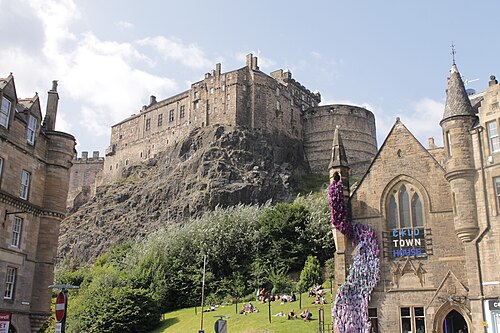 Edinburgh CastleRestored · prime 1520
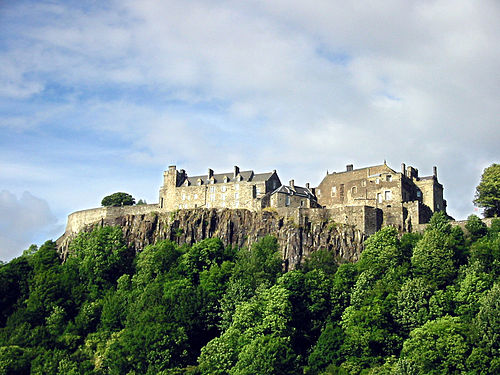 Stirling CastleRestored · prime 1542
 Glamis CastleStill standing · prime 1900
All castles in Scotland → · Strongest castles in Scotland → · Castles of Europe
Play As Your Clan
Hold a real castle against whatever you choose to send at it, take a ship out in her own service years, or stand at the shoulder of someone the record remembers. The chronicler sets the scene; the deeds are yours.
Notable bearers of the Anderson name
- Sir John Anderson, 1st Viscount Waverley (1882–1958), Lord Privy Seal, civil-defence reformer
- John Anderson (1726–1796), professor, founder of the University of Strathclyde
- John Macvicar Anderson (1835–1915), architect
- Lin-Manuel Miranda's grandmother was an Anderson of Scottish descent