Clan Armstrong
also Armstrang
Strong-of-arm, the most feared of the Border riding clans.
- Origin
- The Borders, Scotland
- Motto
- Invictus maneo
- Famous bearer
- Johnnie Armstrong of Gilnockie (d.1530), Border reiver chief, hanged at Carlanrig
- Register
- Scottish clan
The Armstrong arms, crest badge, tartan and country

Crest badgeClan member crest badge - Clan ArmstrongCeltus · CC BY-SA 3.0 
TartanArmstrong tartanMicheletb · CC BY-SA 4.0 
TartanArmstrong tartan (Vestiarium Scoticum)As printed in the Vestiarium Scoticum, 1842, a collection whose claimed medieval source was never produced, and which is now generally held to be a forgery. Families adopted its patterns anyway, and wear them still.TilmannR · CC0 
Coat of armsArmstrong of Mangerton armsBorne by the Mangerton line, one branch of the name rather than all of it.Czar Brodie · CC BY-SA 3.0


.svg)

- Crest badge: The chief's crest inside a belt and buckle: the badge a clansman wears to show whose following he is in.
- Tartan: The checked cloth the family is known by.
- Coat of arms: Granted to an individual and inherited down that one documented line. These are the arms of particular families of the name, not of everyone who shares the surname.
What is the Armstrong clan tartan?
Two Armstrong setts are shown above, one of them the plate printed in the Vestiarium Scoticum in 1842. They are not rival claims to be picked between; they are different records, and different weaves, of the same family cloth. A sett is the block of coloured bands the cloth is built from, repeated in both directions; the whole plaid is that one square enlarged.
Border families did not wear Highland dress, and no proscription touched them. What was worn on the Armstrong ground was the shepherd’s check: the two-colour Border plaid, older than any clan sett and belonging to a district rather than a surname. The Armstrong tartan is a later thing: a Highland-style pattern attached to a Border name in the 19th century, when tartan stopped being Highland and became Scottish. Nobody polices any of it. Wearing the Armstrong sett declares allegiance to the name, not descent from any particular line of it.
CoreHistoric reach
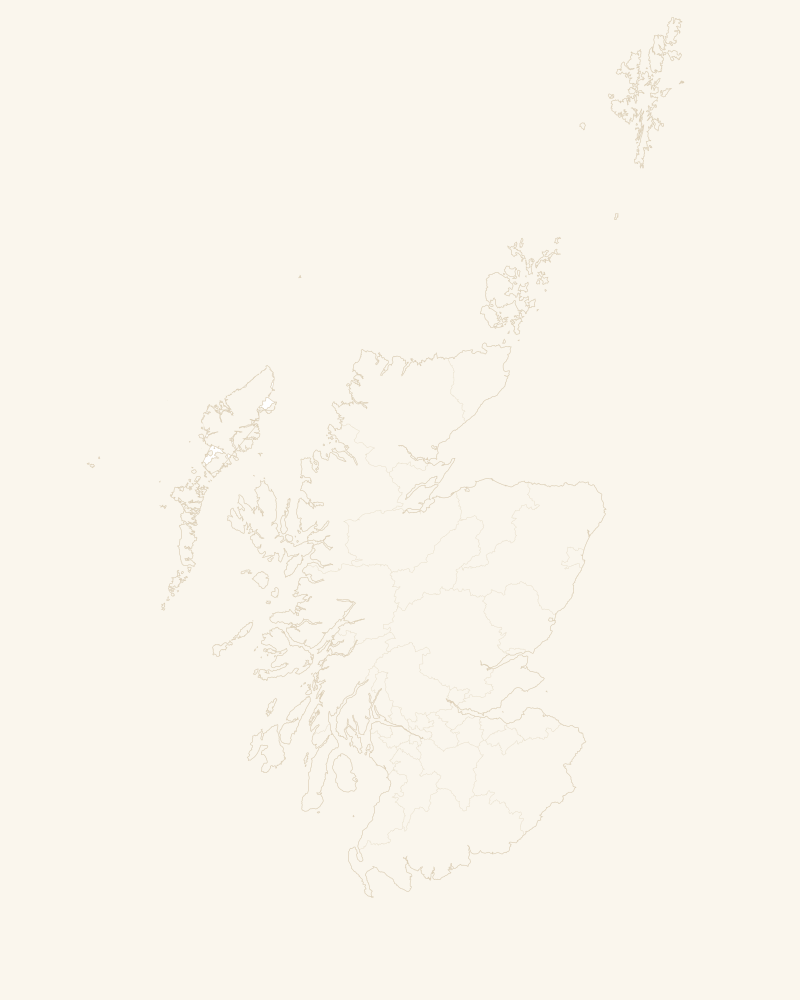
The seat of Clan Armstrong
Seat vacantChief
No one leads the Clan Armstrong community yet. When the movement opens, you can stand for its leadership, or help elect whoever does.
Current mission
No shared goal set yet. Once Clan Armstrong has leadership, it sets the public focus: a restoration, a gathering, a real-world project that helps its own.
The Armstrong clan is being rebuilt. Join the waiting list for the movement today, and you help decide who leads it and what it does.
Help rebuild the Armstrong clan →Motto
Invictus maneo
“I remain unvanquished”
What does the Armstrong name mean?
From the Anglo-Saxon descriptive byname 'Armstrang', strong of arm. Tradition holds the name was conferred on a Northumbrian retainer named Fairbairn who lifted his unhorsed king back into the saddle by main strength; the king, the story goes, granted him lands across the West March and the new name to go with them. The trace history is firmer than the founding legend: the Armstrongs are documented in the Liddesdale by the late 13th century.
The history of Clan Armstrong
Strong of arm, and two founding stories that disagree
The name is a description before it is a family: Armstrang in Scots, from a Middle English nickname for a man with strong arms. Two traditions compete over whose arm it was. One makes the first of the name Siward Beorn, sword warrior, also called Siward Digry, sword strong arm, said to have been the last Anglo-Danish Earl of Northumberland and a nephew of Canute, who reigned in England until 1035. The other has an ancient king of Scotland confer it on Fairbairn, his armour-bearer, who lifted his unhorsed king back into the saddle by main strength. Neither can be documented.
The record is firmer and less flattering. George Fraser Black lists Adam Armstrong in 1235 being pardoned for causing the death of another man. The name was common across Northumbria and the Scottish Borders, and the Armstrongs are documented in Liddesdale by the late 13th century. It is a frontier name, not a Gaelic one, though Gilnockie itself is Geal Cnocan, little white hill.
The crown's men before they were the crown's problem
In the fourteenth century the family's dealings with the crown were far more straightforward than they later became. By tradition the Armstrongs followed Robert the Bruce, and Alexander Armstrong, second laird of Mangerton, was imprisoned and killed by the anti-Bruce conspirator William de Soulis at Hermitage Castle in Liddesdale; the Minholm Cross near Mangerton was raised in about 1320 to commemorate the murder. The oldest Armstrong monument in the country marks a killing, which is fair warning about the ground the family chose.
Service followed. Gilbert Armstrong was steward of the household of David II, Master of the Horse, and ambassador to England in 1363. John Armstrong fought in the army of James, second Earl Douglas, at Otterburn in 1388, and in 1398 Alexander, David and Geoffrey Armstrong signed as borowis, sureties, for the third Earl of Douglas, pledging that the peace of the border would be kept. The name began by standing surety for the frontier rather than raiding it.
The Debatable Land, and three thousand horse
The Armstrongs held Liddesdale and the Debatable Land, the strip between the kingdoms that neither crown could make good a claim to, ungovernable for two and a half centuries until the Union of the Crowns. Mangerton Tower, a mile south of what is now Newcastleton, was the seat of the lairds. The tower at Hollows above the Esk went up about 1518 to 1520 for Johnnie Armstrong, a younger brother of Thomas Armstrong of Mangerton; it is the building the world now knows as Gilnockie.
What they did there should not be dressed up. They were cattle thieves. Johnnie Armstrong took blackmail, in the proper Border sense, from English gentlemen in Cumberland, and his receipts were honoured; the operation ran from Carlisle to Dumfries, and the family could put three thousand horsemen in the saddle. In 1528 Dacre, the English Warden of the Marches, burned the tower at Hollows, and the Armstrongs retaliated by burning Netherby.
Some proportion is owed them. Their depredations never matched the feuds run by the crown's own officers: the Johnstones and the Maxwells, successive Wardens of the West March, fought the Battle of Dryfe Sands with hundreds dead. What made the Armstrong name intolerable was not the body count but that through the sixteenth century they acknowledged neither crown.
Carlanrig, 1530: a safe conduct that was bait
James V was eighteen in the summer of 1530, newly out of his minority and out of the keeping of the Douglases, and intent on showing the West March that the crown's writ ran there. He sent a king's letter of safe conduct to Johnnie Armstrong of Gilnockie, inviting him to a royal hunt at Carlanrig in Teviothead. Armstrong read it as a Border man reads such a paper, an offer of accommodation, and rode to it as if to court: in livery, thirty-six of his best riders behind him, silver-mounted bridles on the horses. The king's officers took them as they dismounted.
Forty-eight Armstrongs were hanged from the trees at Carlanrig that afternoon. The accounts do not agree in every detail (some put the followers at fifty, and one tradition sets the meeting at Hawick rather than Carlanrig), but the nature of the thing is not in dispute. The safe conduct was the bait and not the bond. The graves are still marked at the kirk above the Teviot.
The afternoon broke the political weight of the clan but left the riding tradition where it was: reiving went on for another seventy years. The crown's animus continued when the Armstrongs failed to support James V at Solway Moss in 1542. What survived best was the ballad: Johnie Armstrang, sung between Carlisle and Edinburgh long before Allan Ramsay collected it in 1724 and Walter Scott set it in the Minstrelsy of the Scottish Border in 1802.
Kinmont Willie, and the raid on Carlisle in 1596
From the mid-thirteenth century until 1603 Carlisle Castle was the headquarters of the Western March, and reckoned impregnable. In 1596 it held William Armstrong of Kinmont (Kinmont Willie), and Sir Walter Scott of Buccleuch, Keeper of Liddesdale, whose vassal he was, broke into the fortress and took him out. The Buccleuch side is told on the Scott page here; the Armstrong side is usually left out. The most retold exploit on the entire frontier was mounted to get an Armstrong out of an English royal castle, and it worked.
Kinmont Willie was somebody's man, and that corrects the idea of the riding surnames as free companies. The Border ran on bonds of service and kinship as much as on feud, and an Armstrong of the Debatable Land could be at once a thief to Carlisle, a vassal to a Scott, and a tenant worth a laird's neck to recover. By then the name was political shorthand: James VI kept a jester called Archie Armstrong, named in mockery of the family's last laird.
The Middle Shires, and the scattering to Ulster
The Union of the Crowns in 1603 ended the Anglo-Scottish Wars of the Borders and the clan's independence in one stroke. James VI renamed the frontier the Middle Shires and cleared it systematically: mass executions, transportation to Ireland, conscription into the Continental wars. In 1610 the clan leader Archibald Armstrong was hanged in Edinburgh in reprisal for a raid on Penrith. Families scattered into Northumbria and above all into Ulster, particularly County Fermanagh, where the Plantation absorbed them; Armstrong is now among the fifty most common names there.
Ulster complicates the ancestry in a way worth knowing. In Ireland the name was also adopted as an anglicisation of Gaelic names: Mac Thréinfhir, son of the strong man, and Ó Labhraidh Tréan, strong O'Lavery. After the Plantation many Armstrongs, mainly Catholic ones, went the other way and adopted Traynor, surviving today as Traynor, Trainor, Treanor and McCreanor. An Ulster Armstrong may descend from a Liddesdale rider or from a Gaelic family whose name was translated across, and the spelling alone will not tell you which.
The dispersal turned reivers into soldiers. Armstrongs served as officers in the royalist armies of Charles I, and Robert Armstrong lies buried at St Olave in York among the royalist dead. Sir Thomas Armstrong settled in Ireland in 1639, sat in the Dublin parliament and fought under the Earls of Ormonde and Inchiquin; he and his sons spent the next decade conspiring against the Cromwellian Protectorate. William Armstrong, called Christie's Will, was perhaps the last of the famous Border freebooters. There has been no trace of the Armstrong chiefs since the dispersal, and the name has carried on without one ever since.
Hollows Tower restored, and a Border name on the Moon
The name did well without a chief. Dr Robert Armstrong of Perthshire compiled an authoritative early Gaelic-English dictionary, published in 1825, and Sir Alexander Armstrong went to the Arctic as an explorer. Lord Armstrong bought and restored Bamburgh Castle in Northumberland in 1894, and the family holds it still. Edwin Howard Armstrong, the inventor of FM radio, is a descendant, and the Armstrong Baronets descend from Gilnockie itself.
The stone came back too. By 1978 Hollows Tower was a roofless ruin; it was bought that year by Major T. C. R. Armstrong-Wilson and restored in consultation with the Ancient Monuments division; it is now Category A listed. It closed again in January 2015 for a fuller restoration and reopened on 1 April 2018 as Gilnockie Tower and the Clan Armstrong Centre. The Clan Armstrong Trust was founded the same year the tower was bought.
Neil Armstrong (1930–2012) came of a Borders Armstrong line that emigrated to Pennsylvania in the 1730s, and carried a piece of the Clan Armstrong tartan with him when he became the first man to walk on the Moon. As of 1969 Armstrong was the 171st most prevalent surname in the United States; in Britain and Ireland it is thickest in North East England, Cumbria, the Scottish Borders, Dumfries and Galloway and Northern Ireland, still gathered round the frontier that made it. The motto is Invictus maneo, I remain unvanquished, and for a family hanged from its own trees, transported and left four hundred years without a chief, it has proved accurate.
Champions of the Armstrong name
The bearers whose lives are inseparable from this surname. Each has their own page, biography, achievements, geography, connection to the family.
Castles the Armstrong held
Strongholds this name held for a decade or more, look one up, or rebuild it to explore.
- Bamburgh Castle
Bought and restored by Lord Armstrong in 1894; held by the family still.
- Gilnockie Tower
Internationally recognised as the ancestral home of the Armstrong Clan; since 2018 it has housed the Clan Armstrong Centre and museum.
- Mangerton Tower
Seat of the Armstrong Lairds of Mangerton; Johnnie Armstrong, brother of Laird Thomas, was hanged by James V in 1530.
The castles of the homeland
The great strongholds of the homeland, look one up, see what it looked like in its prime, and recreate it to explore.
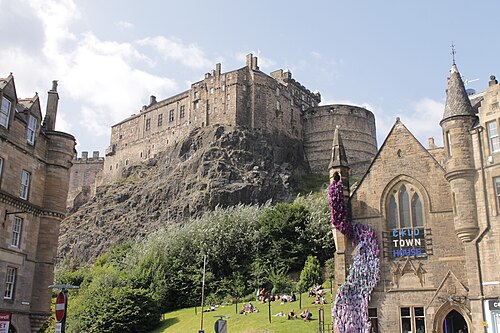 Edinburgh CastleRestored · prime 1520
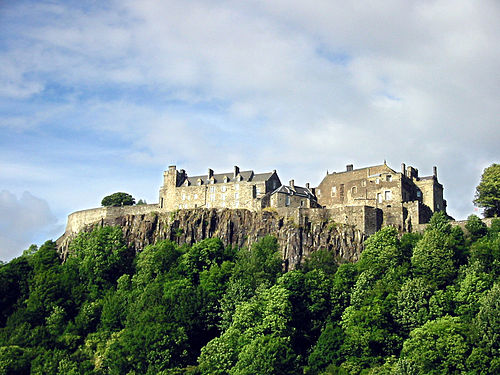 Stirling CastleRestored · prime 1542
 Glamis CastleStill standing · prime 1900
All castles in Scotland → · Strongest castles in Scotland → · Castles of Europe
Play As Your Clan
Hold a real castle against whatever you choose to send at it, take a ship out in her own service years, or stand at the shoulder of someone the record remembers. The chronicler sets the scene; the deeds are yours.
Notable bearers of the Armstrong name
- Johnnie Armstrong of Gilnockie (d.1530), Border reiver chief, hanged at Carlanrig
- Neil Armstrong (1930–2012), first man on the Moon
Stories of Clan Armstrong
Frequently asked
What does the surname Armstrong mean?
Where does the Armstrong family come from?
Where did the Armstrong family historically hold territory?
Is Armstrong Scottish or Irish?
How old is the Armstrong surname?
What is the Armstrong family known for?
What is the Armstrong motto?
What does "Invictus maneo" mean in English?
Is there a Armstrong family crest or coat of arms?
What is the Armstrong clan tartan?
Who is the most famous Armstrong?
Who are some famous Armstrongs?
What stories are told about the Armstrong family?
What is the story of the hanging at Carlanrig?
Is Armstrang the same family as Armstrong?
Where is the Armstrong surname found today?
What does the Clan Rising page for the Armstrong family cover?
Who is the head of the Armstrong family today?
A note from the editors
- Cross-border with England: the Armstrongs spilled into Cumberland and Northumbria. The England catalogue will surface this entry alongside the Scottish home.