Marshall
The stable office, court rank, surname for thousands.
- Origin
- South East, England
- Famous bearer
- George C. Marshall (1880–1959), American General of the Army; US Army Chief of Staff in WW2; US Secretary of State 1947–49; architect of the European Recovery Program (Marshall Plan); Nobel Peace Prize 1953
- Register
- English family
Where the Marshall name comes from
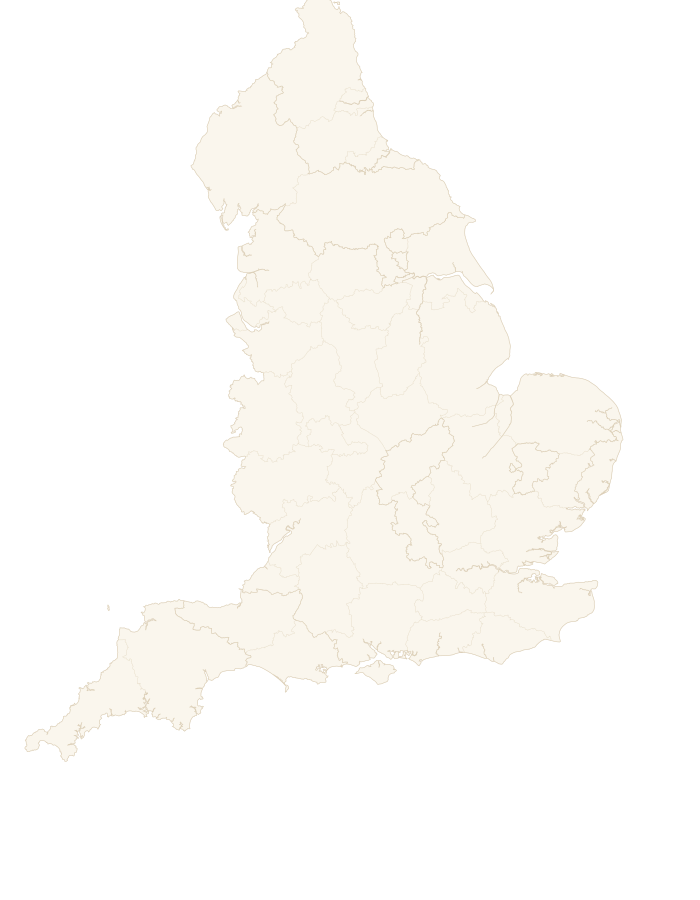
CoreHistoric reach
The seat of Marshall
Seat vacantChief
No one leads the Marshall community yet. When the movement opens, you can stand for its leadership, or help elect whoever does.
Current mission
No shared goal set yet. Once Marshall has leadership, it sets the public focus: a restoration, a gathering, a real-world project that helps its own.
The Marshall clan is being rebuilt. Join the waiting list for the movement today, and you help decide who leads it and what it does.
Help rebuild the Marshall clan →What does the Marshall name mean?
Occupational, horse-servant, royal marshal. Normanmareschal.
The history of Marshall
The horse servant behind the word
Marshall is the Middle English mareshal, and it meant what it said: a groom, or a farrier, the servant who had charge of horses. It came into English from the Old French mareschal, written in Latin as mariscalcus, and behind that stands the Old Frankish marskalk, a compound of marha, a horse, and skalk, a servant. French kept the plain sense: a farrier there is still a maréchal-ferrant.
The climb had happened once before, in Latin. The late Roman and Byzantine comes stabuli, count of the stables, became the Old French conestable and then the English constable, so two of the words a reader files under law and order both began at the stable door. As marshals became trusted members of the courts of medieval Europe, the title grew in reputation, and it went on to name the highest ranks in Europe's armies.
What the work was, from mews to muster
In a royal household the marshal's office ran the king's mews, the king's hostlers and the king's household troops, and was paid by fee in cash rather than in land. It was a court rank, not a magnate one: a family could hold it for generations with no acre attached, and rose or fell with the temper of the man it served. The war-horse was the point, shod and kept sound. He also set the lists at a tournament.
Below the court, every lord of standing kept a marshal, and boroughs used the word for the officer who stopped a fair turning into a riot. What horseflesh was worth shows in the twelfth-century tournament, a paying spectator sport in which two teams of forty or fifty armed knights fought a cavalry battle across open ground; losers were captured and ransomed, winners took their prisoners' horses and arms. A knight's mounts were his working capital, and the marshal kept the capital alive.
From the stable door to a Great Office of State
In England the hereditary title of marshal designated the head of household security for the king, and it climbed until the hereditary Marshal was the Earl Marshal, one of the Great Officers of State, and the officer who regulates heraldry in England, work that in Scotland belongs to the Lord Lyon King of Arms. One word covered the boy mucking out a stall and a man ranking among the highest officers of the crown.
The policing half was split away. The office of Knight Marshal was established in 1236 to keep order within the king's court, and he and the King's Marshalmen held powers of arrest within twelve miles of the sovereign's palace until the office was abolished in 1846. In 1595 Elizabeth I gave a marshal letters patent to maintain order within the City of London, assisted by an under-marshal and six city marshalmen; the post survives, leading the Lord Mayor's processions.
Why the byname stuck in a thousand halls at once
The introduction of family names in England is generally dated to the Domesday Book of 1086, after the Norman Conquest. They were taken up first among the nobility and gentry and spread slowly downward; by the fourteenth century most English and Scottish people used one. The Conquest supplied the word too: Anglo-Norman was the language of the ruling classes, so the French mareschal was what got written down about the man in the stable.
Because every hall, abbey and borough had a marshal, the byname was coined independently in scores of places, and Marshalls are routinely unrelated to one another: two Marshalls in a county's rolls are two households that each employed a marshal, not two branches of a line. Marshall runs thickest across the English south and east, from Kent and Sussex through the Thames valley to Norfolk, Suffolk and the Cambridgeshire fens.
The office the surname outgrew
The office kept rising in places where nobody of the name held it. In Scotland the Marischal was held heritably by the Keith family from Hervey de Keith, marischal under Malcolm IV and William I; Sir Robert de Keith, who died in 1332, was confirmed as Great Marischal by Robert Bruce about 1324, and his great-grandson William was made Earl Marischal by James II about 1458. The Marischal guarded the Royal Regalia of Scotland, which the 7th Earl hid at Dunnottar Castle during the Wars of the Three Kingdoms. These men were Keiths holding the office, not Marshalls.
France took the word further. The maréchal ranked second only to the connétable, commander-in-chief of the royal armed forces. The mounted corps founded as the Connétablie in 1337 became the Maréchaussée in 1627, when the constable's office was abolished; it wore uniforms like the dragoons and existed to clear highwaymen off the roads. It numbered 3,660 men in 1789 and became the Gendarmerie Nationale by the law of 16 February 1791.
A Marshal of France carries a baton inscribed Terror belli, decus pacis, terror in war, ornament in peace. The Royal Air Force still ranks air marshals, and the United States appoints one to each of its ninety-four federal judicial districts. That is how far a stable-hand's job title travelled.
The fourth son led out to the gallows
William Marshal was born about 1146, fourth son of John FitzGilbert the Marshal, hereditary marshal of the royal household under King Stephen. He was about five in 1152 when his father garrisoned Newbury Castle against Stephen's siege army and handed him over as a hostage to guarantee a truce. His father then used the truce to reprovision the castle rather than surrender, and Stephen's troops marched the child out to the gallows below the walls in reprisal. Stephen could not do it, kept him at the king's table for the rest of the siege and returned him when the war ended.
He went at thirteen to his cousin William de Tancarville, Chamberlain of Normandy, was knighted in 1166, and joined the tournament circuit of northern France about 1170. Through that decade he was the most successful jousting knight in Europe: the Histoire records a hundred and three knights taken prisoner at the single tournament of Pleurs in 1177. He gave the proceeds to his retainers and put it back into horseflesh.
Henry II made him tutor-at-arms to Henry the Young King in 1170. Richard I put him on the Council of Regents during the Third Crusade and gave him Isabel de Clare, heiress of Richard Strongbow, in marriage in 1189, turning a landless household knight of forty-three into Earl of Pembroke and Striguil and lord of Leinster. He witnessed Magna Carta at Runnymede on 15 June 1215 as one of its twenty-five named guarantors.
John died at Newark on 19 October 1216 with a French army holding the eastern half of England and a nine-year-old heir. The boy was brought to Gloucester for an emergency coronation on 28 October, with a plain gold circlet because the regalia had been lost in the Wash, and Marshal carried him from the abbey door to the throne. Next morning the prelates and loyalist barons chose him Rector regis et regni, regent of king and kingdom, and in November he confirmed Magna Carta in the child's name, turning a baronial peace treaty into a foundation of the English constitution.
Then he fought one more battle. The decisive engagement was at Lincoln on 20 May 1217: at seventy he led the relief column up from Newark himself, refused to wait for reinforcements, charged the French and rebel army inside the city walls and broke them in a four-hour street fight. The Treaty of Lambeth that September confirmed Henry III's crown. He died at Caversham on 14 May 1219 and lies in the Temple Church on the Strand, where his effigy in armour still rests in the round nave. Stephen Langton preached that he was the greatest knight that has ever been.
Cardigan Castle in Ceredigion was held for William Marshall. Llywelyn the Great captured it in 1215 and made it over to the sons of Gruffydd ap Rhys of Deheubarth in 1216; a second William Marshall, styled the Younger in the record, recaptured it in 1223. Llywelyn held it again until his death in 1240, and Earl Gilbert of Pembroke rebuilt it with town walls in 1244.
The Bermondsey cashier's son who rebuilt economics
Alfred Marshall was born at Bermondsey on the south bank of the Thames on 26 July 1842, second son of a Bank of England cashier. He won an entrance scholarship to St John's College, Cambridge in 1861 to read mathematics, on his own initiative and against his father's plan of the church, and came out in 1865 as Second Wrangler and a fellow of the college. By 1868 he had worked through metaphysics and John Stuart Mill to the conclusion that the questions he cared about were better answered by the technical study of economic life.
What he built is what every student still meets in the first week: the supply-and-demand diagram, price elasticity of demand, consumer surplus, the short run and the long run, ceteris paribus analysis. Principles of Economics appeared in July 1890 and ran through eight editions in thirty years. He held the chair of political economy at Bristol from 1877 and returned to Cambridge as professor in 1885, founding the tripos in economics and politics in 1903 and teaching the generation that ran British economics after him: John Maynard Keynes, Arthur Cecil Pigou, Dennis Robertson. He died at Cambridge on 13 July 1924.
Marshalls of the modern record
The name that began in the stable has carried formidable careers, joined by nothing but the word. George C. Marshall (1880–1959) was General of the Army and United States Army Chief of Staff through the Second World War, then Secretary of State from 1947 to 1949 and the architect of the European Recovery Program that took his name, for which he was awarded the Nobel Peace Prize in 1953. John Marshall (1755–1835) was the fourth Chief Justice of the United States, and Barry Marshall, born in 1951, is the Australian physician and Nobel laureate known for the work on stomach ulcers.
The name recurs in science and letters on both sides of the Atlantic. Humphry Marshall (1722–1801) was an American botanist, Guy Anstruther Knox Marshall (1871–1959) a British entomologist born in India, Mary Paley Marshall (1850–1944) a British economist, and P. J. Marshall (1933–2025) a British historian. Elizabeth Marshall (1768–1836) was an American businesswoman and pharmacist, and Marian Sutton Marshall (1846–1901) an English typist and trade unionist.
English has a long habit of taking the surnames of notable families and using them as given names, a practice that began as a way of signalling political support or patronage. Marshall went through that door too, and the rolls now carry men given the name at the font as well as those who inherited it from a groom who kept somebody's horses.
Champions of the Marshall name
The bearers whose lives are inseparable from this surname. Each has their own page, biography, achievements, geography, connection to the family.
- William Marshal
The landless knight who became the most celebrated soldier of his century, served five English kings, witnessed Magna Carta, and as Regent for the boy Henry III won the war that saved the English crown.
- Alfred Marshall
The Bermondsey bank cashier's son who wrote Principles of Economics in 1890, founded the Cambridge economics tripos, and turned political economy into the technical discipline it has been since.
Historic Places, Rebuilt
Explore the streets and seats the Marshall name knew, rebuilt with AI as they stood in history.
Castles the Marshall held
Strongholds this name held for a decade or more, look one up, or rebuild it to explore.
- Cardigan Castle
Held for William Marshall; recaptured by William Marshall the Younger in 1223, and rebuilt with town walls by Earl Gilbert of Pembroke in 1244.
The castles of the homeland
The great strongholds of the homeland, look one up, see what it looked like in its prime, and recreate it to explore.
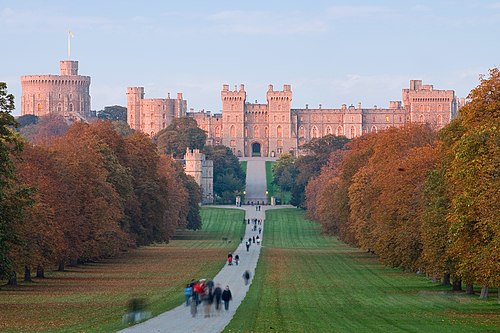 Windsor CastleRestored · prime 1820
 Tower of LondonRestored · prime 1285
 Bamburgh CastleRestored · prime 1904
All castles in England → · Strongest castles in England → · Castles of Europe
Play As Your Clan
Hold a real castle against whatever you choose to send at it, take a ship out in her own service years, or stand at the shoulder of someone the record remembers. The chronicler sets the scene; the deeds are yours.
Notable bearers of the Marshall name
- George C. Marshall (1880–1959), American General of the Army; US Army Chief of Staff in WW2; US Secretary of State 1947–49; architect of the European Recovery Program (Marshall Plan); Nobel Peace Prize 1953