Russell
Norman nickname for the red-haired; Dukes of Bedford and ten thousand leaseholds.
- Origin
- East of England, England
- Motto
- Che sara sara
- Famous bearer
- Lord William Russell (1639–1683), Whig MP, executed for the Rye House Plot
- Register
- English family
The Russell arms and country

Coat of armsCoat of Arms of Earl RussellBorne by Earl Russell: the ennobled line of the name, not the name at large.Tinynanorobots · CC BY-SA 3.0 
Coat of armsArms of Russell, Duke of BedfordBorne by the Duke of Bedford: the ennobled line of the name, not the name at large.Jonas Magnus Lystad · CC BY-SA 4.0


- Coat of arms: Granted to an individual and inherited down that one documented line. These are the arms of particular families of the name, not of everyone who shares the surname.
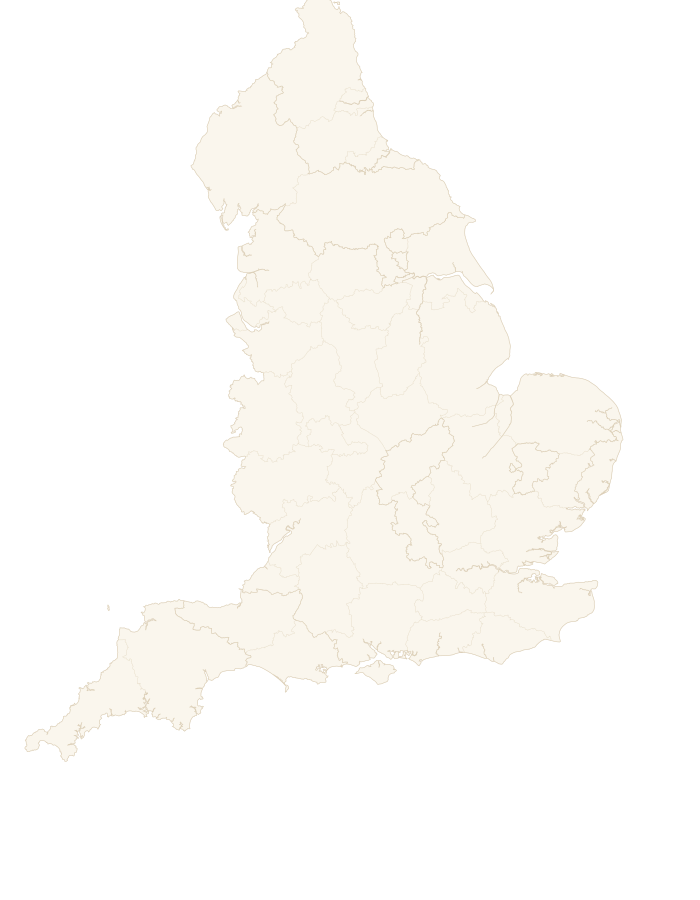
CoreHistoric reach
The seat of Russell
Seat vacantChief
No one leads the Russell community yet. When the movement opens, you can stand for its leadership, or help elect whoever does.
Current mission
No shared goal set yet. Once Russell has leadership, it sets the public focus: a restoration, a gathering, a real-world project that helps its own.
The Russell clan is being rebuilt. Join the waiting list for the movement today, and you help decide who leads it and what it does.
Help rebuild the Russell clan →Motto
Che sara sara
“What will be, will be”
What does the Russell name mean?
Norman nickname, Old French rous, red-haired or ruddy. The great aristocratic line is Dorset; ten thousand Russell leaseholds are not.
The history of Russell
The little red one
Russell is a nickname, and the nickname is a colour. In the Latin of English record it is written Rosellus, and the man it was written against had red hair. Behind it is the Norman-French rus (Old French ros, Modern French roux), red, with the diminutive ending -el: not the red man but the little red one, the half-affectionate tag a village hangs on a man and never takes off. The same word served as an archaic name for the red fox, and it is traced back beyond French to Old Norse rossel, red-haired, a Norse layer under the French one, in a word that reached England through Normandy.
It survives in the spellings a family historian meets in the parish books: Rosel, Rousel, Roussel, Russel, Rossell. Latin produced Rufus for the same trait, so one red-haired man might be Rosellus in one document and Rufus in another.
That is the thing flattering accounts skip. A descriptive byname belongs to one man. It says nothing about his father and promises nothing to his sons, and when it hardened into a surname it passed to children who may have been dark as peat.
Kingston Russel, Rosel in Calvados, and a demolished pedigree
The origin has been genuinely disputed, and the dispute is worth telling straight because the losing side is the one that flatters. Early genealogists traced the Russel or Russell family of Kingston Russel in Dorset to Anglo-Norman landholders bearing a toponymic surname, de Rosel or du Rozel, from Rosel in Calvados (not, as has also been claimed, from Le Rozel in Manche). On that reading the name means a place, an estate, a lordship.
The antiquary J. Horace Round took those pedigrees apart. They had, he observed, erroneously linked men bearing the toponymic to unrelated men who bore something quite different: the nickname rus[s]el, the red one. There is, he concluded, no reason to suppose that the surname Russell was territorial at all. The dictionaries have followed him. The grander story is still in print; only one of the two survived being checked.
Why a nickname had to become a name
The machinery that turned rousel into Russell was installed by the Conquest. The invasion of 1066 killed Harold at Hastings and by 1072 had secured the throne; the lands of the resisting English elite were confiscated and granted to William's followers, some 8,000 Norman landholders by the historians' estimate, a thin layer over a large native population. A dialect of French became the language of the elites and Latin replaced Old English in documents. That is how a French colour-word came to be pinned to a man in an English village.
Surnames then were not yet surnames. The introduction of family names in England is generally credited to the preparation of the Domesday Book in 1086, but they were formed from whatever distinguished the individual (trade, father, birthplace, looks) and were not necessarily inherited. By the 14th century most English and Scottish people used surnames, and by 1400 most English and Lowland Scots families had made them hereditary.
Why a village needed such tags is arithmetic. Of boys born in London in 1510, 24.4 per cent were christened John, 13.3 per cent Thomas and 11.7 per cent William. With four Johns in a parish you needed not a lineage but a distinguishing word, and the red-haired John got one. So there is no single ancestral Russell, only many unrelated men who were the red one in their own parish.
Berwick-Russell to Bedford: the Tudor fortune
One line did far more than the rest. The Russell ducal house, Earls and later Dukes of Bedford, traces to John Russell of Berwick-Russell in Dorset, raised to a barony by Henry VIII in 1539 and to the earldom of Bedford in 1550. Read those dates for what they are. They fall in the years when the Crown had broken up the religious houses and was handing monastic land to laymen who had served it, and a fortune built in that decade was built out of that redistribution. The seat at Woburn in Bedfordshire, held by the Dukes ever since, is still called Woburn Abbey: the word abbey in the name of a ducal house is not decoration, it is a receipt.
The estate then grew as Tudor and Stuart estates grew, by lease and by building. Francis Russell, 2nd Earl of Bedford, leased The More in Hertfordshire from 1576, and the 3rd Earl built a new house inside its deer park around 1617. The women of the house were at court throughout: Anne Russell, Countess of Warwick (1548 or 1549 to 1604), lady-in-waiting to Elizabeth I, and Lucy Russell, Countess of Bedford (1580 to 1627), a great literary patron of the Jacobean age.
Lincoln's Inn Fields, 21 July 1683
What made the Russells a political name rather than merely a rich one was an execution. William Russell, Lord Russell (1639 to 1683), eldest surviving son of the 5th Earl of Bedford and MP for Bedfordshire, led the parliamentary opposition to the succession of James, Duke of York, an open Catholic, to a Protestant throne. In June 1683 a group of hotter Whigs discussed ambushing Charles II and James on the road back from Newmarket at the Rye House in Hertfordshire. Russell was not at those meetings. He was convicted of high treason on 13 July on the evidence of the perjured informer Lord Howard of Escrick, and beheaded in Lincoln's Inn Fields on 21 July.
His widow Rachel Russell (c. 1636 to 1723) had taken the notes in the gallery on which his defence was built and petitioned the King in person; she refused remarriage and left 712 surviving letters, printed by her great-grandson in 1773. In 1689 the Convention Parliament reversed the attainder as contrary to law and restored the lands; in 1694 King William raised the Earl of Bedford to the dukedom, the patent reciting that the honour was given in memory of the son.
The Whig century and the Reform Bill
The house spent the next two centuries in the front rank of Whig politics. John Russell, 4th Duke of Bedford (1710 to 1771), served as Secretary of State; the 6th Duke was Lord Lieutenant of Ireland; Anna Russell, Duchess of Bedford (1783 to 1857), was Lady of the Bedchamber to Queen Victoria; Odo Russell, 1st Baron Ampthill (1829 to 1884), took the family into diplomacy.
The greatest was Lord John Russell, 1st Earl Russell (1792 to 1878). He carried the repeal of the Test and Corporation Acts in 1828, drafted and managed through the Commons the Reform Act of 1832, framed the Municipal Corporations Act of 1835, and was twice Prime Minister, 1846 to 1852 and 1865 to 1866, the central architect of the mid-Victorian constitutional reform programme.
Lord John's grandson was Bertrand Russell (1872 to 1970), born in Monmouthshire and raised at Pembroke Lodge after both parents died before he was four. With A. N. Whitehead he produced the three volumes of Principia Mathematica between 1910 and 1913, setting mathematical logic on its modern footing; the Nobel Prize in Literature followed in 1950. On 9 July 1955, aged eighty-three, he read out the Russell-Einstein Manifesto, signed by Einstein on 11 April, four days before the collapse that killed him; it led to the Pugwash Conferences of 1957 and their Nobel Peace Prize in 1995.
The other Russells: Scotland, Ireland and ten thousand leaseholds
The great line is Dorset in origin and Bedfordshire in seat. Ten thousand Russell leaseholds are not, and a reader should not assume a connection the evidence does not carry. A second and separate fortune was made in commerce: the banker William Russell acquired Brancepeth Castle in County Durham in 1796, and Matthew Russell rebuilt it on a grand scale in the early 19th century. In Scotland the name reaches back at least to Mungo Russell, the textile merchant and paper entrepreneur who died in 1591, and Banff Castle later passed into Russell hands.
The bearers refuse to be one story. Sean Russell (1893 to 1940) was an Irish republican; Micho Russell (1915 to 1994) a Clare musician; Moses Russell (1888 to 1946) a Welsh international footballer; Finn Russell, born 1992, a Scottish rugby international. None of them is a Duke of Bedford. All of them are Russells.
The motto is Che sara sara, what will be, will be, which for a house that took its land from a dissolution and its dukedom from a scaffold is either fatalism or very dry humour. For everyone else carrying the name the meaning is older and simpler. Behind it stands a man nobody could tell from the other Johns in his village until somebody looked at his hair and called him the little red one, and the word stuck to his children, and then to yours.
Champions of the Russell name
The bearers whose lives are inseparable from this surname. Each has their own page, biography, achievements, geography, connection to the family.
- Bertrand Russell
The Trellech-born mathematician-philosopher whose three-volume Principia Mathematica (1910 to 1913, co-authored with A. N. Whitehead) set the foundations of mathematical logic on the modern footing, whose A History of Western Philosophy (1945) is the most-read English-language history of philosophy of the twentieth century, and whose 1950 Nobel Prize in Literature honoured the work as the central intellectual platform of the post-war English-speaking world.
- Lord John Russell
The Whig statesman whose drafting and parliamentary management of the Reform Act of 1832, repeal of the Test and Corporation Acts in 1828, framing of the Municipal Corporations Act of 1835, and two Prime Ministerships (1846 to 1852 and 1865 to 1866) made him the central single architect of the long Whig-Liberal constitutional reform programme of the mid-nineteenth-century British state.
Historic Places, Rebuilt
Explore the streets and seats the Russell name knew, rebuilt with AI as they stood in history.
Castles the Russell held
Strongholds this name held for a decade or more, look one up, or rebuild it to explore.
- Brancepeth Castle
Acquired by the banker William Russell in 1796; Matthew Russell rebuilt the castle in the early 19th century.
- The More
Leased by Francis Russell, 2nd Earl of Bedford, from 1576; the 3rd Earl built a new house within the deer park around 1617.
- Banff Castle
Later passed into the hands of the Russells.
Landmarks the Russell held
Palaces, houses and great buildings tied to this name, look one up, or rebuild it to explore.
- Hill of Tara
The Tara estate was inherited by British Prime Minister John Russell in the 19th century.
The castles of the homeland
The great strongholds of the homeland, look one up, see what it looked like in its prime, and recreate it to explore.
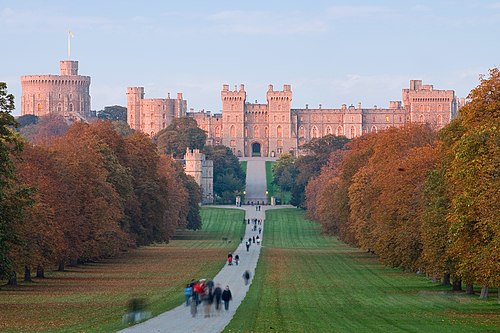 Windsor CastleRestored · prime 1820
 Tower of LondonRestored · prime 1285
 Bamburgh CastleRestored · prime 1904
All castles in England → · Strongest castles in England → · Castles of Europe
Play As Your Clan
Hold a real castle against whatever you choose to send at it, take a ship out in her own service years, or stand at the shoulder of someone the record remembers. The chronicler sets the scene; the deeds are yours.
Notable bearers of the Russell name
- Lord William Russell (1639–1683), Whig MP, executed for the Rye House Plot
- Lord John Russell, 1st Earl Russell (1792–1878), Prime Minister
- Bertrand Russell (1872–1970), philosopher, Nobel laureate 1950
Stories of Russell
Lord William Russell on the scaffold
1683On the morning of the twenty-first of July 1683, on a public scaffold in the open ground of Lincoln's Inn Fields in central London, William Russell, Lord Russell, eldest son of the 5th Earl of Bedford, forty-three years old, Member of Parliament for Bedfordshire, principal organiser of the Whig opposition to the succession of James Duke of York to the Crown, was beheaded for high treason. The charge arose from the Rye House Plot, a Whig conspiracy of June 1683 to ambush Charles II and James on the road back from Newmarket to London at the Rye House in Hertfordshire. Russell had not been at the meetings where the assassination had been discussed, and the Whig defence, before and after the trial, was that he had been concerned only with the parliamentary opposition to the Catholic succession and not with the plot. He was convicted at the King's Bench on the thirteenth of July on the evidence of the perjured informer Lord Howard of Escrick. The execution was politically deliberate: Charles II wished to make a Whig example. The political consequence was the temporary collapse of the Whig opposition through the rest of Charles's reign and the accession of James in 1685. Russell was rehabilitated by Parliament in 1689 after the Glorious Revolution; his attainder was reversed and his family lands restored. The Whig succession movement of the next century, which culminated in Walpole and the political settlement of 1688–1714, was built on the explicit political martyrology of Russell and his fellow Rye House victim Algernon Sidney.
Read the story →
The Russell-Einstein Manifesto
1955At one o'clock on the afternoon of the ninth of July 1955, in the Caxton Hall on the Westminster city-of-London side near the Houses of Parliament, Bertrand Arthur William Russell, third Earl Russell, eighty-three years old, the Trellech-Monmouthshire-born grandson of Lord John Russell (the mid-Victorian Whig Prime Minister, told on this page) and the most internationally recognised philosopher-and-public-intellectual of the twentieth century, gave a press-conference at which he read aloud the Russell-Einstein Manifesto, a eleven-paragraph statement signed by eleven prominent scientific-and-philosophical-figures (including Albert Einstein, who had signed the Manifesto from his Princeton deathbed on the eleventh of April 1955 and died on the eighteenth of April, exactly four days after signing), calling on the governments of the world to acknowledge that the thermonuclear-weapons-revolution had made the traditional war-as-political-instrument doctrine impossible, and to convene a scientific-and-political international-conference to address the existential-risk of thermonuclear-war. The Russell-Einstein Manifesto led directly to the founding of the Pugwash Conferences on Science and World Affairs in 1957 (the first Pugwash Conference was held at the Cyrus Eaton Pugwash, Nova Scotia, family home in July 1957, with Russell as the honorary president); the Pugwash Conferences were awarded the Nobel Peace Prize in 1995. The Manifesto is, by every careful judgment of Cold War intellectual-history (Sandra Ionno Butcher, Joseph Rotblat), the foundational political-philosophical-document of nuclear-disarmament thought.
Read the story →