Clark
also Clarke, Clerk
The clerk, the literate man, when literacy was a profession.
- Origin
- Lothian & Edinburgh, Scotland
- Famous bearer
- James Clerk Maxwell (1831–1879), physicist
- Register
- Scottish family
The Clark arms and country

Coat of armsClark of Kempston EscutcheonBorne by the Kempston Escutcheon line, one branch of the name rather than all of it.Robin S. Taylor · CC BY-SA 4.0 
Coat of armsEscutcheon of the Clark baronets of Dunlambert (1917)Borne by the Dunlambert line, one branch of the name rather than all of it.Charles Matthews · CC BY-SA 4.0

.svg)
- Coat of arms: Granted to an individual and inherited down that one documented line. These are the arms of particular families of the name, not of everyone who shares the surname.
This name is thick on both sides of the border, so the map shows the whole of Britain and Ireland with every region it touches highlighted. It is a regional pattern for the surname, not proof that your branch lived in each place.
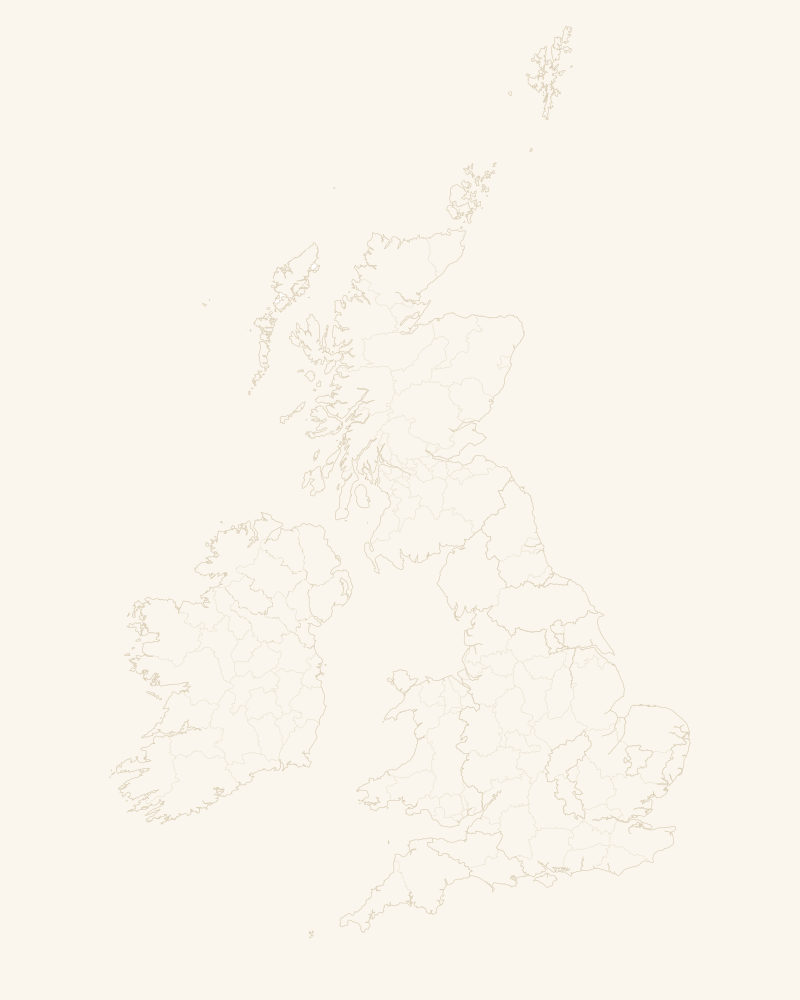
CoreHistoric reach
The seat of Clark
Seat vacantChief
No one leads the Clark community yet. When the movement opens, you can stand for its leadership, or help elect whoever does.
Current mission
No shared goal set yet. Once Clark has leadership, it sets the public focus: a restoration, a gathering, a real-world project that helps its own.
The Clark clan is being rebuilt. Join the waiting list for the movement today, and you help decide who leads it and what it does.
Help rebuild the Clark clan →What does the Clark name mean?
Occupational, the clerk, from Old French clerc, ultimately from Greek klerikos, 'one of the clergy'. In medieval usage 'clerk' meant a literate man, a clergyman, a scribe, a notary, at a time when literacy was largely the church's preserve. Embedded as a hereditary surname across both Scotland and England by the 14th century. The older Scots spelling Clerk persisted into the 19th century in legal record.
The history of Clark
The one man in the parish who could read
Clark is the clerk, and clerk is the Latin clericus, a cleric, itself a latinisation of the Greek klerikos. It reached English through Old French clerc. What turned a churchman's title into a job description was a plain fact of medieval administration: in the courts, writing was entrusted mainly to the clergy, because most laymen could not read. In that setting clerk did not mean priest. It meant scholar, and in practice it meant whoever could be handed a pen.
Literacy was not lying about a medieval village waiting to be picked up. It was a trained skill held by very few, and they were identified by it before anything else. A man was John the clerk in the same breath his neighbour was John the smith, and for the same reason: it was the most useful thing you could say about him. The first records of the surname appear in twelfth-century England.
What a clerk was actually for
The clerk's work was the record. Where a bargain, a judgement or a grant of land had to outlive the memories of the men who made it, someone had to put it into writing, and into Latin. Scottish landholding ran on this. A clan's duthchas, its customary claim to the territory its chief protected, rested on recognition; the oighreachd, the estate as defined by a charter from the Crown or another great landowner, rested on parchment. As heritable succession came to depend on documents, the man who drew and kept them mattered more with every generation.
Court business was the same. Clan disputes were often settled by arbitration, a panel of the leading gentry overseen by the chief, and the decision was then recorded in the local royal or burgh court. The panel argued, the chief presided, and a clerk wrote it down, which is why the argument survives at all. Multiply that by every royal and burgh court, parish and estate and the frequency of the surname stops being a puzzle. In the livery companies of the City of London the clerk is still the chief executive officer.
Secular clergy, and why a churchman's name could be inherited
The clerks who staffed that world were largely secular clergy, which does not mean irreligious. Latin saeculum was the earthly as against the eternal, and by the twelfth century the term marked off priests with parish duties from the regular clergy, the monks bound to the rule of an order. The secular clergy arose to assist the bishop, and the Church's administrative muscle sat among them. That world was reformed hard: the Gregorian Reforms of the eleventh century banned clerical marriage and simony, and in the twelfth century the Western Church made Holy Orders a diriment impediment, so a priest's marriage was not merely forbidden but invalid. A hereditary name descends father to son, so Clark belongs to the lay half of the clerkly world: the court writers and the estate and burgh scribes.
Why the name is everywhere, and why two Clarks are usually strangers
Surnames are documented in eleventh-century England among the barons, and their introduction there is conventionally tied to the preparation of the Domesday Book in 1086; they took hold among the feudal nobility and gentry first, and by 1400 most English families, and those of Lowland Scotland, had hereditary ones. The four-year study led by the University of the West of England that closed in 2016 worked through 45,602 surnames for the Oxford English Dictionary of Family Names in Britain and Ireland, and its leader Richard Coates gave occupational names, Smith and Baker, as the obvious examples of the type.
A name meaning the clerk was coined independently wherever there was one. It did not spread from a single ancestral household but was invented over and over, by people who never met, so two medieval Clarks in one source are not presumed kin and two modern ones almost certainly are not. Clark is the twenty-seventh most common surname in the United Kingdom and fourteenth in Scotland; in the United States it stood thirtieth in the 2010 census, with 562,679 bearers. No family produces those numbers. A job does. In Ireland the spelling is often an anglicisation of O'Cleary or Cleary, and in Scotland the older form Clerk held on in legal record into the nineteenth century.
A trade name in Gaelic Argyll, and how it sticks
Gaelic Scotland shows the same machinery in another language, late enough to be documented in detail: alongside the formal surname ran the far-ainm, the byname, and occupation was one of its commonest sources. Donchadh Clachair, Duncan the stonemason of the Auchindrain township in Argyll, was always given in English as the literal translation, Duncan Stoner. He was not a Clark, and that is the point: his surname was Munro, he was Duncan Munro, and he died in 1937. The trade name sat on top of the surname because the township needed to tell one Duncan from another and did the telling with his work. Clan surnames were themselves applied wholesale to a chief's territory only once a non-Gaelic-speaking administration began writing the inhabitants down.
The sept lists, and what a Clark should believe about tartan
A Clark will sooner or later be told the name is a sept of some clan. Genuine septs were families who followed another chief while keeping their own surname, bound in by marriage, tenancy or a bond of manrent, as the MacMartins of Letterfinlay followed Clan Cameron. The lists sold today are a nineteenth-century product: clan societies and tartan manufacturers linked as many surnames as possible to particular clans whether or not any historical connection existed, making Miller a sept of Clan MacFarlane, Taylor of Clan Cameron and Mason of Clan Sinclair, and leaving a false impression that a common surname has one origin.
The Clark who rehung the National Gallery
Kenneth McKenzie Clark was born in Mayfair on 13 July 1903, the only child of a Paisley cotton-thread heir whose family firm, J & P Coats, was among the largest companies in the United Kingdom. He took a first in modern history at Trinity College, Oxford, in 1925, then spent two years to 1927 at I Tatti outside Florence as assistant to the connoisseur Bernard Berenson, cataloguing Italian Renaissance drawings and learning the attribution tradition. He came home as Keeper of Fine Art at the Ashmolean in 1931, and was offered the directorship of the National Gallery in 1933, at thirty.
The directorship ran eleven years. He rehung the collection on the chronological and national-school principle that has been gallery orthodoxy since, and ran the wartime evacuation: from 1939 the pictures sat out the war in controlled-humidity storage in the Manod slate quarry in north Wales, while the emptied rooms on Trafalgar Square were given over to Myra Hess's lunchtime concerts. He was Surveyor of the King's Pictures from 1934 to 1944 and afterwards chaired the Arts Council of Great Britain. Civilisation, his thirteen-part BBC colour series on the art of western Europe, was first broadcast in 1969, and the book of it sold over a million copies in six years. He was knighted in 1938, given the Order of Merit in 1976, made Baron Clark of Saltwood in 1969, and died at Saltwood on 21 May 1983.
Saltwood, and the Clerk spelling in the Scottish record
Saltwood Castle in Kent, which Clark bought in 1953, had a long history behind it before any Clark came near it, and none of that is Clark history. Its manor was granted to the priory of Christ Church, Canterbury, by a deed dated 1026; after the Conquest Archbishop Lanfranc appropriated the castle, and it remained the archbishops' property until 1540, when Thomas Cranmer was compelled to cede it to Henry VIII. An earthquake on 6 April 1580 left it uninhabitable, and restorations of the 1880s and 1930s made it habitable again. It became the home of Clark's son, the Conservative politician and author Alan Clark (1928–1999), and remains the home of Alan's widow, Jane Clark.
In Scotland the older spelling carried the most consequential bearer of all. James Clerk Maxwell (1831–1879), of Edinburgh, whose family took the Maxwell name by descent from the Maxwells of Middlebie, published A Dynamical Theory of the Electromagnetic Field in 1865, drawing electricity, magnetism and light into a single set of equations and laying the ground for relativity and quantum mechanics. The Clerk in his name is not a middle name: it is the Scots legal-record form of this surname, still in use in the century he was born in.
The rest of the roll is unrelated people sharing a job title. Scotland gave Gavin Brown Clark (1846–1930), MP for Caithness; the railway engineer Daniel Kinnear Clark (1822–1896); the businessman Arnold Clark (1927–2017); and Alistair Clark, Lord Clark, a senator of the College of Justice, a clerk's name returned to the bench. Jim Clark (1936–1968) took the Formula One world championship in 1963 and 1965 and won the Indianapolis 500 in 1965, a day told on this site as its own story. Abroad: Abraham Clark (1725–1794) of the American Revolution; Jonas Gilman Clark (1815–1900), founder of Clark University; the suffragist and historian Alice Clark (1874–1934); the Australian historian Manning Clark (1915–1991); the singer Petula Clark (born 1932); and Helen Clark (born 1950), prime minister of New Zealand from 1999 to 2008.
Champions of the Clark name
The bearers whose lives are inseparable from this surname. Each has their own page, biography, achievements, geography, connection to the family.
Historic Places, Rebuilt
Explore the streets and seats the Clark name knew, rebuilt with AI as they stood in history.
Historic Places, Rebuilt · New
The castle on its crag, St Giles' crown spire, and the closes tumbling to the Cowgate.
Historic Places, Rebuilt · New
The merchant city on the Clyde on the eve of mass emigration, the Cathedral, the Trongate, and the Broomielaw where the ships left.
Historic Places, Rebuilt · New
Scotland's ecclesiastical capital at its peak, the great cathedral, the bishop's castle on the sea, and the new university.
Historic Places, Rebuilt · New
John Brown's shipyard on launch day for the Queen Mary, the great hull on the ways, the cranes and the cloth-capped crowd.
Castles the Clark held
Strongholds this name held for a decade or more, look one up, or rebuild it to explore.
- Saltwood Castle
Bought by the art historian Kenneth Clark in 1953; home of Alan Clark and still of his widow Jane Clark.
The castles of the homeland
The great strongholds of the homeland, look one up, see what it looked like in its prime, and recreate it to explore.
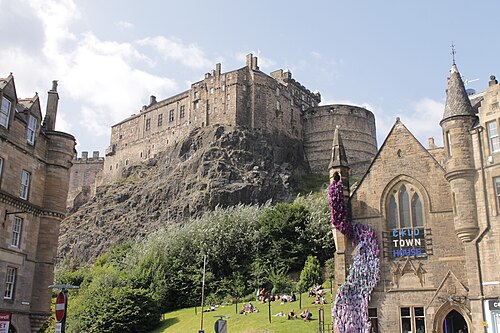 Edinburgh CastleRestored · prime 1520
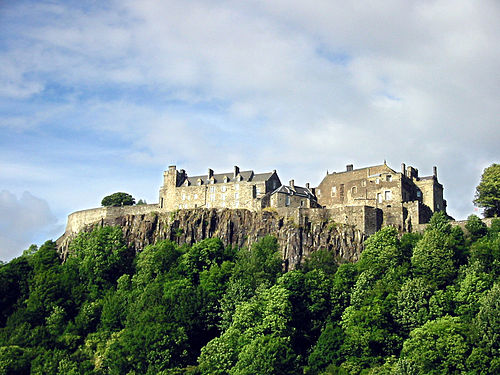 Stirling CastleRestored · prime 1542
 Glamis CastleStill standing · prime 1900
All castles in Scotland → · Strongest castles in Scotland → · Castles of Europe
Play As Your Clan
Hold a real castle against whatever you choose to send at it, take a ship out in her own service years, or stand at the shoulder of someone the record remembers. The chronicler sets the scene; the deeds are yours.
Notable bearers of the Clark name
- James Clerk Maxwell (1831–1879), physicist
- Jim Clark (1936–1968), Scottish racing driver; two-time Formula One World Champion (1963, 1965); winner of the Indianapolis 500, 1965
- Sir Kenneth Clark (1903–1983), art historian, presenter of Civilisation
- Helen Clark (b. 1950), Prime Minister of New Zealand