Clan Murray
Dukes of Atholl, and Jacobite generals.
- Origin
- Perthshire, Scotland
- Motto
- Tout prest
- Famous bearer
- Lord George Murray, Jacobite general
- Register
- Scottish clan
The Murray arms, crest badge, tartan and country

Crest badgeMurray Clan Badge.mw-parser-output .messagebox{margin:4px 0;width:auto;border-collapse:collapse;border:2px solid var(--border-color-progressive,#6485d1);background-color:var(--background-color-neutral-subtle,#fbfcff);color:var(--color-base,#202122);box-sizing:border-box;border-inline-start-width:8px}.mw-parser-output .messagebox.mbox-small{font-size:88%;line-height:1.25em}.mw-parser-output .mbox-warning,.mw-parser-output .mbox-speedy{border:2px solid var(--border-color-error,#b22222);background:var(--background-color-error-subtle,#ffdbdb);border-inline-start-width:8px}.mw-parser-output .mbox-serious,.mw-parser-output .mbox-delete,.mw-parser-output .mbox-stop{border:2px solid var(--border-color-error,#b22222);border-inline-start-width:8px}.mw-parser-output .mbox-issue,.mw-parser-output .mbox-content{border:2px solid #f28500;background:var(--background-color-warning-subtle,#ffe);border-inline-start-width:8px}.mw-parser-output .mbox-query,.mw-parser-output .mbox-style{border:2px solid #f4c430;background:var(--background-color-warning-subtle,#ffe);border-inline-start-width:8px}.mw-parser-output .mbox-shit{border:2px solid #960;border-inline-start-width:8px}.mw-parser-output .mbox-license{border:2px solid #88a;border-inline-start-width:initial}.mw-parser-output .mbox-legal{border:2px solid var(--border-color-notice,#666);background:var(--background-color-base,#fff);border-inline-start-width:8px}.mw-parser-output .mbox-honor{border:2px solid #ca3;background:var(--background-color-warning-subtle,#fcf4db);border-inline-start-width:8px}.mw-parser-output .mbox-growth{border:2px solid #8d4;background:var(--background-color-success-subtle,#d5fdf4);border-inline-start-width:8px}.mw-parser-output .mbox-move{border:2px solid #93c;border-inline-start-width:8px}.mw-parser-output .mbox-protection,.mw-parser-output .mbox-message{border:2px solid var(--border-color-base,#aaa);border-inline-start-width:8px}.mw-parser-output .messagebox .mbox-text{border:none;padding:0.25em 0.9em;width:100%}.mw-parser-output .messagebox .mbox-image{border:none;padding-top:2px;padding-bottom:2px;padding-inline-start:0.9em;padding-inline-end:0;text-align:center}.mw-parser-output .messagebox .mbox-imageright{border:none;padding-top:2px;padding-bottom:2px;padding-inline-start:0;padding-inline-end:0.9em;text-align:center}.mw-parser-output .messagebox .mbox-empty-cell{border:none;padding:0;width:1px}.mw-parser-output .messagebox .mbox-invalid-type{text-align:center}@media(min-width:720px){.mw-parser-output .messagebox{margin:4px 10%}.mw-parser-output .messagebox.mbox-small{clear:right;float:right;margin:4px 0 4px 1em;width:238px}}body.skin--responsive .mw-parser-output table.messagebox img{max-width:none!important} This image is an original work by " Will Murray ( Willscrlt ) ". Attribution must be given to the author, which includes the author's name, his username in parentheses as shown, and a link to either his Website at http://willmurray.name or his online gallery at http://willmurraymedia.com . The author also appreciates notification if you use his work outside Wikimedia. · CC BY-SA 3.0 us 
TartanTartan Murray No 131This tartan was recorded prior to the launch of The Scottish Register of Tartans. Designer: Not Specified - Category: Portrait/Artefact · Public domain 
TartanMurray tartan (Vestiarium Scoticum)As printed in the Vestiarium Scoticum, 1842, a collection whose claimed medieval source was never produced, and which is now generally held to be a forgery. Families adopted its patterns anyway, and wear them still.TilmannR · CC0 
Coat of armsArms of Murray (modern)Borne by the Murray line, one branch of the name rather than all of it.Newm30 · CC BY-SA 4.0 
Coat of armsArms of Murray of CulbinBorne by the Culbin line, one branch of the name rather than all of it.Newm30 · CC BY-SA 4.0 
Clan plateMurray (R. R. McIan)Robert Ronald McIan (1803-1856). · Public domain


.svg)
.svg)

.jpg)
- Crest badge: The chief's crest inside a belt and buckle: the badge a clansman wears to show whose following he is in.
- Tartan: The checked cloth the family is known by.
- Coat of arms: Granted to an individual and inherited down that one documented line. These are the arms of particular families of the name, not of everyone who shares the surname.
- Clan plate: Period portrait art of the clan, from the great 19th-century illustrated surveys.
What is the Murray clan tartan?
Two Murray setts are shown above, one of them the plate printed in the Vestiarium Scoticum in 1842. They are not rival claims to be picked between; they are different records, and different weaves, of the same family cloth. A sett is the block of coloured bands the cloth is built from, repeated in both directions; the whole plaid is that one square enlarged.
Almost no clan tartan is medieval. Highland dress was proscribed from 1746 until 1782, and when it returned it returned as ceremony rather than everyday cloth, so the surname-to-sett map was fixed after the break, by the Bannockburn weavers’ pattern books, the royal visit to Edinburgh in 1822, and the Vestiarium Scoticum of 1842. The Murrays wore tartan long before any of that. What the registers fixed was which one. Nobody polices any of it. Wearing the Murray sett declares allegiance to the name, not descent from any particular line of it.
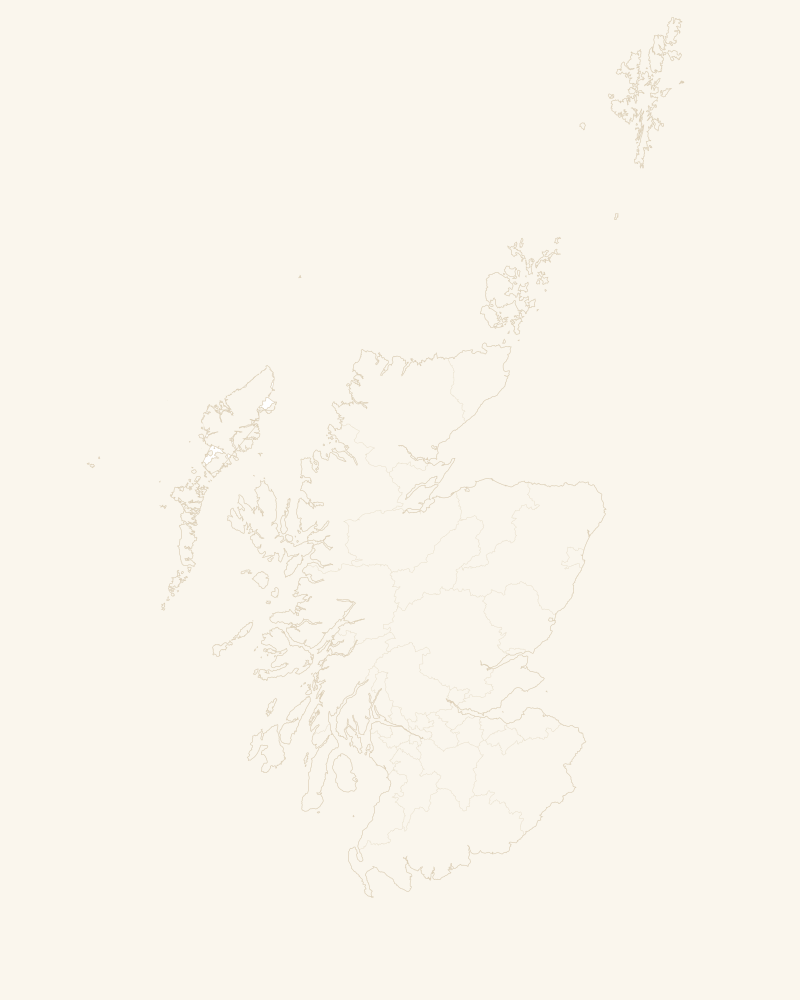
The seat of Clan Murray
Seat vacantChief
No one leads the Clan Murray community yet. When the movement opens, you can stand for its leadership, or help elect whoever does.
Current mission
No shared goal set yet. Once Clan Murray has leadership, it sets the public focus: a restoration, a gathering, a real-world project that helps its own.
The Murray clan is being rebuilt. Join the waiting list for the movement today, and you help decide who leads it and what it does.
Help rebuild the Murray clan →Motto
Tout prest
“Quite ready”
What does the Murray name mean?
From the ancient province of Moray (Latin 'Moravia'), the name spreading from the north-east as branches established themselves across Scotland.
The history of Clan Murray
Freskin's grant, and the province that became a surname
Murray is a place before it is a family. The name comes from Moray, the old province on the south shore of the Moray Firth, whose medieval Gaelic form was Muireb or Moreb. The b in that word was sounded as a v, which is how clerks writing in Latin arrived at Moravia, and Moravia is how the family appears in the charters for the first two centuries of its existence. Murray itself is simply a direct transliteration of the way Scots speakers pronounce Moray. The district kept the older spelling and the people took the newer one, and among emigrant families the Murray form so thoroughly overtook the original that the surname Murray is now far commoner in the world than the surname Moray.
The progenitor of the family was Freskin, who lived in the twelfth century. It has been claimed that he was Pictish, but the likelier account is that he was a Flemish knight, one of the hard professional warlords that the Norman kings used to hold down a newly conquered realm. David I of Scotland, raised at the English court, employed men of exactly that kind to keep his own wilder provinces in hand. Freskin was granted lands in West Lothian and then the ancient kingdom of Moray itself, a grant that finished off what remained of the old northern royal house. What followed was a piece of cold political sense rather than conquest alone: Freskin and his sons married into that same house of Moray, so that the incoming lord and the displaced dynasty became one family. It is possible that Freskin or his son William made the match; no charter settles which of them it was.
Freskin's descendants were designated by the surname de Moravia, of Moray, and in the Lowland Scots tongue that became Murray. The line divided early and permanently. The senior branch, from Freskin's eldest grandson Hugh de Moravia, took the name of their northern earldom instead and were Earls of Sutherland by 1235, so the chiefs of Clan Sutherland and the chiefs of Clan Murray descend from two brothers. The Murray chiefs come from the younger grandson, William de Moravia.
One caution belongs at the front of any Murray page. There is a second, entirely separate Murray, an Irish one, from Ó Muireadhaigh and Mac Muireadhaigh, descendant of Muireadhach, and from Mac Giolla Mhuire, the servant of the Virgin Mary. A great many Murrays in Ireland, particularly in Ulster, are nevertheless of Scottish descent, carried over by the Plantation and the traffic between Antrim and the Scottish coast. Two etymologies, one spelling, and no way to tell them apart by the name alone.
Bothwell, and the war that made the name
The chiefs of the name were first Lords of Petty in Moray, and then, before 1253, Lords of Bothwell in Clydesdale, which came to them through marriage to an heiress of the Oliphants. Sir Walter Murray, who held that lordship, was a regent of Scotland in 1255 and began the building of Bothwell Castle above the Clyde. It grew into one of the most powerful strongholds in the kingdom and was the seat of the chiefs of the name for a century.
Then came the wars with England, and with them the Murray who matters most. Andrew Moray raised the north against Edward I in 1297 and was joined by William Wallace. The two men commanded together at Stirling Bridge, and Moray was mortally wounded winning it. Wallace assumed sole command of the Scottish army only because Moray was dying. It has been argued ever since that the whole war might have run differently had he lived, because he had shown a real gift for pitched battle, the one thing Wallace never mastered. It is a judgement, not a fact, but it is the judgement of people who have studied the campaign closely, and it is the reason a name from a northern province sits at the head of Scotland's fight for its own existence.
His son, Sir Andrew Murray, 4th Lord of Bothwell, carried it on. He married Christian Bruce, sister of King Robert the Bruce, and served as Guardian of Scotland in 1332 and again from 1335 until his death. He was captured at Roxburgh early in 1333 and was still a prisoner in England when the Scots were broken at Halidon Hill. He got his freedom in time to march north and relieve his own wife, who was holding Kildrummy Castle against the enemy. Around 1337 he retook Bothwell, which had been the headquarters of the English commander Aymer de Valence, Earl of Pembroke, and then slighted it himself rather than leave a fortress of that strength standing for the English to reoccupy. He died in 1338 at Ormond Castle, also called Avoch, on the Black Isle.
Bothwell had already been fought over repeatedly, surrendered to the Scots in 1314 and rebuilt by Edward Balliol, and it never regained its former grandeur. The family's hold on it ended not in battle but in an epidemic. The fifth Murray Lord of Bothwell died of plague in 1360, and his widow Joan, herself a daughter of Maurice de Moravia, Earl of Strathearn, took as her second husband Archibald the Grim, Lord of Galloway and later Earl of Douglas. The lordship went with her. The Ormond lands went to the Douglases too. Within a generation the greatest Murray castle and the greatest Murray title had both passed out of the name.
Dupplin Moor, and the long argument over who led the Murrays
It flatters no family to pretend it stood on one side. While the Lords of Bothwell were fighting for Bruce, Andrew Murray of Tullibardine took the other road entirely, supporting Edward Balliol and playing an important part in Balliol's victory at Dupplin Moor. He was executed for treason in 1332. The Tullibardine Murrays, who would eventually lead the whole name, therefore begin their record in the national story on the losing and disgraced side of it.
Tullibardine in Perthshire had been a Murray property from 1284, and the family's later claim to the chiefship rested on descent from Sir Malcolm, sheriff of Perth around 1270 and younger brother of the first Lord of Bothwell. That claim had to be argued, because there were many Murray branches and several of them disputed the leadership. The Tullibardine line is recorded using the undifferenced arms of Murray in 1542, in a work that predates the establishment of the Lord Lyon's register in 1672 and is reckoned of equal authority. Sir David Murray of Tullibardine had founded the chapel there in 1446, and the Murrays have used it as a burial place since the Reformation.
What settled the matter was not heraldry but signatures. In 1586 a bond was drawn up between the lairds of the name, made "with the hail name of Murray and others undersubscribing", providing that an offender against it should be "accounted from thencefurth enemy to them all". Sir John Murray of Tullibardine signed first, and after him Aryngosk, Abercairny, Tibbermuir, Pardens, Airlywith, Strowane, Ochtertyre, Pitcairles, Drumdeway, Raith, Fedalis, Buchanty and more, together with the Moncrieffs. A second bond, styled a "Bond of Association of the Name Murray", brought in Cockpool, Blackbarony, Balvaird, Falahill, Pomauis, Woodend, Lochlan and Kinkell. The sources date that second bond variously to 1589 and to 1598. Read the two lists together and you have a map of where the surname actually sat on the ground in the late sixteenth century, from Perthshire to the Borders to the Solway.
The Murrays feuded less than most clans of comparable size, but not never. In 1490 the Murrays of Ochtertyre fought the Drummonds at the Battle of Knockmary. Tullibardine Murrays fell at Flodden in 1513. In 1562 the clan turned out for Mary, Queen of Scots against the Earl of Huntly at Corrichie, and turned against her when she married the Earl of Bothwell. In 1594 they fought alongside the 7th Earl of Argyll against the Gordons at Glenlivet. And in the early seventeenth century a deadly feud between the Murrays of Broughton and the Hannays ended with the Hannays outlawed.
From Tullibardine to the dukedom of Atholl
Sir John Murray of Tullibardine, who lived from 1548 to 1613 and married first Catherine Drummond and then Elizabeth Haldane, was created the first Earl of Tullibardine in 1606. The step that changed the family's standing for good was a marriage to Lady Dorothea Stewart, heiress of the Stewart Earls of Atholl. The sources disagree about the detail: some say the first earl made the match himself, others that it was his son William, the second earl, and the transfer of the earldom is dated variously to 1626 and to 1629. What is not in dispute is the result. The Stewart earldom of Atholl became a Murray earldom in the late 1620s, was raised to a marquessate in 1676, and in 1703 became a dukedom, the top of the peerage. Marquess of Tullibardine survives as the courtesy title borne by the chief's eldest son until he succeeds.
The family's badges record the same climb. The medieval crest was a peacock's head, with the motto Praite. To it the Murrays added the mermaid holding a mirror in one hand and a comb in the other, under the motto Tout prest, Old French for quite ready, which they bore as Lords of Balquhidder. In the seventeenth century they took up the demi-savage, the upper half of a wreathed and shirtless man holding a dagger in one hand and a key in the other, with the motto Furth, Fortune, and Fill the Fetters: go forth against your enemies, have good fortune, and come back with captives. That badge commemorates the capture of the last Lord of the Isles in 1475 by the first Stewart Earl of Atholl, which is to say the Murrays inherited, along with the earldom, the proudest deed of the family they had married. Both the mermaid and the demi-savage remain valid Murray devices.
The Atholl dukes then acquired something no other British family has held since. For a period in the eighteenth century they were Sovereign Lords of the Isle of Man, ruling it with its own coinage and its own parliament, the House of Keys. Their seat was, and is, Blair Castle in Perthshire, now a great white-harled mansion that still contains part of a thirteenth-century castle. Blair had been a Comyn stronghold, then a property of the Stewart Earls of Atholl, and it came to the Murrays with Dorothea Stewart's inheritance.
Stormont, Mansfield, Dunmore: the branches and their towers
The chiefly line is only part of the story, because the Murray branches built their own dynasties. The largest windfall came out of a conspiracy. After the Reformation the palace of Scone, where the kings of Scots had been inaugurated, had gone to the Ruthvens. When the Gowrie Conspiracy of 1600 destroyed that family, their property was forfeited and their very name proscribed, and Scone was granted to the Murrays because Sir David Murray of Gospertie had been one of those who saved the king's life. His line were made Viscounts of Stormont in 1602 and Earls of Mansfield in 1776. The present Scone Palace dates from 1802 but incorporates older work perhaps of 1580. Huntingtower, a few miles away, had also been Ruthven property and travelled the same road: it went to William Murray, Earl of Dysart, then to the Murrays of Tullibardine, then to the Atholl line, and it was the birthplace of the Jacobite Lord George Murray before being sold to the Mercers in 1805.
In the south-west the Murrays of Cockpool held Comlongon Castle, a five-storey keep near Dumfries, from the early fourteenth century, the sources giving 1331, and the family and its successors as Viscounts Stormont and Earls of Mansfield kept it until 1984, a tenure of well over six hundred years. Around 1627 Sir Richard Murray of Cockpool also bought the strange watchtower called Repentance Tower. In Perthshire, Balvaird Castle, an L-plan tower house built about 1495 for Sir Andrew Murray, came to the Murrays of Tullibardine from the Barclays around 1500 and stayed with the Stormont and Mansfield line until 2017.
Elsewhere the branches spread far past the old Murray country. Darnaway in Moray came to them after the Douglas forfeiture of 1455, returning the name to the province that gave it. Black Barony in Peeblesshire was built by the Murrays of Blackbarony, passed to the Murrays of Elibank in 1771 and stayed with them until 1930. Stobo was in the hands of the Murrays of Tweedsmuir around 1750. Carrick Castle on Loch Goil was sold to the Murray Earls of Dunmore, and in 1754 John Murray, son of the third Earl of Dunmore, paid sixteen thousand pounds for Elphinstone Tower; the Dunmore estate stayed Murray until 1911. Across the border, Langley Castle in Northumberland was bought from the crown in 1625 by John Murray, first Earl of Annandale. In Ireland, the Murrays held Barretstown Castle in County Kildare from 1918 to 1962 and ran the estate as a stud farm. There is no single Murray country: the root is in Moray, the heart is in Perthshire, and the holdings run from the Solway to the Tyne to Kildare.
Montrose at Blair, Cromwell's powder, and Dundee's body
The seventeenth century put Blair Castle at the centre of every Scottish quarrel. The chief of the day, the second Earl of Tullibardine, was a committed supporter of Charles I. In 1644 he received the royalist commander James Graham, Marquess of Montrose, at Blair and raised no fewer than eighteen hundred men for the king. It was that reinforcement which won Montrose the Battle of Tippermuir the same year, and the castle served as his mustering point.
The bill came due. In 1653 Blair was besieged, taken and partly blown up with gunpowder by Cromwell's forces, though enough of it stood for the Earl of Atholl to attempt its recapture the following year. In 1689 John Graham of Claverhouse, Viscount Dundee, garrisoned it for James VII, and after he was killed in his victory at Killiecrankie his body was carried back to Blair.
Then the family began paying in blood on both sides of the same quarrel. John Murray, Marquis of Tullibardine, was killed in 1709 fighting for the British in the alliance against France at Malplaquet, one of the great slaughters of the War of the Spanish Succession. Six years later his kin were in arms against that same government. In the rising of 1715 the Atholl men numbered fourteen hundred, formed into four regiments commanded by William Murray, Marquess of Tullibardine, Lord Charles Murray, Lord George Murray and William Murray, 2nd Lord Nairne. At Sheriffmuir, Tullibardine acted as Major-General of the whole Jacobite army, his own battalion going temporarily under his cousin John Lyon, 5th Earl of Strathmore. The battle settled nothing: each army broke the other's left wing, and both sides claimed the day.
In 1719 Murrays fought at Glen Shiel, where Tullibardine was wounded and escaped to France, and the month after the battle the government posted a reward of two thousand pounds for his capture. When General Wade surveyed the Highlands in 1724 he put the fighting strength of the Atholl men at two thousand.
Lord George Murray, the '45, and the last siege in Britain
On 25 July 1745 the exiled Marquess of Tullibardine came ashore at Borodale with Charles Edward Stuart, and the last rising began. Its soldier was his brother, Lord George Murray, younger son of the first Duke of Atholl, born at Huntingtower, and he was the architect of everything that went right for the Jacobites in the first six months. Most military historians agree that had Lord George been given sole command of the army, the Stuart claim might well have carried the throne. He led the charge at Falkirk in January 1746 and again at Culloden in April, and the strategic disagreements between him and the prince fed directly into that final disaster.
The family split down the middle, and did so openly. Lord George's elder brother, the next duke, stood with the Hanoverian government. Their half-brother Lord John Murray was made colonel of the 43rd Regiment of Foot, later renumbered the 42nd, in April 1745, and Lord John Murray's Highlanders fought the French at Fontenoy that same year. When the armies met at Prestonpans in September 1745 there were Murray regiments on both sides of the field. Later, when government troops occupied Blair Castle, it was Lord George Murray who besieged and damaged his own family's seat, and that action in 1746 remains the last siege of a castle in Britain.
The reckoning was harsh and it is not worth softening. On 27 April 1746, sick and worn out, the Marquess of Tullibardine surrendered to a Mr Buchanan of Drummakill; he was taken to the Tower of London and died there on 9 July. Lord George Murray got away to the continent in December 1746. He was received in Rome by the prince's father, the Old Pretender, who granted him a pension, but when he travelled to Paris the following year Charles Edward Stuart refused to see him at all. He moved from place to place for the rest of his life and died at Medemblik in Holland on 11 October 1760, aged sixty-six, never having come home. And John Murray of Broughton, who had been the prince's own secretary, turned king's evidence and earned the permanent hatred of the Jacobite cause. Culloden was the last time the Highlanders of Atholl went to war.
The only private army in Europe, and the name that carried
The legislation that followed Culloden was aimed at the whole structure of Highland society, not only at the guilty: the Heritable Jurisdictions Act stripped chiefs of the right to hold their own courts, and Highland dress was banned until the Act was repealed in 1782. The Murrays of Atholl, with one brother in exile and another in the government interest, recovered their position and kept their seat. They also kept something unique. The chief's ceremonial guard, the Atholl Highlanders, is the only legal private army in Europe; Queen Victoria presented its colours in 1845, and it still holds its annual gathering at Blair each spring.
Blair Castle is still the seat of the chiefs and is open to the public, as it was to Robert Burns when he visited in 1787. The chiefship has taken an unexpected turn in living memory: George Iain Murray, 10th Duke of Atholl, died in February 1996, and the title and chiefship passed to John Murray, 11th Duke, a South African. The chief today is Bruce Murray, 12th Duke of Atholl, Marquess of Atholl, Marquess of Tullibardine, Earl of Atholl, Earl of Tullibardine, Earl of Strathtay and Strathardle, Viscount of Balquhidder, Viscount of Glenalmond and Lord Murray of Tullibardine.
A word of honesty for anyone tracing the name. A Murray surname does not by itself prove descent from the chiefly house. Scottish clanship ran on kinship and on clientage together: tenants and followers could take, or be given, the surname of the landlord whose ground they lived on, and bonds of manrent tied unrelated families to a powerful chief. The tidy apparatus of clan-specific tartans and sept lists is later still. The Highland Society of London only began naming clan tartans in 1815, many designs descend from the Vestiarium Scoticum, a nineteenth-century forgery, and the sept lists themselves were drawn up by Victorian clan societies and tartan makers keen to attach as many surnames as possible to a clan. None of that makes the connection false. It means the tartan is a badge of belonging rather than a document of descent, and the documents are worth chasing separately.
What the name has carried since is a long way from Perthshire. Adam Murray, who died in 1706, was the Ulster Scots soldier remembered for the defence of Derry in 1689. Matthew Murray, born in 1765, built steam engines and machine tools in Leeds. Alexander Murray, the linguist who died in 1813, went from an obscure Galloway upbringing to a professorship at Edinburgh. Sir James Murray, a Hawick draper's son who had taught himself twenty-five languages by the age of twenty, edited the Oxford English Dictionary from a corrugated iron shed in his garden, and the dictionary is his monument. Eunice Murray, who lived from 1878 to 1960, was a suffrage campaigner and folklorist and the first Scottish woman to stand in the first election open to women, in 1918. Philip Murray, born in Scotland in 1886, went to the pits and the steel mills of America and became one of the most powerful labour leaders in the United States. W. H. Murray, born in 1913, wrote the books that made Scottish mountaineering. And Sir Andy Murray, raised in Dunblane and coached by his mother Judy, won the US Open in 2012 and Wimbledon in 2013 and 2016, took Olympic singles gold in London and Rio, and led Britain to the Davis Cup in 2015, the first British man to win a Grand Slam singles title since Fred Perry in 1936; his brother Jamie made his own career at the top of the doubles game. The province is a county in the north of Scotland. The name reached everywhere else.
Champions of the Murray name
The bearers whose lives are inseparable from this surname. Each has their own page, biography, achievements, geography, connection to the family.
- Sir James Murray
The Hawick draper's son who taught himself twenty-five languages by twenty and built the Oxford English Dictionary from a tin shed in his garden.
- Sir Andy Murray
The Dunblane-raised Scottish tennis player whose three Grand Slam singles titles (US Open 2012, Wimbledon 2013, Wimbledon 2016), two Olympic singles gold medals (London 2012, Rio 2016) and 2015 Davis Cup victory made him the first British male singles Grand Slam champion since Fred Perry in 1936 and the first British Davis Cup-winning singles player since Bunny Austin in 1933.
Castles the Murray held
Strongholds this name held for a decade or more, look one up, or rebuild it to explore.
- Bothwell Castle
Begun by the Murrays (de Moravia) in the 13th century.
- Balvaird Castle
Built c.1495 for Sir Andrew Murray of the Tullibardine family; held by the Murrays, later Viscounts Stormont and Earls of Mansfield, until 2017.
- Darnaway Castle
Passed to the Murrays after the Douglas forfeiture of 1455.
- Langley Castle
Bought from the crown by John Murray, first Earl of Annandale, in 1625.
- Carrick Castle
Sold to the Murrays, Earls of Dunmore.
- Comlongon Castle
Held by the Murrays of Cockpool, later Viscounts Stormont and Earls of Mansfield, from the early 14th century until 1984.
- Stobo Castle
The Stobo estate was owned by the Murrays of Tweedsmuir around 1750.
- Elphinstone Tower
Bought for £16,000 in 1754 by John Murray, son of the 3rd Earl of Dunmore; the Murrays held the Dunmore Estate until 1911.
- Black Barony
Built by the Murrays of Blackbarony; passed to the Murrays of Elibank in 1771, who held it until 1930.
- Repentance Tower
Sold to Sir Richard Murray of Cockpool (Comlongan) Castle around 1627.
- Barretstown Castle
Held by the Murray family, 1918–1962, who ran the estate as a stud farm.
- Tullibardine Castle
Held by the Murrays from the castle's building in the late 13th to early 14th century; the line rose to Earls of Tullibardine before the castle's demolition in 1883.
The castles of the homeland
The great strongholds of the homeland, look one up, see what it looked like in its prime, and recreate it to explore.
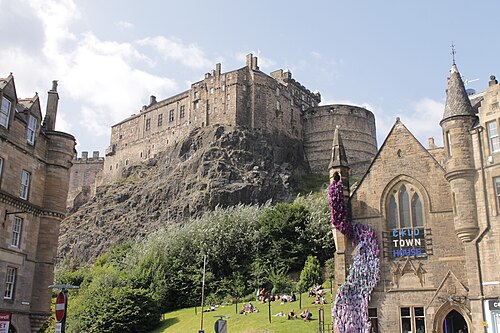 Edinburgh CastleRestored · prime 1520
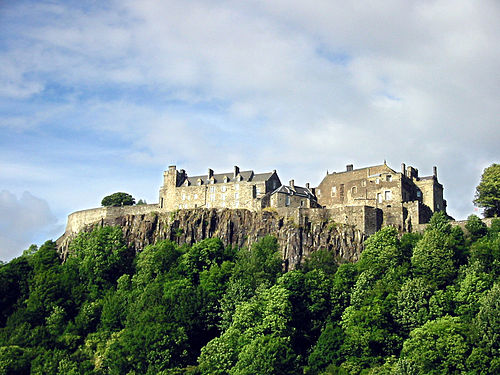 Stirling CastleRestored · prime 1542
 Glamis CastleStill standing · prime 1900
All castles in Scotland → · Strongest castles in Scotland → · Castles of Europe
Play As Your Clan
Hold a real castle against whatever you choose to send at it, take a ship out in her own service years, or stand at the shoulder of someone the record remembers. The chronicler sets the scene; the deeds are yours.
Notable bearers of the Murray name
- Lord George Murray, Jacobite general